


Today’s chapter is regarding Jinnat. Jinn, a creation that is found in countries, religions, and cultures all across the world in one form or another. But perhaps just as many people believe in them, an equal number deny them. While in far-off villages, Jinnat are held responsible for everything, there are many places where Jinnat are dismissed merely as fairy tales.
But one thing is certain: the history of Jinnat is as old as human civilization itself. Whether it is the ancient civilization of Iraq or ancient religions like Zoroastrianism in Iran. Impressed by such an ancient history of Jinnat, those who tried to prove them through scientific sciences sometimes named them viruses or bacteria, claiming that Jinnat actually refers to microscopic living organisms and nothing else. And some said that rebellious humans are actually called Jinnat.
But the reality is quite different from all these concepts, and our topic in this journey today is the world of Jinnat. However, as I explained in great detail in the chapter on Angels regarding which things in this universe we can see and which we cannot, just like with Angels, to describe Jinnat in detail, I will first take support from the knowledge of the Quran and Hadith. After that, I will tell you about the history regarding Jinnat that spans centuries.
This topic is so vast that I will have to divide this chapter into four parts. In the first part of this chapter, I will present my study on the existence of Jinnat, their types, and what they look like. In the second part of this chapter, I will present the difference between Jinnat and Shayateen (Devils), and what is it about Shayateen that makes them distinct from Jinnat. Then, in the third part of this chapter, I will tell you about a specific Shaytan who, in his age, his ability, and his rebellion, is more powerful than all other Jinnat. And in the last part of this chapter, I will tell you about a Shaytan Jinn who has been with us from our birth until today, meaning our Hamzad (Qareen).
But the very first question: What exactly is a Jinn? You have almost certainly heard that the Arabic word “Jinn” means “something that is not visible.” That is why words like Jannah (Paradise), Janin (embryo in the mother’s womb), and Jaan (life) stem from this root word. But the Jinn or Jinnat I am going to tell you about today are living, breathing, eating, and drinking creatures whom our eyes cannot see. And why can’t our eyes see them? The answer lies in Surah Ar-Rahman and Surah Al-Hijr. Surah Ar-Rahman: “And He created the Jinn from a smokeless flame of fire.” And Surah Al-Hijr: “And the Jinn, We created before from scorching fire.”
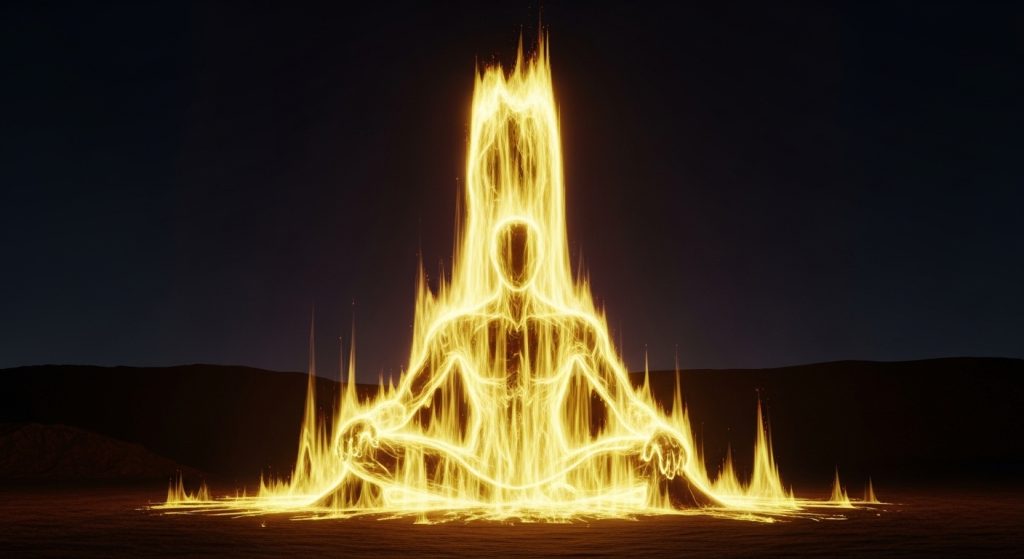
Allah Almighty kept the composition of this creation different from ours. A Hadith from Silsila As-Sahihah, narrated by Hazrat Aisha (R.A), explains this further, where the Prophet (PBUH) said: “The Angels were created from light, the Jinn were created from fire, and Adam was created from that which has been described to you.” Now, from this Hadith, one thing becomes very clear: like Angels, the creation of Jinnat is also from a matter that has not been explained to us. And our eyes cannot see this matter or material. Why they cannot see it, I have explained in great detail in the chapter on Angels.
Secondly, Jinnat are mentioned 29 times in the Holy Quran. In fact, an entire Surah, Surah Al-Jinn, is named after them. Therefore, doubting Jinnat as a distinct creation does not befit a Muslim; a Muslim cannot do that.
Now, if you ask me what Jinnat look like, my counter-question to you would be: what do animals look like? You cannot define “animal.” You will not be able to. This is because the anatomical makeup of every animal is different. What would you call an animal? Something that looks like a lion? Or something with a body like a giraffe? Or a reptile with a body like a crocodile? Or something like a snake? We humans have an anatomical makeup that is almost the same—two legs, two arms, two eyes, one nose; the only difference might be in height or facial features. But just as the entire physiology of animals differs from one another, similarly, the different types of Jinnat look completely different from one another. And moving forward, I will tell you about them in detail.
Now, Jinnat are a very diverse creation of Allah Almighty. In Mishkat Sharif, it is narrated from Abu Tha’labah Al-Khushani (R.A) that: “The Jinn are of three types: one type that has wings and flies in the air; another type that consists of snakes and dogs; and a third type that settles and travels.” From this Hadith, it becomes very clear that among Jinnat, there are some who fly in the skies. Place and distance hold no meaning for them. This is confirmed by the verse in Surah Al-Jinn where they said: “And we used to sit therein in positions for hearing [before the Quran was revealed].”
The beginning of this entire event is actually in Surah Al-Ahqaf: “And [mention, O Muhammad], when We directed to you a few of the jinn, listening to the Quran.” This event took place in a desert valley called Nakhlah near Mecca, where the Prophet (PBUH) was leading his companions in the Fajr prayer. At that very moment, some Jinnat from Nusaybin and Basra, who were passing by, turned their attention toward the Prophet (PBUH).
But I want to tell you this full incident because it clarifies the reach of Jinnat and their way of thinking. This full event is in a Hadith in Bukhari: After prophethood, a time came when Jinnat were stopped from gathering news from the heavens, and burning flames were thrown at them when they went to the skies. To find the reason for this, the Jinnat spread out across the earth. At that time, they were heading towards Tihamah when, on the way, at the time of Fajr in the valley of Nakhlah, they heard the Prophet (PBUH) reciting the Quran. They said: “By Allah, this is what has become a barrier between us and the news of the heavens.”
And this was the occasion when the verses of Surah Al-Jinn were revealed to the Prophet (PBUH): “Say, [O Muhammad], ‘It has been revealed to me that a group of the jinn listened and said, ‘Indeed, we have heard an amazing Quran.””
That night, Zubayr ibn al-Awam was also with the Prophet (PBUH). According to Musnad Ahmad, Sufyan says that those Jinnat had gathered there layer upon layer like dense hair or deep shadows. And in Imam Bayhaqi’s Dalail an-Nubuwwah, it is stated there were seven or nine Jinnat who stood in a circle around the Prophet (PBUH).
According to a personal experience of mine, a lady told me an incident from her life where she saw a Jinn in a state that looked like heat or waves rising from a hot surface. The only difference was that to this lady, that heat appeared yellowish. That Jinn was just like energy and was quite tall, sitting with his legs drawn up.
Regarding these invisible Jinnat, there is a Hadith narrated by Hazrat Abdullah bin Masood (R.A) known as “Laylat al-Jinn” (The Night of the Jinn). In it, Abdullah bin Masood says: “One night we were with the Prophet (PBUH), and he went missing. We went out in search of the Noble Prophet and looked in the valleys and passes, but we did not find him anywhere. We became terrified that perhaps someone had kidnapped the Prophet or, God forbid, assassinated him in secret.” Abdullah bin Masood says: “That night passed upon us like the worst night any people could experience. When morning came, we saw the Prophet (PBUH) coming from the direction of Hira. When we hurriedly presented this whole situation to him, he said: ‘A caller from the Jinn came to me last night, and I went with him.’ I recited the Quran to them.” Ibn Masood further says that after this, the Prophet (PBUH) took us there and showed us their footprints and the marks of their fire.
There is a Hadith in Bukhari in which Masruq talks to the son of this same Abdullah bin Masood, saying that the news of those Jinnat who heard the Quran was given to the Prophet (PBUH) by an Acacia tree. However, I could not find a reference regarding exactly which night this was—whether it was the same Laylat al-Jinn of Abdullah bin Masood or a different night—because there are multiple incidents of Jinnat coming to the Prophet (PBUH) with the intention of learning the Quran.
Another form of Jinnat is like snakes. Regarding this, there is a Hadith narrated by Abdullah bin Abbas that the Prophet (PBUH) said: “Snakes are the transformed shapes of Jinnat, just as the Children of Israel were transformed into monkeys and swine.”
Hazrat Abu Sa’id al-Khudri (R.A) had a nephew who was newly married. In those days, the Battle of the Trench (Ghazwa-e-Khandaq) occurred. During the days of the battle, at one point, he asked the Prophet (PBUH) for permission to go home. The Prophet granted him permission but also said: “Take your weapons with you.” When the companion reached home, he saw his wife standing at the door. The companion’s sense of honor and anger flared, and he aimed his spear at his wife. Upon this, she said: “Do not be in haste. First, look at what has driven me out of the house.” When the companion entered the house, he saw a very repulsive snake sitting there. The companion tried to force it out with the same spear, but the spear pierced it. The snake began to writhe there. Now Abu Sa’id al-Khudri says: “We do not know what happened there; whether the snake died first or my nephew.” Later, his people came to the Prophet (PBUH) and said: “Pray to Allah to return our companion to us.” Upon this, the Prophet (PBUH) said twice: “Pray for forgiveness for your companion.” And then he said: “Some Jinnat in Medina have accepted Islam. When you see them, warn them for three times (meaning three days). And if they still appear after three days, if you wish to kill them, then kill them.” That repulsive snake present in this companion’s house was actually a Jinn.
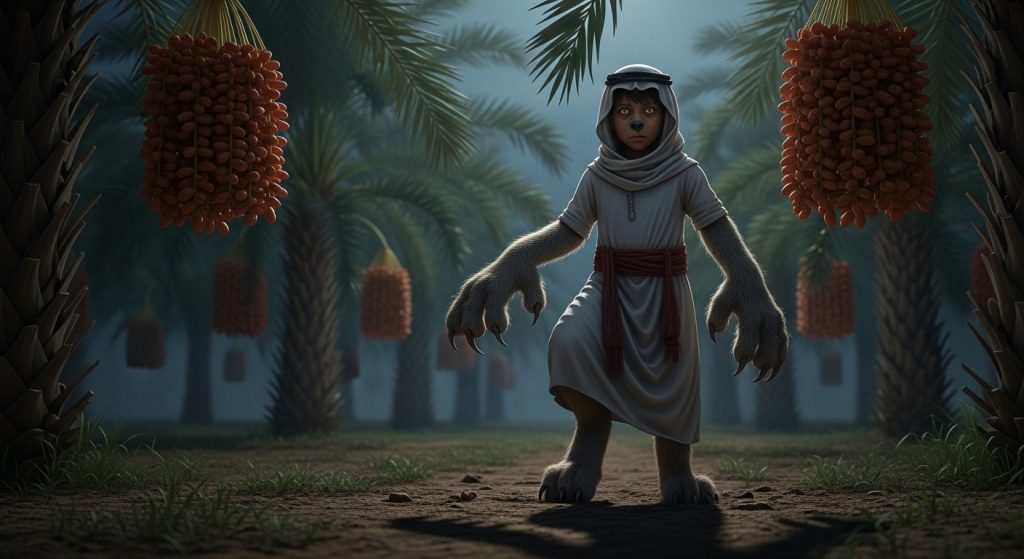
In the year 1832, Sharif Jafar published a book stating that if we could see Jinnat, they might appear to us as half-human or half-animal. This point was particularly interesting to me because a Hadith from Silsila As-Sahihah confirms it with great clarity. Ibn Abi’s father had a field for drying dates, and he used to supervise it himself. Once, while the dates were drying there as usual, he noticed that the dates were decreasing from one spot. Seeing this, he started keeping watch. He saw a creature standing there that looked like a young boy. He greeted it, and the creature returned the greeting. Upon this, he asked: “Are you from humans or from Jinnat?” It replied: “From Jinnat.” Ibn Abi’s father looked at its hands, which were exactly like a dog’s paws, and on them was hair exactly like a dog’s. This Jinn further said: “The Jinnat know that there is no one stronger than me.” So Ibn Abi’s father asked: “Then what compelled you to steal?” It replied: “We received news that you are a person who loves to give charity, so we thought we would eat your food too.” At that time, the Jinn appeared before Ibn Abi’s father in such a way that its hands were like a dog’s. In fact, in Hadith and historical records, the mention of Jinnat appearing in the form of dogs is perhaps more frequent than any other animal.
But before I tell you about these Hadith and historical records, know that regarding these shape-shifting Jinnat, it seems that they have a special attraction to chthonic animals—meaning animals that crawl on the earth, such as snakes, scorpions, and lizards. Some time ago, a huge news story went viral in the Brazilian media where the carcass of a whale was found in the middle of the dense Amazon jungle. How did a 30,000 kg whale carcass reach the jungle? Was it really a whale? Or was it a creature in the form of a whale? No one has the answer to this.
You all have heard about Hazrat Solomon (A.S) being given dominion over Jinnat. I have written in detail about the amazing kingdom of Hazrat Solomon (A.S) in the 15th chapter. But for now, I deem it necessary to mention only two verses from Surah Sad: “And [We subjected] the devils [to him] – every builder and diver. And others bound together in shackles.”
Currently, in the city of Ocaña, Spain, there is an Arabic manuscript that was found under a building from the time of Al-Andalus (Muslim Spain). This strange manuscript was named “The Book of Deadly Names.” In this manuscript, it is written in great detail how 72 different Jinnat were presented before King Solomon (A.S), and also that they told the King about their respective powers and strengths and what they could do.
In this regard, I found another reference in the book Kitab al-Fihrist by the 9th-century Iraqi scholar Abu al-Faraj Muhammad. Some original copies of it are still present today in Istanbul, Vienna, Paris, and Berlin. In it, he wrote very detailed descriptions of 70 of these 72 Jinnat that were present in the era of King Solomon (A.S).
A third reference in this regard was found in the book Al-Shamil fi al-Bahr al-Kamil written in 1089 by Abu’l-Fadl Muhammad al-Tabasi. I obviously cannot give the description of all Jinnat in this chapter, but I will tell you about a few of them. One name among them is Al-Muzahib, a Jinn whose body shone like gold. Then there is a Jinn named Al-Abyad, who was extremely white in color, and his entire body was visible. Then a Jinn named Al-Ahmar, a red-colored Jinn, of whom only the upper part of his legs was visible. Then a name Borkan, whose voice was very thunderous, and only his back was visible. Then a name Shamuresh, upon whose arrival only a glimpse of his belly was visible. Then a Jinn named Maimon, whose only feet were visible. And a name Zub’ah, who traveled with a storm of dust.
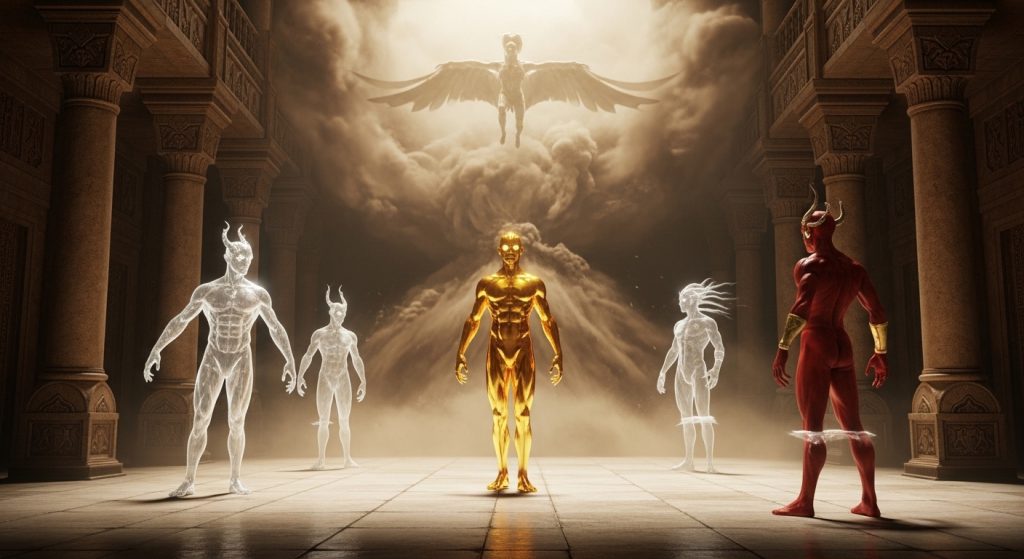
Regarding this last name, Zub’ah, surprisingly, I found a reference in the book The Testament of Solomon, written just 100 years after Hazrat Isa (Jesus) A.S. In this book, an event is written that in the time of Solomon (A.S), there was a Jinn who flew like sand present in the air. Solomon (A.S) sent a man with instructions to keep the mouth of a leather waterskin open in such a way that when the desert wind blew, the waterskin would fill with the sand flying in the air. In this way, that person succeeded in trapping Zub’ah inside the waterskin. And then, using Zub’ah, a stone was lifted and placed in the building of the Temple of Solomon, which was a huge task for other Jinnat to lift.
In this same book, regarding Zub’ah, I found another incident that he brought a very amazing pillar of purple color from the depths of the Red Sea. And at that time, meaning while returning, there was another Jinn with him named Abarzat, who claimed that he had also seen the era of Hazrat Musa (Moses) A.S.
In this book, other Jinnat are also written about, whose names are in various languages like Arabic, Hebrew, and Greek. And their descriptions are also very strange. For example, there was one Jinn whose body had no head visible. How much truth is in these books, only Allah knows best. But the reason for referencing these books in this chapter was only that verse of Surah Sad which tells us that Allah Almighty gave Solomon (A.S) not only dominion over Jinnat but also that they built structures for him (just as, according to this book, Zub’ah lifted a huge stone and placed it in the Temple) and that they performed dives into the depths of the seas for him (just as Zub’ah brought a pillar of purple stone).
However, in the exegesis (Tafseer) of the 34th verse of Surah Sad, Ibn Kathir mentions a Jinn named Sakhr, who tried to steal the ring of Hazrat Solomon (A.S). And the 9th-century scholar Ibn al-Faqih, who was a historian as well as a geographer, mentions this Jinn in great detail in his book Ajaib al-Makhluqat wa Gharaib al-Mawjudat (Wonders of Creation and Strange Phenomena), stating that Hazrat Solomon (A.S) eventually locked him in a chest and threw him into the seas to punish him. Similarly, in a 14th-century book The Book of Wonders, a Jinn is mentioned by the name Al-Malik Al-Aswad, meaning “The Black King.”
Regarding the close contact of humans with Jinnat, I will tell you a little detail further ahead. But for now, I just want to say that this is possible. Evidence for this exists in Quranic verses. And there is a Hadith narrated by Hazrat Aisha (R.A) where she says that one night the Prophet (PBUH) said something to his wives. Upon this, one of the Mothers of the Believers said: “O Messenger of Allah, it seems like this is a talk of Khurafa.” The Prophet (PBUH) asked her in surprise: “How do you know what Khurafa is?” According to this Hadith, Khurafa was a man from the Banu Udhra tribe who was captured by Jinnat in the Days of Ignorance (Jahiliyyah). He stayed with the Jinnat for a long time. After that, they left him among humans, and since then, he used to tell people strange things about Jinnat. People used to call this person’s stories “Hadith-e-Khurafa.”
Now, before I tell you about Shayateen (Devils) after Jinnat, there is a Hadith narrated by Hazrat Jabir (R.A) that some Jinnat came to meet the Prophet (PBUH) and asked some questions regarding the Quran. The Prophet (PBUH) gave them answers and recited Surah Ar-Rahman before them, in which the verse Fabi ayyi ala i rabbikuma tukazziban appears repeatedly. Hearing this, those Jinnat said: “Praise be to Allah, we do not deny any of Allah’s signs.” And when the Prophet (PBUH) once recited this before a few humans, they remained silent. Upon this, the Prophet (PBUH) said: “The Jinnat gave a better response than you.”
In the Laylat al-Jinn Hadith, the Jinnat also asked the Prophet (PBUH) about their food. The Prophet (PBUH) told them: “Every bone on which the name of Allah has been mentioned, and the meat attached to it, will become more meat in your hands than before. This is your food. And the dung of every animal with soft feet and cloven hooves is fodder for your animals.” Basically, this is the reason why the Prophet (PBUH) forbade humans from cleaning themselves (Istinja) with these two things.
Reaching this point, you must have gained a fair idea about Jinnat: that they might look a certain way, they understand the difference between good and evil, they eat and drink. But regarding their true composition of creation, the word Maarij is in the Quran, meaning a fire without smoke. And the word Samoom is also there, meaning a fierce flame of fire. Now exactly what kind of fire and what kind of flame this is, we learn from the Hadith narrated by Hazrat Aisha (R.A) that their creation is from a matter that perhaps we can never fully understand.
Al-Jahiz, in his very famous 8th-century book Kitab al-Hayawan, writes that if he does both good and bad deeds, he is a Jinn. If he listens by hiding in the skies, can lift heavy weights, and is faster and stronger than humans, then he is a Marid. And if he is more than that—if he can do even more than this—then he is an Ifrit. That is, an extremely powerful class of Jinnat. The same Ifrit that was present in the court of Hazrat Solomon (A.S). The same Ifrit whose name is mentioned in Surah An-Naml, and who claimed: “I will bring the throne of the Queen of Sheba to you before you rise from your place.” I have written a full account of this event in the chapter on Solomon (A.S).
However, regarding a special type of invisible Jinnat, an Egyptian scholar, Sheikh Kishk, spent a large part of his life in research. And one point of his always stays in my memory: that some of these Jinnat are so beautiful in their appearance that if we were able to see them, we might forget the meaning of beauty.
From this point forward, I will tell you about Shayateen (Devils). Most scholars differentiate between Jinnat and Shayateen, and consider Jinnat to be closer to humans because the Quran has addressed Jinnat and humans together in many places. And the biggest proof of the difference between them is the 112th verse of Surah Al-An’am: “And thus We have made for every prophet an enemy – devils from mankind and jinn.” Shayateen are from Jinnat and also from humans. As narrated by Huzaifa bin Yaman (R.A), the Prophet (PBUH) said: “After me, there will be such Imams (leaders/rulers) who will not follow my Sunnah. And soon among them, there will be such people whose bodies will be human, but their hearts will be those of devils.”
However, the purpose of this chapter is not these human devils, but to tell you about those Shayateen who are from the Jinnat, and who are attributed solely to evil. Inside this chapter, I will tell you about these Shayateen through various Hadith, their appearance, and the various historical literature existing about them.
The word “Shaytan” has two origins. In Hebrew, the word for Shaytan implies “enemy” or “adversary.” In Arabic, the word Shaytan is derived from Shatan, which means “one who has strayed” or “one who is distant.”
The history of Jinnat and Shayateen is older than humans because their creation is also prior to humans. For example, according to Surah Al-Hijr: “And We created man from sounding clay of altered black smooth mud. And the Jinn, We created before from scorching fire.” Now, according to first-generation Muslim scholars like Ibn Kathir, Jinnat and Shayateen lived in this world before Adam (A.S). And for reference, they take this quote from Hazrat Abdullah bin Umar (R.A) that Jinnat inhabited the world 2000 years before Adam.
Ibn Kathir (R.A) mentions another creation before these Jinnat called Hinn and Binn (demonic spirits and calamities). And then Allah Almighty imposed Jinnat upon them, who engaged in bloodshed with Hinn and Binn and made their place on earth. Basically, seeing this bloodshed, the Angels expressed their concerns: “Why are You creating a creation that will spread corruption on earth?” But the mention of Hinn and Binn is not in any authentic Hadith. Yes, their mention is definitely found in historical literature. For example, a reference from a Moroccan scholar Abdullah Sayed Muhammad Habib is that Hinn and Binn were a creation that went extinct before Adam (A.S). And the second reference is in Al-Jahiz’s world-famous book Kitab al-Hayawan: that basically Hinn and Binn were a weaker creation compared to Jinnat. Were they really a creation or not? Allah knows best.
Anyway, after the end of Hinn and Binn, rebellion slowly began to increase among these Jinnat as well, and they started considering themselves the sole heirs of this earth. Imam As-Suddi, in his Tafseer, narrating from Hazrat Murrah bin Masood (R.A) and other companions like Ibn Abbas (R.A), writes that when this rebellion among Jinnat increased beyond limits, one Jinn from among the Jinnat—who was with the Angels in the heavens at that time (about whom you will read at the end of this chapter)—was sent to earth with the Angels. And then they pushed these earthly Jinnat and Shayateen towards the islands of the sea.
And the interesting thing is that during this research of mine, the most detailed descriptions regarding the appearance of Shayateen were found among the Inuit people living in the maritime islands of the extreme north of Canada. These people live near the icy islands of the Arctic, and among them, I found descriptions of more than 3,500 different Shayateen. And then secondly, in one of the oldest religions of the world, Zoroastrianism.
But before I place thousands of years old literature about Shayateen before you, I want to describe Shayateen once in the light of the Quran and Hadith. In Abu Dawood, Bukhari, and Silsila As-Sahihah—in all three books of Hadith—it is narrated from Jabir bin Abdullah (R.A) that the Prophet (PBUH) said: “After the sun sets, do not let your animals loose; stop your children, for this is the time when Shayateen spread out. Until the darkness of the night settles. Then close your door mentioning Allah’s name, extinguish the lamp mentioning Allah’s name, cover the water vessel mentioning Allah’s name, and cover other vessels mentioning Allah’s name. And if there is no cover, place something across it.”
The connection between Shayateen and the night is certainly very deep. It is narrated from Abu Huraira (R.A) that the Prophet (PBUH) said: “When you hear the crowing of a rooster at night, ask Allah for His bounty, for at that time it (the rooster) is seeing an Angel. And when you hear the braying of a donkey at night, seek refuge in Allah from the evil of Shaytan immediately, for at that time it is seeing a Shaytan.”
Regarding the night time, it is narrated in Musnad Ahmad from Abdullah bin Umar (R.A) that the Prophet (PBUH) said: “If people knew what harm lies in traveling alone at night, no person would travel alone at night.”
Regarding the specific times for Shayateen, there is a Hadith of the Prophet (PBUH) in Bukhari: “Do not pray at the time of sunrise and sunset, for these are the times of Shayateen.” Whenever the Prophet (PBUH) looked towards the East, he would say: “Alas, Fitnah (tribulation) will rise from this direction, and that century will also be a Satanic century.” The Prophet (PBUH) used to forbid his companions from sitting in a place between sunlight and shade—meaning half sun and half shade—because Shayateen sit in this manner.
From these Ahadith, one gets a fairly good idea about the habits of Shayateen. But regarding their appearance, some very specific Ahadith also exist. It is narrated from Qatada bin Nu’man (R.A) that one night was extremely dark and it was raining heavily. I went to the Prophet (PBUH) to offer Isha prayer. When the Prophet (PBUH) finished the prayer and his gaze fell on me, he asked: “Qatada, what happened? You are here at this time?” So I said: “O Messenger of Allah (PBUH), I thought that worshippers would be few today, so I wished to reach the mosque so that I could pray with you.” Upon this, the Prophet (PBUH) said: “When you finish praying, stay in your place until I return.” When the Prophet (PBUH) finished the prayer, I saw that he had a branch of a date palm with the help of which he was walking. The Prophet (PBUH) gave me that branch and said: “In your absence, a Shaytan has come to your family. Take this branch and hold it firmly until you reach home. And when you see a figure in a corner of the house, beat it before it speaks.” Qatada says: “When I left the mosque, that branch lit up like a lamp. And when I reached home, I found my family asleep. However, in a corner of the house, an animal like a hedgehog (seh) was sitting, whose entire body was covered in thorns. And I kept hitting it with the branch until it left the house.” At that time, that Shaytan was sitting in Qatada’s house in such a state that its body was all thorns, just like a hedgehog’s body.
According to my research, the animal in the form of which Shaytan is mentioned most frequently in Ahadith is a black dog. In both Jami` at-Tirmidhi and Silsila As-Sahihah, there is a Hadith from Hazrat Abu Dharr (R.A) that the Prophet (PBUH) said: “If a woman, a donkey, or a black dog passes in front (of a person praying), the prayer becomes invalid and must be repeated.” Abdullah bin Samit says: “I asked Abu Dharr (R.A): ‘Why a black dog compared to a red, white, or yellow one?'” Abu Dharr (R.A) said: “I asked the Prophet (PBUH) the exact same thing, and he said: ‘The black dog is a Shaytan.'” Meaning, Shaytan comes in the form of a black dog as well.
And during my research study, I found the most mentions attributed to Shayateen regarding a black dog. The very first mention of a demonic black dog is found among the ancient Egyptians, whom they called Serberus (or Cerberus-like figure). And they used to draw its picture on their vessels. These are the same Egyptians whose hieroglyphs contain the names of Shayateen written in red ink, which is proof of how important Shayateen were to them. And furthermore, it is surprising that among the Egyptians, the word used for both Shayateen and deities (gods) was the same. I will tell you about these Ancient Egyptians in great detail in the 14th chapter.
But in the last 1400 years, mentions of a black dog are found everywhere in European newspapers. Sometimes in 1856, a black dog is seen inside a church in France while the church doors were closed. Sometimes in Belgium, there are reports of a large black dog that wanders the fields all night with a broken chain hanging from its neck. Sometimes in 1677, a black dog is seen at the funeral of the notorious Richard Cabell, who was a known devil-worshipper. In fact, in a newspaper from the Isle of Man, a whole incident is recorded that once the crew of a fishing boat waited all night for their captain, but the captain did not come. In the morning, the captain came and told them that a black dog had blocked his path all night, and wherever he tried to go, the dog would turn that way.
There is another narration from Jabir bin Abdullah (R.A) that the Messenger of Allah (PBUH) ordered us to kill dogs, and we used to kill them. Even if a dog came from the desert with a woman, we would kill it. But later, the Prophet (PBUH) stopped us from this and said: “Kill the pure black dog that has two white spots over its eyes, for it is a Shaytan.”
But Shayateen do not just come in the form of animals; they can also be from those Jinnat who are invisible to us. For example, there is a narration from Hazrat Abu Darda (R.A). He says: “Once we heard the Prophet (PBUH) saying during prayer: ‘Audhu billahi minka’ (I seek refuge in Allah from you). Then the Prophet (PBUH) said: ‘Al’anuka bi la’natillahi’ (I curse you with the curse of Allah). And the Prophet (PBUH) said this three times. And he stretched out his hand as if he were catching something.” When he finished the prayer, we asked: “O Messenger of Allah, today we heard words from your tongue during prayer that we never heard before. And you also raised your hand.” Upon this, the Prophet (PBUH) said: “That was Shaytan, and he wanted to throw a flame of fire on my face. So first I addressed him and said ‘Audhu billahi minka’, and then said ‘Al’anuka bi la’natillahi’. And then I stretched out my hand to catch him, but he retreated. Otherwise, by morning, the children of Medina would have been playing with him.”
This fire-flame Shaytan seems to be from a specific class of Shayateen because another Shaytan of this kind appears in a different incident in a different Hadith. This second Hadith is basically narrated by Hazrat Abdur Rahman bin Khanbash (R.A). Abdur Rahman says that on the night when Shayateen descended from the valleys and mountains towards the Messenger of Allah (PBUH), there was one Shaytan among them who had a flame of fire with which he wanted to burn the Prophet (PBUH). But awe struck him, and he began to retreat. And at that moment, Jibraeel (Gabriel) A.S came to the Prophet (PBUH) and said: “O Messenger of Allah, say.” He asked: “What should I say?” Jibraeel (A.S) said: “Say: ‘I seek refuge in the perfect words of Allah, which neither the righteous nor the wicked can exceed, from the evil of what He created, and multiplied, and spread. And from the evil of what descends from the heaven and what ascends into it. And from the evil of the trials of night and day. And from the evil of every night visitor, except the one who knocks with good, O Most Merciful.'” And then, by the command of Allah, the fire of this Shaytan was extinguished.
Regarding the close contact of Jinnat and Shayateen with humans, Ahadith exist. One Hadith mentions Shaytan tying three knots at the back of the head of a sleeping person. Another Hadith mentions Shaytan sitting in the nose during the night. And not only this, but the presence of Shayateen inside houses is mentioned in a Hadith in such a way that where five people live (or in one narration, where three people live) and neither Adhan is given nor prayer is offered, Shaytan dominates there.
Then the mention of some Shayateen Jinnat trying to go up to the sky is also found in Surah As-Saffat. And the meaning is something like this: “The sky of the world is adorned with stars and is protected from rebellious Shayateen. They cannot even lend an ear to listen to the talks of the Angels (the Exalted Assembly). But if one of them snatches a word, then a piercing flame (Shihab Thaqib) pursues them.” Usually, these burning flames are written and understood as meteorites (shooting stars). But what does it mean if one of them snatches a word?
It is narrated from Hazrat Aisha (R.A) that once people asked the Prophet (PBUH): “O Messenger of Allah, sometimes these soothsayers tell us something that turns out to be true.” Upon this, the Prophet (PBUH) said: “That is the word of the Jinn (Shayateen) which they steal from the sky. And then they mix more than a hundred lies with this one truth and tell the soothsayers.” And according to the words of this Hadith, these words sound in the ears of the soothsayers as if a hen is clucking in their ear.
Undoubtedly, Shayateen Jinnat fly and roam in the earths and skies. In fact, in Sunan An-Nasa’i, there is a Hadith narrated by Ibn Abbas (R.A) that a person came to the Prophet (PBUH) and said: “O Messenger of Allah, I saw a strange thing descending from the sky and coming towards me. And a desire arose in my heart to speak to it. But then I immediately controlled myself and stepped back.” Now Ibn Abbas says: “Evidently, that person wanted to inquire from the Prophet (PBUH) about this thing.” But the Prophet (PBUH) only gave this reply: “Allahu Akbar! Thank Allah that through faith, He removed the obsession of meeting this thing from your heart.”
Regarding male and female among these Shayateen, there are actually several proofs that female Shaytanah also exists. For example, the 46th Hadith of Silsila As-Sahihah where the word “Shaytanah” itself exists. And then the Dua of the Prophet (PBUH) narrated by Zaid bin Arqam which he emphasized we should read before going to the toilet: ‘Allahumma inni a’udhu bika minal khubuthi wal khaba’ith’ (O Allah, I seek refuge in You from the male and female devils). From these Ahadith, it becomes clear that Shaytanah (female devils) and Khaba’ith exist.
But to what extent do they contact us? Or can a relationship like marriage be formed between a human man and a Jinn woman, or a Jinn man and a human woman? There is a difference of opinion among scholars on this. And there is also a difference of opinion on whether, if such a marriage were to happen, they could have offspring or not.
However, regarding these Shaytanah, meaning female Shayateen, I found very detailed descriptions in a book written in Europe in 1486. This information was so astonishing that I have written about the shocking past of this book and the strange events that occurred after it was written in detail in the 19th chapter. Therefore, I am not mentioning that book here right now.
The mention of Shayateen in history is as old as history itself. In the world’s oldest Mesopotamian civilization, which existed 5000 years ago in modern Iraq, there is mention of a harmful and invisible creature that wants to harm us. Ancient Egyptians also speak of invisible, strayed beings, to protect against whom and to summon whom they invented entire mantras. Because they believed that these Shayateen could be the cause of plague, mental illnesses, and even death. And they left all this information in great detail in their hieroglyphs, about which I will tell you in the 13th chapter.
The People of the Book, i.e., Jews and Christians, also have a concept of Shayateen very clearly. They also talk about a Shaytan who sits in water vessels and troubles those who drink from them. Then in Talmudic literature, a Shaytan named Ashmedai is mentioned who claims to be a prince himself and claims to be so old regarding his age that he has seen the era of the flood of Noah (A.S).
But among modern Jews and Christians, the description we get regarding the appearance of Shayateen—meaning pointed teeth, a pointed tail, and a trident in hand, or sometimes the form of a male goat—these are actually just Greek mythological characters. For example, Pan, who is a creature looking like a goat. Or Poseidon, who has a trident of fire in his hand. Or Bes, who has hair like fire. The shapes are derived from creatures like these. But there is no doubt that literature from all over the world is filled with descriptions of different Shayateen. And for your interest, I will tell you about a few of them.
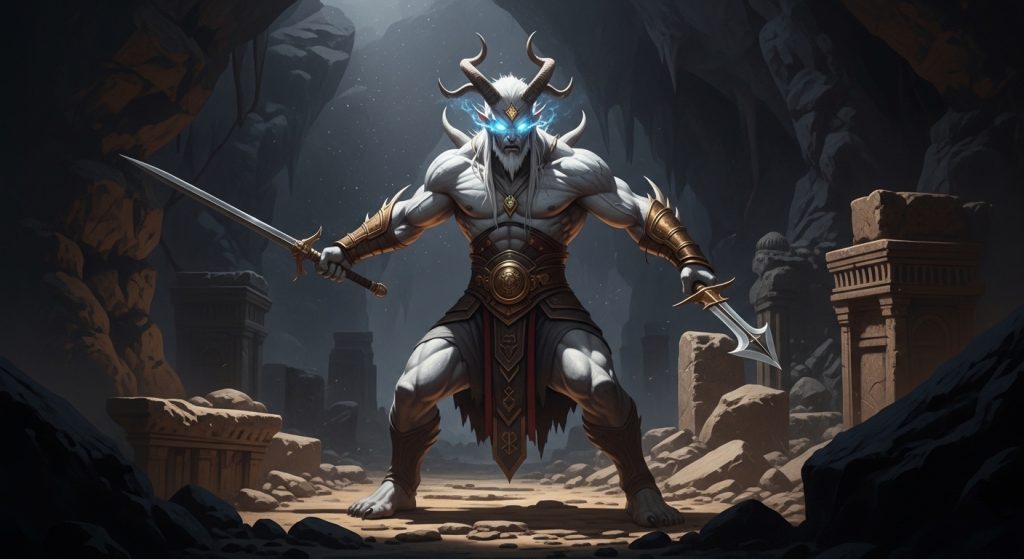
In our Pakistan and India, there is a very common word “Deo” (Demon/Giant), stories of which you and I have heard since childhood. But the origin of this word is actually 2,500 years old, when the Zoroastrian religion used to be practiced in ancient Iran. Within the Zoroastrian religion, I found a word called “Daeva” which was used for a special order, a special class of Shayateen. Shayateen who are physically very powerful.
In fact, in 9th-century Iran, Sultan Shah Mahmud Ghaznavi’s poet Ferdowsi wrote a very long poem called Shahnameh (The Book of Kings). In it, he writes very interesting details on the concept of “Deo.” And among them, a specific Deo called Div-e-Sepid (White Demon), who is specifically a very powerful Shaytan. But Rustam eventually defeats him. And in this way, detailed information is found in African culture regarding another order of powerful Shayateen called Halfa and Malfa. Or as in India, there are concepts like Pishacha or Rakshasa. There is no culture in the world where you do not find the concept of Shayateen.
