
Close Menu
  • Home
  • Islamic History
    • Life of Prophet Muhammad
    • Abu Bakr al-Siddiq
    • Umar ibn al-Khattab
  • Companions
  • Series
    • 40,000 Years of Knowledge
    • The Secrets of the Universe
    • Amazon Series
  • About
  • Contact
  • Series Reading Guide
What's Hot

Ibrahim and Nimrod in Islam: What the Quran Says—and What History Cannot Confirm

2 October 2026

Prophet Ibrahim and Ancient Mesopotamia: Quran, Sumer and the Limits of History

30 September 2026

Thamud and Prophet Salih: The Quranic Account and the Archaeology of al-Hijr

28 September 2026
YouTube
YouTube Facebook
Religion Essence Hub
  • Home
  • Islamic History
    • Life of Prophet Muhammad
    • Abu Bakr al-Siddiq
    • Umar ibn al-Khattab
  • Companions
  • Series
    • 40,000 Years of Knowledge
    • The Secrets of the Universe
    • Amazon Series
  • About
  • Contact
  • Series Reading Guide
Religion Essence Hub
Home » Part 49 – The fate of Banu Qurayza
Life of Prophet Muhammad (PBUH)

Part 49 – The fate of Banu Qurayza

Religion Essence Hub Editorial TeamBy Religion Essence Hub Editorial Team19 February 2025Updated:9 September 2026No Comments4 Mins Read4 Views
Facebook Twitter Pinterest Telegram LinkedIn Tumblr Copy Link Email
Follow Us
Google News Flipboard
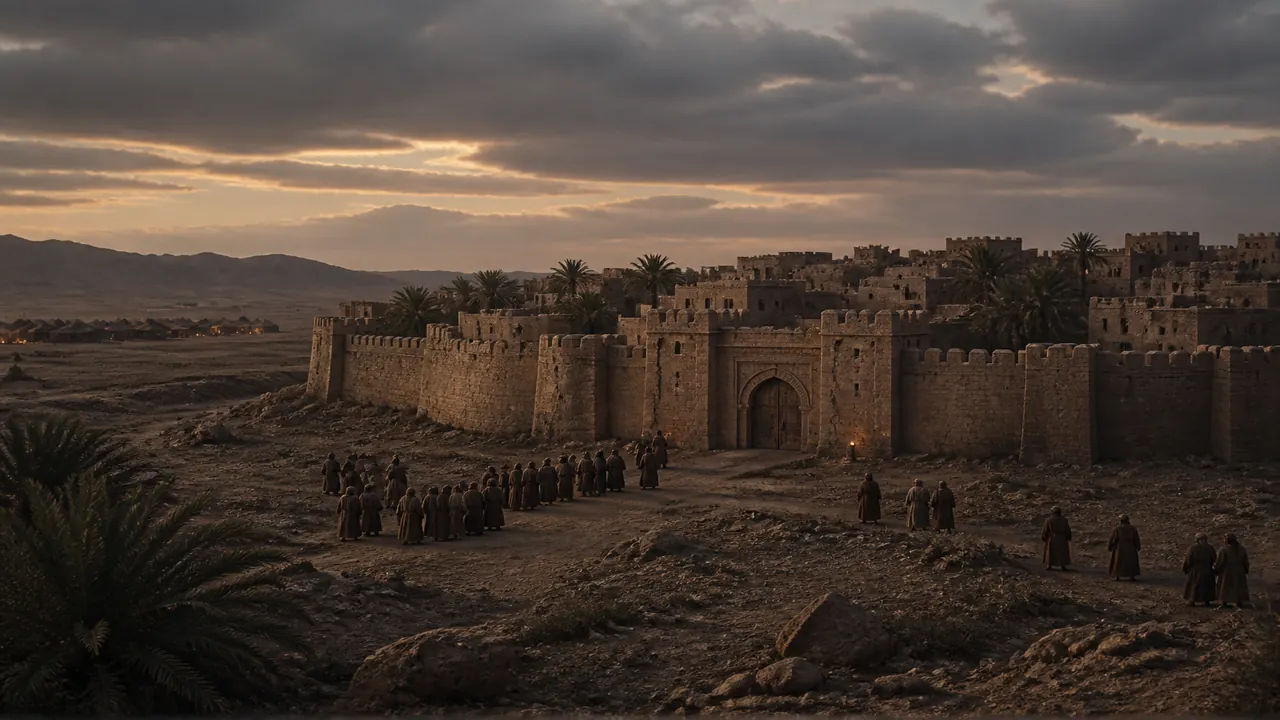
A solemn view of the Banu Qurayza fortress at dusk
Share
Facebook Twitter LinkedIn Pinterest Email Copy Link

The campaign against Banu Qurayza followed the withdrawal of the allied armies from Medina. It ended in surrender, a judgment associated with Sa‘d ibn Mu‘adh, executions and the captivity of women and children. These are grave events that require accurate description, not celebratory language or blame directed at a whole religious community.

This episode presents the main reports in the Quran and Sunni hadith collections. It distinguishes what those texts say from additional details in later biographies, without pretending that a short article resolves every historical debate.

The setting after the Trench

Banu Qurayza were a Jewish tribal community in the Medinan setting. Traditional Muslim accounts connect the campaign with their support for the besieging alliance and a breach of the agreement with the Prophet Muhammad.

Quran 33:26–27 refers to people from the People of the Book who supported the alliance, their strongholds, killing, captivity and the transfer of property. The verse itself does not name the tribe; the accompanying biographical and exegetical tradition identifies Banu Qurayza.

A statement about the conduct attributed to this particular group during a specific conflict is not a statement about Jews generally. The distinction matters both for historical accuracy and for fair treatment of people living many centuries later.

The order to proceed

Aisha’s report in Sahih al-Bukhari 4122 places the next campaign after the Prophet had returned from the Trench and laid down his arms. It describes Gabriel directing him toward Banu Qurayza.

A separate narration records the instruction to pray Asr at Banu Qurayza. Some companions understood it literally and delayed the prayer; others understood it as an instruction to hurry and prayed on the way. The Prophet did not rebuke either group when told about their decisions. See Sahih al-Bukhari 4119.

This report is more precise than saying that all the companions prayed at the same place. It preserves a disagreement about how to act on an instruction, even while they were responding to the same urgent order.

Surrender and Sa‘d’s judgment

In Sahih al-Bukhari 4121, the people of Banu Qurayza agree to accept Sa‘d ibn Mu‘adh’s judgment. The report describes his decision that their fighting men be killed and their offspring taken captive. It also records the Prophet’s approval of the judgment. Bukhari 4122 explicitly includes women and children among the captives and the distribution of property.

These reports describe a severe outcome. Captivity and enslavement in this historical setting should not be softened into ordinary relocation or described as though the affected families were unharmed.

The brief reports cited here do not provide an execution total. Nor do they justify replacing the category of fighting men with a claim that only a few chiefs were sentenced. Precise numbers and descriptions of individual cases require separate evidence.

How another report complicates the picture

Atiyya al-Qurazi recalls being among the captives and being spared because he had not reached puberty. His account describes a physical maturity test used to distinguish those killed from those spared. It appears in Sunan Abi Dawud 4404.

This evidence matters when reading the term “fighting men” in other reports. It does not establish that each person underwent an individual inquiry into battlefield participation. An honest summary should neither conceal the report nor add a modern legal procedure that the source does not describe.

Sa‘d’s wound and death

Aisha’s account in Bukhari 4122 also describes Sa‘d being wounded during the Trench and cared for in a tent near the Prophet. It records the reopening of his wound and his death. His role in the judgment and his own injury belong to the same sequence, but they are distinct events.

Remembering Sa‘d’s place in Muslim tradition does not require turning the suffering of another community into a spectacle. People on every side of the account had families, fears and losses.

Historical description and present responsibility

The episode should be read with attention to the differences between scripture, hadith and later historical narrative. These sources are not all written in the same form or concerned with the same details.

Describing an ancient judgment is not permission for present-day collective punishment, antisemitism, enslavement or private violence. The purpose here is to understand what the sources report and where their limits lie, while avoiding both embellishment and the erasure of suffering.

Sources and further reading

  • Quran 33:26–27: strongholds, killing, captivity and property
  • Bukhari 4122: the campaign, judgment and Sa‘d’s wound
  • Bukhari 4119: the companions’ different readings of the Asr instruction
  • Bukhari 4121: acceptance of Sa‘d’s judgment
  • Abu Dawud 4404: Atiyya’s account as a captive

Continue the series

← PreviousAll partsNext →

Blog Life of Prophet Muhammad (PBUH)
Follow on Google News Follow on Flipboard
Share. Facebook Twitter Pinterest LinkedIn Telegram Email Copy Link
Religion Essence Hub logo
Religion Essence Hub Editorial Team
  • Website

The Religion Essence Hub Editorial Team researches, reviews and updates articles about religion, history, beliefs and culture.

Related Posts

Part 11 – Ridicule, Accusations and Demands for Signs

27 August 2026

Part 10 – Quraysh’s Objections and Attempts at Compromise

27 August 2026

Part 9 – The Warning at Mount Safa and Abu Lahab’s Response

27 August 2026

Comments are closed.

Top Posts

Part 2 – Shepherding as a Metaphor for Prophethood

19 August 202446 Views

Part 4 – Hanifs: Monotheism in Pre-Islamic Arabia

19 August 202436 Views

Part 6 – The First Revelation in the Cave of Hira

4 September 202429 Views

Part 3 – Prophet Muhammad’s Marriage to Khadijah: Partnership, Sources and Context

19 August 202424 Views
Don't Miss
40,000 Years of Knowledge

Ibrahim and Nimrod in Islam: What the Quran Says—and What History Cannot Confirm

2 October 20268 Mins Read1 Views

The Quranic debate between Ibrahim and an unnamed ruler, the later identification with Nimrod, and why claims connecting him to Sargon of Akkad remain unproven.

Prophet Ibrahim and Ancient Mesopotamia: Quran, Sumer and the Limits of History

30 September 2026

Thamud and Prophet Salih: The Quranic Account and the Archaeology of al-Hijr

28 September 2026

Aad, Iram and Prophet Hud: What the Quran and Archaeology Show

25 September 2026
About Religion Essence Hub

Religion Essence Hub publishes accessible articles about religion, history, beliefs, scripture and culture. We explain complex topics clearly and responsibly. Email: contact@religionessencehub.com

Facebook YouTube
Our Picks

Ibrahim and Nimrod in Islam: What the Quran Says—and What History Cannot Confirm

2 October 2026

Prophet Ibrahim and Ancient Mesopotamia: Quran, Sumer and the Limits of History

30 September 2026

Thamud and Prophet Salih: The Quranic Account and the Archaeology of al-Hijr

28 September 2026
Most Popular

Prophet Ibrahim and Ancient Mesopotamia: Quran, Sumer and the Limits of History

30 September 20261 Views

Ibrahim and Nimrod in Islam: What the Quran Says—and What History Cannot Confirm

2 October 20261 Views

Part 38 – Madinah’s Jewish Communities and Early Political Tensions

19 February 20252 Views
  • Home
  • Privacy Policy
  • About Us
  • Corrections Policy
  • Disclaimer
  • Editorial Policy
  • Editorial Team
  • Get In Touch
  • Terms of Use
  • Cookie Policy (UK)
© 2026 Religion Essence Hub. All rights reserved.

Type above and press Enter to search. Press Esc to cancel.

Manage Consent
To provide the best experiences, we use technologies like cookies to store and/or access device information. Consenting to these technologies will allow us to process data such as browsing behavior or unique IDs on this site. Not consenting or withdrawing consent, may adversely affect certain features and functions.
Functional Always active
The technical storage or access is strictly necessary for the legitimate purpose of enabling the use of a specific service explicitly requested by the subscriber or user, or for the sole purpose of carrying out the transmission of a communication over an electronic communications network.
Preferences
The technical storage or access is necessary for the legitimate purpose of storing preferences that are not requested by the subscriber or user.
Statistics
The technical storage or access that is used exclusively for statistical purposes. The technical storage or access that is used exclusively for anonymous statistical purposes. Without a subpoena, voluntary compliance on the part of your Internet Service Provider, or additional records from a third party, information stored or retrieved for this purpose alone cannot usually be used to identify you.
Marketing
The technical storage or access is required to create user profiles to send advertising, or to track the user on a website or across several websites for similar marketing purposes.
  • Manage options
  • Manage services
  • Manage {vendor_count} vendors
  • Read more about these purposes
View preferences
  • {title}
  • {title}
  • {title}