
Close Menu
  • Home
  • Islamic History
    • Life of Prophet Muhammad
    • Abu Bakr al-Siddiq
    • Umar ibn al-Khattab
  • Companions
  • Series
    • 40,000 Years of Knowledge
    • The Secrets of the Universe
    • Amazon Series
  • About
  • Contact
  • Series Reading Guide
What's Hot

Ibrahim and Nimrod in Islam: What the Quran Says—and What History Cannot Confirm

2 October 2026

Prophet Ibrahim and Ancient Mesopotamia: Quran, Sumer and the Limits of History

30 September 2026

Thamud and Prophet Salih: The Quranic Account and the Archaeology of al-Hijr

28 September 2026
YouTube
YouTube Facebook
Religion Essence Hub
  • Home
  • Islamic History
    • Life of Prophet Muhammad
    • Abu Bakr al-Siddiq
    • Umar ibn al-Khattab
  • Companions
  • Series
    • 40,000 Years of Knowledge
    • The Secrets of the Universe
    • Amazon Series
  • About
  • Contact
  • Series Reading Guide
Religion Essence Hub
Home » Part 28 – Brotherhood Between the Muhajirun and Ansar
Life of Prophet Muhammad (PBUH)

Part 28 – Brotherhood Between the Muhajirun and Ansar

Religion Essence Hub Editorial TeamBy Religion Essence Hub Editorial Team18 February 2025Updated:5 September 2026No Comments4 Mins Read5 Views
Facebook Twitter Pinterest Telegram LinkedIn Tumblr Copy Link Email
Follow Us
Google News Flipboard
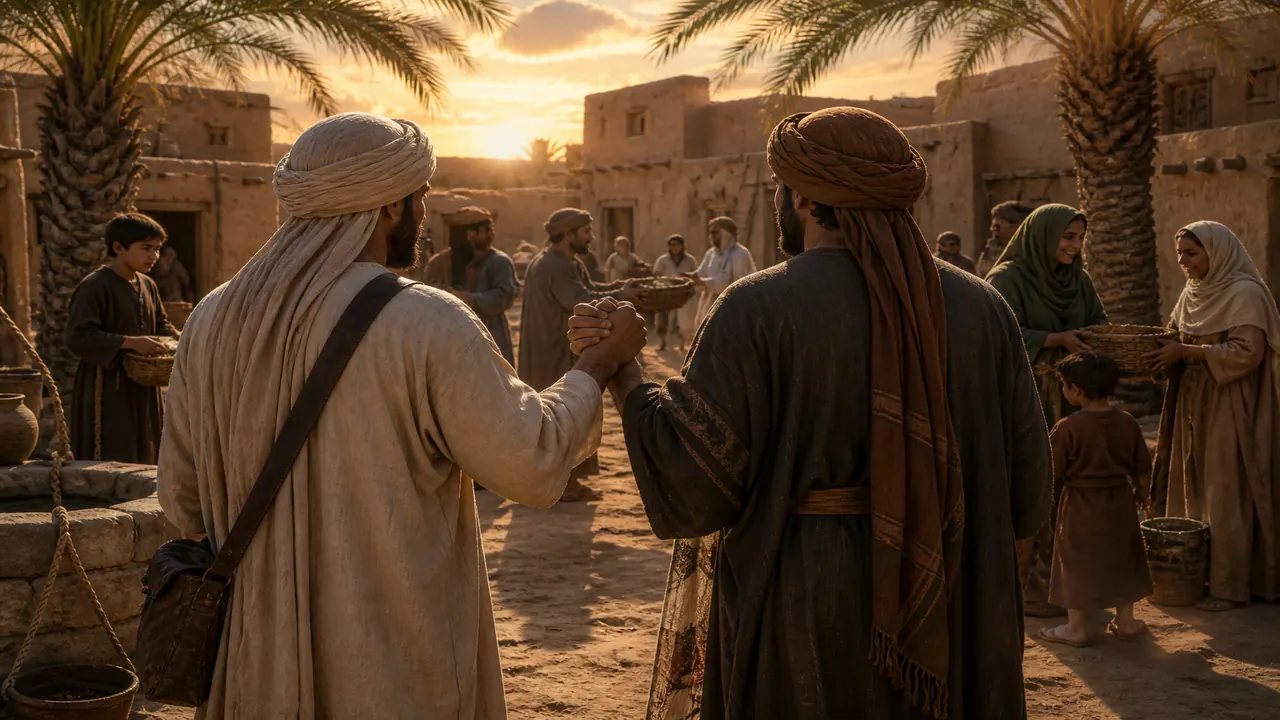
The Muhajirun and Ansar sharing provisions in Medina
Share
Facebook Twitter LinkedIn Pinterest Email Copy Link

Editorial note: The Quran and authenticated hadith establish the solidarity between the emigrants from Mecca and the helpers of Medina. Details from later biographical works should be read as historical reports rather than as Quranic statements.

Two communities after the Hijra

The migration to Medina transformed the early Muslim community. The Muhajirun were believers who had left Mecca, often separating themselves from homes, property and established livelihoods. The Ansar were the Muslims of Medina who received and supported them. Their relationship was not simply that of visitors and hosts; it became one of the foundations of the new community.

The Quran repeatedly joins migration with shelter and assistance. Quran 8:72 speaks of those who believed and emigrated alongside those who gave refuge and help. Quran 59:9 praises the people already established in Medina for loving those who migrated to them and preferring others even when they themselves were in need. These verses give the relationship a moral meaning: faith was expressed through practical solidarity.

The bond of brotherhood

Authenticated reports state that the Prophet established bonds of brotherhood between members of the two groups. One of the best-known examples pairs the Meccan emigrant Abd al-Rahman ibn Awf with the Medinan helper Sa’d ibn al-Rabi’. Sa’d offered generous material assistance. Abd al-Rahman responded with a prayer for blessing and asked to be shown the market, where he began trading.

The account is important for both halves of the exchange. The Ansari offered help without resentment, while the Muhajir sought a path back to economic independence. The story therefore does not present generosity and self-reliance as opposites. A healthy community can provide immediate support while also helping a newcomer rebuild a secure livelihood.

Beyond emergency relief

The Hijra created urgent needs for housing, food, work and social belonging. Pairing individuals and households helped turn an abstract call for unity into relationships with recognizable responsibilities. The bonds reduced isolation among migrants and encouraged cooperation across tribal lines.

This did not erase every older identity overnight, nor did it make Medina free from later disagreement. The Quran itself addresses tensions, obligations and groups with different levels of commitment. The achievement of the brotherhood lies not in an idealized claim that conflict vanished, but in the creation of a shared moral framework strong enough to guide a diverse community.

A community defined by support

The names themselves are revealing. Muhajirun remembers sacrifice through migration; Ansar means helpers. The community preserved both experiences. Those who left Mecca were not reduced to helpless refugees, and those who received them were not remembered merely as residents of Medina. Each group was recognized for a form of service.

The partnership also helped create the social setting in which the Prophet’s mosque, the market and the wider civic life of Medina could develop. Religious belonging was linked with worship, economic participation and mutual protection. Brotherhood was therefore more than an emotional slogan: it had consequences in homes, work and public responsibility.

Lessons for readers today

  • Welcome must become practical: hospitality matters most when it answers real needs.
  • Dignity accompanies assistance: support should help people recover agency and stability.
  • Unity requires relationships: institutions are strengthened when individuals accept responsibility for one another.
  • Generosity is a form of faith: Quran 59:9 connects spiritual character with preferring others despite personal need.
  • Different sacrifices can serve one purpose: migration and hospitality were distinct contributions to the same community.

Sources

  • Quran 8:72 — migration, refuge and mutual support.
  • Quran 59:9 — the generosity of the people established in Medina.
  • Sahih al-Bukhari 3780–3781 — the brotherhood of Abd al-Rahman ibn Awf and Sa’d ibn al-Rabi’.
  • Encyclopaedia Britannica: Muhammad and the Constitution of Medina — historical context for the Medinan community.

Continue the series

← PreviousAll partsNext →

Blog Life of Prophet Muhammad (PBUH)
Follow on Google News Follow on Flipboard
Share. Facebook Twitter Pinterest LinkedIn Telegram Email Copy Link
Religion Essence Hub logo
Religion Essence Hub Editorial Team
  • Website

The Religion Essence Hub Editorial Team researches, reviews and updates articles about religion, history, beliefs and culture.

Related Posts

Part 11 – Ridicule, Accusations and Demands for Signs

27 August 2026

Part 10 – Quraysh’s Objections and Attempts at Compromise

27 August 2026

Part 9 – The Warning at Mount Safa and Abu Lahab’s Response

27 August 2026

Comments are closed.

Top Posts

Part 2 – Shepherding as a Metaphor for Prophethood

19 August 202446 Views

Part 4 – Hanifs: Monotheism in Pre-Islamic Arabia

19 August 202436 Views

Part 6 – The First Revelation in the Cave of Hira

4 September 202429 Views

Part 3 – Prophet Muhammad’s Marriage to Khadijah: Partnership, Sources and Context

19 August 202424 Views
Don't Miss
40,000 Years of Knowledge

Ibrahim and Nimrod in Islam: What the Quran Says—and What History Cannot Confirm

2 October 20268 Mins Read1 Views

The Quranic debate between Ibrahim and an unnamed ruler, the later identification with Nimrod, and why claims connecting him to Sargon of Akkad remain unproven.

Prophet Ibrahim and Ancient Mesopotamia: Quran, Sumer and the Limits of History

30 September 2026

Thamud and Prophet Salih: The Quranic Account and the Archaeology of al-Hijr

28 September 2026

Aad, Iram and Prophet Hud: What the Quran and Archaeology Show

25 September 2026
About Religion Essence Hub

Religion Essence Hub publishes accessible articles about religion, history, beliefs, scripture and culture. We explain complex topics clearly and responsibly. Email: contact@religionessencehub.com

Facebook YouTube
Our Picks

Ibrahim and Nimrod in Islam: What the Quran Says—and What History Cannot Confirm

2 October 2026

Prophet Ibrahim and Ancient Mesopotamia: Quran, Sumer and the Limits of History

30 September 2026

Thamud and Prophet Salih: The Quranic Account and the Archaeology of al-Hijr

28 September 2026
Most Popular

Prophet Ibrahim and Ancient Mesopotamia: Quran, Sumer and the Limits of History

30 September 20261 Views

Ibrahim and Nimrod in Islam: What the Quran Says—and What History Cannot Confirm

2 October 20261 Views

Part 38 – Madinah’s Jewish Communities and Early Political Tensions

19 February 20252 Views
  • Home
  • Privacy Policy
  • About Us
  • Corrections Policy
  • Disclaimer
  • Editorial Policy
  • Editorial Team
  • Get In Touch
  • Terms of Use
  • Cookie Policy (UK)
© 2026 Religion Essence Hub. All rights reserved.

Type above and press Enter to search. Press Esc to cancel.

Manage Consent
To provide the best experiences, we use technologies like cookies to store and/or access device information. Consenting to these technologies will allow us to process data such as browsing behavior or unique IDs on this site. Not consenting or withdrawing consent, may adversely affect certain features and functions.
Functional Always active
The technical storage or access is strictly necessary for the legitimate purpose of enabling the use of a specific service explicitly requested by the subscriber or user, or for the sole purpose of carrying out the transmission of a communication over an electronic communications network.
Preferences
The technical storage or access is necessary for the legitimate purpose of storing preferences that are not requested by the subscriber or user.
Statistics
The technical storage or access that is used exclusively for statistical purposes. The technical storage or access that is used exclusively for anonymous statistical purposes. Without a subpoena, voluntary compliance on the part of your Internet Service Provider, or additional records from a third party, information stored or retrieved for this purpose alone cannot usually be used to identify you.
Marketing
The technical storage or access is required to create user profiles to send advertising, or to track the user on a website or across several websites for similar marketing purposes.
  • Manage options
  • Manage services
  • Manage {vendor_count} vendors
  • Read more about these purposes
View preferences
  • {title}
  • {title}
  • {title}