

Source note: The construction of the Prophet’s Mosque is well attested in Sahih al-Bukhari. Architectural details added by later writers should not be treated as equally certain unless independently sourced.
A mosque for the new community
After arriving in the Madinah area, the Prophet Muhammad stayed among Banu ‘Amr ibn ‘Awf and then entered the city. Sahih al-Bukhari 3932 connects that arrival directly with the decision to build a mosque. The project gave the growing community a shared place for prayer, teaching and consultation.
The site and construction
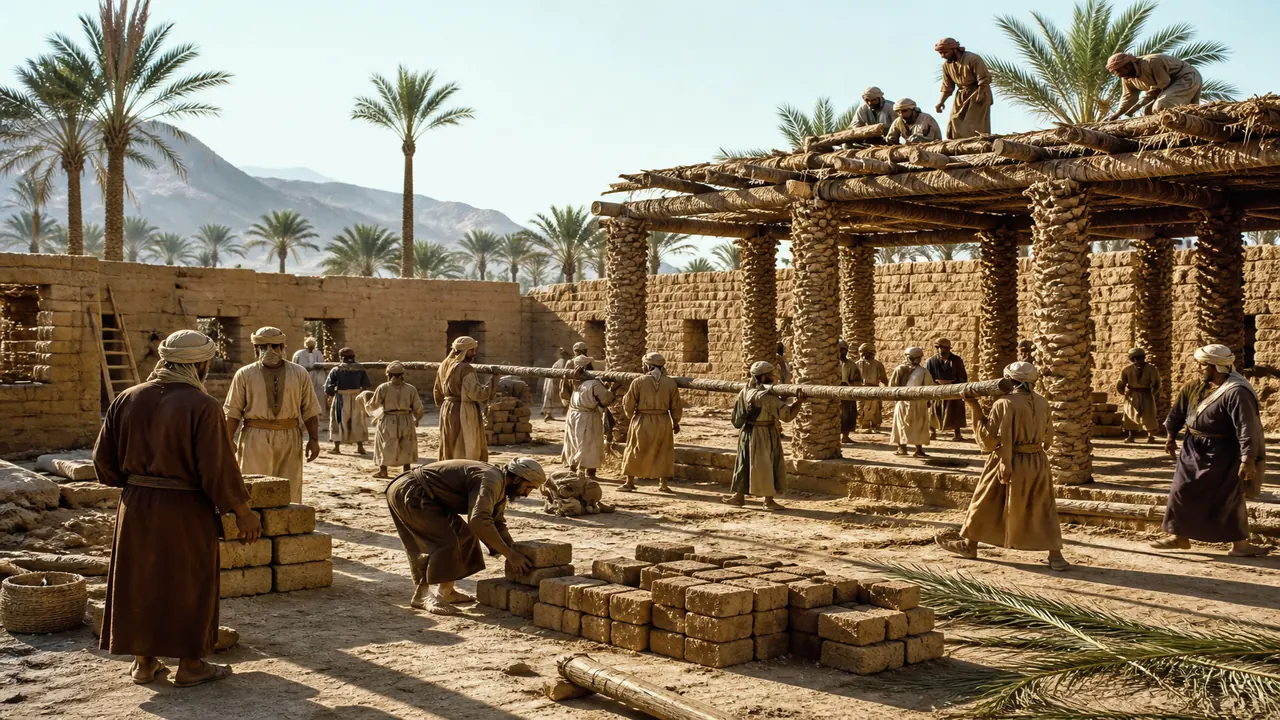
The Prophet asked Banu al-Najjar to name a price for the site. They declined payment and sought reward from God. The report says the ground was prepared before construction: old graves were moved, uneven areas levelled and date palms cleared. These details appear in Sahih al-Bukhari 1868.
The earliest mosque was a practical structure made with locally available materials. Later expansions transformed its appearance, so modern photographs should not be mistaken for the seventh-century building. What remained constant was the site’s religious and communal importance.
Participation and purpose
Bukhari’s narration remembers the companions carrying building materials with the Prophet among them. The account presents leadership as participation rather than distant command. It also explains why the mosque belongs in the story immediately after the Hijra: worship and public community-building developed together.
The Quran praises a mosque founded on God-consciousness in Quran 9:108. Classical interpreters differed over whether this verse refers specifically to Quba or the Prophet’s Mosque, so the verse should not be used to erase that interpretive discussion.
What the mosque represented
- A regular place for congregational worship.
- A setting for teaching and receiving visitors.
- A shared institution for emigrants and local supporters.
- A visible centre for a community still learning how to organise its public life.
The Prophet’s Mosque became one of Islam’s most important sacred spaces, but its beginnings were modest. The strongest sources emphasise collective work, lawful acquisition of the site and service to the community rather than luxury.
