

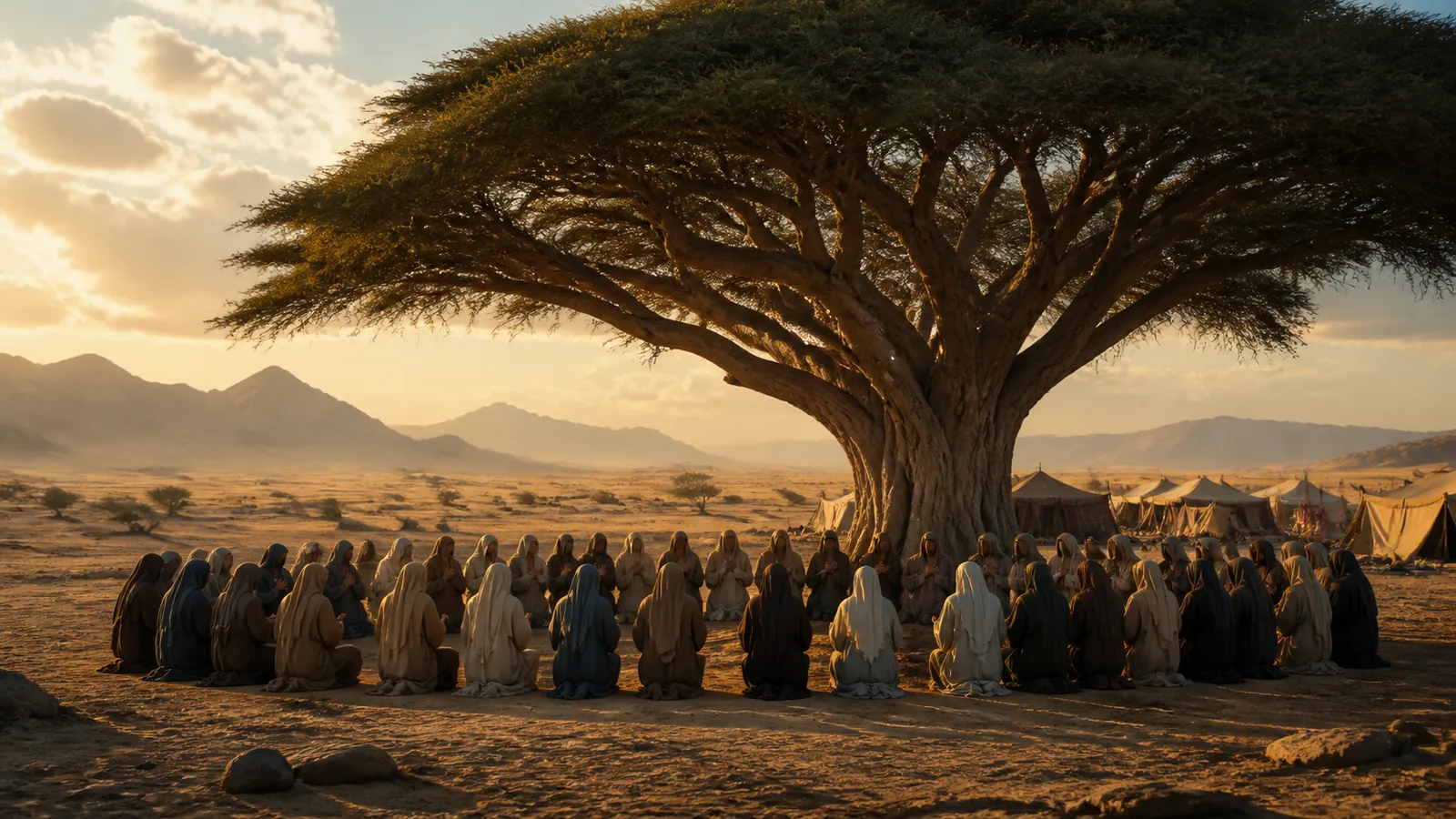
Bay‘at al-Ridwan, the pledge beneath the tree at Hudaybiyyah, was a defining moment of trust during the Prophet Muhammad’s journey towards Makkah. The Muslims had come intending to perform umrah. Instead, a dispute over access to the sanctuary led to tense negotiations, a pledge of support and, eventually, a treaty.
A pilgrimage interrupted
The journey belongs to 6 AH in the standard seerah chronology. A report in Sahih al-Bukhari 4158 describes the Prophet entering the pilgrim state and marking the sacrificial animals at Dhul-Hulayfa. These preparations help explain why the journey should not be introduced as an expedition whose original purpose was to capture Makkah.
The travellers nevertheless faced a serious security problem. Quraysh intended to prevent their entry. Bukhari’s extended account of the negotiations identifies Khalid ibn al-Walid, then on the opposing side, with the Quraysh cavalry. The Muslim party took another route and stopped at Hudaybiyyah. Abu Jahl was not commanding these forces: he had died years earlier at Badr.
Why Uthman was absent from the pledge
Uthman ibn Affan went to Makkah as the Prophet’s representative. Reports in the seerah connect the pledge with alarm over his safety and a rumour that he had been killed. That rumour must not be mistaken for the outcome: Uthman survived and returned.
Sahih al-Bukhari 3698 addresses his absence directly. Ibn Umar explains that Uthman was away on the Prophet’s mission, not avoiding his companions. The Prophet used his own hand to represent Uthman’s participation. This detail changes how the episode is understood: being absent from the gathering did not mean being absent from its purpose.
The Quran and the people beneath the tree
Quran 48:18 speaks of God’s pleasure with the believers who pledged beneath the tree. It describes knowledge of their hearts, tranquillity and a coming victory. Quran 48:10 also gives the pledge its religious meaning: allegiance to the Messenger carries responsibility before God.
Jabir’s recollection in Bukhari 4154 gives a figure of 1,400 participants and remembers the place of the tree. Other reports express the travelling party’s size somewhat differently. It is more accurate to identify which report supplies a number than to treat every surviving count as identical.
Commitment did not rule out negotiation
The pledge did not end the search for a settlement. Bukhari 2731–2732 describes negotiations that concluded with an agreement and postponed the pilgrimage. The Prophet’s willingness to accept terms respecting the sacred ordinances was part of that process, not an unconditional promise to accept any demand.
A related report in Sahih Muslim 1808 describes an armed group captured and released, connecting the incident with Quran 48:24 and the restraint of both sides’ hands. Read together, these sources show resolve alongside restraint. They do not describe an inevitable rush from a pledge into battle.
For readers following the series, the essential sequence is simple: a pilgrimage journey, obstruction, diplomacy, the pledge and then the treaty. Keeping that order clear makes the disappointment and later significance of Hudaybiyyah easier to understand. Its lesson is not that negotiations are always easy, but that loyalty and patience can be tested precisely when a hoped-for result is delayed.
Sources and further reading
- Quran 48:18 and 48:24: the pledge and restraint.
- Bukhari 3698: Uthman’s mission and participation.
- Bukhari 4154 and 4158: participants and pilgrimage preparations.
- Bukhari 2731–2732: negotiations; Muslim 1808: release of captives.
