
Close Menu
  • Home
  • Islamic History
    • Life of Prophet Muhammad
    • Abu Bakr al-Siddiq
    • Umar ibn al-Khattab
  • Companions
  • Series
    • 40,000 Years of Knowledge
    • The Secrets of the Universe
    • Amazon Series
  • About
  • Contact
  • Series Reading Guide
What's Hot

Ibrahim and Nimrod in Islam: What the Quran Says—and What History Cannot Confirm

2 October 2026

Prophet Ibrahim and Ancient Mesopotamia: Quran, Sumer and the Limits of History

30 September 2026

Thamud and Prophet Salih: The Quranic Account and the Archaeology of al-Hijr

28 September 2026
YouTube
YouTube Facebook
Religion Essence Hub
  • Home
  • Islamic History
    • Life of Prophet Muhammad
    • Abu Bakr al-Siddiq
    • Umar ibn al-Khattab
  • Companions
  • Series
    • 40,000 Years of Knowledge
    • The Secrets of the Universe
    • Amazon Series
  • About
  • Contact
  • Series Reading Guide
Religion Essence Hub
Home » Part 57 – Battle of Mu’ta
Life of Prophet Muhammad (PBUH)

Part 57 – Battle of Mu’ta

Religion Essence Hub Editorial TeamBy Religion Essence Hub Editorial Team19 February 2025Updated:9 September 2026No Comments3 Mins Read13 Views
Facebook Twitter Pinterest Telegram LinkedIn Tumblr Copy Link Email
Follow Us
Google News Flipboard
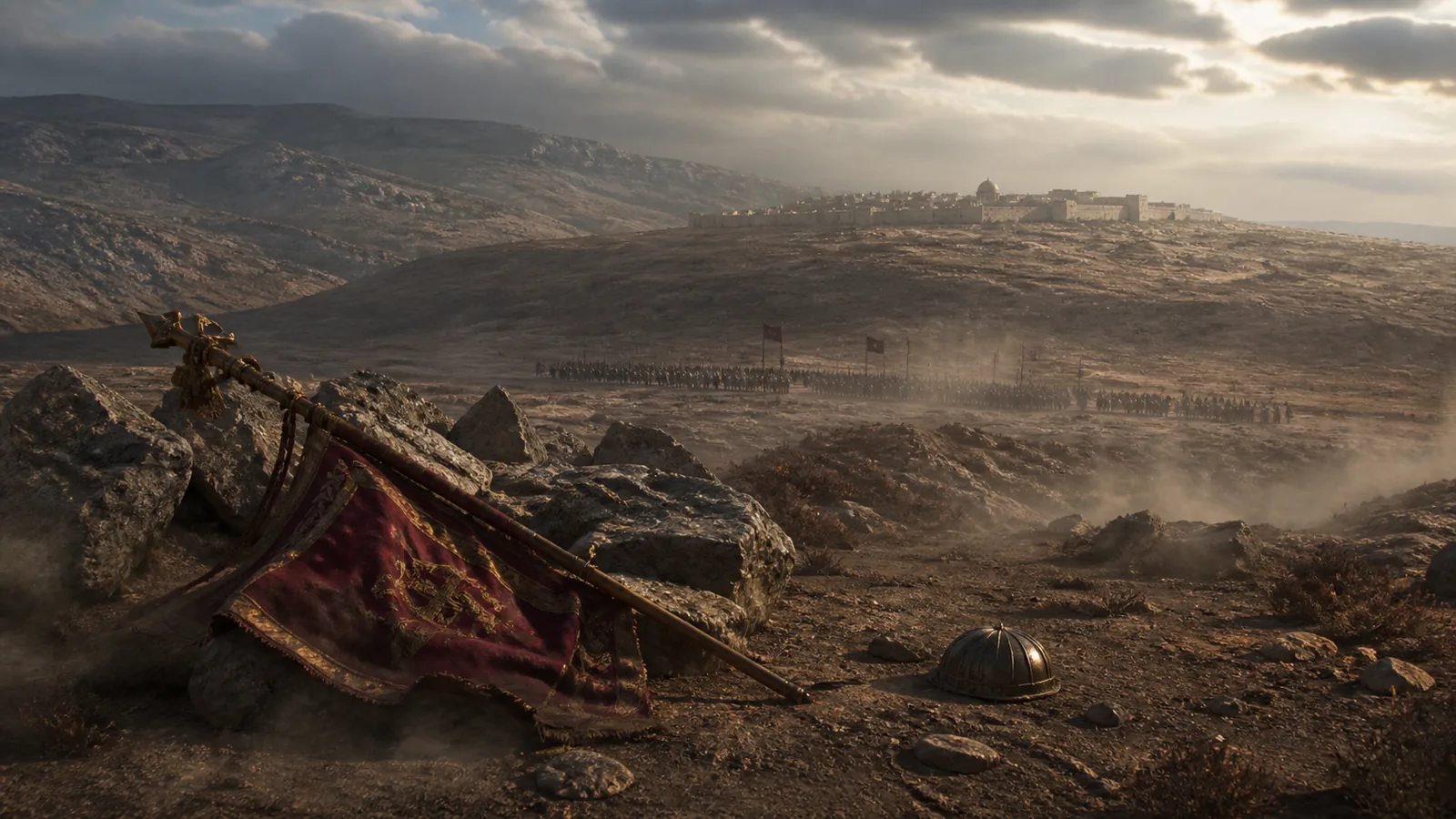
Distant armies in the valley near Mu’ta
Share
Facebook Twitter LinkedIn Pinterest Email Copy Link

The Battle of Mu’ta is remembered for the deaths of three appointed commanders and the leadership of Khalid ibn al-Walid after them. It took place on the northern frontier of the early Muslim community, in the region of present-day Jordan. The Prophet Muhammad did not personally accompany this expedition.

A northern expedition

Standard seerah accounts place Mu’ta in 8 AH and connect it with the killing of a Muslim envoy and tensions in the northern borderlands. Those background details come from historical narratives; the shorter hadith reports cited below concentrate on the commanders and the losses.

In this context, references to the Romans mean the Byzantine, or Eastern Roman, world and its regional allies. They do not mean “the West” in a modern political sense. Likewise, al-Sham refers to a historical region wider than today’s Syrian state. Mu’ta should not be presented as a battle between every Muslim and every Christian.

Later accounts give strikingly large figures for the opposing army. Their precision is difficult to establish. The hadith evidence considered here does not provide a reliable basis for calculating an exact numerical ratio between the forces, so this article does not use one.

The three commanders

According to Ibn Umar in Sahih al-Bukhari 4261, the Prophet appointed Zayd ibn Haritha first. If Zayd was killed, Ja‘far ibn Abi Talib would take command; if Ja‘far was killed, Abdullah ibn Rawaha would succeed him. These were successive appointments, not three unrelated armies.

Ibn Umar also recalls finding Ja‘far’s body after the fighting with many wounds. The report communicates the severity of the loss without requiring a reconstructed speech or an imagined description of his final thoughts. All three appointed commanders died during the battle.

Khalid takes responsibility

Anas’s account in Bukhari 4262 describes the Prophet informing the community of the commanders’ deaths and weeping as he spoke. It then identifies Khalid’s assumption of the banner and describes God granting success through him. The passage is important both for Khalid’s reputation and for its direct acknowledgement of grief.

A separate report, Bukhari 4265, records Khalid’s recollection that nine swords broke in his hand during Mu’ta. It conveys the intensity of the fighting. It does not, by itself, establish the size of either army or prove every manoeuvre described in later popular accounts.

How should the outcome be described?

Seerah narratives commonly emphasise Khalid’s preservation of the surviving force and its return to Medina. That is not the same as the conquest of the Byzantine Empire or permanent occupation of the whole region. Bukhari’s language of success should be read alongside the losses, rather than used to erase them.

The distinction matters because a leader’s task can change during an emergency. After the loss of successive commanders, maintaining order and bringing survivors home were serious responsibilities. This is an interpretation of the episode’s significance, not a claim to know every decision Khalid made on the battlefield.

Mu’ta’s lasting themes are preparation for a change of command, responsibility under pressure and remembrance of those who died. The Prophet’s tears also prevent the story from becoming a celebration of loss for its own sake. Later northern expeditions belong to their own accounts and should not be blended into this battle.

Sources and further reading

  • Bukhari 4261: succession of commanders and Ibn Umar’s recollection.
  • Bukhari 4262: the Prophet’s announcement, grief and Khalid’s command.
  • Bukhari 4265: Khalid’s account of the fighting.

Continue the series

← PreviousAll partsNext →

Blog Life of Prophet Muhammad (PBUH)
Follow on Google News Follow on Flipboard
Share. Facebook Twitter Pinterest LinkedIn Telegram Email Copy Link
Religion Essence Hub logo
Religion Essence Hub Editorial Team
  • Website

The Religion Essence Hub Editorial Team researches, reviews and updates articles about religion, history, beliefs and culture.

Related Posts

Part 11 – Ridicule, Accusations and Demands for Signs

27 August 2026

Part 10 – Quraysh’s Objections and Attempts at Compromise

27 August 2026

Part 9 – The Warning at Mount Safa and Abu Lahab’s Response

27 August 2026

Comments are closed.

Top Posts

Part 2 – Shepherding as a Metaphor for Prophethood

19 August 202446 Views

Part 4 – Hanifs: Monotheism in Pre-Islamic Arabia

19 August 202436 Views

Part 6 – The First Revelation in the Cave of Hira

4 September 202429 Views

Part 3 – Prophet Muhammad’s Marriage to Khadijah: Partnership, Sources and Context

19 August 202424 Views
Don't Miss
40,000 Years of Knowledge

Ibrahim and Nimrod in Islam: What the Quran Says—and What History Cannot Confirm

2 October 20268 Mins Read1 Views

The Quranic debate between Ibrahim and an unnamed ruler, the later identification with Nimrod, and why claims connecting him to Sargon of Akkad remain unproven.

Prophet Ibrahim and Ancient Mesopotamia: Quran, Sumer and the Limits of History

30 September 2026

Thamud and Prophet Salih: The Quranic Account and the Archaeology of al-Hijr

28 September 2026

Aad, Iram and Prophet Hud: What the Quran and Archaeology Show

25 September 2026
About Religion Essence Hub

Religion Essence Hub publishes accessible articles about religion, history, beliefs, scripture and culture. We explain complex topics clearly and responsibly. Email: contact@religionessencehub.com

Facebook YouTube
Our Picks

Ibrahim and Nimrod in Islam: What the Quran Says—and What History Cannot Confirm

2 October 2026

Prophet Ibrahim and Ancient Mesopotamia: Quran, Sumer and the Limits of History

30 September 2026

Thamud and Prophet Salih: The Quranic Account and the Archaeology of al-Hijr

28 September 2026
Most Popular

Prophet Ibrahim and Ancient Mesopotamia: Quran, Sumer and the Limits of History

30 September 20261 Views

Ibrahim and Nimrod in Islam: What the Quran Says—and What History Cannot Confirm

2 October 20261 Views

Part 38 – Madinah’s Jewish Communities and Early Political Tensions

19 February 20252 Views
  • Home
  • Privacy Policy
  • About Us
  • Corrections Policy
  • Disclaimer
  • Editorial Policy
  • Editorial Team
  • Get In Touch
  • Terms of Use
  • Cookie Policy (UK)
© 2026 Religion Essence Hub. All rights reserved.

Type above and press Enter to search. Press Esc to cancel.

Manage Consent
To provide the best experiences, we use technologies like cookies to store and/or access device information. Consenting to these technologies will allow us to process data such as browsing behavior or unique IDs on this site. Not consenting or withdrawing consent, may adversely affect certain features and functions.
Functional Always active
The technical storage or access is strictly necessary for the legitimate purpose of enabling the use of a specific service explicitly requested by the subscriber or user, or for the sole purpose of carrying out the transmission of a communication over an electronic communications network.
Preferences
The technical storage or access is necessary for the legitimate purpose of storing preferences that are not requested by the subscriber or user.
Statistics
The technical storage or access that is used exclusively for statistical purposes. The technical storage or access that is used exclusively for anonymous statistical purposes. Without a subpoena, voluntary compliance on the part of your Internet Service Provider, or additional records from a third party, information stored or retrieved for this purpose alone cannot usually be used to identify you.
Marketing
The technical storage or access is required to create user profiles to send advertising, or to track the user on a website or across several websites for similar marketing purposes.
  • Manage options
  • Manage services
  • Manage {vendor_count} vendors
  • Read more about these purposes
View preferences
  • {title}
  • {title}
  • {title}