
Close Menu
  • Home
  • Islamic History
    • Life of Prophet Muhammad
    • Abu Bakr al-Siddiq
    • Umar ibn al-Khattab
  • Companions
  • Series
    • 40,000 Years of Knowledge
    • The Secrets of the Universe
    • Amazon Series
  • About
  • Contact
  • Series Reading Guide
What's Hot

Ibrahim and Nimrod in Islam: What the Quran Says—and What History Cannot Confirm

2 October 2026

Prophet Ibrahim and Ancient Mesopotamia: Quran, Sumer and the Limits of History

30 September 2026

Thamud and Prophet Salih: The Quranic Account and the Archaeology of al-Hijr

28 September 2026
YouTube
YouTube Facebook
Religion Essence Hub
  • Home
  • Islamic History
    • Life of Prophet Muhammad
    • Abu Bakr al-Siddiq
    • Umar ibn al-Khattab
  • Companions
  • Series
    • 40,000 Years of Knowledge
    • The Secrets of the Universe
    • Amazon Series
  • About
  • Contact
  • Series Reading Guide
Religion Essence Hub
Home » Part 65 – Some events of the Battle of Tabuk
Life of Prophet Muhammad (PBUH)

Part 65 – Some events of the Battle of Tabuk

Religion Essence Hub Editorial TeamBy Religion Essence Hub Editorial Team19 February 2025Updated:5 September 2026No Comments4 Mins Read9 Views
Facebook Twitter Pinterest Telegram LinkedIn Tumblr Copy Link Email
Follow Us
Google News Flipboard
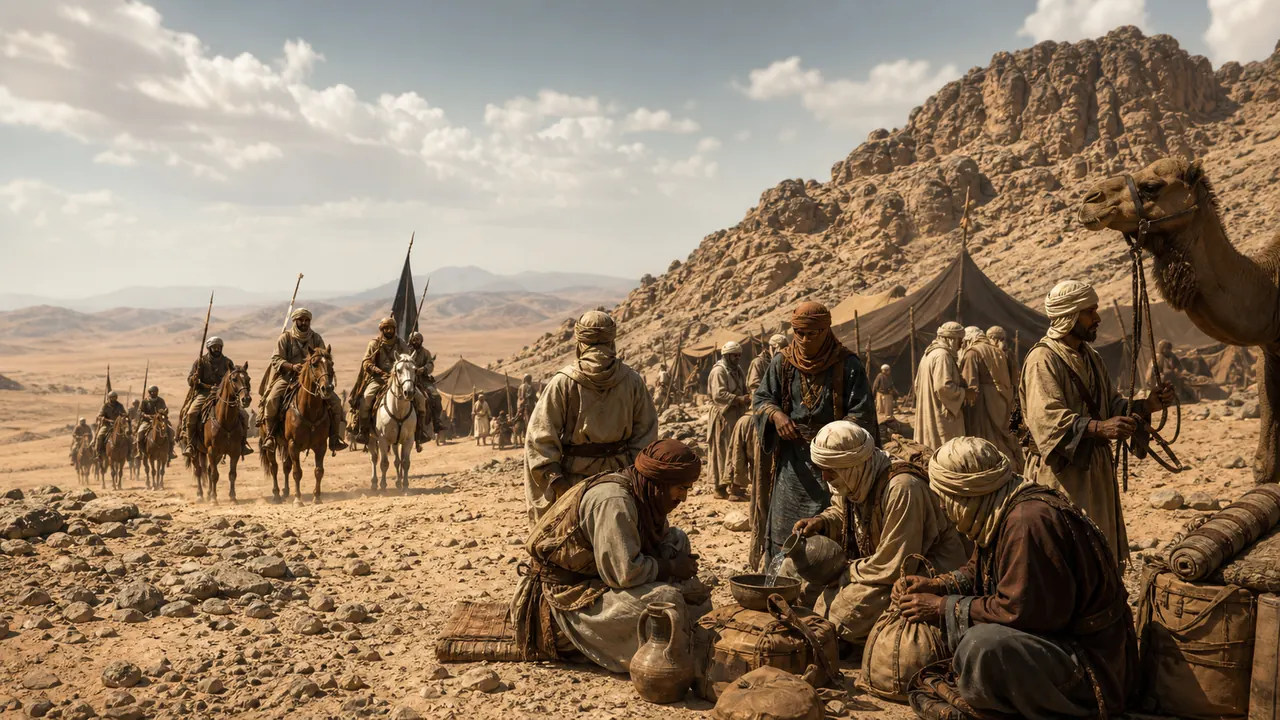
Travellers managing supplies at the remote Tabuk encampment
Share
Facebook Twitter LinkedIn Pinterest Email Copy Link

Editorial note: The expedition to Tabuk is addressed directly in Surah al-Tawbah and in authenticated hadith. Exact army sizes and many dramatic details come from later historical works and should not be treated as equally certain.

The expedition of hardship

The expedition to Tabuk took place late in the Prophet Muhammad’s Medinan period, in 9 AH. Muslim sources remember it as an expedition of exceptional difficulty. The destination was far to the north, the season was intensely hot and resources were limited. Unlike campaigns whose destination had been kept less explicit, the Prophet announced the direction so that the community could prepare for a long journey.

Surah al-Tawbah calls this the “hour of hardship” and describes God turning in mercy toward the Prophet, the Muhajirun and the Ansar who followed him in that difficult time. The Quran’s emphasis is therefore not simply military. It examines willingness, hesitation, excuses, sacrifice and repentance.

Preparing Medina

Leaving Medina for a distant frontier required arrangements at home. Sahih al-Bukhari records that the Prophet appointed Ali ibn Abi Talib as his deputy in Medina. When Ali expressed concern about remaining behind, the Prophet reassured him with the comparison to Aaron’s relationship with Moses, while explicitly stating that there would be no prophet after him.

The report shows that responsibility during the expedition was divided. Service did not consist only of traveling with the army. Protecting the city and caring for those who remained were also necessary tasks.

No major battle at Tabuk

The expedition reached Tabuk, but the large confrontation feared by the Muslims did not take place. This does not make the journey historically unimportant. The mobilization demonstrated the community’s ability to travel beyond the Hijaz, maintain discipline under severe conditions and negotiate relationships in the northern frontier region.

It is better to describe this outcome precisely than to turn every expedition into a battlefield story. Tabuk’s central themes are preparation, endurance, political reach and the moral testing of the community. Its significance lies partly in what the journey revealed about those who went, those with genuine excuses and those who stayed behind without a valid reason.

The Quran and the excuses of those who stayed behind

Surah al-Tawbah distinguishes among several groups. It criticizes people who preferred comfort and offered insincere excuses, while exempting the weak, the ill and those without means when they were sincere. This distinction prevents a harsh and simplistic reading: inability was not the same as unwillingness.

The most detailed personal account concerns Ka’b ibn Malik, one of three believers who remained behind without a valid excuse. In Sahih al-Bukhari, Ka’b says he was physically and financially able to go but delayed preparing until the expedition had left. When the Prophet returned, Ka’b refused to protect himself with a lie. His long account leads to the Quranic announcement that God accepted the repentance of the three.

What Tabuk teaches

  • Preparation is part of faithfulness: good intentions do not replace timely action.
  • Hardship reveals priorities: comfort can become a serious obstacle when responsibility calls.
  • Different duties still matter: protecting Medina was necessary even while others traveled north.
  • Truth opens the way to repentance: Ka’b accepted consequences instead of inventing an excuse.
  • Mercy recognizes genuine inability: the Quran separates sincere incapacity from deliberate avoidance.

Sources

  • Quran 9:38–52 — the call to mobilize and the exposure of false excuses.
  • Quran 9:91–118 — valid exemptions, the hour of hardship and the repentance of the three.
  • Sahih al-Bukhari 4416 — Ali appointed as deputy in Medina.
  • Sahih al-Bukhari 4418 — Ka’b ibn Malik’s detailed account.

Continue the series

← PreviousAll partsNext →

Blog Life of Prophet Muhammad (PBUH)
Follow on Google News Follow on Flipboard
Share. Facebook Twitter Pinterest LinkedIn Telegram Email Copy Link
Religion Essence Hub logo
Religion Essence Hub Editorial Team
  • Website

The Religion Essence Hub Editorial Team researches, reviews and updates articles about religion, history, beliefs and culture.

Related Posts

Part 11 – Ridicule, Accusations and Demands for Signs

27 August 2026

Part 10 – Quraysh’s Objections and Attempts at Compromise

27 August 2026

Part 9 – The Warning at Mount Safa and Abu Lahab’s Response

27 August 2026

Comments are closed.

Top Posts

Part 2 – Shepherding as a Metaphor for Prophethood

19 August 202446 Views

Part 4 – Hanifs: Monotheism in Pre-Islamic Arabia

19 August 202436 Views

Part 6 – The First Revelation in the Cave of Hira

4 September 202429 Views

Part 3 – Prophet Muhammad’s Marriage to Khadijah: Partnership, Sources and Context

19 August 202424 Views
Don't Miss
40,000 Years of Knowledge

Ibrahim and Nimrod in Islam: What the Quran Says—and What History Cannot Confirm

2 October 20268 Mins Read1 Views

The Quranic debate between Ibrahim and an unnamed ruler, the later identification with Nimrod, and why claims connecting him to Sargon of Akkad remain unproven.

Prophet Ibrahim and Ancient Mesopotamia: Quran, Sumer and the Limits of History

30 September 2026

Thamud and Prophet Salih: The Quranic Account and the Archaeology of al-Hijr

28 September 2026

Aad, Iram and Prophet Hud: What the Quran and Archaeology Show

25 September 2026
About Religion Essence Hub

Religion Essence Hub publishes accessible articles about religion, history, beliefs, scripture and culture. We explain complex topics clearly and responsibly. Email: contact@religionessencehub.com

Facebook YouTube
Our Picks

Ibrahim and Nimrod in Islam: What the Quran Says—and What History Cannot Confirm

2 October 2026

Prophet Ibrahim and Ancient Mesopotamia: Quran, Sumer and the Limits of History

30 September 2026

Thamud and Prophet Salih: The Quranic Account and the Archaeology of al-Hijr

28 September 2026
Most Popular

Prophet Ibrahim and Ancient Mesopotamia: Quran, Sumer and the Limits of History

30 September 20261 Views

Ibrahim and Nimrod in Islam: What the Quran Says—and What History Cannot Confirm

2 October 20261 Views

Part 38 – Madinah’s Jewish Communities and Early Political Tensions

19 February 20252 Views
  • Home
  • Privacy Policy
  • About Us
  • Corrections Policy
  • Disclaimer
  • Editorial Policy
  • Editorial Team
  • Get In Touch
  • Terms of Use
  • Cookie Policy (UK)
© 2026 Religion Essence Hub. All rights reserved.

Type above and press Enter to search. Press Esc to cancel.

Manage Consent
To provide the best experiences, we use technologies like cookies to store and/or access device information. Consenting to these technologies will allow us to process data such as browsing behavior or unique IDs on this site. Not consenting or withdrawing consent, may adversely affect certain features and functions.
Functional Always active
The technical storage or access is strictly necessary for the legitimate purpose of enabling the use of a specific service explicitly requested by the subscriber or user, or for the sole purpose of carrying out the transmission of a communication over an electronic communications network.
Preferences
The technical storage or access is necessary for the legitimate purpose of storing preferences that are not requested by the subscriber or user.
Statistics
The technical storage or access that is used exclusively for statistical purposes. The technical storage or access that is used exclusively for anonymous statistical purposes. Without a subpoena, voluntary compliance on the part of your Internet Service Provider, or additional records from a third party, information stored or retrieved for this purpose alone cannot usually be used to identify you.
Marketing
The technical storage or access is required to create user profiles to send advertising, or to track the user on a website or across several websites for similar marketing purposes.
  • Manage options
  • Manage services
  • Manage {vendor_count} vendors
  • Read more about these purposes
View preferences
  • {title}
  • {title}
  • {title}