

Editorial note: This article distinguishes between the Quran, rigorously authenticated hadith, and details preserved in later biographical chronicles. Dates and tactical details can differ between historical accounts.
Where the siege fits in the story
The siege of Ta’if took place in 8 AH (630 CE), shortly after the conquest of Makkah and the Battle of Hunayn. At Hunayn, a coalition led by Hawazin and Thaqif initially surprised the Muslim army before the battle turned in the Muslims’ favour. The Quran refers directly to Hunayn in Surah al-Tawbah 9:25–27, warning that numbers alone do not guarantee success and describing the restoration of confidence after the early setback.
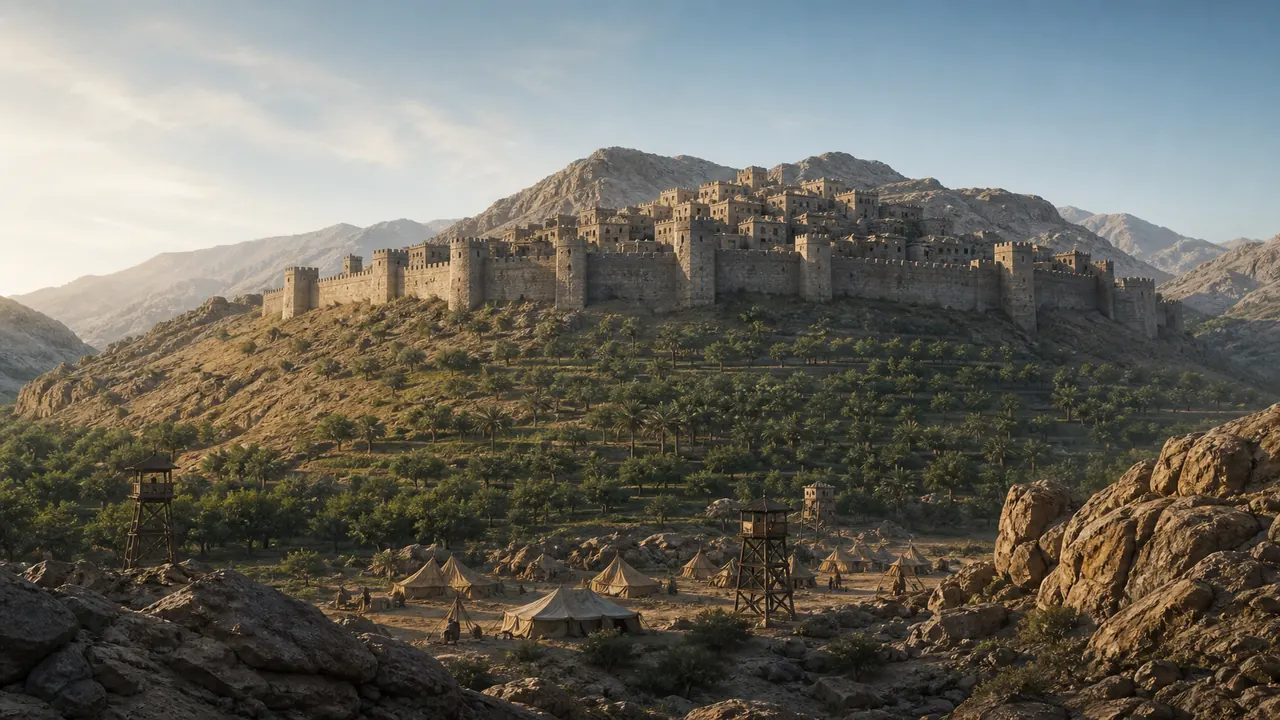
Survivors of the opposing coalition withdrew toward strongholds in the region, including the fortified settlement of Ta’if. Ta’if was not an exposed encampment: it was a defended town associated with the tribe of Thaqif, protected by walls and supplied well enough to resist an immediate assault. The campaign therefore changed from open battle to siege warfare.
A difficult fortified position
Later sira and historical works describe the use of archery, protective screens and siege equipment. These reports help explain the military setting, but they should not all be treated as equally certain. What is firmly supported by authenticated hadith is that the defenders’ resistance caused injuries and that the fort was not taken during the siege.
Sahih al-Bukhari 4325 and Sahih Muslim 1778 preserve a concise account. The Prophet Muhammad announced that the army would return. Some companions found it difficult to leave without a victory, so another attack was attempted; men were wounded, and the decision to withdraw was then welcomed. The report presents withdrawal as a deliberate response to conditions, not as the capture of Ta’if.
What the sources do—and do not—say
- The Quran names Hunayn and supplies its religious lesson, but it does not narrate a detailed siege chronology for Ta’if.
- Authenticated hadith confirms that Ta’if was besieged, the defenders were not overcome during the operation, and Muslim fighters suffered wounds.
- Specific claims about the exact length of the siege, particular machines, crop cutting and named casualties mainly come through later historical narration. Such details should be presented with attribution rather than as uncontested facts.
- The siege should not be described as a straightforward conquest. Ta’if entered the Muslim polity later, after a delegation from Thaqif negotiated with the Prophet.
The decision to withdraw
Ending an operation without capturing its objective can be strategically sound. A prolonged assault against a prepared fortification risked further casualties and did not offer a quick result. The hadith narrative also shows the companions learning this in practical terms: enthusiasm for another assault changed after they experienced the defenders’ arrows.
The withdrawal allowed the Muslim force to move on to al-Ji‘ranah, where matters connected with the captives and property from Hunayn were addressed. Reports about the distribution of the spoils and the concerns of the Ansar belong to this same wider sequence and are recorded in the chapters following the Ta’if campaign in Sahih al-Bukhari.
Ta’if’s later peaceful entry
The immediate siege ended without the fort being taken, but that was not the end of relations with Thaqif. In the following year, representatives from Ta’if came to Madinah and negotiated their community’s acceptance of Islam. This later development is essential because it prevents the story from being reduced to a single military encounter. Political change eventually occurred through delegation and agreement rather than the successful storming of the walls.
Key lessons
The episode illustrates patience, realistic command and the difference between immediate military success and longer-term political change. It also demonstrates why source quality matters. The broad outline is secure, while many colourful tactical details come from later chronicles and should be labelled accordingly.
Sources for further reading
- Quran 9:25–27 — the Battle of Hunayn and its lesson.
- Sahih al-Bukhari 4325 — the decision to end the siege after another assault caused wounds.
- Sahih al-Bukhari 4326–4327 — reports associated with people leaving the fort at Ta’if.
- Sahih Muslim 1778 — parallel report of the siege and withdrawal.
