

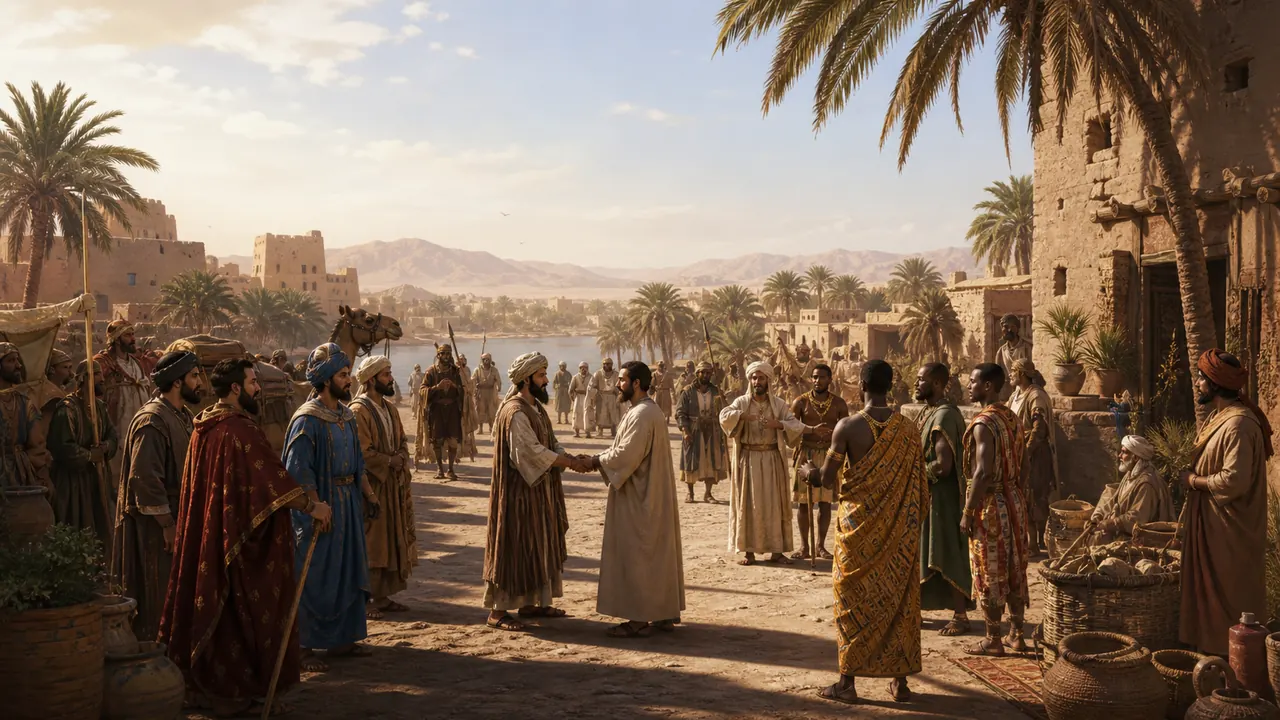
Today we will discuss Aam Al Ufud topic. It means the year of the delegates because at this time, delegations from different places or from different parts of Arabia came to meet the Prophet Muhammad (peace be upon him). This year, various tribes of Arabia sent their representatives to the Prophet Muhammad (peace be upon him), which is why it is called the Year of the Representatives or Aam Al Ufud.
In this regard, Allah Almighty says in the Quran:
When the victory of Allah has come and the conquest, And you see the people entering into the religion of Allah in multitudes, Then exalt [Him] with praise of your Lord and ask forgiveness of Him. Indeed, He is ever Accepting of repentance.
(Quran 110:1-3)
This verse states that when Allah’s victory comes, people will embrace Islam in droves. The other tribes of Arabia were eager to see when the war between the Prophet (peace and blessings of Allaah be upon him) and the Quraysh would end, and they were eager to see one group win. When the Prophet was victorious, they began to embrace Islam in droves.
The Arabs held the Quraysh in high regard because they were the religious leaders. Until now, they were the guardians of the House of Allah. When the conflict between the Prophet Muhammad (PBUH) and the Quraysh began, many in Mecca wanted to wait until the conflict ended. After the conquest of Mecca, many tribes converted to Islam, such as the Shakib tribe.
Tribes approaching the Muslim community
The Prophet first arrested them and then released them, but later they came voluntarily and embraced Islam. Thus, soon after the largest tribes of Mecca, the Quraysh and the Sakhi tribes, embraced Islam, other tribes in Mecca and its surroundings began to embrace Islam.
Their oath of allegiance was to the Prophet Muhammad. However, compared to them, those who embraced Islam earlier, that is, those who embraced Islam in Mecca, have a much higher status because they embraced Islam when times were difficult. In this regard, Allah Almighty says in the Quran:
And why do you not spend in the cause of Allah while to Allah belongs the heritage of the heavens and the earth? Not equal among you are those who spent before the conquest [of Makkah] and fought [and those who did so after it]. Those are greater in degree than they who spent afterwards and fought. But to all Allah has promised the best [reward]. And Allah, with what you do, is Acquainted.
(Quran 57:10)
First we will discuss the delegation of the Saki tribe. They initially wanted to compromise, they wanted to convert to Islam, but then they wanted permission to worship their other gods for a year. The idea was that the people of their tribe would not easily accept the destruction of the gods they had worshipped for so many years. They also wanted to avoid being banned from committing adultery, taking interest, and drinking alcohol.
Negotiations in the account
But the Prophet did not accept even one of their demands. Then, if they want, they should be given a break for at least a month. But the Prophet did not agree. Then they agreed in despair and said that we cannot do this work but rather send representatives from among you to break the idol.
Then the Messenger of Allah (peace and blessings of Allah be upon him) sent Abu Sufyan and Abu Suhail. They were from that tribe. When they went to break the idol, the people of that tribe started cursing them.
The next delegation came from the Banu Tamim tribe. When the Prophet (peace and blessings of Allaah be upon him) saw them, he said, “Receive the good news.” They said, “You have given us the good news for a while now.” The Prophet was not pleased, realizing that they were greedy for wealth. Another delegation came from Yemen and told them to accept the good news that the Banu Tamim tribe had not accepted. They replied that they were willing to accept it. When a delegation arrived, the Prophet (peace be upon him) would assign leadership to one person.
Two local leaders from that tribe came and a dispute broke out between Hajj Abu Bakr (may Allah be pleased with him) and Umar (may Allah be pleased with him) over who should be given the responsibility. Allah revealed the following verse in the Quran:
O you who have believed, do not put [yourselves] before Allah and His Messenger but fear Allah. Indeed, Allah is Hearing and Knowing.
(Quran 49:1)
The Christian delegation
Then came the delegation from Nazra. This group was made up of Christians. They came to meet in response to a letter. In a previous letter, the Prophet had invited them to Islam. They were told in that letter that either they would convert to Islam or they would have to pay the Jizya tax, otherwise the Muslims would fight against them.
This letter will go to the king of that place who sent a delegation. But they accepted Jesus (peace be upon him) as the son of God and did not want to deny it. They then asked the Messenger of Allah to show them proof that Allah created man without a father. Then Allah Almighty revealed this verse of the Quran:
Indeed, the example of Jesus to Allah is like that of Adam. He created Him from dust; then He said to him, “Be,” and he was. The truth is from your Lord, so do not be among the doubters.
(Quran 3:59-60)
This verse was enough to suppress them. But they still continued to argue. In this regard, Allah Almighty says:
Then whoever argues with you about it after [this] knowledge has come to you – say, “Come, let us call our sons and your sons, our women and your women, ourselves and yourselves, then supplicate earnestly [together] and invoke the curse of Allah upon the liars [among us].”
(Quran 3:61)
About 80 verses of Surah Al Imran were revealed based on this incident. Then they agreed to make a peace treaty with the Messenger of Allah.
Delegations from Yemen
The next incident was that the delegation from Yemen was related to the Ansar of Medina. The Prophet was very impressed by their manners and clothing. They accepted the advice of the Prophet and returned.
Some descriptions of the delegation that came to the Prophet. During the last years of the Prophet’s (PBUH) life, delegations from Arab groups were coming to Islam. Basically, he was getting the reward in this life for everything he did in his life of spreading Islam.
Now we will discuss the delegation sent by the Prophet. The Messenger of Allah began to send wise men to preach Islam to the tribes of the delegations that had embraced Islam. Mu’adh (may Allah be pleased with him) and Abu Sahaqad (may Allah be pleased with him) was particularly famous and knowledgeable. The two of them were sent to two different provinces in Yemen. Mu’adh (may Allah be pleased with him) was sent to the north of Yemen.
The Messenger of Allah said to Abu Musa Al-Ash’ari (may Allah be pleased with him) Sent to the south of Yemen. The Prophet Muhammad (peace be upon him) appointed wise companions as governors of Mecca to maintain the stability of Islam.
Sources and further reading
- Encyclopaedia Britannica: Muhammad
- Quran 3 — Badr and Uhud context
- Quran 33 — the Trench and related Madinan events
- Quran 48 — Hudaybiyyah and its aftermath
- Quran 9 — Tabuk and the later Madinan period
