


Jinn occupy a distinctive place in Islamic belief. They are not simply another name for angels, and the Quran does not describe every jinn as evil. Understanding the subject begins with separating three questions: what scripture says, how later writers interpreted it, and what evidence would be needed to establish a claim about an event today.
This article introduces the main terms and follows the relevant passages directly. It treats Quranic and hadith accounts as religious sources, rather than presenting folklore, imagined appearances or modern supernatural anecdotes as independently verified discoveries.
What the Quran says about the creation of jinn
Quran 55:15 describes the creation of jinn from a flame of fire. Quran 15:27 places their creation before the creation of the human described in the surrounding passage. These are statements within the Quran’s account of creation; neither passage supplies a chemical formula or a measurable date for the event.
A report attributed to Aisha in Sahih Muslim 2996 distinguishes the creation of angels from light, jinn from fire, and Adam from the material already described to the audience. The wording does not identify jinn with bacteria, radiation, plasma or a previously unknown physical particle. Such identifications would be additional hypotheses, not translations of the report.
In Quran 7:27, the warning about Satan and his company includes their seeing humans from where humans do not see them. This supports discussion of the unseen within Islamic belief. It does not give an observer a method for identifying an unusual sound, shadow or photograph as a jinn.
Jinn, shaytan, Iblis and qareen: different terms
These words are often used interchangeably in popular conversation, but their contexts matter.
- Jinn: the beings addressed in Surah al-Jinn. The chapter describes differences in their conduct and response to guidance, rather than portraying them as a single community with identical beliefs.
- Shaytan: a term associated with rebellion and deception. Quran 6:112 speaks of devilish humans as well as jinn. It therefore cannot be used as a simple biological label for every jinn.
- Iblis: the named figure in the account of the refusal to obey the command concerning Adam. Quran 18:50 explicitly identifies him as one of the jinn. The passage concerns his rebellion; it does not establish a complete biography of all jinn before humanity.
- Qareen: an accompanying companion. Sahih Muslim 2814a describes a companion from the jinn associated with a person. This report should not be expanded, without further evidence, into a story about a visible physical double or a spirit that can be summoned on demand.
The practical distinction is between a category of beings and a description of wrongdoing. Calling all jinn devils erases a distinction present in the sources themselves.
The jinn who listened to the Quran
Surah al-Jinn opens with a group listening to the Quran and responding to its guidance. Later in the chapter, they speak of differences among themselves and acknowledge that they cannot escape God’s authority. The focus is responsibility, worship and response to revelation—not a catalogue of frightening appearances.
A separate narration in Sahih Muslim 450a recounts the companions being unable to find the Prophet during the night. On returning, he explains that he had gone with an inviter from the jinn and recited the Quran to them. The narration also discusses their provisions and a related instruction about cleaning materials.
This example shows why references need to accompany details. An article should not combine the setting of one encounter, the participants in another and an unreferenced description of their appearance into a single eyewitness account. A reader needs to know which report supports each part of the story.
Solomon, the ifrit and the limits of knowledge
In Quran 27:39, an ifrit from the jinn offers to bring the queen’s throne to Solomon before he rises from his council. This is a particular claim within a particular narrative. It is not a complete classification system ranking every kind of jinn by speed, strength or appearance.
Quran 34:12–14 describes jinn working under Solomon by divine permission. The account of his death then emphasises a limit: they did not know he had died until his support gave way. The passage does not portray them as possessing unrestricted knowledge of the unseen.
Reading these passages together avoids a common imbalance. Retelling only the extraordinary feat can leave the impression of unlimited power; the adjoining account also describes dependence and limited knowledge. Both belong in an explanation of the topic.
What can be said about their appearance?
The passages discussed here do not provide a complete anatomical portrait of jinn. Some hadith literature contains accounts involving appearances or animals, but each report requires its own citation and interpretation. A description in one account cannot automatically identify every animal of the same colour or species as a supernatural being.
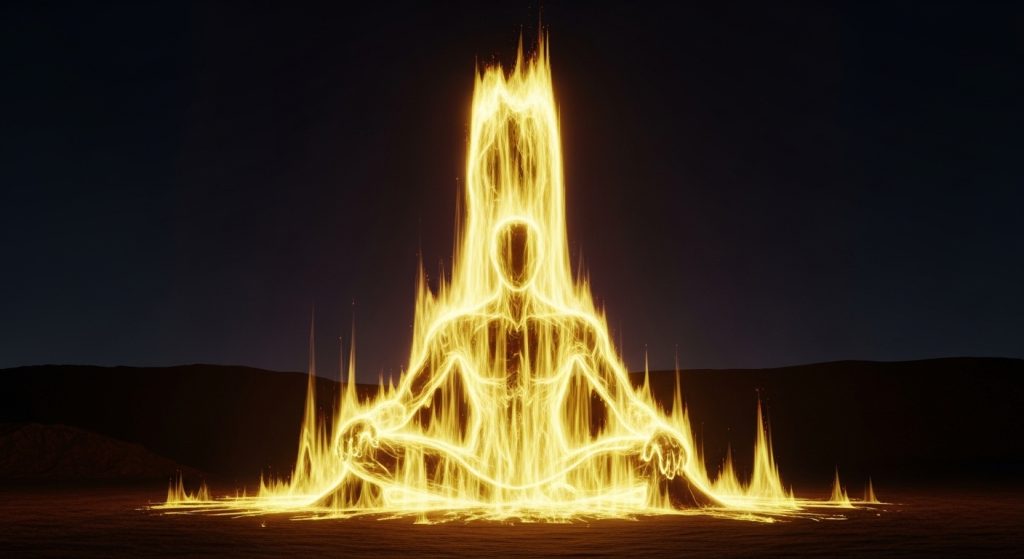
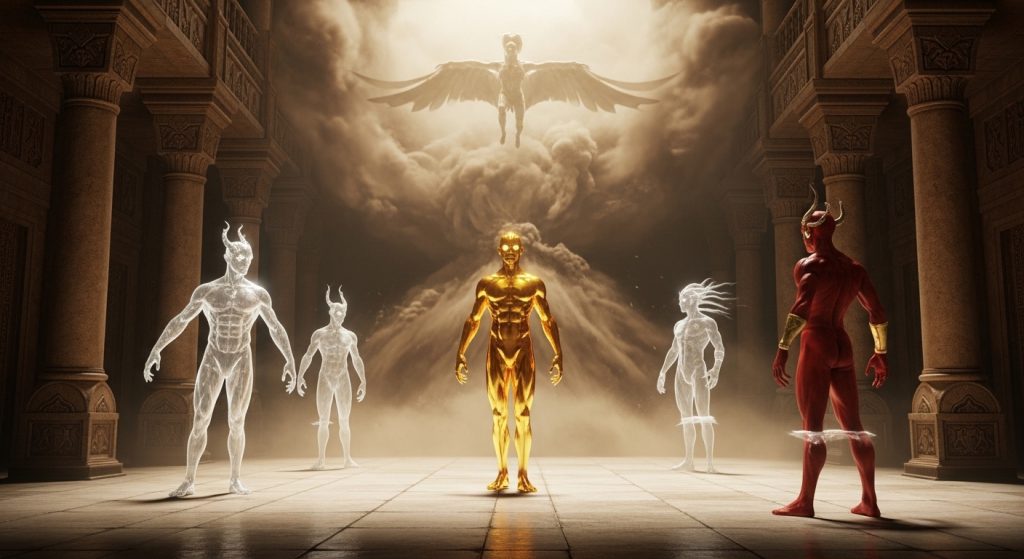
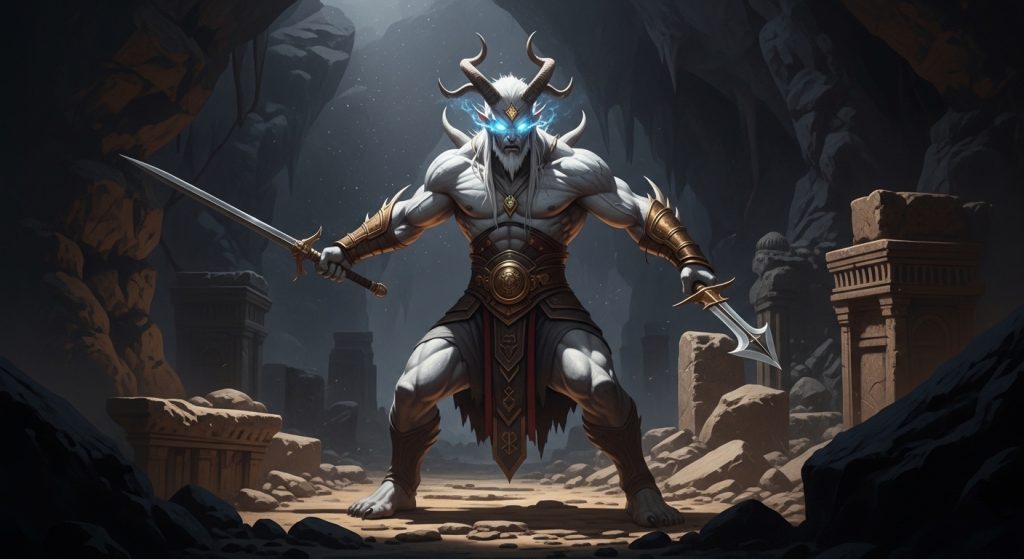
Nor does an illustration settle the question. The artwork in this article is conceptual: it helps distinguish sections and evoke the subject, but it is not evidence of what jinn look like. Readers should apply the same caution to dramatic online images or videos whose origin and context are unknown.

Folklore is not the same kind of source as scripture
Stories about invisible beings appear in many bodies of literature. Comparing stories can be useful, but a similar motif does not establish that the traditions describe the same being or that one event actually occurred. A responsible comparison identifies the work, its date, its cultural setting and the passage being discussed.
Names, colours, kingdoms and detailed prehuman timelines attributed to jinn are sometimes repeated without a traceable edition or passage. This article does not treat those details as established Islamic teaching. An old book can establish that a story circulated; its age alone cannot verify the events within the story.
It is also important not to replace a community’s own terminology with an outsider’s label. Describing every figure in another religion or Indigenous tradition as a shaytan would obscure what that community actually believes. Comparisons require evidence and respectful description, not a universal list assembled from superficially similar characters.
Claims about fortune-telling and personal experiences
In Sahih al-Bukhari 5762, a report from Aisha answers a question about fortune-tellers sometimes saying something that turns out to be true. The response warns that falsehood is mixed with such information. It should not be presented as an endorsement of fortune-telling or as proof that a particular modern claimant has supernatural access.
A personal experience may be meaningful to the person describing it without being independently verifiable. Responsible reporting distinguishes an experience from the explanation attached to it. An unexplained event is not, by that fact alone, evidence that all ordinary explanations have been ruled out.
How to read a claim about jinn carefully
- Identify the source. Is it a Quranic verse, a named hadith, a commentary, a literary work or a personal account?
- Check the actual wording. Does the source state the claim, or has the retelling added a name, number, motive or physical description?
- Keep the context. A report about one event does not necessarily establish a rule about every person, animal or unexplained incident.
- State the limit. Religious belief, historical evidence and a modern observation answer different questions. None should silently substitute for another.
The main lesson is precision. Islamic sources distinguish jinn from angels, acknowledge moral differences among jinn and describe limits on their knowledge. A useful article can explain those teachings without filling the gaps with frightening details that its sources do not establish.
For the related distinction between these beings, read Angels in Islam: Belief, Roles and Scriptural Sources.
Sources and editorial note
The links beside each passage lead to the Quran or the identified hadith report. English explanations above are paraphrases, not a replacement for the Arabic text or a specialist commentary. Hadith numbering follows the linked editions.
Editorial revision, 5 September 2026: This article was substantially revised to remove unverified anecdotes, unsupported cross-cultural comparisons and speculative physical descriptions, and to distinguish scriptural accounts from later interpretation.
