
Close Menu
  • Home
  • Islamic History
    • Life of Prophet Muhammad
    • Abu Bakr al-Siddiq
    • Umar ibn al-Khattab
  • Companions
  • Series
    • 40,000 Years of Knowledge
    • The Secrets of the Universe
    • Amazon Series
  • About
  • Contact
  • Series Reading Guide
What's Hot

Ibrahim and Nimrod in Islam: What the Quran Says—and What History Cannot Confirm

2 October 2026

Prophet Ibrahim and Ancient Mesopotamia: Quran, Sumer and the Limits of History

30 September 2026

Thamud and Prophet Salih: The Quranic Account and the Archaeology of al-Hijr

28 September 2026
YouTube
YouTube Facebook
Religion Essence Hub
  • Home
  • Islamic History
    • Life of Prophet Muhammad
    • Abu Bakr al-Siddiq
    • Umar ibn al-Khattab
  • Companions
  • Series
    • 40,000 Years of Knowledge
    • The Secrets of the Universe
    • Amazon Series
  • About
  • Contact
  • Series Reading Guide
Religion Essence Hub
Home » Part 38 – Madinah’s Jewish Communities and Early Political Tensions
Life of Prophet Muhammad (PBUH)

Part 38 – Madinah’s Jewish Communities and Early Political Tensions

Religion Essence Hub Editorial TeamBy Religion Essence Hub Editorial Team19 February 2025Updated:6 September 2026No Comments3 Mins Read2 Views
Facebook Twitter Pinterest Telegram LinkedIn Tumblr Copy Link Email
Follow Us
Google News Flipboard
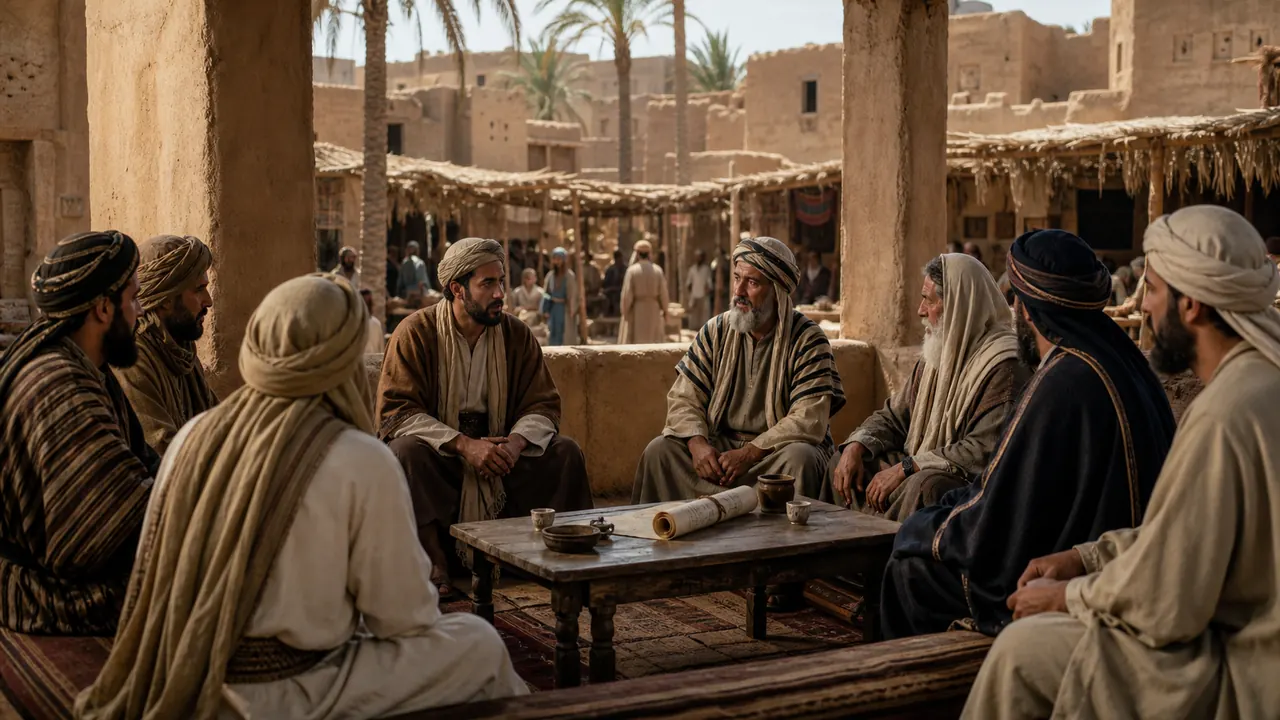
A council discussing early political tensions in Medina
Share
Facebook Twitter LinkedIn Pinterest Email Copy Link

Source note: Jewish residents of Madinah were not one unified political actor. This article distinguishes named clans, particular conflicts and later historical reports rather than assigning collective guilt to Jews.

A religiously diverse oasis

When the Prophet Muhammad migrated to Yathrib, the oasis included Arab clans, Jewish clans and people following other religious practices. The Jewish communities had their own alliances, livelihoods and internal leadership. They cannot accurately be described as one ethnic or ideological “enemy.”

Agreements and changing alliances

The text commonly called the Charter of Madinah preserves arrangements for mutual security, dispute resolution and the responsibilities of named groups. Historians debate the compilation and date of individual clauses, but the document is important evidence that political cooperation could cross religious boundaries.

Relations changed as Madinah became involved in war with Quraysh. Conflicts later developed with Banu Qaynuqa, Banu Nadir and Banu Qurayza at different times and under different circumstances. Combining their stories into a single permanent Jewish conspiracy is both historically misleading and religiously derogatory.

Scripture and particular disputes

The Quran sometimes addresses “People of the Book” in criticism and sometimes in praise. Quran 3:113–115 explicitly says they are not all alike. Any article using critical verses must preserve that distinction and explain the immediate subject rather than treating the verses as descriptions of every Jewish or Christian person.

Quran 5:8 commands believers not to let hostility toward a people make them abandon justice. That principle is especially relevant when writing about communities involved in conflict.

After Badr

Badr altered the political balance in Madinah and increased pressure on existing agreements. Later biographies describe disputes and provocative acts around the Banu Qaynuqa conflict, but the exact initiating episode is not equally established in authenticated sources. It should be reported as later narrative, not unquestioned fact.

Standards for the rest of the series

  • Name the specific clan and event.
  • Separate Quran, authenticated hadith and later chronicles.
  • Avoid theories about an entire religion or ethnicity.
  • Describe violence and displacement without celebration.

Madinah’s history includes cooperation, competition and conflict. Accuracy requires preserving that complexity and refusing language that turns a political opponent into a timeless religious stereotype.

Sources

  • Quran 3:113–115 and Quran 5:8.
  • Encyclopaedia Britannica: Muhammad for the general Medinan chronology.

Continue the series

← PreviousAll partsNext →

Blog Life of Prophet Muhammad (PBUH)
Follow on Google News Follow on Flipboard
Share. Facebook Twitter Pinterest LinkedIn Telegram Email Copy Link
Religion Essence Hub logo
Religion Essence Hub Editorial Team
  • Website

The Religion Essence Hub Editorial Team researches, reviews and updates articles about religion, history, beliefs and culture.

Related Posts

Part 11 – Ridicule, Accusations and Demands for Signs

27 August 2026

Part 10 – Quraysh’s Objections and Attempts at Compromise

27 August 2026

Part 9 – The Warning at Mount Safa and Abu Lahab’s Response

27 August 2026

Comments are closed.

Top Posts

Part 2 – Shepherding as a Metaphor for Prophethood

19 August 202446 Views

Part 4 – Hanifs: Monotheism in Pre-Islamic Arabia

19 August 202436 Views

Part 6 – The First Revelation in the Cave of Hira

4 September 202429 Views

Part 3 – Prophet Muhammad’s Marriage to Khadijah: Partnership, Sources and Context

19 August 202424 Views
Don't Miss
40,000 Years of Knowledge

Ibrahim and Nimrod in Islam: What the Quran Says—and What History Cannot Confirm

2 October 20268 Mins Read1 Views

The Quranic debate between Ibrahim and an unnamed ruler, the later identification with Nimrod, and why claims connecting him to Sargon of Akkad remain unproven.

Prophet Ibrahim and Ancient Mesopotamia: Quran, Sumer and the Limits of History

30 September 2026

Thamud and Prophet Salih: The Quranic Account and the Archaeology of al-Hijr

28 September 2026

Aad, Iram and Prophet Hud: What the Quran and Archaeology Show

25 September 2026
About Religion Essence Hub

Religion Essence Hub publishes accessible articles about religion, history, beliefs, scripture and culture. We explain complex topics clearly and responsibly. Email: contact@religionessencehub.com

Facebook YouTube
Our Picks

Ibrahim and Nimrod in Islam: What the Quran Says—and What History Cannot Confirm

2 October 2026

Prophet Ibrahim and Ancient Mesopotamia: Quran, Sumer and the Limits of History

30 September 2026

Thamud and Prophet Salih: The Quranic Account and the Archaeology of al-Hijr

28 September 2026
Most Popular

Prophet Ibrahim and Ancient Mesopotamia: Quran, Sumer and the Limits of History

30 September 20261 Views

Ibrahim and Nimrod in Islam: What the Quran Says—and What History Cannot Confirm

2 October 20261 Views

Part 38 – Madinah’s Jewish Communities and Early Political Tensions

19 February 20252 Views
  • Home
  • Privacy Policy
  • About Us
  • Corrections Policy
  • Disclaimer
  • Editorial Policy
  • Editorial Team
  • Get In Touch
  • Terms of Use
  • Cookie Policy (UK)
© 2026 Religion Essence Hub. All rights reserved.

Type above and press Enter to search. Press Esc to cancel.

Manage Consent
To provide the best experiences, we use technologies like cookies to store and/or access device information. Consenting to these technologies will allow us to process data such as browsing behavior or unique IDs on this site. Not consenting or withdrawing consent, may adversely affect certain features and functions.
Functional Always active
The technical storage or access is strictly necessary for the legitimate purpose of enabling the use of a specific service explicitly requested by the subscriber or user, or for the sole purpose of carrying out the transmission of a communication over an electronic communications network.
Preferences
The technical storage or access is necessary for the legitimate purpose of storing preferences that are not requested by the subscriber or user.
Statistics
The technical storage or access that is used exclusively for statistical purposes. The technical storage or access that is used exclusively for anonymous statistical purposes. Without a subpoena, voluntary compliance on the part of your Internet Service Provider, or additional records from a third party, information stored or retrieved for this purpose alone cannot usually be used to identify you.
Marketing
The technical storage or access is required to create user profiles to send advertising, or to track the user on a website or across several websites for similar marketing purposes.
  • Manage options
  • Manage services
  • Manage {vendor_count} vendors
  • Read more about these purposes
View preferences
  • {title}
  • {title}
  • {title}