
Editorial note: This revised article separates Quranic wording, later interpretation and modern scientific ideas. Speculative comparisons are identified as speculation and are not presented as established doctrine or scientific proof.
What does “Alamin” mean?
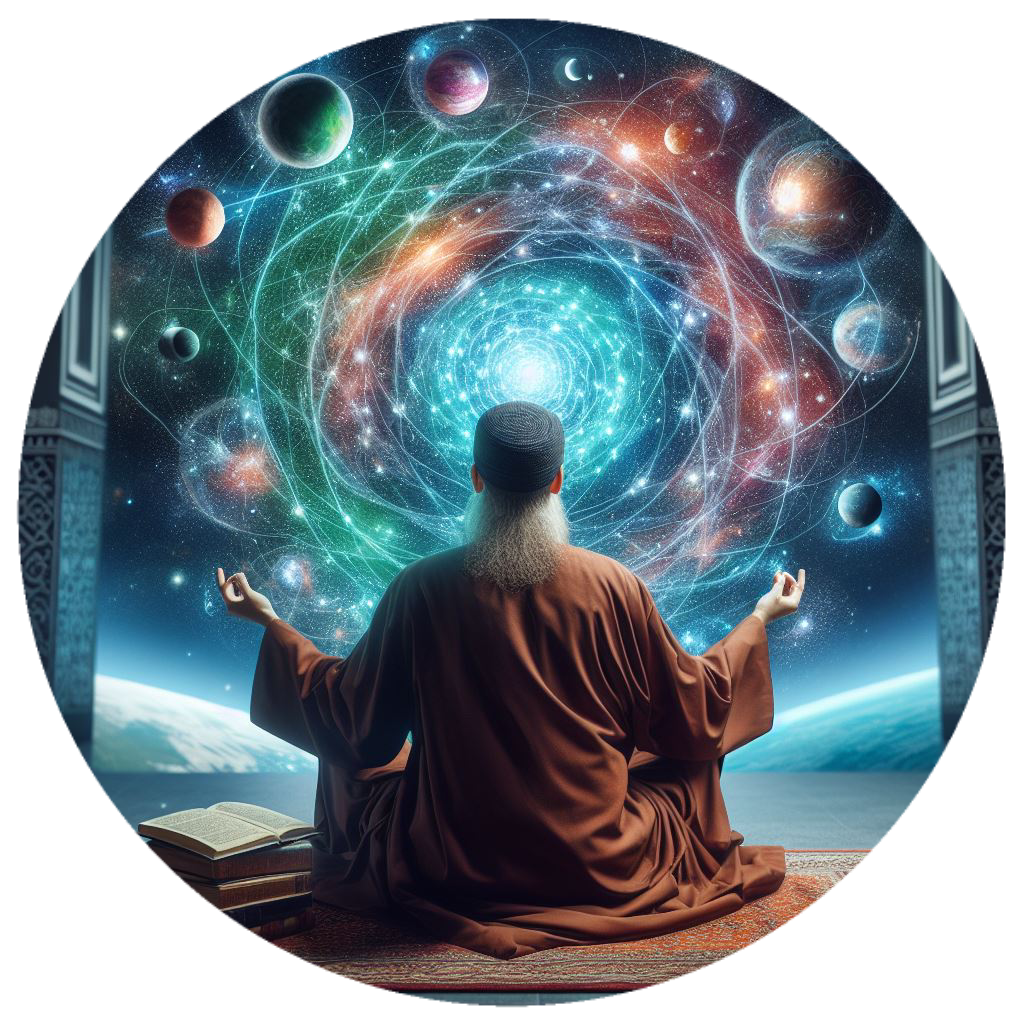
The phrase Rabb al-‘alamin appears at the beginning of Surah al-Fatihah and is commonly translated as “Lord of the worlds.” In Quranic usage, the plural communicates the breadth of creation under God’s authority. The word does not, by itself, supply a scientific map of multiple universes or a numbered catalogue of dimensions.
Classical commentators discussed the expression in several ways. Some treated “worlds” as the different classes of created beings—humanity, jinn, angels, animals and other parts of creation. Others emphasized that everything other than the Creator belongs to the created order. These explanations are theological and linguistic; they should not be converted into precise astronomical claims without additional evidence.

What the Quran establishes
The Quran repeatedly describes God as the creator and sustainer of the heavens, the earth and all that lies between them. It also speaks of creatures that human beings do not ordinarily perceive. Those teachings establish a religious belief in a creation far larger than everyday human experience.
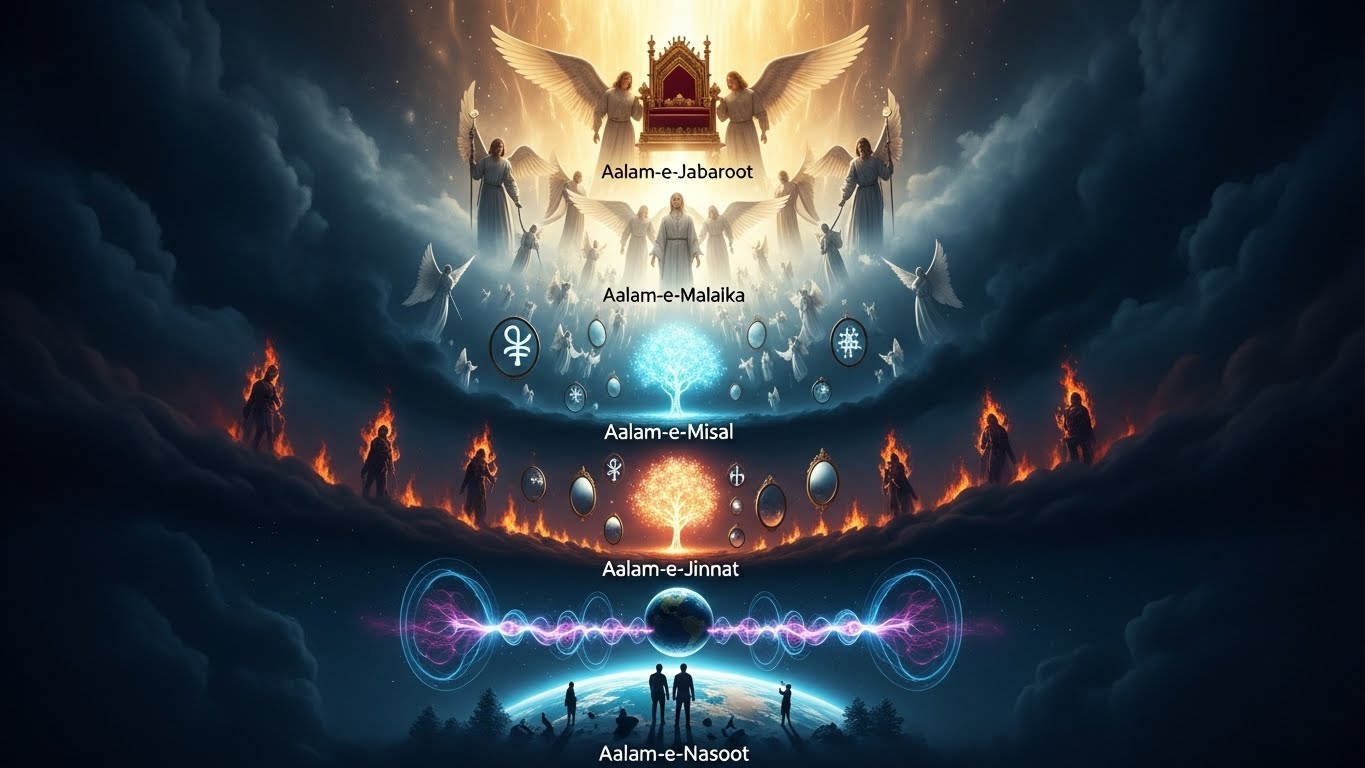
They do not establish that the word alamin means ten, eleven or eighteen thousand physical dimensions. Numbers sometimes quoted in later devotional or cosmological literature belong to particular interpretive traditions. Their chains of transmission and intended meanings must be examined before they are attributed to the Quran, the Prophet, or early authorities.
Dimensions are a scientific concept, not a translation of Alamin
In everyday physics, dimensions are coordinates used to describe position and change. Some modern mathematical theories explore additional spatial dimensions, but such models remain theoretical and are tested through physics—not through a linguistic reading of a Quranic plural. CERN describes searches for possible signatures of extra dimensions as tests of proposed models, not proof that hidden religious worlds have been discovered.
It is therefore reasonable to compare ideas at the level of metaphor, provided the limits are stated. It is not responsible to say that higher-dimensional models prove the existence of angels, jinn, the afterlife or particular spiritual realms. Religious belief and experimental science answer different kinds of questions and use different standards of evidence.
Later spiritual vocabulary
Terms such as nasut, malakut, jabarut and lahut appear in later theological, philosophical and mystical writing. Authors have used them in different ways to discuss the visible world, the angelic order, divine power or metaphysical reality. They are not a single Quranic list of separately measurable universes.
Readers should also distinguish a text’s devotional value from its historical status. A later scholar may offer a meaningful spiritual framework without claiming that it is a verse, a rigorously authenticated hadith or a laboratory finding.
A careful conclusion
“Lord of the worlds” is best read first as a comprehensive statement of divine lordship. It invites humility about the scale and variety of creation. The phrase leaves room for reflection, but it should not be used as proof for a fixed number of dimensions, inhabited planets, portals or parallel universes.
Where this series explores such comparisons, they should be understood as modern reflection rather than settled creed. The strongest approach is to identify the primary text, explain how recognized commentators read it, and clearly label any later analogy.
Selected sources
- Quran 1:2 — the phrase Rabb al-‘alamin.
- Quran 6:1 — creation of the heavens and the earth.
- Quran 51:56 — humanity and jinn in the created moral order.
- CERN: Extra dimensions, gravitons and tiny black holes — how extra dimensions are treated as testable theoretical physics.
- NASA: Visible light — the limited range of human vision, which is not itself proof of spiritual beings.
