
What does Islamic scripture mean by the seven heavens, and how does that discussion relate to the universe studied by astronomers? The questions are connected by human curiosity, but they are not answered by the same methods. A Quranic passage, an ancient creation narrative and a telescope observation each need to be understood in their own context.
This guide begins with the relevant Islamic texts, then separates them from atmospheric science and modern cosmology. Its aim is to make the distinctions clear without reducing religious belief to a scientific diagram or treating an unresolved scientific question as proof of a particular interpretation.
The seven heavens in the Quran
Quran 2:29 describes the formation of seven heavens and God’s knowledge of all things. Quran 67:3 describes seven heavens arranged one above another and directs attention to the order of creation. These passages are central to the Islamic discussion; they do not give a list of atmospheric temperatures, planetary orbits or modern galaxy names.
The distinction between a text and an interpretation matters here. Saying that the Quran speaks of seven heavens reports the text. Saying that each heaven must correspond to a particular physical layer is a further interpretation, which needs its own argument. The number seven alone does not demonstrate a correspondence with a modern classification.
Likewise, the English words sky and heaven can carry different associations. A translation should be read in the context of the passage, not treated as a reason to combine every mention of clouds, stars, rain and the unseen into one precise geographical map.
Creation, water and the divine command
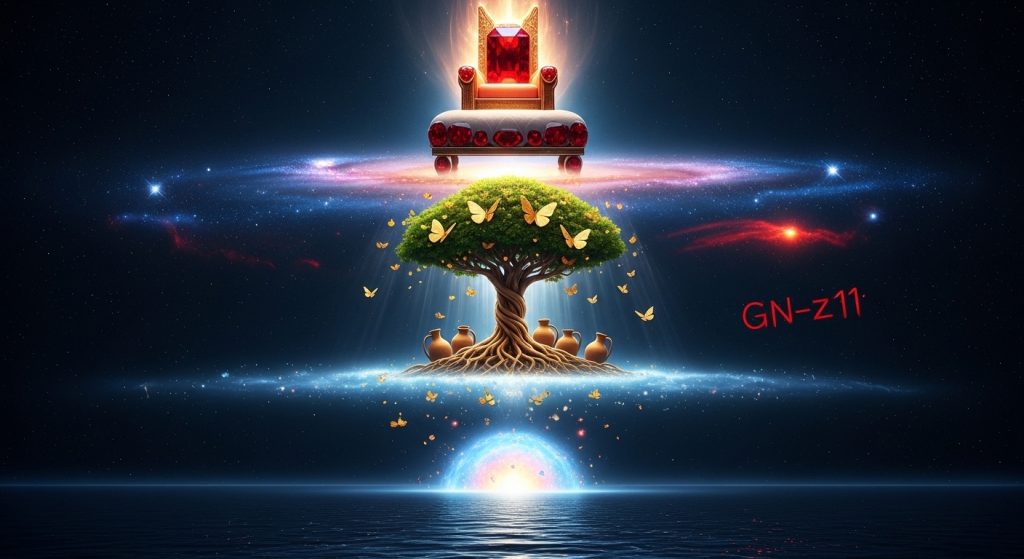
Quran 11:7 connects the creation of the heavens and earth in six days with the Throne upon water and the testing of human conduct. An account concerned only with physical dimensions would miss that ethical setting. The verse is not a laboratory description of the water or a calculation of the age of the universe.
Quran 21:30 describes the heavens and earth as joined and then separated, and connects living things with water. Readers sometimes draw a comparison with the Big Bang. Such a comparison should be labelled as interpretation: the verse does not state a measured expansion rate, a cosmic microwave background temperature or the equations of a cosmological model.
The divine command in Quran 36:82 expresses God’s power to bring about what He wills. It should not be renamed as a newly discovered force in physics. Theological language about creation and scientific language about forces perform different explanatory tasks, even when a reader reflects on both.
What the Mi’raj account adds
The narration in Sahih al-Bukhari 3207 describes the Prophet Muhammad’s ascent with Gabriel and meetings with prophets in successive heavens. In this report, the sequence includes Adam; Jesus and John; Joseph; Idris; Aaron; Moses; and Abraham. The account also connects the journey with the obligation of prayer.
This is a religious narration of a prophetic experience, not a flight plan that assigns those meetings to measured altitudes. The report should be presented as the report actually reads. Additional lists naming the material of each heaven—such as metals or precious stones—need separate, traceable sources and an assessment of those sources.
Not knowing the physical dimensions is different from finding a contradiction in the text. It means that this particular source does not supply the measurement being requested. An illustration can help a reader follow the narrative, but its layout is an artist’s arrangement rather than a verified map of the unseen.
The atmosphere is not a map of the seven heavens
NASA’s atmospheric overview describes five major layers: the troposphere, stratosphere, mesosphere, thermosphere and exosphere. They are classified by physical characteristics, including how temperature changes with altitude. Most weather occurs in the troposphere; the ozone layer is in the stratosphere.
The Karman line, conventionally placed about 100 kilometres above Earth’s surface, is a commonly used boundary for space. It is not a solid ceiling, and the atmosphere does not end abruptly there. It is also not beyond the entire thermosphere, as an earlier version of this article incorrectly suggested.
These scientific categories therefore cannot simply be relabelled as seven scriptural heavens. Doing so would confuse a model of the gases around Earth with a theological account. It would also make the proposed interpretation depend on which atmospheric layers or subdivisions a writer chose to count.
Why the sky changes colour
According to NASA’s explanation of sky colour, molecules in the atmosphere scatter shorter-wavelength blue light more strongly than longer-wavelength red light. Near sunset, sunlight passes through more air before reaching the observer, so more of the shorter-wavelength light is scattered out of the direct path.
The change does not require the atmosphere to become a fixed percentage denser each evening. The important difference is the path the light takes through it. A description of sky colour is a useful example of a testable physical explanation; it does not establish the dimensions or composition of a religious heaven.
What modern cosmology can tell us
NASA’s overview of cosmic history describes a universe about 13.8 billion years old. The cosmic microwave background is associated with the period around 380,000 years after the Big Bang, when the universe became transparent enough for light to travel freely over great distances. Stars and galaxies formed later.
Cosmologists continue to investigate the earliest stages, including inflation and what powered it. A model can be useful and supported by observations while still containing open questions. Those questions should be described as open, not filled with a theological explanation and then labelled a scientific finding.
GN-z11 offers a concrete example of looking back in time. In NASA’s 2024 report on Webb observations, the galaxy is seen as it was when the universe was about 430 million years old. It should not be described here as the most distant galaxy currently known or as an object whose light has travelled for longer than the estimated age of the universe.
The limits of an observation are important. A telescope detects radiation reaching it; it does not automatically settle a theological question about ultimate purpose. Conversely, a religious conviction does not replace the measurements needed to establish a galaxy’s age or distance.

Comparing creation accounts without flattening their differences
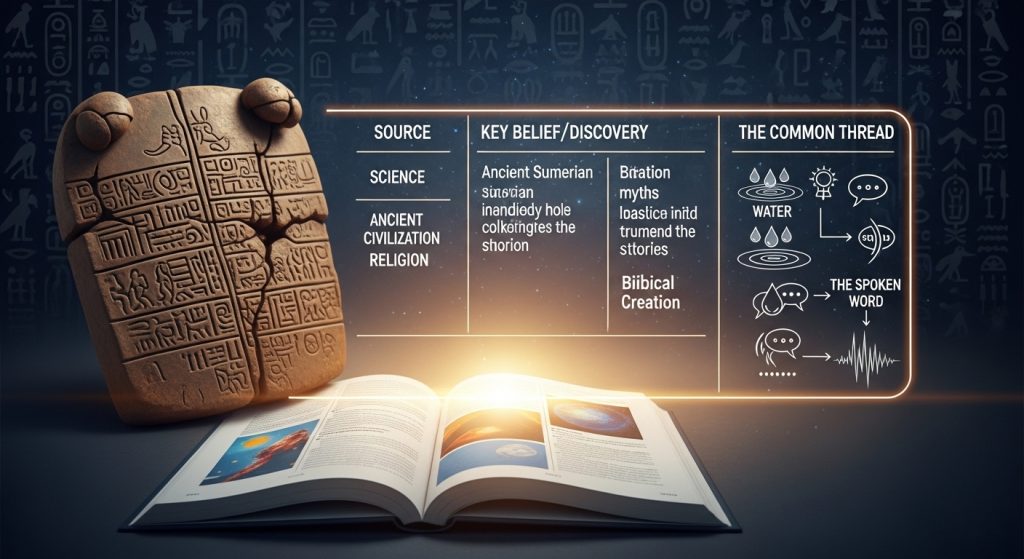
Creation narratives are not interchangeable. The Metropolitan Museum of Art’s discussion of Mesopotamian creation myths describes several traditions rather than a single uniform account. It explains how the Babylonian Enuma Elish celebrates the position of Marduk and Babylon. Its opening involves Apsu and Tiamat and the emergence of other gods, not a simple equivalent of Islamic monotheism.
Water, separation or divine speech may invite comparison, but resemblance alone does not prove direct transmission or identical belief. A meaningful comparison asks which text is being used, when it was composed, how it was translated and what its narrative is trying to explain.
It would be especially misleading to select a few familiar elements, discard the rest and then claim that every culture teaches the same six- or seven-day creation story. Respectful comparison preserves differences as well as similarities. It does not require the reader to accept every narrative as literal history.
A practical way to keep the evidence clear
- For a scriptural claim: identify the verse or report and explain its immediate context.
- For an interpretation: show what is being inferred beyond the wording and avoid presenting that inference as universal agreement.
- For a historical comparison: name the actual text and distinguish its story from evidence that an event occurred.
- For a scientific statement: use an appropriate scientific source and state the uncertainty without replacing it with speculation.
The seven heavens remain a subject of Islamic belief and interpretation. The atmosphere and observable universe remain subjects of empirical investigation. Discussing both can encourage reflection, provided the article tells the reader which kind of evidence is doing the work at each point.
Continue with Angels in Islam: Belief, Roles and Scriptural Sources, or browse the Series Reading Guide.
Sources and correction note
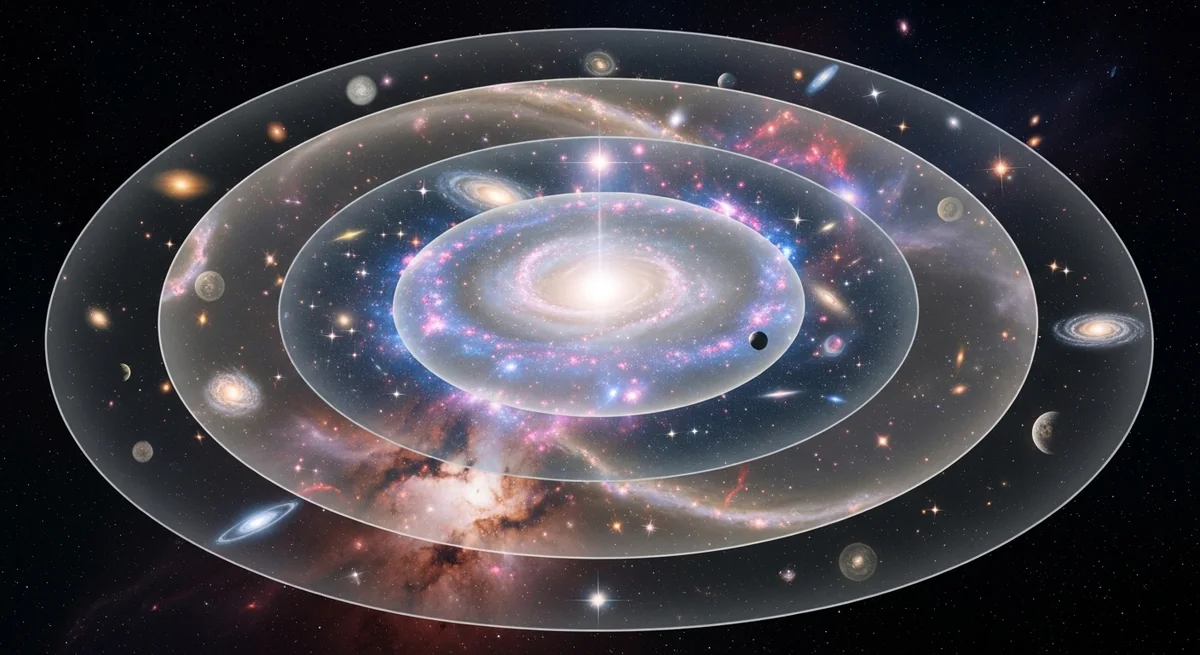
Source links appear alongside the statements they support. Scriptural explanations are paraphrases; the linked translations and hadith edition allow readers to check the wording. The existing illustrations are conceptual artwork, not observational evidence or literal diagrams of the heavens.
Correction, 5 September 2026: This article was substantially revised to correct its treatment of GN-z11, atmospheric layers, the Karman line and sunset colours. Unsupported claims that all religions share one identical creation account, and that physical science establishes a particular map of the seven heavens, were removed.
