

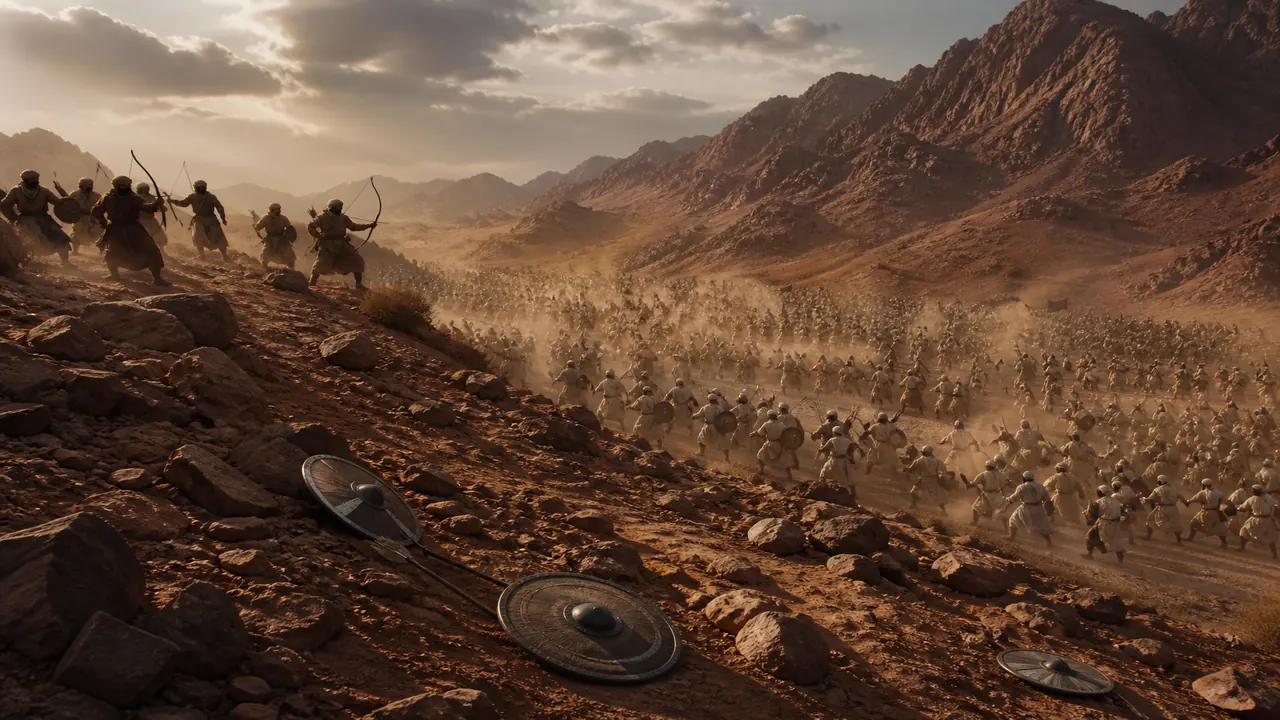
We discussed the Battle of Uhud. They came to Medina from Mecca with three thousand soldiers. Their intention was to capture Medina. 700 Mujahideen gathered at the edge of Uhud to confront the Quraysh. Instead of attacking the Muslims, the Quraysh fled in the face of fierce resistance. Allah Almighty mentions in the Quran the departure of the first group of Muslims.
And Allah had certainly fulfilled His promise to you when you were killing the enemy by His permission until [the time] when you lost courage and fell to disputing about the order [given by the Prophet] and disobeyed after He had shown you that which you love. Among you are some who desire this world, and among you are some who desire the Hereafter. Then he turned you back from them [defeated] that He might test you. And He has already forgiven you, and Allah is the possessor of bounty for the believers.
(Quran 3:152)
The situation had become such that it seemed that the Muslims would be victorious in a short time and joy had already begun in the Muslim camp.
Meanwhile, the Muslims began to collect the spoils left by the Quraysh, which led to disaster due to the wrong decisions of some of the companions. In this regard, Allah Almighty says:
(Quran 3:152)
The archers' position
This verse is talking about some companions whose wrong decisions caused the entire Muslim army to face a major disaster. These companions were the archers whom the Prophet (peace be upon him) had given strict orders to stay on the mountain. But when they saw that the warriors below had begun collecting the spoils of war, they too became eager to come down. But their leader said, “Have you forgotten the command of the Prophet (peace be upon him)?” We cannot go down until he gives us permission. Then they said the war was over and 40 out of 50 people came down.
On the other hand, one of the enemy forces had not yet participated in the battle, his name was Khalid bin Walid. Abu Jahl noticed this weakness of the Muslims and took advantage of the opportunity. They attacked the Muslims from the rear with 150 cavalry. Suddenly, the Muslim army was devastated by the attack, and those who were fleeing, that is, the Quraysh, turned back and saw this scene, rejoining the battle. The Muslim army was stunned by the attack from two sides.
On Khalid bin Walid’s left were the companions who were busy collecting the spoils of war, and on his right was the camp of the Prophet (peace and blessings of Allaah be upon him). Taking this opportunity, the enemy forces began to massacre the Muslims. The Muslim army was so stunned that they could not distinguish between friend and foe.
The fighting around the Prophet
The Quraysh intended to kill the Prophet Muhammad (peace be upon him). While fighting, they came to the Prophet Muhammad’s tent. At that time, only nine companions surrounded the camp of the Prophet (peace and blessings of Allaah be upon him). The Prophet Muhammad (peace be upon him) decided to help Muslims even if it meant risking his own life. The Messenger of Allah (peace and blessings of Allah be upon him) then shouted, “O people of Allah, come here!” And as it happened, the Quraysh realized his position and attacked him.
Utbah threw a stone at the Prophet and cut his lip. He then shot the Prophet with an arrow, and the blow broke the Prophet’s front tooth. When the Muslims were in a devastated state, the Quraysh killed the companions of the Prophet.
Allah Almighty mentions in the Quran the story of the Prophet’s companion Musab, just before his death.
Muhammad is not but a messenger. [Other] messengers have passed on before him. So if he was to die or be killed, would you turn back on your heels [to unbelief]? And he who turns back on his heels will never harm Allah at all; but Allah will reward the grateful.
(Quran 3:144)
Hazrat Musayyib’s appearance was somewhat similar to the Prophet Muhammad (peace be upon him), so after he was killed, rumors spread that the Prophet Muhammad (peace be upon him) had been killed.
When the Muslims heard this rumor, they were shocked and, throwing away their weapons, began to flee towards Medina. But some of the companions did not flee, but rather they fought bravely.
Quranic reflection on the setback
Allah, may He be pleased with him, says in the Quran that:
Among the believers are men true to what they promised Allah. Among them is he who has fulfilled his vow [to the death], and among them is he who awaits [his chance]. And they did not alter [the terms of their commitment] by any alteration.
(Quran 33:23)
These companions went to the Prophet while fighting and saw that the Prophet was alive and this news reached the other Muslim who were fighting.
They regained their courage, and the Messenger of Allah (peace and blessings of Allah be upon him) said, “Whoever is martyred with me today will enter Paradise.”
Hearing this call, an Ansar came and, running after the arrow, was martyred. Thus, one by one, seven companions were martyred to protect the Prophet Muhammad (peace be upon him).
One by one, seven Ansar men died at the feet of the Prophet. Seeing the extraordinary prophethood of Talha (may Allah be pleased with him), the Prophet said that Talha had taken a place in Paradise. Talha (may Allah be pleased with him) endured at least 35 blows to protect the Prophet. The Kurds did not dare to attack Medina. They wanted to weaken the power of the Muslims by carrying out such an attack.
Then the Quraysh invited the Muslims to fight again in the Battle of Badr the following year, and the Muslims accepted, and with that, the Battle of Uahu came to an end. Let’s find out what Allah says about this in the Quran.
Forgiveness after the setback
Indeed, those of you who turned back on the day the two armies met, it was Satan who caused them to slip because of some [blame] they had earned. But Allah has already forgiven them. Indeed, Allah is Forgiving and Forbearing.
(Quran 3:155)
That is, the reason for the defeat of the victory in the Battle of Uhud was Satan, and Allah also made the hypocrites’ faces clear. In this regard, he said that:
(Quran 3:152)
Allah tested the Muslims with victory in the Battle of Badr and with defeat in the Battle of Uhud. Even if the battle was over, the Prophet was not sure, and what is to be expected is that although the Quraysh were returning to Mecca, they changed their positions along the way. Abu Jahl’s provocative words caused the Quraysh to attempt to attack Medina again.
The Muslims came out with their wounded bodies and pitched their tents at a place called Amara Asar. The Quraysh are looking at them and are surprised to think that these are the same people we defeated yesterday. Finally, Abu Sufyan decided to return to Mecca, but none of his threats broke the morale of the Muslims.
Responding after injury
Those [believers] who responded to Allah and the Messenger after injury had struck them. For those who did good among them and feared Allah is a great reward. Those to whom hypocrites said, “Indeed, the people have gathered against you, so fear them.” But it [merely] increased them in faith, and they said, “Sufficient for us is Allah, and [He is] the best Disposer of affairs.” So they returned with favor from Allah and bounty, no harm having touched them. And they pursued the pleasure of Allah, and Allah is the possessor of great bounty. That is only Satan who frightens [you] of his supporters. So fear them not, but fear Me, if you are [indeed] believers.
(Quran 3:172-175)
The Prophet always cared for his companions like his own children and always thought about them. The Battle of Uhud was a painful chapter for the Muslims, but their faith was not destroyed.
Sources and further reading
- Quran 3:121–175 — Uhud and its lessons
- Sahih al-Bukhari 4043–4044 — the archers and the battlefield reversal
- Sahih al-Bukhari 4075 — treatment of the Prophet’s wounds
