

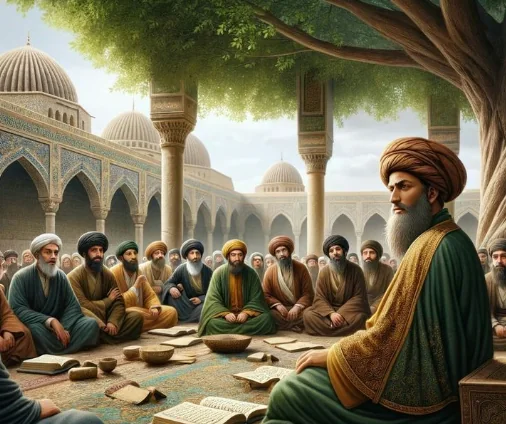
The Prophet Muhammad’s migration to Medina, known as the Hijra, brought the Meccan period of his mission to a close and opened a new stage of communal life. It was a journey made under threat, supported by careful preparation and the work of several trusted people.
The Quran and hadith accounts preserve the central story. They also help distinguish the journey itself from later additions that are often repeated alongside it.
Opposition and departure
Quran 8:30 recalls plans to restrain, kill or expel the Prophet and contrasts those plans with God’s purpose. The verse establishes the threat without giving a transcript of a council meeting or an exact list of men assigned to an attack.
Later biographies give a fuller account of the plot and of Ali remaining behind. Such details belong to that biographical tradition. They should not be mistaken for wording found in the Quranic verse itself.
The danger explains why departure required discretion. It also helps readers understand the importance of the welcome already offered by the Ansar: the destination was a community prepared to receive him, not an arbitrary place on a map.
Abu Bakr’s household prepares
Aisha describes the Prophet visiting Abu Bakr at an unusual hour and telling him that permission to leave had been granted. Abu Bakr asked to accompany him. Camels had been prepared, and the Prophet agreed to take one with payment. Food was packed for the journey; Asma used part of her waistband to secure the provision bag. See Sahih al-Bukhari 3905.
This scene combines a major decision with ordinary tasks. Transport, food and discretion mattered. The participation of the household also reminds us that assistance did not always take the form of public leadership or direct confrontation.
Three nights at the cave
The same narration places the Prophet and Abu Bakr in the cave on Mount Thawr for three nights. Abdullah ibn Abi Bakr brought news, while Amir ibn Fuhayra provided milk from the flock. An experienced guide, who did not share their religion, was trusted to bring the camels and lead the onward journey along a coastal route.
The account describes coordinated roles rather than an entirely unsupported journey. Selecting a skilled guide also shows that competence and trustworthiness could be recognized across religious differences.
Reassurance in danger
Abu Bakr recalls how close the pursuers came. He feared that someone looking down would see them. The Prophet reassured him of God’s support. This brief exchange appears in Sahih al-Bukhari 3653.
Quran 9:40 also recalls the two in the cave, the reassurance offered to the companion and divine help. Its emphasis is on support in a moment of vulnerability. It does not say that believing people never experience fear or never need practical precautions.
Read alongside the preparations, this passage presents trust and action together. The travellers had made arrangements, but they could not control every possible danger. The narrative’s religious meaning does not depend on pretending that the risk was unreal.
Does the Quran describe a spider’s web at the cave?
No. The familiar spider-web story is not narrated in Quran 9:40. Another verse, Quran 29:41, uses a spider’s home as a comparison for relying on protectors besides God. It is not an account of the migration.
Stories about a web or other events at the cave require examination of their own transmitted reports. A verse mentioning a spider cannot authenticate them merely because it contains the same animal. The cave narrative in the sources cited here is meaningful without adding details those texts do not supply.
Arrival and a new stage
Al-Bara ibn Azib remembers the joy in Medina when the Prophet arrived. His account also recalls earlier companions teaching the Quran there. This sequence, preserved in Sahih al-Bukhari 3925, connects migration with a community that had already begun learning and preparing.
The Hijra would later become the reference point for Muslim year numbering. Sahih al-Bukhari 3934 identifies the arrival in Medina as the event from which the companions reckoned. That does not mean the journey occurred on the first day of Muharram or that people previously lacked calendars.
What the journey teaches
The migration brings together planning, companionship, household work and religious trust. It is not a lesson in refusing help: receiving help responsibly is visible throughout the account.
Its outcome also points beyond survival. The journey made possible a new setting for worship, learning and shared responsibilities. The next episode turns from the road to the city that became Medina.
Sources and further reading
- Quran 8:30: the threat against the Prophet
- Bukhari 3905: preparations, provisions and the cave
- Bukhari 3653: Abu Bakr’s concern and reassurance
- Quran 9:40: the two in the cave
- Quran 29:41: the separate comparison with a spider’s home
- Bukhari 3925: learning and the welcome in Medina
- Bukhari 3934: the migration as a reference for years
