
Close Menu
  • Home
  • Islamic History
    • Life of Prophet Muhammad
    • Abu Bakr al-Siddiq
    • Umar ibn al-Khattab
  • Companions
  • Series
    • 40,000 Years of Knowledge
    • The Secrets of the Universe
    • Amazon Series
  • About
  • Contact
  • Series Reading Guide
What's Hot

Ibrahim and Nimrod in Islam: What the Quran Says—and What History Cannot Confirm

2 October 2026

Prophet Ibrahim and Ancient Mesopotamia: Quran, Sumer and the Limits of History

30 September 2026

Thamud and Prophet Salih: The Quranic Account and the Archaeology of al-Hijr

28 September 2026
YouTube
YouTube Facebook
Religion Essence Hub
  • Home
  • Islamic History
    • Life of Prophet Muhammad
    • Abu Bakr al-Siddiq
    • Umar ibn al-Khattab
  • Companions
  • Series
    • 40,000 Years of Knowledge
    • The Secrets of the Universe
    • Amazon Series
  • About
  • Contact
  • Series Reading Guide
Religion Essence Hub
Home » Part 60 – Events following the conquest of Mecca
Life of Prophet Muhammad (PBUH)

Part 60 – Events following the conquest of Mecca

Religion Essence Hub Editorial TeamBy Religion Essence Hub Editorial Team19 February 2025Updated:9 September 2026No Comments3 Mins Read9 Views
Facebook Twitter Pinterest Telegram LinkedIn Tumblr Copy Link Email
Follow Us
Google News Flipboard
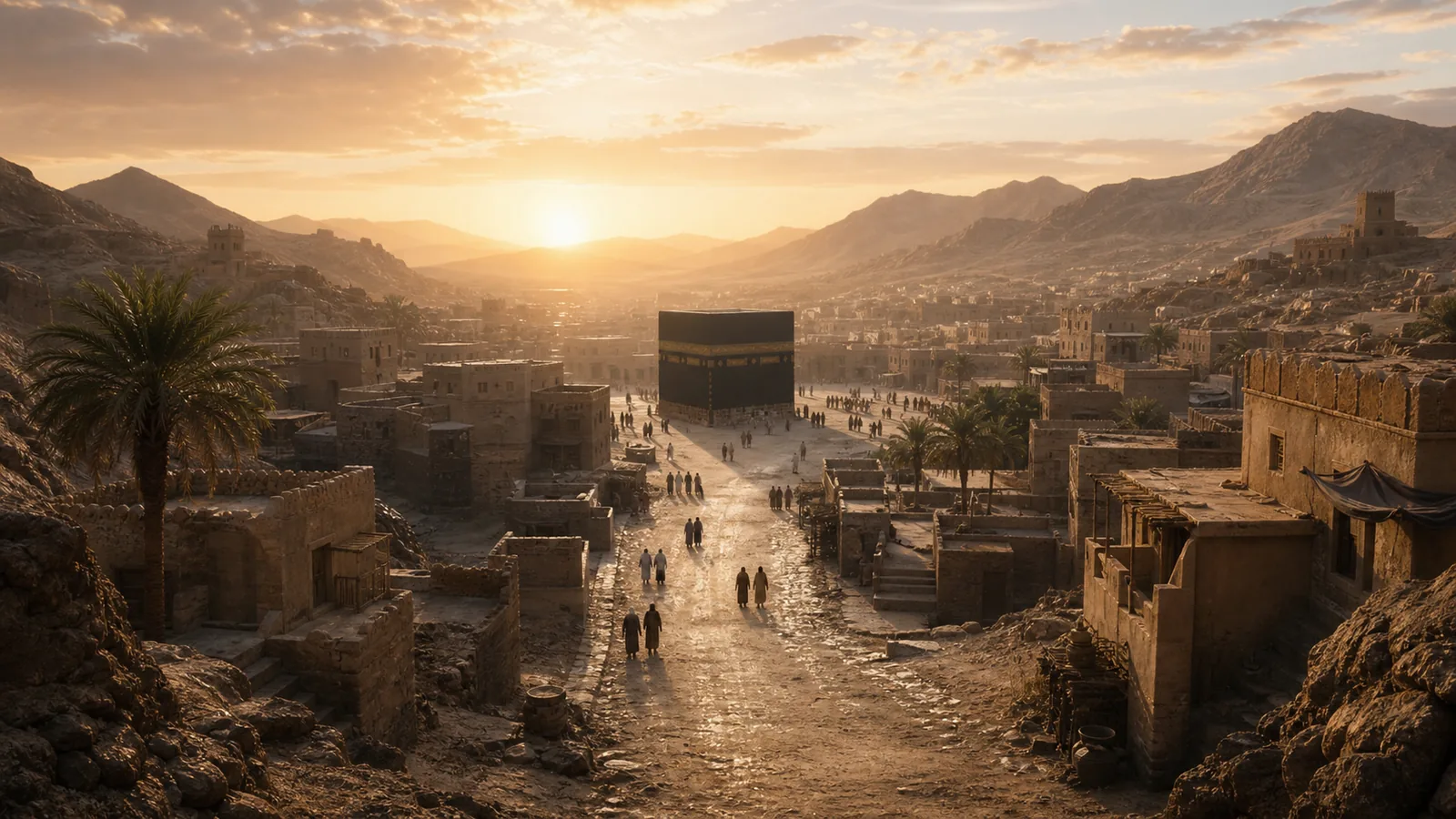
Peaceful Meccan valley following the conquest
Share
Facebook Twitter LinkedIn Pinterest Email Copy Link

The events following the conquest of Makkah involved more than a change of political authority. The Kaaba’s religious role, the position of former opponents and the Prophet Muhammad’s relationship with the Ansar all required attention. Individual responses also unfolded over time, rather than in one instant of universal agreement.

The sanctuary and Abraham’s legacy

Quran 14:37 presents Abraham’s prayer for descendants settled near the Sacred House in a valley without cultivation. Quran 2:127–129 describes Abraham and Ishmael raising the House’s foundations and praying for acceptance, guidance and a messenger among their descendants.

These passages explain why Muslim accounts place such importance on the Kaaba’s return to worship of one God. The figure named in the Quranic account is Ibrahim, or Abraham, not Imran. The verses establish the religious framework; they are not a detailed chronological record of every event after the conquest.

Former opponents were individuals

Prominent Makkans did not all respond in the same way. Some had negotiated with the Prophet, some had fought against him, and some reassessed their position as circumstances changed. Their stories should therefore be told by name and source, without assigning one motive to an entire population.

Suhayl ibn Amr, for example, appears as Quraysh’s negotiator in Bukhari’s account of Hudaybiyyah. That earlier role helps explain his prominence in later seerah narratives about Makkah. However, the treaty report does not authenticate every conversation subsequently attributed to him at the conquest.

Safwan’s changing attitude

A more directly documented personal response appears in Sahih Muslim 2313. Safwan ibn Umayya recalls that the Prophet’s generosity changed his feelings from intense hostility to affection. The narration places the gifts in the sequence of the conquest and Hunayn, rather than all on the day of entry into Makkah.

Safwan’s recollection offers an individual example of reconciliation. It does not prove that every former opponent received the same gifts or followed the same path. Nor should a report about material generosity be reduced to a claim that religious conviction can simply be purchased.

Abu Bakr’s father

Sahih Muslim 2102 records the appearance of Abu Quhafa, Abu Bakr’s father, in connection with the conquest. It describes his white hair and beard. The correct name here is Abu Quhafa; the altered names found in some retellings can make readers mistake him for another person.

The brief hadith does not supply a complete dialogue about who escorted him, every family member’s emotions or the precise words of his conversion. Such additions need their own evidence. Keeping the secure core separate from later narrative detail makes the account clearer without diminishing its personal significance.

Reassurance and the next stage

Muslim 1780a records the Prophet reassuring the Ansar that he would remain bound to them. This addresses a different concern from that of the former Makkan opponents: the people who had offered him a home feared losing him after his return to his native city.

The transition therefore involved both reconciliation with some former opponents and loyalty to longstanding companions. It also remained incomplete. Hunayn followed, and its aftermath brought further questions about gifts, captives and community relations. Those events belong to the next stage of the series, not to an imagined single day on which every difficulty disappeared.

Sources and further reading

  • Quran 14:37 and 2:127–129: Abraham, Ishmael and the sanctuary.
  • Bukhari 2731–2732: Suhayl at Hudaybiyyah.
  • Muslim 2313: Safwan’s recollection.
  • Muslim 2102: Abu Quhafa; 1780a: reassurance to the Ansar.

Continue the series

← PreviousAll partsNext →

Blog Life of Prophet Muhammad (PBUH)
Follow on Google News Follow on Flipboard
Share. Facebook Twitter Pinterest LinkedIn Telegram Email Copy Link
Religion Essence Hub logo
Religion Essence Hub Editorial Team
  • Website

The Religion Essence Hub Editorial Team researches, reviews and updates articles about religion, history, beliefs and culture.

Related Posts

Part 11 – Ridicule, Accusations and Demands for Signs

27 August 2026

Part 10 – Quraysh’s Objections and Attempts at Compromise

27 August 2026

Part 9 – The Warning at Mount Safa and Abu Lahab’s Response

27 August 2026

Comments are closed.

Top Posts

Part 2 – Shepherding as a Metaphor for Prophethood

19 August 202446 Views

Part 4 – Hanifs: Monotheism in Pre-Islamic Arabia

19 August 202436 Views

Part 6 – The First Revelation in the Cave of Hira

4 September 202429 Views

Part 3 – Prophet Muhammad’s Marriage to Khadijah: Partnership, Sources and Context

19 August 202424 Views
Don't Miss
40,000 Years of Knowledge

Ibrahim and Nimrod in Islam: What the Quran Says—and What History Cannot Confirm

2 October 20268 Mins Read1 Views

The Quranic debate between Ibrahim and an unnamed ruler, the later identification with Nimrod, and why claims connecting him to Sargon of Akkad remain unproven.

Prophet Ibrahim and Ancient Mesopotamia: Quran, Sumer and the Limits of History

30 September 2026

Thamud and Prophet Salih: The Quranic Account and the Archaeology of al-Hijr

28 September 2026

Aad, Iram and Prophet Hud: What the Quran and Archaeology Show

25 September 2026
About Religion Essence Hub

Religion Essence Hub publishes accessible articles about religion, history, beliefs, scripture and culture. We explain complex topics clearly and responsibly. Email: contact@religionessencehub.com

Facebook YouTube
Our Picks

Ibrahim and Nimrod in Islam: What the Quran Says—and What History Cannot Confirm

2 October 2026

Prophet Ibrahim and Ancient Mesopotamia: Quran, Sumer and the Limits of History

30 September 2026

Thamud and Prophet Salih: The Quranic Account and the Archaeology of al-Hijr

28 September 2026
Most Popular

Prophet Ibrahim and Ancient Mesopotamia: Quran, Sumer and the Limits of History

30 September 20261 Views

Ibrahim and Nimrod in Islam: What the Quran Says—and What History Cannot Confirm

2 October 20261 Views

Part 38 – Madinah’s Jewish Communities and Early Political Tensions

19 February 20252 Views
  • Home
  • Privacy Policy
  • About Us
  • Corrections Policy
  • Disclaimer
  • Editorial Policy
  • Editorial Team
  • Get In Touch
  • Terms of Use
  • Cookie Policy (UK)
© 2026 Religion Essence Hub. All rights reserved.

Type above and press Enter to search. Press Esc to cancel.

Manage Consent
To provide the best experiences, we use technologies like cookies to store and/or access device information. Consenting to these technologies will allow us to process data such as browsing behavior or unique IDs on this site. Not consenting or withdrawing consent, may adversely affect certain features and functions.
Functional Always active
The technical storage or access is strictly necessary for the legitimate purpose of enabling the use of a specific service explicitly requested by the subscriber or user, or for the sole purpose of carrying out the transmission of a communication over an electronic communications network.
Preferences
The technical storage or access is necessary for the legitimate purpose of storing preferences that are not requested by the subscriber or user.
Statistics
The technical storage or access that is used exclusively for statistical purposes. The technical storage or access that is used exclusively for anonymous statistical purposes. Without a subpoena, voluntary compliance on the part of your Internet Service Provider, or additional records from a third party, information stored or retrieved for this purpose alone cannot usually be used to identify you.
Marketing
The technical storage or access is required to create user profiles to send advertising, or to track the user on a website or across several websites for similar marketing purposes.
  • Manage options
  • Manage services
  • Manage {vendor_count} vendors
  • Read more about these purposes
View preferences
  • {title}
  • {title}
  • {title}