

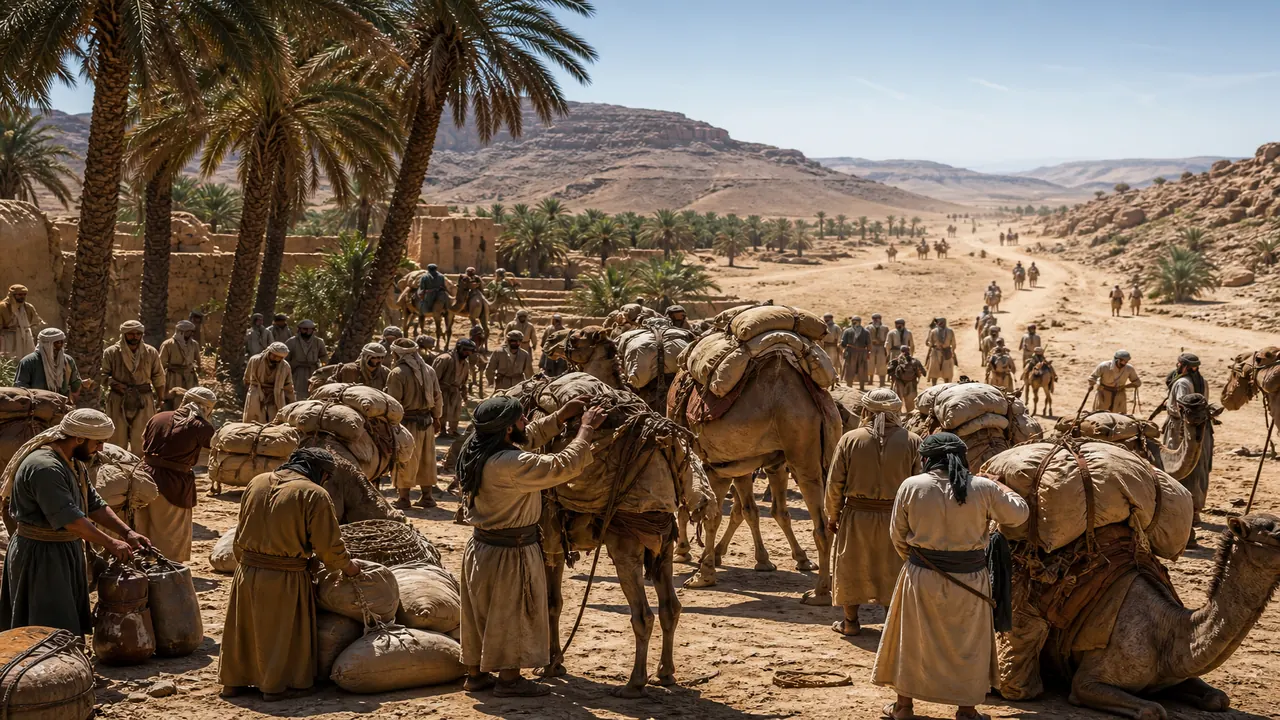
The expedition to Tabuk took the Prophet Muhammad and a large Muslim force north from Medina in 9 AH. Although often called the Battle of Tabuk, it did not culminate in a major battle with a Byzantine army. Its importance lies in the demanding preparations, the frontier setting and the questions of responsibility reflected in Surah al-Tawbah.
Why the northern frontier mattered
By this stage, the Muslim community’s position in Arabia had changed substantially. Makkah had come under its authority, while the earlier expedition to Mu’ta had brought its forces into contact with the northern borderlands. Seerah narratives describe concern about a possible Byzantine threat as part of Tabuk’s background.
Those reports should not be turned into certainty about the emperor’s private motives or the precise movements of an army that never met the Muslims in battle. Nor was al-Sham one city captured during this expedition. It was a broad historical region; the major conquests there belonged to a later period.
A destination announced in advance
Ka‘b ibn Malik’s account in Sahih al-Bukhari 4418 describes severe heat, a long journey and the prospect of a powerful opponent. Because the expedition required substantial preparation, the Prophet made the destination clear. Ka‘b also remembers the attraction of ripe fruit and shade at home.
These details explain the practical test. Leaving Medina meant organising transport, provisions and responsibilities at home, not merely expressing enthusiasm. The physical and financial burden differed from person to person. A narrative that treats everyone who stayed behind as equally able to travel misses that distinction.
Who was excused?
Quran 9:91 explicitly exempts the weak, the ill and those without resources when they are sincere. Verse 9:92 describes people who wanted to go but could not be provided with mounts. Their distress is presented sympathetically, not as evidence of weak faith.
These passages must be read alongside verses criticising avoidable reluctance. The text distinguishes unwillingness from inability. That distinction is essential to understanding the expedition fairly and prevents the misuse of the story to shame people for illness, disability or poverty.
Ali’s responsibility in Medina
Sahih al-Bukhari 4416 records the Prophet leaving Ali ibn Abi Talib behind as his deputy. When Ali questioned remaining with the households, the Prophet compared his position to Aaron’s relationship with Moses, while expressly stating that there would be no prophet after him.
The report shows that remaining in Medina could itself be an assigned responsibility. It is therefore another reason not to describe absence from the travelling force as automatically blameworthy. People had different duties, and their circumstances need to be considered individually.
What Tabuk did and did not establish
The expedition is associated in historical narratives with frontier agreements and a strengthened regional presence. It did not destroy the Byzantine Empire or begin an uninterrupted eight-hundred-year war. Those claims collapse many later conflicts into one episode.
For this series, the most useful starting point is the combination of a difficult journey and different responses to it. Quran 9:117 recalls the period as an hour of hardship and emphasises mercy towards the Prophet and those who followed him. The next article examines that Quranic perspective in more detail, including its explicit protection of people who genuinely could not participate.
Sources and further reading
- Bukhari 4418: Ka‘b’s account of the preparations.
- Bukhari 4416: Ali’s assignment.
- Quran 9:91–92: genuine inability; 9:117: hardship and mercy.
