

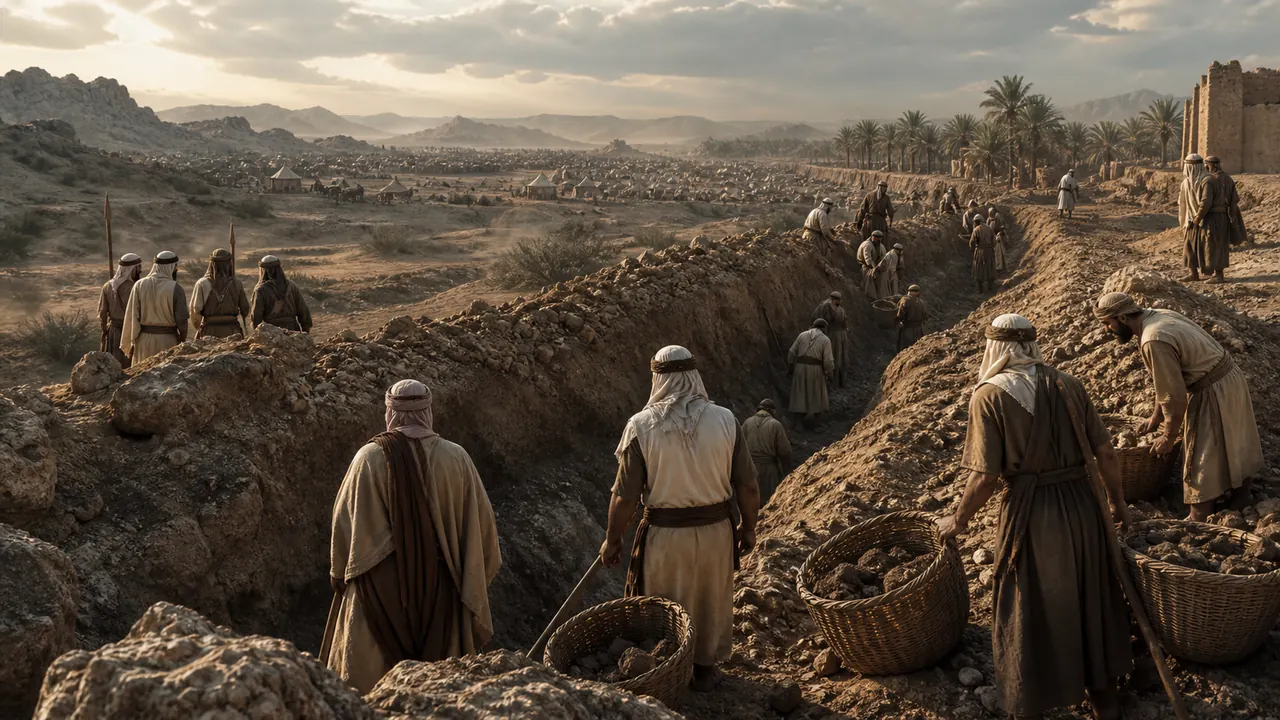
The Battle of the Trench, also called al-Khandaq or al-Ahzab, was a siege of Madinah rather than a single open-field encounter. Its story brings together the practical work of defending a settlement and the religious meaning that the Quran gives to fear, commitment and endurance. This article follows those themes while distinguishing Quranic passages and hadith from later narrative detail.
Why the campaign is called al-Ahzab
Al-Ahzab refers to the allied groups that approached Madinah. In his commentary on Quran 33:9, Ibn Kathir describes a coalition involving Quraysh under Abu Sufyan, Ghatafan and opponents from among the leaders of Banu Nadir. He gives 5 AH as the commonly accepted date while noting a different chronology. These are details of a later historical commentary, not a list supplied by the Quran itself. Read Ibn Kathir’s account.
Precision matters when describing these alliances. Banu Nadir and Banu Qurayzah were particular communities with their own leaders and circumstances. An allegation concerning a named political actor cannot be extended to every Jewish person, either then or now. Nor should everyone outside the Muslim community be treated as a participant in this campaign. Religious history is clearer when it identifies the people involved instead of assigning collective motives.
The trench as a defensive measure
Ibn Kathir’s account attributes the advice to dig a trench to Salman al-Farisi and describes the barrier separating the defenders from the approaching forces. The point of the measure was to obstruct access, not to create a water-filled well. The practical distinction is important: a barrier can reduce the places where an attacking force can advance, but it still needs people to maintain and guard it.
Exact measurements should not be repeated as established facts without an identifiable source. The earlier version of this article gave conflicting dimensions, including a claim that each team dug forty feet deep. Those figures have been removed. A clear explanation of the defensive purpose is more useful than an impressive number that the article cannot substantiate.
Shared work and the hardship of digging
The hadith record gives the work a human scale. In Sahih al-Bukhari 4104, al-Bara describes the Prophet carrying earth until he was covered in dust and praying for steadfastness. The account presents him taking part in the labour rather than directing everything from a distance.
Sahih al-Bukhari 4101 preserves Jabir’s report about hunger, a difficult rock encountered during excavation and a meal prepared by his household. The narration includes a miraculous multiplication of food. It should be identified as a miracle report within Islamic tradition, not restated as a modern engineering or nutritional calculation.
Together, these reports allow readers to discuss leadership through participation and care for others. That is an interpretation of the narrated conduct, not an additional event. Keeping this distinction makes it possible to draw lessons without inventing conversations, thoughts or measurements.
Fear and commitment in the Quranic account
Quran 33:10–11 describes the intense fear and testing experienced when the opposing forces approached. Sahih al-Bukhari 4103 records Aisha’s identification of this passage with the day of the Trench. The emotional language is part of the text’s account of the crisis; it does not support invented quotations from individual defenders.
The passage also differentiates responses to danger. Quran 33:13 criticises a group who sought to leave, claiming that their homes were exposed. Later, Quran 33:22 describes believers whose encounter with the coalition strengthened their faith and submission. The contrast is between particular responses described in the passage, not a licence to label every frightened person a hypocrite.
Reading these verses together avoids two extremes: pretending that the defenders felt no fear, or reducing the account to fear alone. The passage depicts strain alongside commitment. Its religious lesson concerns how people respond under pressure, rather than an absence of ordinary human emotion.
What can be said about the end of the siege?
Quran 33:9 presents the community’s deliverance as God’s favour and refers to wind and forces unseen by the believers. Quran 33:25 describes the opposing forces withdrawing without achieving their purpose. These verses provide the theological account of the outcome; they are not a day-by-day campaign diary.
Later histories fill out the narrative with negotiations, tensions within the coalition and individual encounters. Such details need their own attribution. This article does not retain the earlier unsupported claims about captured camel-loads of supplies or exact troop detachments. It also removes the mistaken claim that Abu Jahl crossed the trench: the hadith record places his death in the earlier Badr campaign, including Sahih al-Bukhari 3962.
Reading the episode responsibly
The strongest account does not need exaggerated dimensions, sweeping claims about religious communities or imagined dialogue. It can explain the barrier’s defensive role, the shared work described in hadith and the Quranic themes of testing and endurance. When a later source adds a detail, naming that source lets readers assess it rather than treating every retelling as equally certain.
This episode introduces the siege and its pressures. The next article in the series discusses the withdrawal of the allied forces. Use the series navigation below to continue or return to the full reading order.
Editorial correction, 5 September 2026: Revised for clearer sourcing and English. Corrected the reference to Abu Jahl, removed inconsistent trench measurements and unsupported tactical figures, and replaced generalisations about Jewish communities with discussion of specific historical actors.
