
The story of your life, mine, and all of ours. It is a story of an incredible past, present, and an amazing future. This story begins when there was nothing, and it will end when nothing remains. From the heavens to the earth, and everything in between—the stars, planets, the sun, time, and all the creations that we, in our limited language, call the Universe.
Today, we are about to begin a journey—a journey to explore this universe. Who made it? What is hidden within it? And our tiny earth, which we call the world—what has happened here and what is yet to come? This is a journey to know it all. Our journey begins 14 billion years ago. But why exactly 14 billion years?
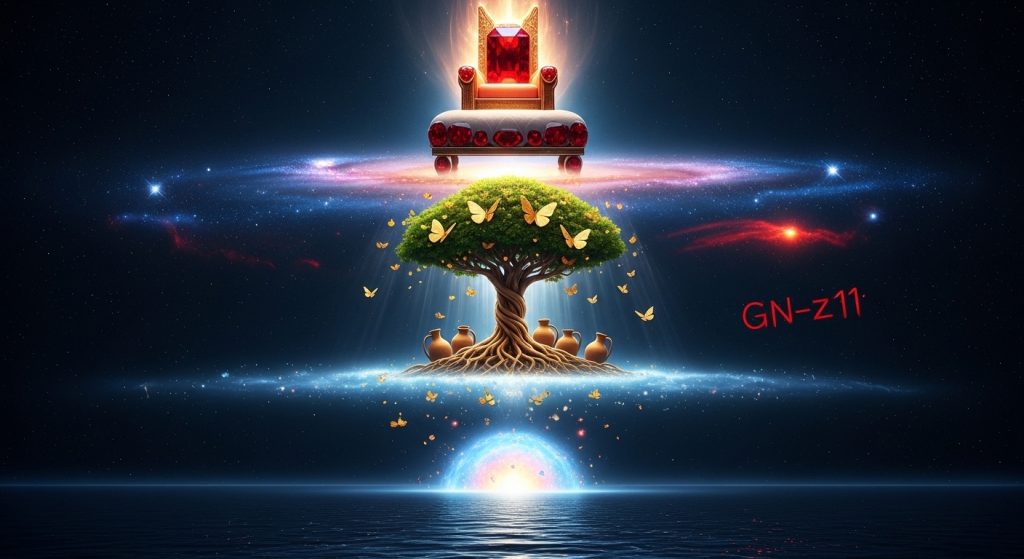
Have you ever seen this cluster of seven stars in the night sky? When I was a child, my mother told me about it; it is called Ursa Major, or in Arabic and Urdu, Dab-e-Akbar (The Great Bear). In Pakistan, this cluster is visible almost every night. If your eyes were as powerful as the world’s strongest telescope, you would see a small red spot just above the middle star. This is GN-z11, the most distant galaxy known to date. Millions of stars appear as a tiny red smudge, so far away that its light—the fastest thing in the universe—takes 14 billion years to reach us. Looking into this small, nameless part of the sky tells us that we can travel at least this far in our journey.
However, 99.9985% of these 14 billion years passed before humans even existed. We humans arrived only in the final few seconds. So, how can we witness the birth of this universe? To find out, free yourself from the prison of time and come with me as we explore the sciences that will tell us the true story of this universe.
There is a field of knowledge very common around us called Science. A branch of this science is Cosmogony—the study of the birth of the universe—which led to a discovery in 1964. This discovery was so significant that the two scientists who made it, Arno Penzias and Robert Wilson, were awarded the Nobel Prize. They discovered a type of radiation in space. But the strange thing was that this radiation wasn’t coming from a star, a planet, or any other galaxy; it was like an energy scattered everywhere in space. Wherever they looked in the universe, they felt and saw this energy. It seemed as if it had spread everywhere after a massive explosion in ancient times, like the echo of a great, powerful blast that can still be heard today. Consequently, they named it the ‘Cosmic Microwave Background.’ Today, the world knows this explosion as the ‘Big Bang’—the idea that the heavens, the earth, and everything in between were once a single entity and then separated after a powerful explosion.
But this discovery raised a massive problem called the ‘Horizon Problem.’ In some parts of the sky, we see this energy spread over a distance of 46 billion light-years, while in others, it is just 300,000 years away. There could only be one answer to this: that light travels at different speeds in different parts of the universe. This is impossible and, according to our knowledge, a violation of the laws of nature. Light has only one speed: 300,000 kilometers per second. Yet, there was no other explanation. And if it is true that light’s speed varies in some places, we must also accept that the passage of time in those places would be different from everywhere else. At this point, we realize that perhaps science can only provide knowledge up to a certain limit. This isn’t the fault of science, as we have only been familiar with its modern form for a few hundred years. Therefore, we must turn our attention to another source of knowledge—the wisdom of people from before these few hundred years. To know their knowledge, we must go into history—a very, very ancient history.
It was about 173 years ago, in 1849, in the city of Nineveh, Iraq, that an archaeologist named Austen Henry discovered several clay tablets during excavations. These were tablets on which writing was done in ancient times. Austen Henry named these tablets ‘Enuma Elish.’ It was essentially a story written on seven tablets, where people from 3,500 years ago discussed the creation of the universe. They said that when the high heavens had no name, when there was no earth below, when there was only water—no bush, no hut, no marsh—when there was no soul and no destiny written, then came the command of God.
This is very interesting. If we read this entire text, in these thousand lines, we find mention of the existence of water before the creation of anything else—that there was just water. Besides that, there is mention of an eternal garden, and finally, man and his soul, which came from the heavens. But the most interesting part of this text is a word from its Greek translation: ‘Logos,’ meaning ‘a spoken word.’ In simple terms, it says that when God wanted to create, He spoke a word. But what that word was, these tablets are silent about.
So, let’s look at an even older civilization—the people of Samara (Sumer), 5,000 years ago. Sumer was also a region in modern-day Iraq, and they wrote on their clay tablets that there was a power named ‘Nammu’ who existed forever. Nammu created the earth and heavens from a massive reservoir of water. Don’t think Sumer was a small civilization; it is the oldest civilization in history. At least a hundred inventions used in today’s world were made by the Sumerians, such as the first writing system, the first clock, the first irrigation system, and even the first use of geometry.
Let’s assume two civilizations aren’t enough, so we dig further. Ancient Egypt, 3,000 years ago, was a superpower of its time. In the inscriptions inside their pyramids, they tell of a power named ‘Nun’ who created the heavens and earth from a vast, stormy ocean of water that existed in total darkness. If we talk about the 2,300-year-old Greek civilization, they also talk about the concept of the creation of heavens and earth from a black ocean called ‘Oceanus.’
But you might think these civilizations were close to each other in distance and time, so they might have learned these concepts from one another. Therefore, let me take you to the history of other civilizations located very far away. The Aboriginal people of Australia believe that the master of all souls was a great power, and besides him, nothing else existed. He created light and gave life to the earth. Far from them, in Chinese Taoist mythology, they mention a God who separated the great waters, put the mountains in their place, and did all this through his knowledge and spoken words. In Korea’s Cheonjiwang mythology, there is also the concept that heaven and earth were once one.
Only two continents remain, so let me show you their cultures. First, the Mande of West Africa and the Yoruba mythology of Central Africa; both mythologies mention the existence of a great power that was completely alone and then created from water. The second continent is America, where there is the ancient Cherokee tribe of Native Americans. Even in the islands of Hawaii, situated in the middle of the ocean with almost no connection to the rest of the world, we find the same concepts: that heaven and earth emerged from water and everything was created over seven days. Finally, in Finland, the legend of Väinämöinen still lives, telling how he created through water.
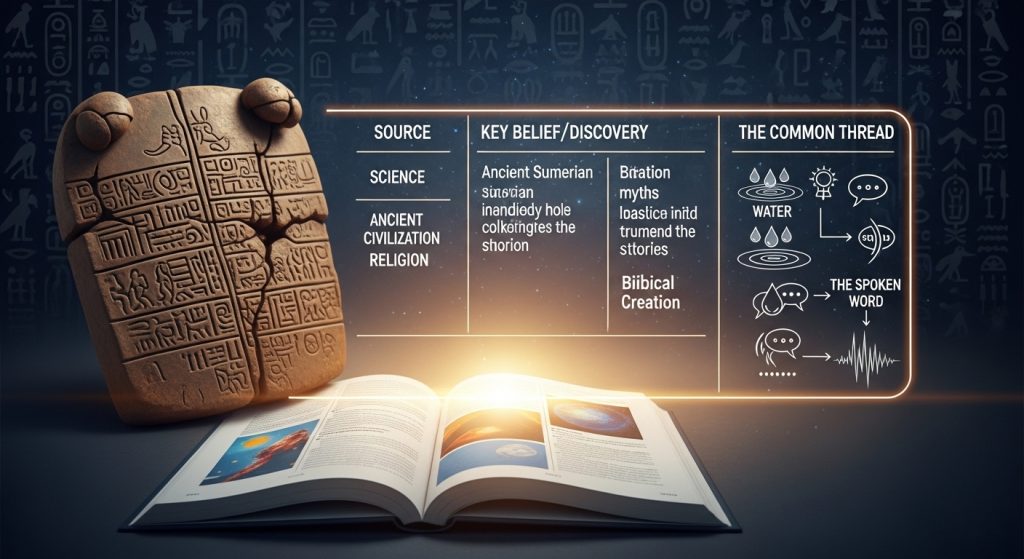
Now you understand that I am telling you about civilizations and cultures from thousands of years and thousands of miles away. Studying them was fascinating for me. But these mythologies also presented a problem: some of their details were quite ridiculous. For instance, in African culture, stories appear about the earth being bound in golden chains after creation. Or in Finland, where a crow appears in mythology to help Väinämöinen build heaven and earth. Now, you and I both know that neither is this earth bound by chains, nor was building heaven and earth a task for a crow. Therefore, I filtered out these ridiculous elements and studied what was common across all these civilizations. In every single one, the exact same core event is heard: a great power called God was all alone, nothing else existed, He created from water, and it all happened in six or seven days.
At this point, it begins to seem as if the same message was sent to all corners of the world. The messengers were different and came at different times, but the sender of the message was one. One thing becomes very clear: there is a field of knowledge even more vast than science, a knowledge that 85% of the world’s population believes in some form or another—and that knowledge is Religion. But the question arises: which religion? Currently, there are 3,000 different religions in the world, and followers of each believe theirs is the only true one. So, let’s look at some major religions and ancient philosophies.
Judaism is undoubtedly one of the oldest religions. According to them, God created the universe, but the earth is flat and stands over water, with heaven above and hell below the earth. Christianity is currently the world’s largest religion, and they also say the creator of the universe is one God. However, according to them, the sun, moon, and stars all revolve around the earth, and the entire creation happened only 6,500 years ago. Additionally, in Christianity, God rested on the seventh day. Greek philosophy, 2,500 years old, still has an influence today. The Greeks also believed in God’s creation, saying God made the universe. But they also said a goddess named Andromeda was flying through the sky, and wherever she dropped milk, a milky path was formed. Even today, our galaxy is named the ‘Milky Way’ because of this, a name given by the Greeks. Then there are Hinduism, Buddhism, and Jainism—ancient religions that say the universe has no beginning and no end; it has always been and will always be.
But wait a moment and reflect on each of these religions. If the Jewish religion is right, why is it day in Japan and night in America at the same time? On a flat earth, day and night should occur simultaneously in every country. Furthermore, we have 4,550 satellites orbiting the world, proving that the earth is not flat. If Christianity is right that everything happened only 6,000 or 6,500 years ago, the light from GN-z11 should never have reached us; it would be impossible. But most importantly, why would the God who created such a vast universe get tired after making it? He should be the All-Powerful. Also, the Christian holy book, the Bible, has fifty versions—so which version is actually true? Which one should we accept as correct? Similarly, if the Greeks were right, who dropped milk on all the other galaxies besides the Milky Way, which are actually clusters of stars upon stars? And if Hinduism, Jainism, and Buddhism are right that everything existed from the start and will always remain so, then why are all the galaxies moving away from each other? And why are they moving so fast that our own Milky Way is traveling at a speed of 2.1 million kilometers per hour? We all know that everything that travels has a beginning and an end.
Now, it feels as if the knowledge of all these religions is also limited. Yes, the original message was one, but over time, much was changed. However, there is one religion I haven’t told you about yet. This is the only religion that claims its own truth—that there is no lie in it. About 1,400 years ago, a religion emerged in Arabia called Islam. In a few years, it spread across Arabia and then to the rest of the world. Today, after Christianity, Islam is the world’s second-largest religion. In Islam, too, we find a similar account of creation—for example, in Surah Hud: ‘It is Allah who created the heavens and the earth in six days, and His Throne was upon the water.’ It seems this message in the Quran also came from the same Sender. But there is one thing that distinguishes the Quran from all other cultures, religions, and books—a claim that no one else has made. A claim found right at the beginning of the book, in Surah Al-Baqarah: ‘This is the Book about which there is no doubt.’ This is a massive claim. For those of us on a long journey to explore the universe, it was impossible to overlook this claim. It is also the only book in the world that has no second version. One book, one version, one claim. This is a claim that neither Cosmogony, nor any historical tablet, nor any culture, nor any other religion has ever made. Therefore, let’s hear the perspective on creation from the person who introduced this book—Prophet Muhammad bin Abdullah (peace be upon him)—as recorded in his collection of Hadith, Sunan Ibn Majah. Abu Razin bin ‘Amir al-Uqayli (may Allah be pleased with him) asked the Prophet (peace be upon him): ‘O Messenger of Allah, where was our Lord before creation?’ The Prophet (peace be upon him) replied: ‘He was in Al-Ama (a state of non-place/nothingness) with nothing above it and nothing below it, and then He created His Throne upon the water.’ These Islamic sources seem to provide very logical and advanced concepts because they align with reality—they include the concept of time and space, as well as the concept of ‘non-place.’ From this point forward, we will take guidance from the other teachings of this religion to see where it leads us. In this guidance, our two primary sources will be the holy book of Islam, the Quran, and the personality to whom it was revealed—the last of the messengers, Prophet Muhammad (peace be upon him).
Regarding the creation of the universe, there is a claim in the Quran that is very difficult to challenge. In Surah Al-Anbiya, it says: ‘Have those who disbelieved not considered that the heavens and the earth were a joined entity, and We separated them and made from water every living thing?’ This is absolutely true because, certainly, when the heavens and earth separated from each other, there must have been an explosion of extreme force—the same explosion whose echo still remains today, known as the Cosmic Microwave Background. This explosion also explains why galaxies are moving away from each other rapidly. It’s a very basic point: if you reverse or rewind the outward movement of galaxies, you will inevitably find them joined together at one point in time. These are fascinating revelations, but we need more guidance, so we read this book further. In the Quran, in at least five places—Surah Hud, Surah Al-Furqan, Surah As-Sajdah, Surah Qaf, and Surah Al-Hadid—it is mentioned that the heavens and the earth were created in six days. What kind of days were these? Were they our 24-hour days? Our objection to Christian philosophy was that under a six-day creation, GN-z11 should not be visible. The Bible provides no explanation for this.
Do you remember the ‘Horizon Problem’ I mentioned earlier—that it seems time moves at different speeds in different parts of the universe? I believe science made a mistake here; they should have called it a ‘revelation’ rather than a ‘problem,’ because the concept of time in the Quran is very clear, unlike in Christianity. In Surah Al-Hajj and Surah Al-Ma’arij, the concept of time is clearly shown to be relative. For example, Surah Al-Hajj says: ‘A day with your Lord is like a thousand years of those which you count.’ Or Surah Al-Ma’arij: ‘The angels and the Spirit will ascend to Him during a Day the extent of which is fifty thousand years.’ In some places, a day is 1,000 years, and in others, 50,000 years. This is a highly advanced book that explains the concept of time relativity so clearly, whereas no other religion offers such an explanation. Therefore, we should seek further guidance from the Quran regarding creation. The very first verse of Surah Al-An’am says: ‘All praise is [due] to Allah, who created the heavens and the earth and made the darkness and the light.’ This is something truly incredible. If you look closely, it mentions multiple heavens and the ‘making’ of darkness. How is darkness ‘made’? In common terms, darkness is simply the absence of light. But the Quran uses the word Khalaq (created) for the heavens and earth, and Ja’al (made/appointed) for darkness and light. Why is that? And perhaps the most important question: who is Allah, the Being who made all this? Let’s look at these things one by one, but first, the mystery of darkness. In the 17th century, a German astronomer named Heinrich Olbers raised a question now known as ‘Olbers’ Paradox.’ He argued that if the universe is infinite and uniformly populated with stars, then wherever we look in the night sky, our line of sight should end on a star, and the night sky should be as bright as day. But it isn’t. It seems as though something is covering or hiding these lights—something black like the darkness of the night. Three hundred years have passed, and there is still no completely satisfactory scientific answer to Olbers’ question. However, I feel the answer lies in Surah Ash-Shams: ‘And [by] the night when it covers it.’ This is a very advanced book, and the desire to explore it further to know the secrets of creation grows.
The next stage is to understand the Sky (Heavens), because ultimately, humans have a deep and ancient connection with the sky. We have been looking at the sky for centuries, to the point that we have named those who watch it. Someone who loves the sky and its clouds is called a ‘Nephophile.’ Someone who loves the thunder of the sky is called a ‘Ceraunophile.’ Someone who loves the rain from the sky is a ‘Pluviophile.’ One who loves the night sky and stars is an ‘Astrophile.’ And one who loves the sky and its moon is given the title ‘Selenophile.’ But the question is: what is this sky? Before telling you more, I want to share a small experience. Before writing this chapter, I asked about twenty people: ‘What do you think the sky is?’ Someone replied that the blue color above is the sky. Someone said that far above, there must be a white sheet, and that is the sky. Someone said clouds are the sky. In short, there were many interesting answers. Let’s look at what the sky is according to science. This blue color is actually just our atmosphere. It is blue because when the sun’s light—composed of seven colors—enters our atmosphere, the blue light is separated from the rest and scattered in all directions by the gases because blue has the shortest wavelength. In the evening, this blueness disappears and redness spreads because the sun is closer to the horizon, and the atmosphere between the sun and our eyes becomes 38% denser. But how far up does this atmospheric layer go? Science has the answer. In fact, up to 6.5 miles up, you will find this atmospheric layer called the ‘Troposphere.’ All the world’s weather is created within this layer: clouds, rain, storms. We ourselves live in this layer, and the clouds we see far away are also born within these 6.5 miles. But what is above that? Above that, you will find another layer, 31 miles thick, called the ‘Stratosphere.’ A 31-mile-thick layer. You have surely heard of the infamous Ozone Layer, which protects the earth from the sun’s dangerous rays; it is located within this layer. Many commercial flights travel in the lower part of this layer, and some spy jets fly in its middle section. But what is above that? Above that is another layer, 53 miles thick, called the ‘Mesosphere.’ Life is impossible for humans here because the temperature drops to -90 degrees Celsius and there is almost no air. This is basically the layer where meteoroids start to burn upon entry, a mystery I will tell you about in the tenth chapter. But what is above that? Above that is another layer, 300 miles thick, called the ‘Thermosphere.’ This is the layer where most of our satellites orbit the earth, and it is where the world’s most beautiful dark green lights are created, which we call the ‘Aurora Lights’—one of the world’s most beautiful light shows. But what is above them? After this comes the boundary of our earth called the ‘Karman Line.’ Beyond this begins the void of space extending for trillions of miles—so far that light from GN-z11 takes 14 billion years to travel through it. But in all of this, where did the ‘Sky’ go? And what lies beyond? Science cannot help us here because this point is outside its scientific domain. What is the world like beyond this? Where will the sky be found? What is the sky actually like? And what is above the sky? For these answers, our source of knowledge is now the Quran and Hadith.
The Quran mentions water descending from the sky at least 22 times. But the clouds that bring rain are only 2 kilometers high. Therefore, we must look for more attributes of the sky in the Quran. I found mention of the sky being a ‘protected ceiling’ in at least three places. In two places, it mentions this ceiling being ‘held up’ so that it doesn’t fall. It seems as though the sky is protecting us from something and is itself being protected so it doesn’t collapse. Is this ‘Sky’ the name for Ozone or one of the layers protecting the earth? Perhaps these clues aren’t enough. To find more attributes, we must read further. In Surah At-Tariq, a very amazing attribute of the sky is mentioned, and an oath is taken by it: ‘By the sky which returns.’ Those familiar with literature and climatology know that while there are only four seasons (winter, summer, spring, autumn), there are actually twelve types of weather influenced directly by the atmosphere in the sky, which ‘returns’ things to the earth—such as rain, fog, humidity, snow, storms, and winds. Their return to earth at specific periods is directly linked to the atmospheric sky of that area. In three places, I found mention of the sun, moon, and stars being present ‘in the sky.’ In two more places, there is mention of stars ‘adorning’ the sky. In three places, the ‘Buruj’ (Constellations/Towers) are mentioned in the sky. For example, the 16th verse of Surah Al-Hijr says: ‘And We have placed constellations in the heaven and have adorned it for the observers.’ What exactly are these ‘Buruj’? Who knows. But in 1995, a photograph was taken that was included among the ten most beautiful images of the universe. It was so beautiful that it was captured again many times—three towering pillars which were actually named the ‘Pillars of Creation’ (Takhleeq ke Buruj). They have been an adornment and a source of beauty for observers for the last 27 years. At least here it becomes clear that the ‘Sky’ extends very far up. Besides the sun, moon, stars, and constellations, the Quran mentions other attributes of the sky—such as sparks of molten flame burning and leaping, or ‘monster stars’ where entire galaxies could be lost. I even found mention in the Quran of stars with tails up to 6 million miles long. But all that is for later; first, we continue our journey to the sky itself.
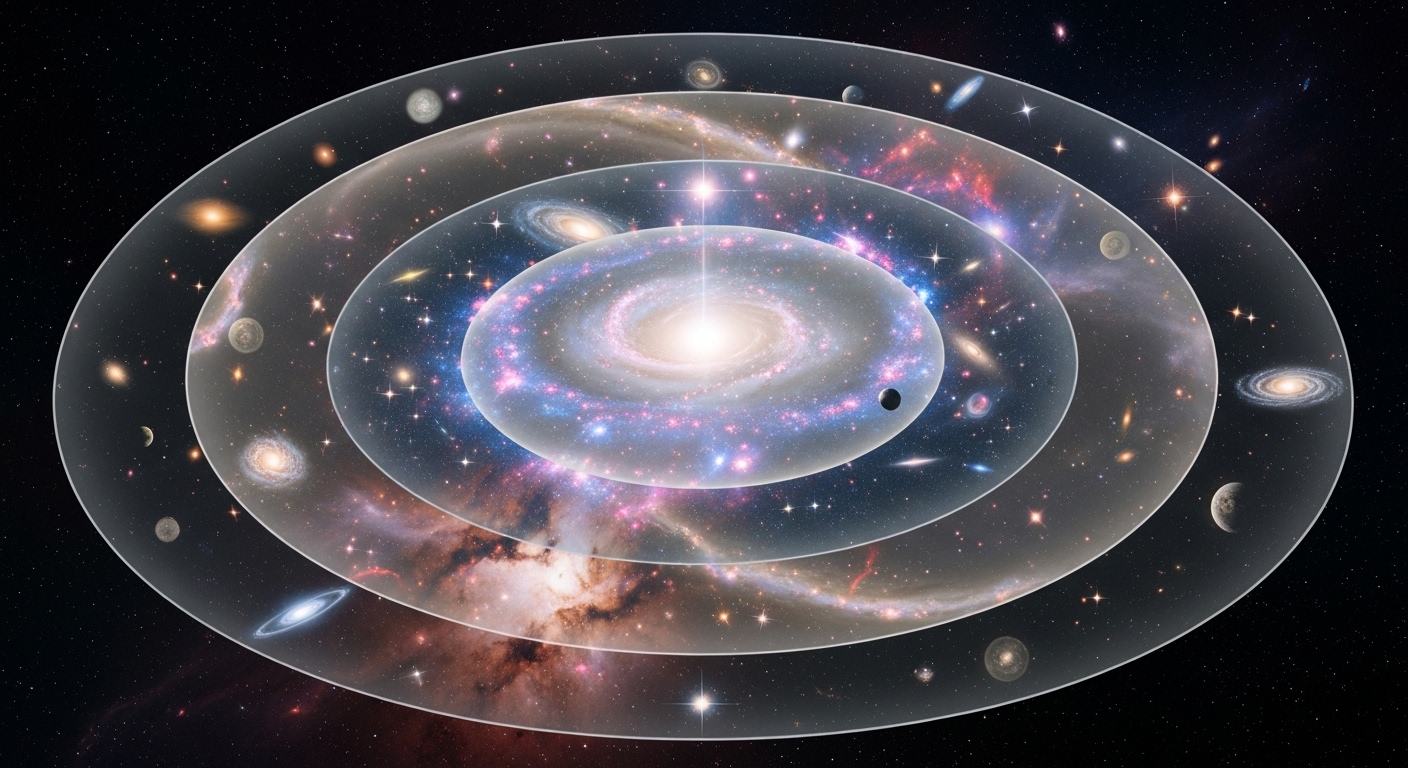
Such a grand wonder and the adorning constellations, sun, moon, and stars cannot belong only to our galaxy, the Milky Way. Stars exist in other galaxies too. While our Milky Way has 400 billion stars (our sun being just one), our neighboring galaxy, Andromeda, has two and a half times more—over a trillion stars. And there are 2 trillion more galaxies like the Milky Way and Andromeda. Is this entire expanse the ‘Sky’? How high does it go? Further research led me to four places in the Quran regarding the height and vastness of the sky. Two are very clear: Surah Al-Ghashiyah asks, ‘And at the sky—how it is raised?’ and Surah Adh-Dhariyat says, ‘And the heaven We constructed with strength, and indeed, We are [its] expander.’ After seeing these verses, it becomes clear that the sky’s boundaries might start right above us and extend very far up. But is there a final limit to this expansion? The answer is yes; there is a limit, an edge, mentioned in Surah An-Nazi’at and Surah Ar-Rahman. Surah An-Nazi’at: ‘Are you a more difficult creation or is the heaven? Allah constructed it. He raised its Samk (ceiling/surface) and proportioned it.’ And the other verse is very powerful, essentially giving an open challenge. Surah Ar-Rahman: ‘O company of jinn and mankind, if you are able to pass beyond the regions of the heavens and the earth, then pass. You will not pass except by authority [from Allah]. There will be sent upon you a flame of fire and smoke, and you will not defend yourselves.’ You see, after these endless heights whose distances I can neither explain nor can you understand, there will eventually be a place where there is a Samk of the sky—a surface where smoke and flames of fire will fall upon those who reach it. Perhaps that place is the limit of our sky’s expanse. Our sky’s expansion and height likely go from our atmosphere to that far-off Samk. That is why water descends from ‘within’ this sky, and the sun, moon, and stars float ‘within’ this sky, and it is adorned with stars. The Sky is a massive expanse starting from above our heads and stretching for trillions upon trillions of miles, which eventually has a surface.
But before telling you more about that, I want to mention a few small things. During my research on the sky in the Quran, I found mentions of the sky’s design in four places, celestial creatures in six places, sustenance (rizq) descending from the sky in three places, doors and paths of the sky in six places, the emotions of the sky in two places, the coming and going of jinn and devils in two places, things descending from and ascending to the sky in three places, the destiny of the sky in sixteen places, and five instances where Allah takes an oath by this magnificent creation. I will share all these things with you one by one when the time comes. However, another point is that in seven places in the Quran, I found mention of the number of heavens—and they are seven. From here on, I will tell you about these heavens one by one. It is clear that science cannot reach this point. Therefore, under the shadow of Quran and Hadith, I explored more about the composition of these heavens. In a book by the 14th-century Egyptian scholar Hafiz Jalaluddin al-Suyuti, Al-Haba’ik fi Akhbar al-Mala’ik, I found a very detailed description of these heavens. Now I will tell you what lies beyond the Karman Line—beyond our final reachable limits, above these infinite expanses.
The final limit of this expanse starting above us is the First Heaven—the ‘Heaven of the World’ (Asman-e-Dunya). It is made of water, and its name is ‘Raqia.’ Perhaps it is because of this water that Surah Ar-Rahman mentions smoke being released upon those who reach there. According to the Hadith of the Miraj (Night Journey), Adam and Eve live in this first heaven. According to some narrations, the Prophet (peace be upon him) saw an angel named Habib there, whose body was half ice and half fire. I also want to tell you a story about the water of this first heaven. The Roman ruler Heraclius wrote a letter to Muawiyah asking about several things people often ask about, but requested answers from the teachings of the Prophetic era. Muawiyah sent the letter to Ibn Abbas (may Allah be pleased with him) for a better answer. One question was about ‘Majarra’ (the path/gate). Ibn Abbas replied that Majarra is the gate of heaven which is the ‘dividing limit’ (Hadd-e-Fasil) between the two. ‘Fasil’ is a type of barrier through which nothing can pass, not even heat or temperature. I have also read about this Majarra that it is a ‘living saliva’—in simple words, it is alive. Although I couldn’t find verification for this specific narration elsewhere, if it is true, the first heaven is made of water that is ‘living.’ It has gates through which nothing can pass without permission, not even temperature.
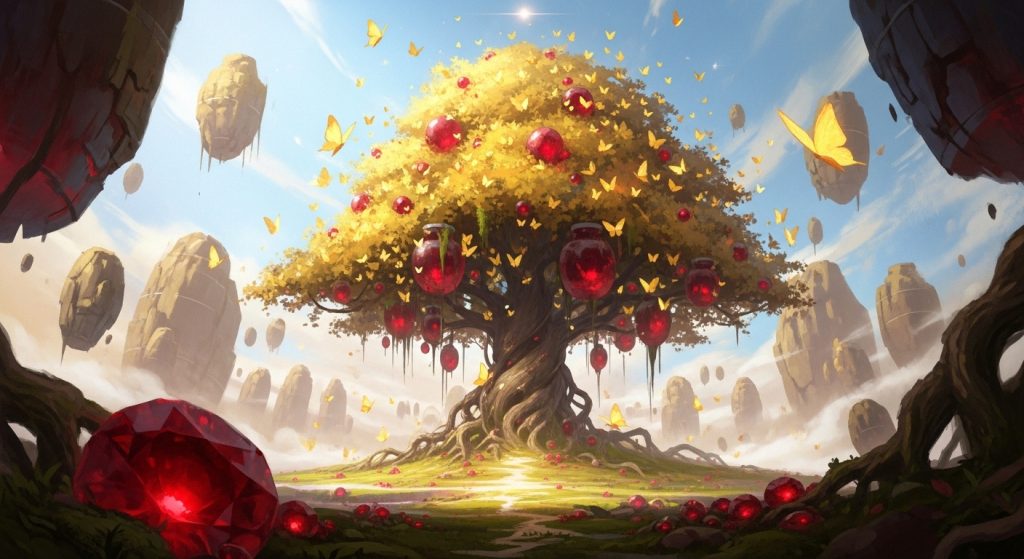
Above it is the Second Heaven, made of white pearls, named ‘Asfalun.’ According to Hadiths in Bukhari and Sunan al-Nasa’i, Jesus and John the Baptist (peace be upon them) live there. Above it is the Third Heaven, called ‘Qaydum,’ which is made of iron. Joseph (peace be upon him) lives in this third heaven. Some narrations also mention Azrael (peace be upon him) being there, who is known as the Angel of Death. Above it is the Fourth Heaven, made of brass, named ‘Ma’una.’ Enoch (Idris, peace be upon him) lives in this fourth heaven, and there is mention of an angel named Kasfayail, known as the ‘Angel of Tears.’ Above it is the Fifth Heaven, named ‘Riq’a,’ made of silver. Aaron (peace be upon him) lives in the fifth heaven, and Maalik, the guardian of Hell, is also mentioned as being there. Maalik has very mysterious angels under his command, mentioned in Surah Al-Alaq as ‘Zabaniyah.’ I will tell you about these angels in detail in the second chapter. Above it is the Sixth Heaven, called ‘Daqna,’ made of gold and red rubies. Moses (peace be upon him) lives there. But before I tell you more, I want you to imagine for a minute: a sky made of golden-like gold and ruby-like red stones. According to Surah An-Najm, there is a magnificent tree here whose roots start in this sixth heaven and whose branches go up to the seventh heaven. This tree is named ‘Sidrat al-Muntaha’ (The Lote Tree of the Furthest Boundary). It is a lote tree with very large leaves and fruit like clay jugs. Golden butterflies hover around this tree. The Prophet (peace be upon him) said that on the night of Miraj, when the command of Allah covered the tree, its colors changed in a way that he did not recognize—no creature in the world can describe the beauty of its colors.
And above that is the Seventh Heaven, called ‘Ariba,’ which is also mentioned by the People of the Book as ‘Araboth.’ This is the heaven where Abraham (peace be upon him) lives. It is a heaven made of a light that humans cannot comprehend. The branches of Sidrat al-Muntaha reach this heaven. Whatever ascends from below is stopped here, and whatever descends from above is received here. But what is above that? From here on, I am speaking very carefully, and you must listen very carefully too. Above this is the Arsh (Throne), which is carried by eight angels. This Throne is made of red rubies. Above the Throne is the Kursi (Footstool). This is the end of the knowledge of all creatures, including humans, because above this is the Owner of the Throne—Allah, the Almighty, who made me and made you. The Owner of everything I have written or spoken thus far. I feel a sense of trembling and awe even writing about what is above the Throne. To the right of this Throne is the Lawh al-Mahfuz (The Preserved Tablet). Allah created this Tablet from white pearls; its pages are made of red rubies, its pen is made of light (Noor), and the writing on it is also of light and is connected to the Throne. The Preserved Tablet is where creation, sustenance, life, death, rise, fall, and every command of Allah is written—along with anything else Allah wills. Its root is made of milk-white stone, and an angel holds it in his lap. Allah looks at it 360 times a day. According to a Hadith in Silsilah al-Sahihah, the Prophet (peace be upon him) said that the seven heavens compared to the Throne are like a small ring thrown into a vast desert, and the Throne compared to the Kursi is also like a small ring thrown into a vast desert.
Now, stop for a minute and think: what have you just heard? Can your mind comprehend these expansions? Can I explain these magnitudes to you? Never. It is impossible for any creature. Remember I mentioned at the beginning that in almost all world cultures, it is said that the heavens and earth were born from a few words of a great power. But no culture could say what those words were. Even in Theoretical Physics, there is a theory that before heaven and earth, many universes were floating between various forces like gravity, and every few trillion years, these forces collide, creating a Big Bang. The reason for this collision could be unimaginably powerful gravity or, as the theory says, ‘a force which is unknown to us.’ I don’t know what you understood from those last words, but when I was writing them in this chapter, a smile definitely came to my face because I found mention of this magnificent power in the Quran at least seven times: that when We intend a thing, We only say to it, ‘Be,’ and it is. The incomprehensible and most powerful force to date: ‘Kun Faya Kun‘ (Be, and it is).
Knowing the creation of this universe and the secrets hidden within it is one of mankind’s biggest questions. Imran bin Husain (may Allah be pleased with him) once visited the Prophet (peace be upon him) and tied his camel at the door. Some people from Yemen had also come to meet the Prophet (peace be upon him), and Imran bin Husain heard them say: ‘O Messenger of Allah, we have come to you to ask about the beginning of this creation.’ The Prophet (peace be upon him) began to explain that Allah existed from eternity and there was nothing else besides Him. His Throne was upon the water. He wrote everything in the Preserved Tablet and then created the heavens and the earth. Just as the Prophet (peace be upon him) was explaining further, someone called out to Imran bin Husain: ‘Husain! Your camel has run away!’ Imran bin Husain immediately ran out and saw his camel far away in the desert. After this incident, Imran bin Husain said: ‘By Allah, my heart regretted so much—I wish I had let that camel go but stayed to hear the Prophet’s (peace be upon him) full explanation.’ To be honest, reading this Hadith, I also felt a deep wish that the camel hadn’t run away that day, so Imran bin Husain could have heard and passed that knowledge to us. God knows how many secrets the Prophet (peace be upon him) was going to unveil that day. Just as the Prophet (peace be upon him) said regarding Moses’ (peace be upon him) meeting with that mysterious personality (Khidr) and his inability to remain patient: ‘May Allah have mercy on Moses; I wish he had been patient so Allah would have told us more of their stories.’
Today’s chapter was just the beginning of our journey. After this, I will present more chapters in which we will explore the secrets of this universe, taking guidance from the Quran, Hadith, and Science. JazakAllah.”
