

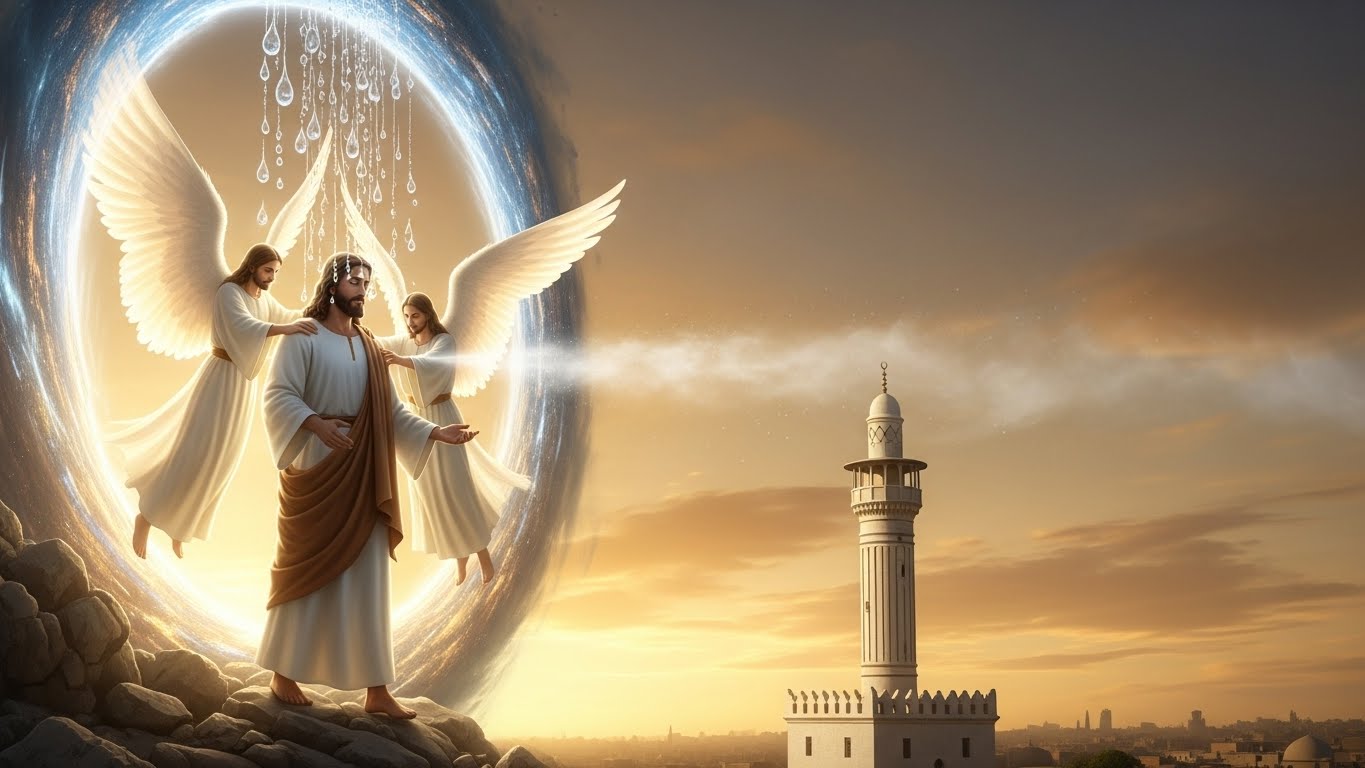
In the name of Allah, the Most Gracious, the Most Merciful. Peace be upon you. My name is Furqan Qureshi, and I welcome you all to the series on the secrets of the universe, “Wonders of the Universe.” In the previous episode, I shared a very interesting topic with you. Why is it that in every mysterious place, or let’s say, every place where a mysterious event has occurred, there is always some mention of the presence of water? For example, I recited a hadith to you in which the Prophet Muhammad (peace be upon him), while mentioning Prophet Isa (Jesus), peace be upon him, says: “When I saw Isa in a dream, water was dripping from his hair at that time. And when Isa, peace be upon him, comes again before the emergence of Yajuj and Majuj (Gog and Magog), remember that he will have his hands on the shoulders of two angels. And even at that time, water will be dripping from his hair, although his hair will not be wet.” At this time, there is probably no member of my YouTube family who has not heard the story of the night of Miraj (the Prophet’s ascension). And from the hadiths about Miraj, we come to know that at this time, Prophet Isa, peace be upon him, is in the second heaven. Now, how will Prophet Isa, peace be upon him, come from the second heaven to our world? Surely, through some path in the sky. And I say this because the Prophet, peace be upon him, told us, “Look, he will have his hands on the shoulders of two angels.” And how do angels ascend and descend from above and below? This secret is mentioned in the fourth verse of Surah Al-Ma’arij, that the way angels and the Spirit ascend and descend is a kind of path. But it is a path like a shortcut because in that verse of Al-Ma’arij, it is mentioned, “The angels ascend in a way that they cover a distance of fifty thousand years in just one day.” I am telling you straight from the verses and hadiths. There is no personal opinion of mine involved in this. Now, the verse I just recited to you, meaning the paths in the heavens through which thousands of years of distance can be covered in just one day, what do you call such a path in English? In the language of physics, a wormhole, and in simple language, a portal. Okay, one more thing. Today, if any of you is a first-time viewer, meaning if someone is watching this video for the first time, they might think I am talking about random things. But today, this is actually the fourth episode of this series. Therefore, I would recommend that if you haven’t watched the first three episodes, please watch them first. Because you will only understand today’s episode properly and enjoy it in its full grandeur when you are familiar with the information from the previous three episodes. In those episodes, I have explained the basics of portals, wormholes, and water. And from today, the next phase of the series is starting, where we will start exploring the other worlds that exist behind those paths in the sky. Okay, one more thing that I think is important to address first, is that often people who talk about portals and the paths in the sky are told that these are things from Marvel movies, from films. They have no connection to reality, etc. So, I present a hadith to you. This is a sahih (authentic) hadith, and I want you to listen to it carefully and also imagine it while listening, because it is very important. Picture this hadith in your mind because later, I will ask you a question. This hadith is in Sahih Muslim, Jami’ at-Tirmidhi, Sunan Ibn Majah, and Mishkat al-Masabih. That one morning, the Prophet (peace be upon him) stood on the pulpit and started mentioning the Dajjal (Antichrist) in front of his companions. He was talking about him so seriously that the narrator of this hadith, Nawas ibn Sam’an (may Allah be pleased with him), says that sometimes the Prophet’s voice would rise, sometimes it would be normal, and sometimes he would start speaking very softly, just as we sometimes do when we are talking about something important, leaning close to our listener and speaking softly. Nawas says that seeing the Prophet do this, we felt as if the Dajjal was standing right behind these date palm trees. And thinking this, we became quite scared. And the Prophet, peace be upon him, observed our fear and asked us, “What’s wrong with you?” So we said, “O Messenger of Allah (peace be upon him), the seriousness and secretive manner in which you are speaking makes us feel as if the Dajjal is standing somewhere behind the trees.” And then the Prophet, peace be upon him, said that the Dajjal would be killed by Isa, peace be upon him. And from here, you have to imagine this scene: “To kill the Dajjal, Isa, peace be upon him, will descend from the sky onto a white minaret in Damascus, with his hands on the shoulders of two angels. And when he breathes, the vapor from his breath will reach every disbeliever, and that disbeliever will die and fall right there. And the vapor of his breath will be seen going as far as the eye can see. And then, after this, Isa, peace be upon him, will find the Dajjal and kill him at the gate of Lud.” Did you imagine this hadith? What scene was created in your eyes? Isa, peace be upon him, is descending from the sky, he has his hands on the shoulders of two angels, he is breathing, and as he breathes, a vapor or something like it is coming out, and as far as the eye can see, that vapor is visible going. And whichever disbeliever that vapor touches, that disbeliever dies and falls right there. Does this seem like a scene from a movie less than Marvel? If you have imagined this scene in your imagination as it is described, then by Allah, it feels exactly like a scene from some movie. So, to just say that these doors, these portals, all these are cinematic things, since we haven’t seen them, we don’t believe them, that argument is illogical. I can give you dozens of more examples from Islamic accounts of such events that if you imagine them, to see them happening before your eyes, you would think by Allah that this is a scene from some very top-budget film. And the things I am going to tell you further, even Hollywood might seem very small in front of them. Anyway, from here we move on. Now we have established that there are paths in the sky, which for our convenience we call portals. Both the Quran and Hadith mention them. Water also exists in them, and why it does, I have already told you in the previous episode. So the next question is, if hypothetically, we were able to travel through these paths, then what other worlds would we emerge into? Okay, this is a very wonderful question, and the interesting thing is that its answer is in just one word: On islands. Now, I’m sure you must have smiled hearing this word, thinking, what am I saying? On which islands will we emerge? So allow me to explain. Because the definition of an island that I am going to give you today will completely change your concept of an island. The word “Jazeera” is an Arabic word. It is a very old word. This word is used in Hadith, meaning in the conversations of the Prophet Muhammad (peace be upon him). Then this word is also used in “Athar,” meaning in the conversations of the companions of the Prophet (may Allah be pleased with them all). And now I will tell you the meaning of this word “Jazeera” from seventeen Arabic and three Urdu dictionaries. According to the largest Arabic dictionary, “Taj al-Arus,” and other dictionaries like “Kitab al-Jim,” “Tahdhib al-Lughah,” “Qamus al-Muhit,” and “Mu’jam al-Lughah al-Arabiyyah,” the word “Jazeera” has four meanings, one of which is: “That part of the land which can be accessed only by crossing water.” Listen carefully. “That piece of land where you can only reach by crossing water, by passing through it.” Now, when we use the word “Jazeera” (island) in our daily language, only this image comes to our mind: an island. An isolated land, a remote place, a dry land between which and us there is water. You need to keep all these words in mind because a very interesting point is coming up. And all these words are going to be repeated again. Okay, after Arabic, it’s Urdu’s turn. You must have all heard of the Mughal emperor Akbar. And you would also know that I often give examples of Emperor Akbar in my lectures. But you probably don’t know that Akbar was illiterate. He was not educated. Therefore, one of Akbar’s “Navratnas” (nine jewels), Maulana Abul Fazl ibn Mubarak, wrote two very magnificent books for his sake: one is “Ain-i-Akbari” and the other is “Akbarnama.” And in these two books, Abul Fazl, for Akbar’s convenience, wrote in great detail about all the reforms and terminology related to the governance of India, its geography, and its administration, and one of these terminologies is the word “Jazeera,” so that he could elaborate it for Akbar, what we should call a “Jazeera.” And look at what Abul Fazl writes on page 29 of the second volume of “Ain-i-Akbari”: “A Jazeera will be that part of the land which can only be reached after crossing water.” But according to astronomy, a “Jazeera” can also be the name of an isolated piece of land or an earth-like dry body existing in the sky. Do you understand something? Let me explain again in simple words. Entering the paths of the sky, crossing the waters in them, if you reach a dry planet or a dry land, then technically that land is a “Jazeera.” After crossing the waters, an isolated land, a remote place between which and us there is water. This is why when Tamim al-Dari’s ship was lost at sea, they accidentally entered such a path that took them to some other realm. A path through which they reached an island where the Dajjal was imprisoned. It is very possible that that island, that piece of land, did not exist on this earth at all. But that path, that portal, took them to that land which was not present on this earth at all, which Tamim al-Dari, by definition, called a “Jazeera,” and there they saw the Dajjal bound in chains. That narration of Ibn Abbas and Ibn Umar (may Allah be pleased with them), that before the creation of Adam, Iblis, along with the angels, killed the jinn, and then beat them and drove them towards the islands. And we know that the jinn have access to the heavens because this is known from verse 9 of Surah Al-Jinn, that the jinn used to sit in various places in the heavens.
Then why didn’t the jinn go to the heavens to escape this dangerous purge by the angels? Because they were banished from this earth. They were pushed into those paths and made to cross the waters in those paths, and then they were sent to the dry lands behind those waters, which in today’s simple language we call other planets, and which could actually be a completely different land, an alien world. Jinn can hide in the heavens, so they can very much live on other planets as well. Now, “Al-Jassasah.” I dearly wish that you have seen the previous episode because in the previous episode, “Al-Jassasah” was discussed in great detail. What did Tamim al-Dari’s party ask it? “Ma Anti?” (Who are you?) And what did it reply? “Ana Al-Jassasah.” (I am the Jassasah). Then what did they ask? “Mal Jassasah?” (What is the Jassasah?). Okay. Stop here for a minute. Now, obviously, this conversation took place in a language that Tamim al-Dari and his party understood. Most likely, the Arabic language. And “Jassasah” is an Arabic word whose meaning in Urdu is “spy.” So just think how is it possible that they started asking it the meaning of “Jassasah,” what that is. No, they were not asking what “Jassasah” is, but they were asking in the sense of, “What kind of spy are you? What are you spying on? Jassasah what?” Those of you who have been to the Emirates will understand this, that often the locals there, pointing to something, say in Arabic, “Haza shu?” Meaning “what is this?” So this doesn’t mean that they are asking what this thing is, what its meaning is, but its sense is something else entirely. Like, “what is all this?” And then the Jassasah replied that I will not tell you anything more than this. You just go to that place of worship that you see in front of you. The Jassasah is, in fact, that spy of the Dajjal who used to come here through some path and, after gathering information, would then inform the Dajjal. An informant, a spy, who used to come to gather intelligence of this world. And it might be that it still comes, who knows? And that is why the Dajjal knew about those six or seven things that he then asked Tamim al-Dari and his party. The spring of Zughar, the date palms of Baysan, the prophet of the Arabs, the water of Tiberias. In the last episode, I told you all those questions. That hairy creature was some informant of the Dajjal who would travel through some path to and from here. And in fact, another possibility is that this very Jassasah is going to be the donkey of the Dajjal later on, the distance between whose two ears will be forty cubits. I have a reason to believe this, but the central topic of this video is not the Dajjal, so we will discuss that some other day. But another very important point is that, according to the report of Tamim al-Dari and the hadith of Jami’ at-Tirmidhi, the Jassasah had a lot of clothes on it. And I want you to think for a second, that every character that apparently does not belong to this world, the Messenger of Allah (peace be upon him) has specifically mentioned some kind of clothing on their body. For example, Isa, peace be upon him, who will descend to our world from the second heaven through some path, the Prophet of Allah said about his body, “Look, he will have two yellow garments on his body.” Then Khidr, peace be upon him, about whom you all know that he is one of the most mysterious characters of Surah Al-Kahf, where did he meet Moses, peace be upon him?

At the meeting point of two waters. And how did Moses, peace be upon him, recognize him? When he reached near a rock. And by the way, the Prophet, peace be upon him, mentioned the name of this rock by name. You won’t find that name in the Urdu translation, but it is present in the original Arabic: “Sakhrah.” That when he reached near the Sakhrah, and I will also tell you what Sakhrah is. Anyway, when Moses, peace be upon him, reached near the Sakhrah, what did he see? That at the meeting point of two waters, a man was sitting who had a cloth wrapped around him. Once again, a cloth. Every character who seems to be from outside this world, somewhere there is a mention of some kind of cloth wrapped around them. Look, every person in this world wears clothes. In normal circumstances, this is not a sign that you would specially mention. For example, when you direct someone to meet someone, do you guide them like this: “Look, when you reach that place, you will find a man who is wearing clothes?” Of course not. It is a given that the man will be wearing clothes. Every person wears clothes, but here, every character who belongs to some other realm, who is coming from some other “Jazeera” (island), from some other piece of land, the hadith and the “athar” specifically mention some kind of cloth wrapped around them. For example, Khidr, peace be upon him, who had a “thawb” wrapped around him, meaning two clothes folded and wrapped together. Then, when Isa, peace be upon him, descends on the minaret of Damascus, he will be wrapped in “mahrudatain,” two yellow garments. Then when Tamim al-Dari saw the Jassasah, what does he say? “Hiya dabbatan libasatan nashiratan sha’raha.” “She was a living creature with a lot of hair, wrapped in clothes.” I am very much sure that these are some very special clothes that help these three to travel through the paths of the sky, to cross those paths. I don’t know, no one knows what kind of clothes these will be. But every character who comes to our land from their own land through some path, is wrapped in this special cloth, the nature of which we are still unaware of, what exactly it is. We only know one type of clothing that helps us to travel to other worlds, and that is this cloth. But what kind of cloth could the Jassasah, Khidr, and Isa, peace be upon him, have? That I have no idea of. I will tell you another very interesting thing. Carefully read the story of the meeting of Khidr and Moses, peace be upon them. I just told you about the Sakhrah, that the Prophet, peace be upon him, mentioned the name of this rock by name. That where Moses was to meet Khidr. The Prophet, peace be upon him, says that when Moses and his servant reached near the Sakhrah, Moses fell asleep there, but his servant was awake. And by the way, this servant was none other than Yusha ibn Nun (Joshua son of Nun), who later became a prophet himself. And you should also keep his name in mind. This will also become very important later on. Moses, peace be upon him, is sleeping near the Sakhrah. Yusha ibn Nun is awake, and what he saw happening, according to the Quran, look at how Yusha is describing it: “Fattakhaza sabeelahu fil bahri saraba.” “That fish made its way into the water like a tunnel and went away.” A tunnel-like path in the water. Now, how else can I tell you that the opening of a tunnel-like path in the water is nothing but a portal? Where a fried fish comes back to life, where things start happening that are not possible in the world of regular physics. And what is this Sakhrah? The Prophet, peace be upon him, called it Sakhrah in Arabic. But when it was translated into Urdu, this word “Sakhrah” was translated as “stone.” But at this time, there is only one stone in the world whose name is still “Sakhrah,” “Qubbat as-Sakhrah,” the Dome of the Rock. This very place.

It might well as be Qubbat as-Sakhrah where that path opened. And is this impossible? Just think, where is this Sakhrah? This is exactly the same place from where the Prophet Muhammad (peace be upon him) went on the journey of the heavens on the night of Miraj, from where the gates of the seven heavens were opened for him one by one. This is the same place from where Prophet Isa, peace be upon him, was raised to the heavens. Quite possibly through one of those heavenly paths that opens near the Sakhrah. And through one of those paths, in its water, that fish came back to life and entered. And when Yusha told this incident to Moses, peace be upon him, Moses said, “O Yusha, this is the very place where we could see Khidr.” And according to the words of the Quran, they returned, following their footsteps, and saw that Khidr, peace be upon him, was sitting there wrapped in clothes. And see how their conversation takes place according to the hadith: Moses, peace be upon him, greets him. And Khidr replies, “How is there peace on your land?” Yes, these are the words of a sahih hadith. That Khidr asks Moses, “How is there peace on your land?” What does this question of Khidr, peace be upon him, imply? That this land was an alien land for Khidr, peace be upon him. This land was a strange land for him. He was not from here. That’s why he asked Prophet Moses, peace be upon him, “Are you Moses of the Children of Israel?” And Moses, peace be upon him, says, “Yes.” Now, what does this question of Khidr imply? What do you think, how many Moses were there in the world at that time that Khidr should have a doubt? The Prophet of great resolve, Prophet Moses son of Amram, peace be upon him, was only one. But was he really? Do you remember that “athar” of Ibn Abbas (may Allah be pleased with him), “Athar” meaning the sayings of the companions, where he says that just as there are seven heavens, there are also seven earths, in which there are prophets like your Prophet, Adams like Adam, Moses like Moses, Noahs like Noah, and Isas like Isa. And at that time, the man sitting in front of Ibn Abbas said, “O Ibn Abbas, tell me more.” Then Ibn Abbas said, “If I tell you more, you will not believe it, and not believing is to disbelieve.” Allah knows how many Moses of how many earths Khidr knew, that he confirmed, “Are you Moses of the Children of Israel?” And then Moses requested, “Will you take me with you?” And Khidr replies, “If you go with me, you will not be able to be patient with what you see. And how can you be patient,” according to the words of Surah Al-Kahf, Khidr says, “O Moses, how can you be patient with something that is completely outside your realm of understanding? The place I am going to, the journey I am on, that place is not within your realm of knowledge, what happens there and how it happens.” Okay, another very interesting thing that I should have mentioned earlier, but I’m glad I remembered it in time. Regarding Khidr, peace be upon him, almost all researchers will definitely tell you one thing, that Khidr, peace be upon him, had “Ilm-e-Ladunni.” This word actually appears in Surah Al-Kahf, verse 65, “Wa ‘allamnahu min ladunna ‘ilma.” “And We had taught him knowledge from Our own presence.” But I will also tell you one more thing that no one else pays attention to. That right before this word, Allah the Almighty also said, “Ataynahu rahmatan.” “We gave him mercy.” And what else has Allah said about mercy? The very first verse of Al-Isra, where Allah the Almighty is telling the story of the Prophet’s Miraj, his journey to the heavens. He says about that place, Sakhrah or Masjid al-Aqsa, “Al-Masjid al-Aqsa allathee barakna hawlahu.” “Al-Aqsa Mosque, whose surroundings We have blessed.” “We took Our servant by night, so that We might show him some of Our great signs.” Allahu Akbar. Near Masjid al-Aqsa, near Sakhrah, Allah the Almighty has placed that blessing that is connected to the paths of the sky. And the same blessing Allah bestowed upon Khidr, peace be upon him. From the same place, the Prophet, peace be upon him, went on his Miraj towards the heavens. From the same place, Prophet Isa, peace be upon him, was raised to the heavens. Quite possibly through one of those heavenly paths that opens near the Sakhrah. And through one of those paths, in its water, that fish came back to life and entered. And when Yusha told this incident to Moses, peace be upon him, Moses said, “O Yusha, this is the very place where we could see Khidr.” And according to the words of the Quran, they returned, following their footsteps, and saw that Khidr, peace be upon him, was sitting there wrapped in clothes. And see how their conversation takes place according to the hadith: Moses, peace be upon him, greets him. And Khidr replies, “How is there peace on your land?” Yes, these are the words of a sahih hadith. That Khidr asks Moses, “How is there peace on your land?” What does this question of Khidr, peace be upon him, imply? That this land was an alien land for Khidr, peace be upon him. This land was a strange land for him. He was not from here. That’s why he asked Prophet Moses, peace be upon him, “Are you Moses of the Children of Israel?” And Moses, peace be upon him, says, “Yes.” Okay, I really hope that whatever I have told you so far, you have understood it very well. I pray that all your concepts are cleared, because now I want to move on from here and show you the other worlds that exist behind those paths. So are you ready? Before I show you the living beings in those worlds, it is very important that you first understand two words properly. This is called setting the nomenclature, meaning that now and from now on, what will be the meaning of the words I will use in the context of my lecture. The first word is “ardh,” “zamin” (earth). When my first season on 40,000 years of knowledge was released, I made a whole episode on what “earth” means. Now, of course, I can’t narrate the whole episode here, but I can give you a general overview of what “ardh” or “zamin” is. According to “Taj al-Arus,” every walkable part that is separate from air and water is called “ardh.” It is the earth. Every surface on which you can stand, can walk, by definition, it is “ardh.” And how big is this “ardh”? In the fourth chapter of the 40,000 years of knowledge series, I had explained with relevant examples like basalt etc., how big the “ardh” is and where it extends. But for now, I will tell you in a very simple way. In the 12th verse of Ha-Mim As-Sajdah, it is said, “We created the seven heavens in two days.” And then in An-Nazi’at, Allah the Almighty asks about the heavens, “Is your creation more difficult or that of the heavens?” So, the time it took to create the seven heavens, meaning the seven heavens, then the trillions of stars in them, the trillions of suns and trillions of moons etc., so the same amount of time Allah says was taken in the creation of the earth as well. So just think, if we only consider this, our small world, this small sphere of 12,500 kilometers in diameter, as the whole earth, then doesn’t it seem strange that on one hand, it took two days to create seven heavens, trillions of galaxies in them, then trillions of stars, then trillions of nebulae, and perhaps trillions of black holes, and on the other hand, it took two days to create just this small ball? What an illogical thing it would be to think that this is all the earth. No. Our world is just a part of the “ardh.” Whereas the real “ardh” is the name of every surface in this entire universe on which one can walk. If you are standing on the moon, then for you, the surface of the moon is also “ardh.” If you are standing on Mars, then for you, the land of Mars is also “ardh.” If you are standing on Jupiter’s moon Titan, then by definition, you are standing on the sphere of the “ardh” named Titan. And the day you understand this concept, on that day, you will also understand the 6th verse of Ash-Shams, “By the ‘ardh’ and its expanse.” “Ardh” is not just the name of this small world, but “ardh” includes every planet that is spread throughout this entire universe. Our world and our moon are just a small part of the “ardh.” The planet named Jupiter has 79 moons, which are all part of the “ardh.” Some part of the “ardh” is very small, for example, Mercury, also known as ‘Utarid, a small “ardh” with a diameter of only 3,000 miles. But some part of the “ardh” is so big that we can’t even imagine it, for example, ROXs 42b. Mercury’s diameter is only 3,000 miles, whereas ROXs’ diameter is more than 100,000 miles. This is also an “ardh,” a part of the “ardh” that Allah has spread. And it is about 500 light-years away from us. And up to the making of this video, that is, according to the database updated until October 22, 2024, 15,770 parts of the “ardh” have been discovered, which are spread out to where we can see them. And with every passing 27 months, the number of these visible parts of the “ardh” is doubling. And this is just a small definition of that “ardh” which Allah the Almighty has sworn by, “By the ‘ardh’ and its expanse.” That “ardh” which is spread all over the universe. Okay, I had told you that there are two such words whose meaning I want to make clear to you. One was “ardh.” And the other word, I wish I could cover it today, but it’s been half an hour, and my phone doesn’t have the ability to record for longer than that. So now you do two things. One, like this video, because this way, this rare information reaches the rest of our YouTube family. And second, please read my pinned comment in the comment section, because there is an important message from me to all of you, which is very important to continue this research work. So, the rest of the topic will be in the next episode, Insha’Allah. And please read my comment below once. Allah Hafiz (May God protect you).
