

In the name of Allah, the Most Gracious, the Most Merciful. Today we are going to watch the fifth and final episode of the Amazon series. The topic of today’s episode is not the jungle itself, but the ocean spread around it and the centuries-old tales hidden within that ocean.
I told you that the Amazon is not just the name of forests, but also of a river flowing through those forests. And if I speak the truth, the Amazon River is, in itself, a very big secret among nature’s secrets. In fact, most scientists call it the world’s greatest natural secret. Every year, hundreds of brand-new living creatures are discovered in the Amazon River. Insects, fish, and new herbs found within the water that are used in the treatment of dozens of diseases.
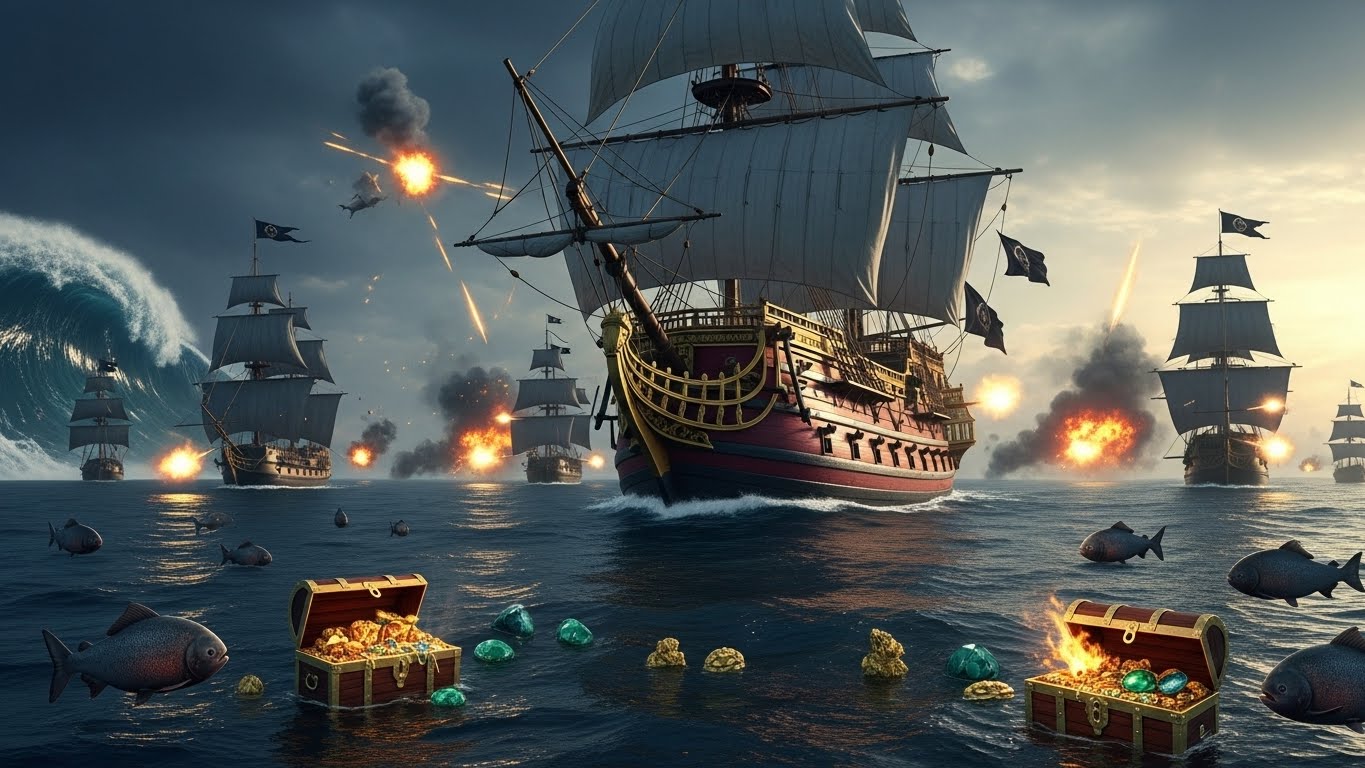
Then, Allah Almighty has kept a strange and terrifying fish in this river as a sort of cleansing system, known as the Piranha fish. Piranhas’ teeth are sharp like razors and are interlocked with one another. And they are so hard that they can cut through bone along with the flesh. Piranha fish usually hunt in schools and eat, drink, and vanish animals dying in the river within minutes.
But yes, such incidents are also recorded and reported when Piranhas attacked humans, especially in the rainy season when people go down into the river to bathe. Or if an injured animal or human falls into the river, sometimes Piranhas come running towards that unfortunate soul in a swarm. And those who survived these attacks said that within a few moments, their hand or foot or fingers had vanished.
Then, another strange sight is seen in the Amazon River which is not found anywhere else in the world, and that is the Pororoca, meaning reverse waves. What happens is that when the ocean water rises, meaning when high tide occurs in the ocean, sometimes its waves enter inside the Amazon River and travel within it for many kilometers. And these reverse-moving waves form a sort of tunnel that, if I speak the truth, looks like an entrance way. A meeting place of two waters. Where seemingly it looks as if this tunnel is a path to enter somewhere. The meeting place of two waters. I hope you have understood what I am pointing towards.
And then the Amazon River’s estuary. Like every river, the Amazon eventually joins the ocean at one point. And the place where the river meets the ocean is called an estuary in English. And the estuary of the Amazon River is 350 kilometers wide. Do you know what this means? It means that if you place all of Karachi, Lahore, Islamabad, and Rawalpindi at the mouth of the Amazon, even then, the mere mouth of the Amazon would be bigger than these four cities.
And then after the Amazon River begins the Atlantic Ocean. The world’s second-largest ocean. And this is the ocean crossing which the Spanish Conquistadors reached the Amazon jungles. Crossing this same ocean, Christopher Columbus reached America. This is the same ocean within which the famous, or rather infamous, Bermuda Triangle exists.
Since today is the last episode of the Amazon series, I am telling you some things in small fragments without going into too much detail so that you can gain maximum information within the time. But what will you get from all this information after all?
So first of all, know that the ocean is mentioned as a very great sign of Allah Almighty in the Holy Quran. And when Allah wanted to tell about His knowledge, He used the ocean as an example. For instance, in Surah Al-Kahf: “Say, ‘If the sea were ink for [writing] the words of my Lord, the sea would be exhausted before the words of my Lord were exhausted.'” In fact, in Surah Luqman, it goes as far as to say that even if there were seven more seas like it, Allah’s words would not be exhausted. Meaning, Allah Almighty has used the ocean as a standard of cosmic grandeur.
Then the mention of magnificent ships sailing in it. By the way, I am telling you all these verses for a reason. Then the mention of treasures coming out of the ocean. That He subjected the sea to you so that you may eat fresh meat from it and bring forth from it ornaments which you wear. And if you read this full verse, you will know that the ocean is a very big source of sustenance, adornment, trade, and travel for humans which Allah Almighty has granted them.
Then regarding the oceans themselves, there is a very famous verse which you often hear, that He released the two seas, meeting [side by side]. Between them is a barrier [so] neither of them transgresses. Regarding this, there are two verses in the Quran, one in Al-Furqan 25:53 and the other in An-Naml. And often you must have seen these verses with the picture of the ocean of Alaska where two oceans actually meet but they do not mix.
And then that famous verse where the pitch-black darkness of the ocean is mentioned. That in a vast deep sea, overwhelmed by a wave, above which is a wave, above which is a cloud. Layers of darkness, one above another.
And lastly, a sign for the believers that the ocean became the means of punishment in the flood of Noah, yet this same ocean became the means of salvation for Moses (AS) and the Children of Israel.
So how much importance do oceans have in Islamic literature? I will tell you another interesting thing. In the Holy Quran, the mention of oceans, meaning ‘Bahr’, is 32 times. And the mention of land, meaning ‘Barr’, is 12 times. Meaning a total of 44 times. And if you reflect a little, ‘Bahr’, which is 32 times, makes up 73% of 44. And ‘Barr’, which is 12 times, makes up 27% of 44. Meaning, the exact ratio of land and sea of this world has been told to us in the Holy Quran, that on this earth the ocean is at 73% and the land is 27%. And exactly these figures are what we learn from modern science today.
So oceans are mentioned very explicitly in the Holy Quran, but the surprising thing is that in the Islamic literature currently available on YouTube, you will find the least mention of oceans. And right now I have only told you Quranic verses. If I come towards Hadiths, there is a vast treasure that discusses oceans. For example, our last Prophet Muhammad (PBUH) said that he who did not get the opportunity to fight a war alongside me should partake in naval Jihad. Because one war fought in the oceans is equal to two wars fought on land. And the martyr dying in it is a superior martyr in the eyes of Allah. Even if someone goes to the ocean with the intention of war and feels seasick, he will get the reward of one martyr. And for the one who drowns, there is the reward of two martyrs.
In fact, once the Prophet (PBUH) woke up from sleep, and he was smiling. Umm Haram (RA) asked him, “O Messenger of Allah, what are you smiling about?” He replied that “I am happy seeing those people of my Ummah who are going for Jihad in the oceans in such a way as if kings are sitting on their thrones.” Therefore, if you look at the oceans as a sign of Allah Almighty, you can learn a lot from them.
And today I will also tell you some events from which you will realize how controlling the oceans can become the cause of the rise and fall of nations. And the beginning of our story today starts with the millions of tons of treasures collected in Spain through the Spanish Conquistadors.
At the very beginning of the series, I told you one thing: that whatever treasures the Conquistadors looted from the Amazon jungles, they kept collecting and bringing them to Spain. And the result was that Spain became the richest kingdom in the world. Now there is a verse in Surah Al-Imran that “These days [of varying conditions] We alternate among the people.” Meaning power and strength in the world do not always remain with one individual or one nation. Rather, it keeps rotating. And the fate of Spain’s richest kingdom was somewhat similar.
What happened was that in the late 17th century, a king ruled Spain, Charles II. There were no children in Charles’ house. Neither did he have a son nor a daughter who could become the King or Queen of Spain after Charles. So when Charles died, the kings of the surrounding countries began to drool. And they thought that right now Spain has no king, so if we somehow capture it, the millions of tons of treasure looted from the Amazon will come into our possession. And thus began the War of Spanish Succession, which lasted for seven years.
This was an era when obviously there were no tanks and airplanes; rather, most fighting took place in the ocean between the power of naval ships. Therefore, the principle was simple: whoever controls the trade routes present in the ocean will be considered the superpower of this world. Therefore, every country in Europe started training their people to sail ships and also to wield swords, meaning combat training.
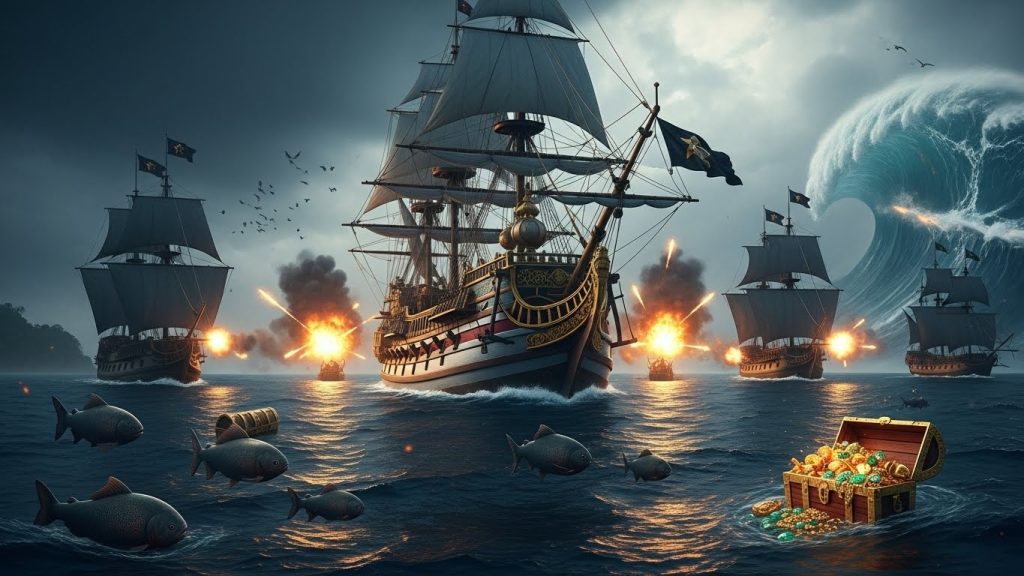
The War of Spanish Succession lasted for seven years. But when this war ended, and now the need for fighter sailors diminished, these people became unemployed. And obviously, they didn’t know anything else except these two jobs—sailing ships and fighting. Therefore, they decided that instead of wandering door-to-door looking for jobs, we will go out into the open seas and do the very two things we are experts in. Sailing ships and fighting. And thus, a new power emerged in the oceans of the world: the Pirates.
Hearing the name of pirates, mysterious ships, black flags, ocean treasures, and the film series “Pirates of the Caribbean” immediately come to mind. But to tell the truth, as much as all this seems like fiction to you, there is just as much truth in these stories.
When I was researching for this video, such events regarding pirates came before me that upon hearing them, a person wonders if this all really happened. But I promise that whatever events I am going to tell you are all recorded in history. And one of those events, the one involving Emperor Aurangzeb, is such an event that a whole feature film can be made on it. Therefore, come with me into the interesting and astonishing maritime world of pirates.
The 16th, 17th, and 18th centuries were the era when trade through the oceans was at its peak. Huge naval ships from Europe carrying weapons and other products would go to Africa. In exchange for those products, they would buy slaves from Africa. To sell whom, they would then go to the islands of the Caribbean. And from there, in exchange for slaves, they would buy codfish, tobacco, chocolate, and rum and return to Europe. And thus, these people were earning money at every stop. Therefore, naturally, the trade route of these ships became a golden route for sea pirates.
The interesting thing is that in the pirate community, the most valuable cargo to loot was considered to be medicines. Meaning if a ship had medical supplies, it could sell for up to 200 million rupees in today’s terms in the black market of that time. And selling it was actually very easy. But this absolutely does not mean that jewelry or gems were not valued. Rather, their looting was at such a level that a person would be amazed.
In 1692, sea pirates looted an Indian ship which was carrying diamonds, gems, and gold. And at that time, every looter’s share came to 1 billion and 330 million rupees according to today’s calculation. While the captain of the looters, Thomas Tew, received 9.5 billion rupees in his share. Can you believe it? Practically, sea pirates looted so much wealth that diamonds and gems perhaps became meaningless to them. Rather, sometimes it seems that these people engaged in piracy perhaps only for adventure.
I will tell you about a record-breaking loot. Once, a Spanish Conquistador ship, the Hermione, was going back to Spain from the Amazon jungles carrying gold, silver, and emeralds. On the way, pirates looted it. Hermione was a ship laden with gold, and every pirate who looted it received 4 billion and 400 million rupees in his share according to today’s calculation. And the captain received 51 billion rupees. I can understand that believing these figures is very difficult, but all of this is recorded in history.
Actually, in the 18th century, an English author, Captain Charles Johnson, wrote a book: A General History of Pirates. Now, all these events are written in that book, and not just these, but many other astonishing and interesting events too. And reading some events, it feels as if for pirates, perhaps the biggest motivation was not money, but adventure. Highly organized people who understood human psychology, who became pirates in search of adventure.
For example, there was a famous sea pirate, Edward Teach. At least that is the name written in the record, otherwise, it is very possible that this was not his real name. You see, most pirates never told their real names. And not just this, but they used to keep changing their fake names too, so that due to being a looter, their name or their family’s name would not be ruined. Therefore, Edward Teach, or as the world knew him, Blackbeard. And this name was because he was known for his black, thick beard and terrifying personality.
Blackbeard often used to correspond with big merchants and even government officials. And when he died, a letter was found in his belongings which was from the Chief Justice of Carolina. And you know that in the 18th century, being educated meant only one thing: that Blackbeard was originally from a good, big, and elite family. From a very rich family, who perhaps went out into the oceans to become a pirate just for adventure.
Adventure and freedom. If not all, then this was the weakness of most pirates. For example, in the same book I just told you about, A General History of Pirates, it is written about two such women who, for four years, disguised as men, lived as pirates on Captain Calico Jack’s ship. They changed their disguise because women were not allowed to board ships. And they became pirates because in that era, women did not get their rights in the way they do today. Therefore, for four years, Anne Bonny and Mary Read lived as pirates in search of that freedom, wealth, and adventure, which at that time was only possessed by men.
But not all pirates were amateur pirates. This is a dark chapter of history that many governments used them secretly like tissue papers. For example, there was a pirate named Captain Kidd. Once again, what was his real name, perhaps no one knows except Allah. However, once the East India Company used him to carry out attacks on several ships in the oceans. Sometimes sinking a Spanish ship, sometimes attacking a French ship.

But when Captain Kidd was caught, all the officials who had been using him disowned the Captain. They said we don’t even know him. Captain Kidd was sentenced to death, and that too a very bad one. For three years his corpse hung over the River Thames in London. And today, centuries later, letters have been found from a London building office that East India Company officers had written to Captain Kidd. From which it is proven that they had used him. And to hide the evidence, those letters were put in the wrong files. Today, 300 years later, when those documents were found, it was revealed that the East India Company had a direct hand in making Captain Kidd a pirate.
Captain Kidd is among those pirates about whom a lot of data is found. And records show that when he was captured and presented in London, a small treasure was also brought against him as evidence. But the reality is that the small treasure was perhaps not even one percent of Captain Kidd’s real treasure. At least 200 bars of gold and at least 50 chests of silver. This was Captain Kidd’s real treasure, which he had hidden somewhere before being arrested, and which has not been found by anyone to this day.
However, there is one incident of Captain Kidd that is famous and interesting too. That once he visited Block Island. This was an island in the Caribbean where his hostess was Mrs. Mercy. It is said that Captain Kidd liked Mrs. Mercy’s food very much. So when he was leaving, he said to Mrs. Mercy, “Hold out the apron you wore while cooking the food.” So when Mrs. Mercy spread her apron in front of Captain Kidd, he filled it with gold, silver, and gems.
After this incident, Mrs. Mercy shifted to London with her entire family. Where she bought a lot of land. And even today, Mrs. Mercy’s family, meaning England’s The Raymonds family, is famous by the name “Enriched by the Apron.” Meaning the family that became rich because of an apron.
Now, one thing is that hearing the name of sea pirates, apart from gold, silver, and gems, a group of looters based on lawlessness and lies without any principles comes to mind. Who don’t care about anything except treasures and treasure maps. But reading about them, one gets a strange feeling as if they were far more principled than any organization or institution of their time.
You can guess from this that when a Captain made a big decision, as a counterbalance, there used to be another post on the ship: Quartermaster. Meaning if the Captain ever made a wrong decision or said something based on injustice, the Quartermaster would immediately veto his decision. And this was a quality that was not seen even in a huge institution of the world at that time, the East India Company.
Then the pirates had five very strict rules, which were necessary for every pirate to follow.
Rule Number 1: Every man present on the ship shall have the right to speak. And he shall be entitled to eat anything present on the ship.
Rule Number 2: No man present on the ship shall deceive anyone. And if anyone cheated even equal to a glass, a plate, or a diamond, his nose and ears would be cut off and he would be left alone on a desolate island.
Rule Number 3: No person present on the ship shall gamble.
Rule Number 4: There will be no lights on the ship after 8 o’clock at night.
And the last and strictest rule: Neither any underage person nor any woman shall be on the ship. And if anyone brought any one of these, his punishment would be nothing but death.
And believe me, pirates used to follow these rules very strictly.
Look, there is a very big reason why I am telling you all this in such detail. God willing, moving forward, you will know that reason yourself. Anyway, one thing is for sure, the end of these pirates… If they were caught, it wasn’t good. Once a sea robber or a pirate was caught, usually, he was hanged publicly. And to see this punishment, the public would gather just like they go to see a fair or a show today.
But if a big looter was caught, then the punishment for him used to be far more barbaric than hanging. He would be locked in an iron cage and hung in the air. Where he would die of hunger and thirst. And he would not be taken down until he had completely decomposed. And you will be surprised to hear that it could take up to two years to completely decompose. Captain Kidd, Calico Jack, and Captain Charles Vane, all met the same fate.
But it is about the year 1695, that a 35-year-old pirate, Henry Every, whom today can be called the King of Looters… This was the person who looted the biggest wealth in history. And that loot happened on 7th September 1695. And this is such an event in history that when I tell you, you won’t be able to understand whether to call it strange, interesting, astonishing, or tragic.
It is about the year 1695, when Emperor Aurangzeb ruled India. And that was the era when European traders used to call India the “Golden Bird.” During Aurangzeb’s era, India used to account for 25% of the entire world’s GDP. Meaning there was this much money in India at that time. By the way, I am saying ‘India’ because obviously at that time Pakistan and India were not separate, but it was all one.
And the British who came to the courts here at that time wrote in their diaries and memoirs that in the Mughal court, you only see three colors. Golden, Silver, and Deep Red. Meaning everything in the court was made either of gold, silver, or precious red rubies.
Francis Bernier, who was a French doctor and a tourist, and came to India during Aurangzeb’s time, called the Mughal court in his book more luxurious than any court in Europe. And he says that looking at the thrones of gold and silver, walls studded with diamonds and gems, rows of thousands of soldiers, elephants decorated with war armor, and the awe of the Emperor, it feels as if a fairy tale is coming to life before your eyes.
Aurangzeb’s great-grandmother’s name was Maryam-uz-Zamani, meaning the ‘Mary of the Age’. And this used to be a very big title in that era. Maryam-uz-Zamani had her own personal armada. Meaning a whole fleet of naval ships, which used to take people from India to Arabia for trade and Hajj and then bring them back. Maryam-uz-Zamani was at that time the most influential woman in all of India, or perhaps one could say in the whole world. And this event happened with one of Maryam-uz-Zamani’s ships.
On 7th September 1695, a huge naval ship of Maryam-uz-Zamani, a 1600-ton heavy ship named Ganj-i-Sawai. This is a word from the Persian language, and it means “The Exceeding Treasure” (or Overflowing Treasure). And the British wrote this ship as Gunsway in their books.
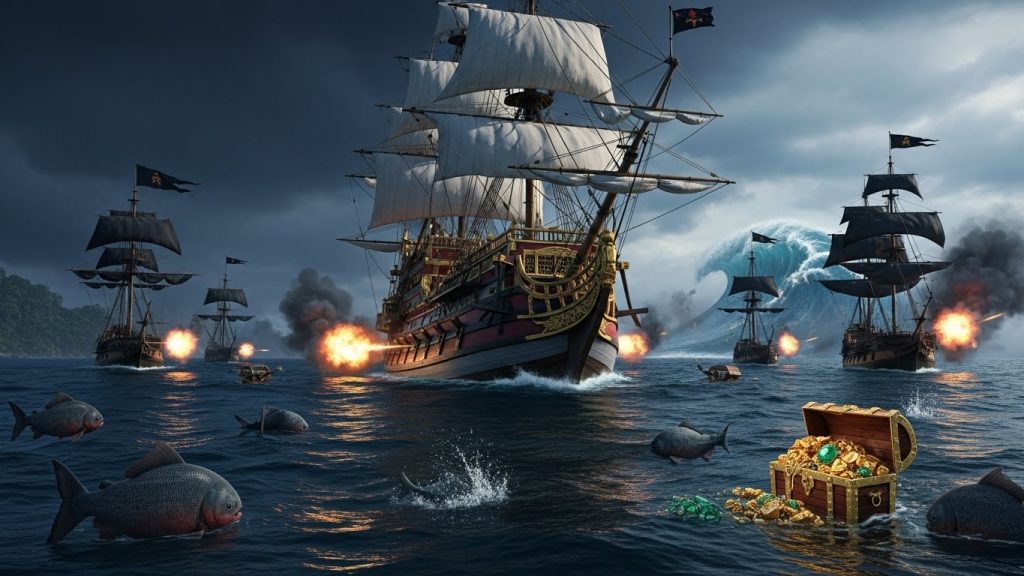
This ship was returning from Arabia carrying so much gold, silver, and gems that for its security, for its protection, a separate ship, Fateh Muhammad, was moving ahead just as its escort. And 23 small ships were behind it. I am trying to portray the grandeur of that level with correct rights in the artwork, but still, you imagine a magnificent ship whose compartments were filled with nothing but gold. And it was traveling under the protection of 24 other ships. At that time, what a spectacular view it must have been. And this was the convoy of Maryam-uz-Zamani’s 25 ships that Every had made full arrangements to loot.
When Ganj-i-Sawai was at a distance of only eight days from India, Every attacked it with his five ordinary ships. But Ganj-i-Sawai had also made full arrangements for its protection. It had 80 cannons installed. And within minutes, Ganj-i-Sawai could have drowned an entire pirate ship along with its captain to the bottom of the sea. But then look at the luck, that Ganj-i-Sawai‘s biggest cannon exploded right on the ship itself. Due to which Ganj-i-Sawai itself got significantly damaged.
Ganj-i-Sawai‘s crew panicked. And taking advantage of this panic, Henry took only 113 pirates and overpowered the 500 guards of Ganj-i-Sawai. The fight continued for two to three hours, but eventually, Every’s people won. And for the next several days, they tortured the crew of Ganj-i-Sawai to tell where the treasure was hidden in the ship. And after that day, Every, along with the treasure of Ganj-i-Sawai, disappeared forever. I will come back to what happened to him.
But do you know that when the news of this event reached Aurangzeb, he became so angry that he sealed all the offices of the British present in India? That until Every is arrested, until he gets punished, you people won’t be able to even squeak here. And look at the situation, at that time the British conducted the biggest manhunt in human history. England’s navy kept searching for Every in the oceans of the entire world. But the King of Pirates was never found by anyone to this day.
Many looters of his group were later caught, but no one knew where Every went. 1695 was the year when Henry Every, the uncrowned king of looters worldwide, disappeared from every record.
A famous international historian, Rogozinski, writes that no loot bigger than Ganj-i-Sawai has occurred in human history. And the estimate of the treasure present on it, in today’s rupees, perhaps even if I tell you, you won’t believe it.
But now you listen to what basically happened on Ganj-i-Sawai that day. Ganj-i-Sawai‘s captain was a man named Ibrahim. And many years after this event, a historian living in Surat, Muhammad Hashim Khafi Khan, wrote a history book based on several volumes called Muntakhab-al-Lubab (History of India through the words of its own historians).
In this book, Khafi Khan writes that the biggest culprit in the looting of Ganj-i-Sawai was its captain, Ibrahim. When the big cannon exploded, Ibrahim left everything and ran down from the deck. And the helper girls, the maidservants, he handed them weapons and sent them up to fight. Those poor souls went up, but without a leader and in front of looters, what more could they do? And this was the reason that within three hours, 24 ships including Ganj-i-Sawai surrendered before the looters.
Regarding the atrocities committed during this surrender, Khafi Khan has also written in great detail. That they were torturing every person present on the deck. Some people say that these stories of atrocities were created only to spread sensationalism, but the truth is that in reality, it happened just like that. I told you that later some of Every’s looters were also caught. So one of those looters, John Sparkes, confessed while dying that “the merciless torture we did on Ganj-i-Sawai never let me sleep peacefully at night.”
Then another looter, Philip Middleton, also testified that the looters present on Ganj-i-Sawai committed great atrocities against Indian women. And among them, there were many women who, from their jewelry and their habits, meaning their style of speaking, seemed to be from very high families. To the extent that almost from the royal family.
Then apart from these two testimonies, the President of the East India Company, Sir John Gayer, in the letters he wrote to the Lords of the Trade, there is a very clear mention of the barbarity of the looters. And in Sir Gayer’s letters, there is a mention that on Gunsway, meaning Ganj-i-Sawai, there was also an “Umrao” lady who was returning after performing Hajj. “Umrao”, meaning Royal Lady. This was a title that was used only for royal women.
John Gayer wrote that the pirates targeted them with violence despite them being of old age. On which the Umrao and her nurse or her maidservant committed suicide so that their husbands could not see them in that state.
When I was researching the Ganj-i-Sawai incident, I felt as if a whole feature film could be made just on this one event. Let alone five parts of Pirates of the Caribbean.
Do you know that in the era of Chinese Emperor Qin, Chinese pirates had become so many in power and numbers that they could technically fight with the Emperor’s army? Yes, it is a separate matter that then due to their internal fights, they became weak.
But now I come to the point of why I am telling you all this today after all. See, the stories of sea pirates or marine looters apparently seem like romantic tales filled with swords, ships, and treasure maps. But if looked at closely, even for today’s era, there are several types of moral lessons hidden in them.
First of all, you see that pirates always emerged in those times when the law was weak and the state failed. Wherever states are weak, criminals like pirates and powerful people will definitely come forward to fill this vacuum. Remember that the vacuum of power is always filled by someone or other. The chair of power never remains empty. And if the power of truth does not sit on it, then surely it will become the throne of the power of falsehood.
Then the second moral lesson. That the real purpose of piracy was the search for easy wealth and treasure. But eventually, even that wealth could never give them peace. Because most pirates were either killed or they were hung on gallows. Which gives us another moral lesson that wealth obtained through the wrong path can give temporary happiness, but its end is always ruin.
Then I told you about the five rules existing on the ships of sea pirates. In which even the Captain was accountable. From which we get another moral lesson that no matter how illegal a society may be, still the demand for justice and equality remains present in it. It is human nature that it does not like injustice.
Fourth moral lesson. You noticed that often in battles pirates were very few, but still, they used to overpower ships many times larger than themselves. The reason for this was their black flags. Often ships would surrender upon seeing the black flags. From which you realize how big a weapon a person’s image can be for them. You have to have a powerful image, guys.
As for the Amazon jungles, remember one thing: experts call them the lungs of the earth. And if the cutting of Amazon jungles continues in the same way as it is happening now, then not only Brazil, but I and you, we all will be affected.
Clean air to breathe will decrease. In many countries of the world, fields will dry up, and there will be a shortage of food. Global warming will increase rapidly and the natural balance of the world will be disturbed beyond limits. And the result will be that human existence itself will be in danger.
Now what can we do in this matter? Saving the Amazon jungles is not just South America’s, but the duty of all humanity. First of all, we have to pay attention to recycling. The more paper, plastic, and wood are used, the more forests will be cut. Tell the importance of the Amazon plus all forests in educational institutions and among your friends. The more people are aware, the safer nature will remain.
The floods coming in Pakistan these days, a very big reason for them is deforestation. The cutting of these forests is unprecedented. For all the people who died in the floods, a prayer for forgiveness from my side. Remember that according to Hadith, the drowned, meaning the one who dies by drowning, is a martyr.
