


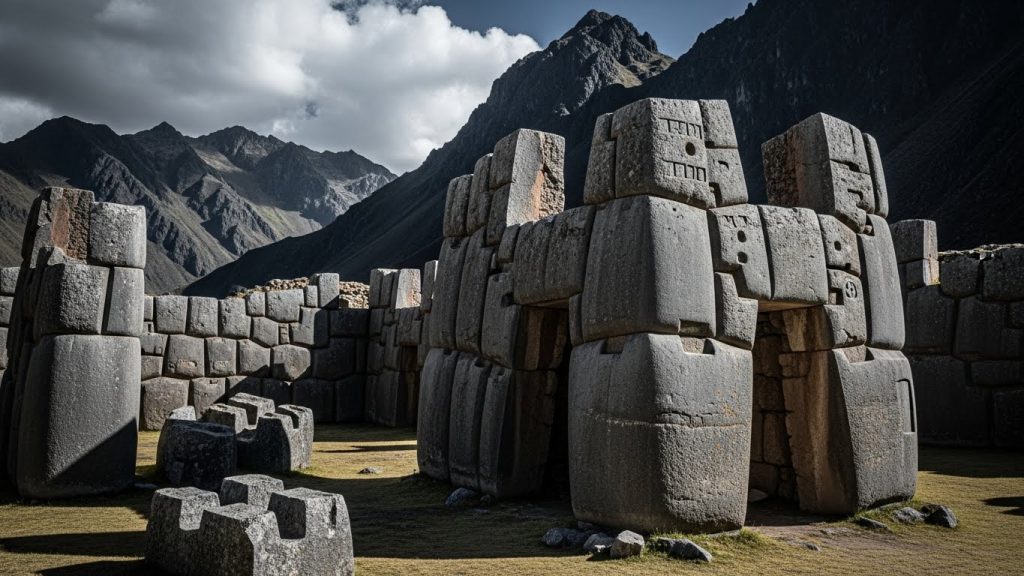
In the name of God, the Most Gracious, the Most Merciful. Today you will be watching the fourth episode of the Amazon series. But before we begin today’s episode, I want you to imagine a scene. Imagine that you are walking in a high mountain meadow when you suddenly see some large stones in front of you. Giant stones scattered all over the ground. But these stones are not shapeless rocks, but stones that have been cut with a very advanced CNC machine.
Some of these stones are in an “H” shape, and they are cut in such a way that they can fit into each other, that is, they can interlock.
These are called “H-blocks,” and each H-block has intricate compartments, impossible angles, and facets.
It seems very difficult for all of this to be done with a hammer and chisel.
Rather, looking at the hole in one stone, it seems as if someone has used power tools on it, for example, a drill machine, which runs on electricity and is a very modern invention.
Then the edges of some stones are so sharp, that is, razor-sharp, that someone has cut them with a computerized numerical machine or a laser cutting machine.
Then the matter does not end here because each of these blocks is exactly the same in size.
There is not an inch of difference between any two blocks.
Incredible engineering, machine-like accuracy, and the surface of the stones, that is, the surface is so smooth, so plain that if two blocks are joined together, you cannot even insert a blade between them.
It is exactly as if they are 150-ton Lego pieces carved with a very modern cutting machine.
But the mystery does not end here either, but becomes more mysterious because these blocks are made of two types of stones.
The first is andesine and the second is sandstone, which are almost impossible to cut with ordinary tools.
Ordinary hammers, chisels, or sandpaper do not affect these stones.
So you need very powerful tools to cut them.
But the most surprising thing about this place is that the people who live in the area where this complex is built have never used a wheel.
That is, they did not use any kind of handcart, bullock cart, horse-drawn carriage, any kind of cart, or any such thing.
Therefore, we have no idea how these people would have brought these huge blocks weighing hundreds of tons to the middle of the meadow.
And this place is not a plain meadow, but there are very rough mountains around it, where even large wheeled cranes cannot go, let alone such large carved stones.
Today, the name of this place is Puma Punku, and it is a site that is like the set of a mysterious film.
The only difference is that unlike a film, this place is a stark reality and is located in the middle of the Andes Mountains.
And it is so strange that even today, scientists, engineers, and historians look at each other’s faces when they reach here.
No one knows who built Puma Punku, but at one time this place was the property of the Inca people who lived in the Amazon jungle and near it.
Therefore, we assume that the builders of these incredible blocks were probably the Inca people.
But there are still many questions that we have no answer to.
For example, the first question is who actually built these blocks?
Were they really the Incas or a nation that existed before them?
Then what was the purpose of building them?
Although these blocks are now broken, it is clear that at one time these pieces joined together to form a magnificent building, the purpose of which we do not know.
That is why some researchers believe that in some respects, Puma Punku is more surprising than the pyramids of Egypt.
For example, the pyramids of Egypt were built in a plain desert.
It would have been easier to transport the stone blocks there.
The Nile River also passes nearby, and today there are many theories that they would have brought the blocks of the pyramids there by putting them in large boats in the Nile River.
But Puma Punku, as I told you, is built in the middle of rocky and pointed mountains, where there is no road and no wheels.
Then when these large blocks are joined together, no cement was needed to hold them together.
Rather, they were joined so strongly without cement that there was no question of them falling.
Even today, the destruction that we see is the vandalism of later people who came to find the treasure hidden in these blocks, otherwise these blocks remained intact with each other for a long time.
And to be honest, it is like building a house today without using any kind of cement, mortar, or plaster, but just placing bricks on top of each other and hoping that this house will not fall.
Is it possible? Of course not, but it happened in Puma Punku.
No cement, no mortar, nothing.
Rather, some explorers and researchers have even said that there is no mark on these stones that would indicate that they were dragged here.
The marks of dragging, that is, any kind of friction or scratch, etc.
So sometimes it seems as if these 150-ton heavy blocks have reached this complex by floating in the air.
So how or how was this supernatural set of Puma Punku built?
I will tell you two theories that are popular at the moment, and then from there we will move on to the Inca Empire, an empire that used to build its palaces in the clouds.
The first theory about the H-blocks is that it is very strange, but it is being discussed very seriously in the research community at the moment, that they could melt stones.
This is a bit strange, how can a stone be melted?
But in some towns of the Andes mountains, an ancient folk tale is told that the Incas used the juice of a special plant or herb that would soften the stones.
That is, when they would grind this herb, they would extract a paste, a juice, and when they would apply that juice to large stones, the stone would become as soft as clay, so that it could be easily shaped.
And then when that juice dried, the stone would return to its original hardness.
In fact, once an archaeologist, Mr. Denham, published a whole article on this theory, which was titled “The 3D Printing of the Inca Empire.”
Some experts believe that this juice was probably some kind of natural acid, but so far no such plant or formula has been found, so this theory needs further investigation.
Along with that, we move on to our second theory, which is sometimes used for the blocks of the pyramids of Egypt, and that theory is about the secret of moving large stones with the power of sound.
Look, science believes that everything in this universe is vibrating at a certain frequency.
And if we can produce a sound whose frequency matches the frequency of that thing, we will have complete control over it.
This is the secret of how Tansen used to break a glass with his voice.
He would produce a sound with a frequency at which the glass would vibrate.
Some researchers also discuss that perhaps the people of the Inca empires had discovered the secret of infrasound voices to move large stones.
One reason for this theory is that even today, there are some caves in the Andes mountains in which a slight whisper amplifies the sound many times over.
Those caves are a kind of sound chamber.
So can we say that the Inca people had learned the secrets of voices?
Maybe, maybe not.
But the one thing we can say with 100% certainty is that they somehow learned to build extremely advanced and incredible constructions.
Therefore, we have no other option but to learn more about the Inca Empire, perhaps we will find some clue from there.
But before you think about what a Muslim will gain from this, by learning about them, a Muslim will be following verse 42 of Surah Rum, which says, “Walk in the earth and see what was the end of those who came before you, and most of them were polytheists.”
Ar-Rum 30:42.
Okay, in the first episode of the Amazon series, I told you a word, “pristine civilization,” that is, a civilization, people who grew on their own in different corners of the world without any external influence.
They developed their own language, their own way of life, and invented new ways of living.
They had their own style.
No one from outside came and told them to do this and speak like this.
An example of this was the ancient Egyptians, who had their own language, their own style, and their own architecture, which you will not find anywhere else.
So the Inca empires were one of those six pristine civilizations that grew on their own in the Andes mountains beyond the Amazon jungle.
But there were some things in them that were not in any other civilization.
For example, the biggest thing is that all civilizations used the wheel except the Incas.
These people did not use the wheel.
They had no handcart, no bullock cart, no horse-drawn carriage, no cart of any kind.
All transportation was either done by humans with their hands, that is, on their backs, or on this animal that looks like a small camel, called a llama, by carrying it.
Then the second thing that was not in any other civilization except the Incas was that these people never wrote anything.
No other pristine civilization did this.
Everyone left their writings and their memorials.
For example, the ancient Egyptians left hieroglyphs.
The Indus Valley civilization, that is, the civilization that lived in Pakistan at one time, also left seals and much more.
The Mayans and Aztecs, in the last two episodes, I have given you the names of many of their books.
But not the Incas.
The Incas never wrote a stone tablet, nor any kind of text.
And this is what makes them the most mysterious, that without any writing or writing, how did they build such large constructions?
By the way, I will now show you another amazing construction of theirs, and then after that, God willing, I will give a solid theory on this matter as to who taught them to do these constructions.
According to the Incas, a tall man in white clothes came from the sky, who had a long staff and something like a book in his hand.
He taught the people farming and construction, constructions that were very difficult for ordinary humans to do.
And then the description that the Incas give of that person, it feels like he was not a native of the Andes, but they say that his skin was fair, his beard was white, and he was tall.
And these characteristics are not those of the people of the Andes, but it seems as if he really came from somewhere else.
And in return for this favor, the Incas were so grateful to him that every one of their kings started wearing a crown like that person’s, and that is why I had asked you to keep the crown in your mind.
I am showing you pictures of 18 Inca kings, and these pictures were made by those Spaniards who had seen the kings themselves.
If you look closely, you will see that one thing is common in every king.
Every one of their crowns has two feathers.
Not one less, not one more.
Two standing feathers, which are a representation of the crown of that man who came from the sky, and whose crown had two horns.
And those horns were decorated on the crown of Zulqarnain in the image of those two horns.
Who could be the king with two horns?
You know that his mention is also found in the ancient Celtic people of Europe.
They did not write any books, so we only know about them from their ruins.
And in their ruins, they had built a pillar which is called “The Pillar of the Boatmen.”
On that pillar, they have also written about a person who came from the sky and whose crown had two horns, and whose name they called Karnonos, meaning “the one with two horns.”
And according to the Celtic people, this person knew how to build constructions.
Then we come to the ancient Egyptians.
There are large pyramids and temples, and on their walls, a picture is often seen, which they call Amon, a great god of the Egyptians, who they believed came to earth from the sun 4,500 years ago, and he had two horns on his head.
And he taught the Egyptians how to build large pyramids.
Now in some places, the picture of Amon, which in the language of Egyptology is called hieroglyphs, in some places, the skin tone of Amon is shown as brown, but in some places, the skin tone of Amon is shown in blue, as a symbol that Amon came from the blue sky, and then came to earth and taught construction.
Now I will tell you a very interesting thing.
Just 200 years ago, when the ancient Egyptian language began to be translated, archaeologists made a small mistake in translating Amon.
They translated Amon as, “Amon, the Lord of Creation,” meaning, “Amon, the creating god.”
But in fact, the translation was, “Amon, the Lord of Construction.”
It also means the same thing, “the creating god,” but the meaning is completely different.
“The creating god,” the god who knows how to build constructions.
And then the ancient Egyptians learned to build pyramids from him.
And that god also wore a crown on his head that had two horns.
And most interestingly, the mention of such a person is also found in the Quran, by the name of Zulqarnain, who had built a very intelligently designed wall between Gog and Magog and an innocent nation.
And it is known from the Quran itself that Zulqarnain had also traveled in all directions.
And the meaning of his name is also “the one with two horns.”
So my theory is that it was Zulqarnain who, centuries ago, taught the ancient Egyptians and the Incas to build impossible constructions like the H-blocks.
Because Zulqarnain was an expert in making extremely strong and intelligently designed designs.
And then in memory of Zulqarnain, that is, the two horns, every king of the Inca Empire wore a crown with two feathers, in imitation of those two horns that were decorated on Zulqarnain’s crown.
No wonder we see pyramid-like constructions all over the world, because the person who inspired them was perhaps only one, Zulqarnain.
There are more than 250 pyramids in Sudan, 138 in Egypt, more than 100 in Mexico, about 38 in China, and in Peru, the country we are talking about today, there are more than 30 pyramids.
And then other small countries like Guatemala, Belize, Indonesia, France, Germany, Italy, Japan, Canada, and Ireland, some have two pyramids, some have six.
And those of you who are familiar with the world map will understand that all the countries I have named are located in different corners of the world.
And according to the Quran, Zulqarnain had also traveled in all directions, and he had traveled through the sky.
Ali ibn Abi Talib (may Allah be pleased with him) once said that Zulqarnain used to travel in the clouds.
The clouds used to carry him.
Ka’b ibn Ahbar (may Allah have mercy on him) once said that Zulqarnain used to tie his horse to the Pleiades star.
Someone asked him why he said that.
He replied, “Did not Allah say that we had given him the means of everything?”
And this is exactly the identification that the ancient Incas and Egyptians give, that a man in white clothes came from the sky, from the clouds, who taught us the art of construction.
It all makes sense.
There were such constructions in the Incas that experts have noted micrometer-level precision cutting on some blocks, which is a very advanced technique for people who used hand tools and sacrificed humans again and again.
There are such drill holes in these blocks that seem impossible without power tools or some very advanced cutting machine.
But they are there, so someone definitely taught them, and I believe that it was Zulqarnain who came there by traveling on the clouds.
When he came, he taught them both the art of construction and teachings.
But with time, corruption spread among the Incas, and their beliefs became corrupt.
Machu Picchu and Puma Punku are two of the most mysterious and amazing places in this world, whose secrets have not been fully understood by experts to this day, let alone the doors that open here.
And now one last question: what ultimately happened to the Incas?
Why did they suddenly abandon their lofty palaces?
And the answer to this begins in July 1526.
In the last episode, I told you about a Spanish conquistador named Hernan Cortes.
Inspired by the same Cortes’s stories, another conquistador, Francisco Pizarro, began a journey in search of gold in the Amazon jungle.
But as soon as he started this journey, he had to face a lot of difficulties.
First, they got caught in a sea storm.
Pizarro even lost an eye, but what to do, he had also heard the stories of Cortes’s gold.
So two years later, he started his journey again, and during this time, when they had not yet reached Peru, they saw a boat on the rocky shores of the Andes, which was carrying tons of gold, besides clothes, utensils, silver, and dark green emeralds.
So Francisco stopped the boat, and sent a letter to the Spanish government in nearby Colombia, saying, “Look, there is a lot of gold here, so send me some more men so that we can all attack the Inca people.”
But for some reason, the governor not only refused, but also said, “No, on the contrary, send your companions back to Colombia.”
And with this answer, the governor also sent a ship to bring the men back.
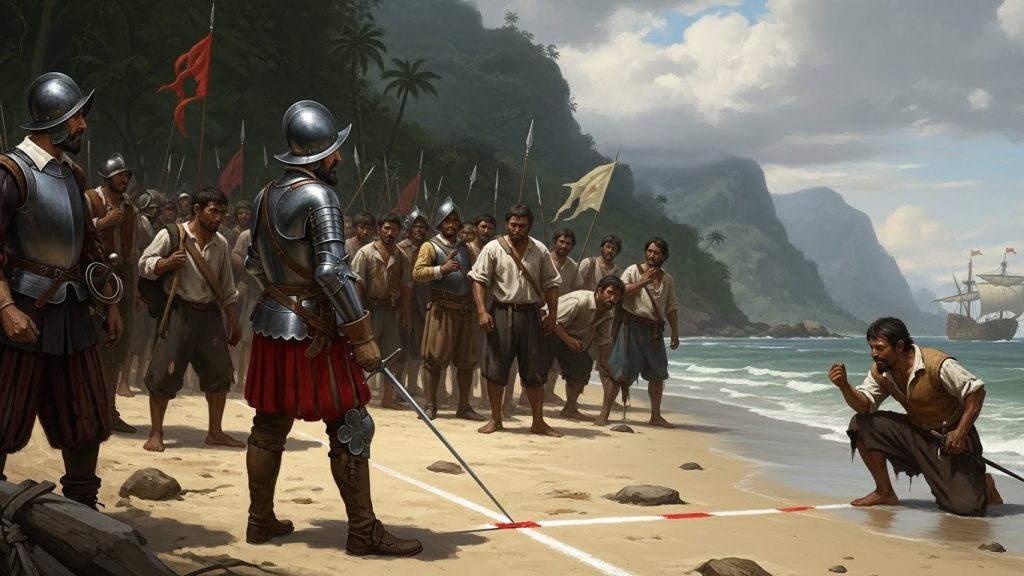
And then Pizarro said a historical sentence.
He sat on the sand of the shore and drew a line in the sand with his finger and said, “From here onwards is Peru with its treasures, and from here backwards is Panama with its poverty.
Every man present here should decide at this very moment which side of the line he wants to go to.”
And then 13 people decided to go with Pizarro to the Inca Empire, who later became known as “The Famous Thirteen.”
And from there, they reached the present-day Tumbes region, where the Inca king lived.
And what they write about him is that the king’s house was decorated with gold and silver everywhere, even his curtains were made of gold chains.
For the first time in their lives, they saw an animal called a llama, which they recorded in their books as a small camel.
And the local Incas called them “Children of the Sun” because their skin was very fair.
But despite all this warm welcome, the Incas still did not tell the Spaniards anything about their treasures.
Now Pizarro also had dreams of cities of gold in his eyes like Cortes, so how could he give up so easily?
So he thought that this time, instead of going to the governor, he would go directly to the king of Spain.
So he went to Charles I.
He told him the stories of the gold and silver found in Peru, and returned with about 200 men, one cannon, and 27 horses.
And then what happened?
The Inca people had never seen horses in their lives, and the cannon was like something that had fallen from the sky for them.
An iron genie that breathes fire.
Seeing all this, a delegation of the Inca people, including the king, came to meet the Spaniards.
And Pizarro did exactly what Cortes had done.
He arrested the king.
The king, whose name was Atahualpa, offered Pizarro a deal that if he let him go, he would give him gold bars equal to the size of the room, and silver bars twice the size of the room. Pizarro agreed, and the interesting thing is that the Incas also paid this ransom. They loaded gold bars on the horses of the Spaniards. But Pizarro completely backed out of his promise and killed the king.
And look, from here on, there is a very instructive story. Despite having all the power, the Incas did not resist.
They silently accepted the subordination of the Spaniards. For them, the death of the king was in a way the death of their god. So they silently accepted the employment or slavery of the Spaniards. They became slaves of the Spaniards. They started working in the gold and silver mines for them. They would take out this wealth and give it to the Spaniards. And what were the Spaniards doing in return?
First, they did not pay the Incas any salary. And second, if any Inca worker died while working in the mine, his family had to immediately send a replacement, whether it was his brother or his father. And mind you, given the kind of mountains these were, hundreds of people died every year. And so, as people died one by one, the Inca Empire slowly disappeared from the face of the earth.
The empire that had built incredible constructions was itself erased from existence in 1572.
The story of the Inca Empire has lessons for us from many angles. This kingdom was very advanced, with magnificent buildings, organized agriculture, that is, terrace farming, and then control over water. But when superstition and cowardice prevailed, only 27 horses and one cannon were enough to destroy the entire empire. If they had learned the language of the Spaniards and dealt with them with wisdom, understanding their psychology, as it is in Al-Baqarah, “And speak to people in the best way,” then perhaps the fate of the Incas would have been a little different.
But the biggest thing was polytheism. Instead of worshipping the Creator, they worshipped the creation. How they had made the sun, moon, and king their gods, how they would sacrifice for them without any restraint. The case study of the Inca Empire teaches us the true power of monotheism. It reminds us of that verse of Surah Yusuf, “That which you worship are but names that you have named.” The Incas had given dozens of names, Viracocha, Inti, Q’asa, Con, and dozens of others that they worshipped.
The greatest power of the continent was wiped off the face of the earth due to misguidance.
Here our episode for today is complete, but in the next episode, a topic is coming that I personally like very much.
