

The Rise and Fall of the Aztec Empire: A Tale of Gold, Gods, and Greed
In the name of God, the Most Gracious, the Most Merciful. Peace be upon you.
In Surah Yusuf, there’s a verse that says, “Have they not traveled through the earth and seen the end of those before them?” You see, when you mention “people of old” or “previous nations” to an ordinary person, only three or four names come to their mind: the people of Aad, the people of Thamud, the people of Lot, or at most, someone might mention the people of Noah or Pharaoh. But many more nations than these four have passed away in the world.
According to archaeological and anthropological studies, we know about at least 10,000 nations that have existed. In fact, Surah Yasin tells us, “How many generations have We destroyed before them?”
Now, from among the past nations, why did I choose the people living in the Amazon, like the Mayans or the Aztecs? Because they were very advanced in their knowledge of calendar systems, the sun, the moon, and other celestial bodies, and in astrology, the knowledge of the stars. But still, these civilizations were rife with intense idolatry, sacrifices, and magic.
So, until we study them and understand their culture, how will we know where polytheism can lead a person? Until we study them, how can we learn a lesson from them? How will we know that even with knowledge, if a nation doesn’t follow guidance, how it gets destroyed?
Then there’s the angle of Da’wah and Tabligh. When a Muslim studies ancient and powerful civilizations like the Mayans or the Aztecs, or understands the temperament of other such nations, naturally, he can communicate with the global academic community in a much better way. He can spread the message of Islam with history, reason, and logic.
Imagine how great it would be if a researcher, after watching my videos, after learning from me, stands on a big platform like TEDx and represents Islam at an international level by giving examples from world history.
Then there’s another point. Mayans and Aztecs were civilizations that wanted to know the secrets of the universe. They wanted to connect with a higher power through the sky, stars, and time. So, this tells a Muslim that every human is naturally in search of a creator, but without guidance, the result is the worship of stones and the sun, and human sacrifice. And then we realize what a great favor Allah has bestowed upon us by giving us guidance.
And finally, whether it’s the Mayans or the Aztecs, the Incas, or the ancient Egyptians, every one of these civilizations influenced humanity, but at the same time, every one of them committed polytheism. They all worshipped the creation instead of the creator, and the end of all of them was nothing but decline and destruction. Whereas Islam has taught man monotheism. Instead of sacrificing man, it has taught him his sanctity. And as a result, instead of decline and destruction, it has promised an eternal life.
So, the question of what benefit the community is getting from all this, dear family, if the community wants to benefit, then there is only benefit for it from all this knowledge. And if it doesn’t want to benefit, then for it, these videos of mine will be nothing more than stories. But remember, according to Al-Furqan, this was the answer of those who used to say after hearing the lessons from past nations, “These are but tales of the ancients.”
So let’s start today’s episode, in which I’m going to tell you a story of a nation from the past, a story that you might never be able to forget after hearing it.
The Founding of a Floating City
Many centuries ago, a nation was wandering here and there in the dense forests of the Amazon. We don’t know much about the beginnings of these people, where they came from. But this nation called themselves the people who came from Aztlan, which is why later in history, their name became the Aztec tribes.
The best information about the Aztec tribes is found in a book written in 1577, the Florentine Codex, which was written by a Spanish priest who lived with the Aztec people. This book is in 12 volumes, and it is in the old Spanish language. And through it, we learn that these homeless and poor tribes, who wandered in the jungles, had no land of their own to live on.
But one night, their king had a dream that wherever you see a lake and an eagle on it, catching and eating a snake, that will be your sacred land. And after many years of searching, that day finally came when these tribesmen saw the exact same scene on the shore of a lake: that an eagle was catching and eating a snake in its talons, just as the king had seen in his dream.
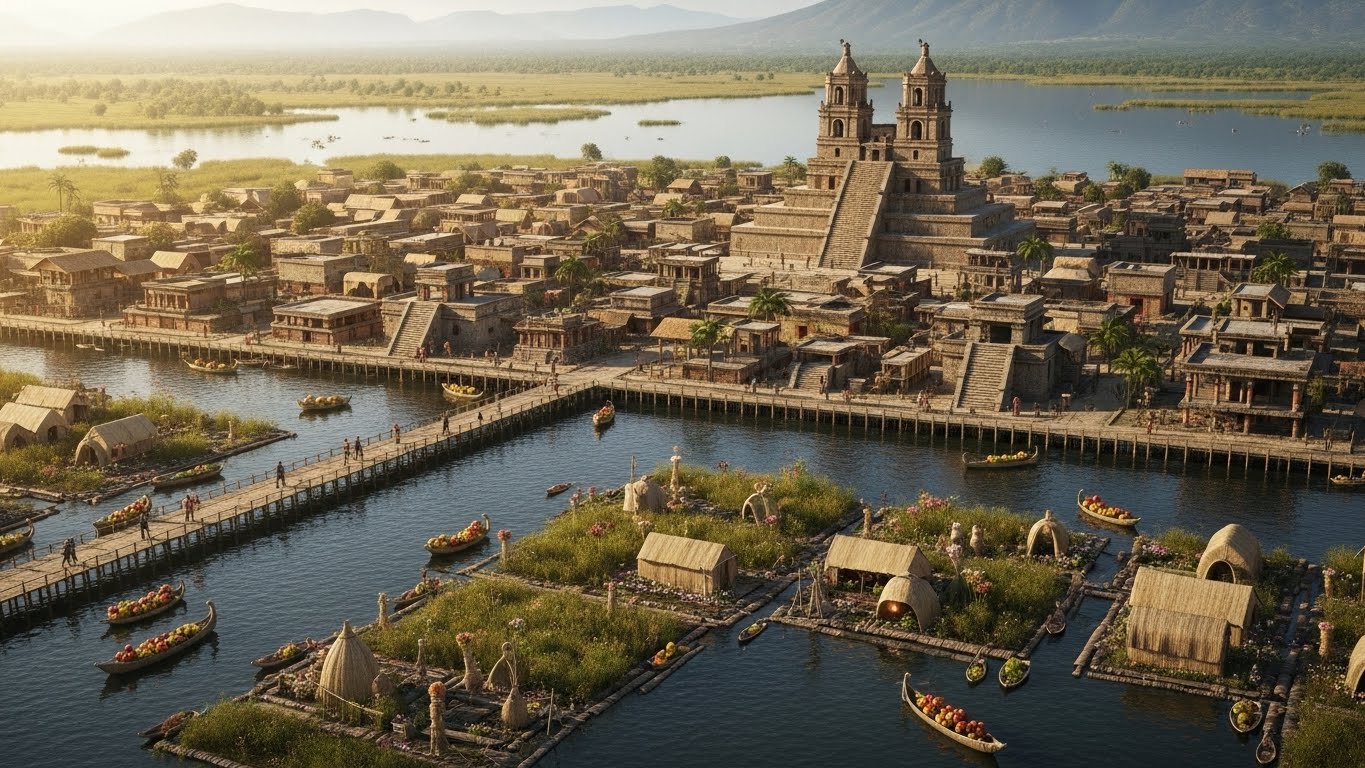
And then, in the middle of the lake, these people established a whole city, which was named Tenochtitlan.
A Marvel of the Ancient World
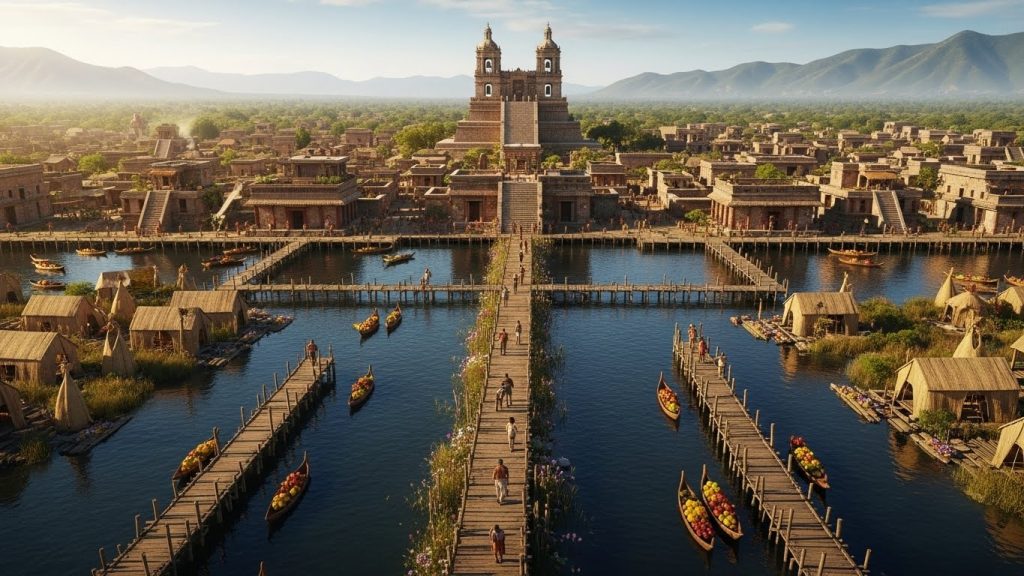
Tenochtitlan was no ordinary city; it was literally a dream floating on water—the capital of the Aztec Empire, which started with a dream and became a reality in the middle of a lake. And in its heyday, that is, in the 13th century, its population had exceeded two hundred thousand, which was more than many large cities in Europe at that time.
This city, due to its structure, its system, and its beauty, was one of the oldest and most amazing cities in the world. It had floating fields that were made with mud and the roots and reeds present in the lake, and in which corn, beans, tomatoes, and green and red chilies were cultivated. Whole islands were made of mud and roots, canals were built, in which boats plied like urban transport. To connect the city with the surrounding land, i.e., the mainland, there were three large wooden bridges around which boats carrying beautiful fruits and fresh vegetables floated. And also those boats in which they used to sit and hunt fish and water birds.
When people from Spain first saw Tenochtitlan in 1519, the conquistador among them, Hernán Cortés, writes that “I have seen Rome and I have also seen the Turkish city of Constantinople, but seeing Tenochtitlan has opened my eyes in amazement. I have never seen such a city in my whole life.”
By the way, this Cortés is a very important character in this story. You must remember his name in your mind. Right now, I’m just mentioning him, but later on, I will tell you in detail who he was and what his role was in this story. But for now, you should know why the Aztecs basically built this pyramid.
A Civilization Built on Sacrifice
You see, while the Aztecs were very advanced in engineering and astrology, some of their beliefs were, to the worst extent, based on polytheism and fear. For example, they believed that the sun would only rise every day if they gave it blood. And so, every morning, they would perform human sacrifice on top of this pyramid.
They were already very expert in warfare. So, what would they do? They would attack the surrounding tribes at night, capture them, and sacrifice them every day in front of the sun god on top of the pyramid.
You may remember that in 2006, a movie came out, “Apocalypto.” In this movie, the same Aztec ritual is depicted in a very amazing way, how they sacrificed their enemy tribes. First, they would take the sacrifice to the very top of the pyramid because they believed that this way, the sacrifice would quickly reach the sun god. And then… okay, I’m skipping some details because they are quite disturbing, and listening to them will unnecessarily upset you. But after the sacrifice, then the priest would take out the heart and raise it towards the sun, and throw the rest of the body down the stairs of the pyramid. In the Florentine Codex, there are complete details of the sacrifice, which the author saw with his own eyes. And there are some things that I can’t even tell you here, what they used to do. In fact, in some cases, the priests would even consume the sacrifice.
Anyway, I told you that this pyramid was a double pyramid, of which one pyramid was for the god of the sun and war, while the other pyramid was for the god of rain and agriculture. And the purpose of the sacrifice on both of them was that the gods, pleased with the tears flowing from the eyes of the sacrifice, would shower rain on us like those tears. And seeing the heart, the sun god would rise upon us.
Human sacrifice was a daily routine for the Aztec civilization. First, teaching warfare in their schools, preparing the best warriors and sending them to fight wars with the surrounding tribes, capturing those people, and then sacrificing them. And sacrifice had become a kind of obsession for those people. And for this reason, the surrounding tribes started to hate those people intensely. And this hatred, later on, played a very important role in this story, which I will discuss again in a little while, God willing.
You see, by the way, in the jungles of the Amazon and the Mesoamerican tribes, sacrificing a human was quite a common thing. But the Aztecs took the concept of sacrifice to a new level of bloodthirstiness. They had two types of calendars. One was the normal 365-day calendar that we also use, and the other was a 260-day calendar, which was their own spiritual calendar, or you could say, their sacrificial calendar. Because according to that calendar, they would decide which sacrifice to make on which day. Once every 52 years, it would happen that the last dates of both calendars would fall on the same day. And on that day, they would perform a very horrific ritual, that indiscriminate sacrifices would be made on top of the pyramid.
In fact, the Aztecs’ own books, for example, the Codex Magliabechiano, tell us that in 1487, in just four days, the Aztec king sacrificed 20,000 people. In just four days. And the movie “Apocalypto” is basically based on the events of that day. If you feel like it, you should definitely watch that movie once.
The Prophecy and the Conquistador
By the way, I just mentioned that they would often consume those sacrifices. Because this act was a symbol of the king’s political power. And it would send a message to the rebels that, “Listen, if you rebel, this will be your fate.”
This bloodthirstiness, this cruelty, all of this would happen on this stone that was on top of the pyramid, which was found during excavations about 50 years ago. This is the original picture of that stone, and its name is the Coyolxauhqui Stone. And what is carved on it, you can see for yourself.
This stone used to be on this pyramid, which was a great symbol of construction, engineering, astronomy, and treasure. But the slab of stone placed on this pyramid is the one on which humanity, mercy, and faith have been sacrificed millions of times. This is the stone that has drunk the blood of millions of people. Because they believed that they had to offer their hearts to the gods, whereas our true Lord only requires the intention of the heart and our piety.
For the Aztecs, sacrifice was not just a ritual, but a belief wrapped in fear. A system in which man was food for his god. Whereas in Islam, the sanctity of human life is taught, and the Quran tells us that whoever kills a person, it is as if he killed all of humanity. So, what a sense of safety and security one feels knowing how much our religion loves us, how much it cares for us.
These are the reasons why I’m telling you this story of the Aztecs. So that by learning about the Amazon, the value of our religion in our hearts increases many times. What a beautiful feeling it is to see that Allah has given us guidance and what a great blessing He has given us in the form of the Quran.
Anyway, let’s move on from here. The Aztec was such a civilization, such an empire, that it established its cities on water. It built pyramids made of gold, whose every day began with a sacrifice for the sun. Then their warfare, which even today is famous as Aztec warfare, and let me tell you something interesting. Even today, we use some Aztec words in our daily speech. For example, what is the English word for tomato? Tomato. Which was basically the Aztec word “tomatl.” Similarly, chocolate too, which was basically the Aztec word “xocolatl.” In fact, avocado too, was originally the Aztec word “ahuacatl.” All these words come to us from the Aztec language, which they called Nahuatl.
The Fall of an Empire
The Aztec was a very developed civilization. But at the same time, if you look at their obsession with sacrifice, you will be amazed. A world shining with gold, that started with a dream, was decorated with blood, and turned to dust. And the beginning of turning to dust starts with a girl living in the empire.
The information that I am going to give you from now on, some of that information we know from the letters written by Cortés himself, which were printed in 1526 as a book in the Spanish language, named “Cartas de Relación,” meaning “Letters of Conquest,” in which we get a direct first-person account from Cortés’s point of view, that when the Spaniards first went to the Aztec Empire, what they saw there. And the rest of the information, then, in 1632, another Spanish book was written, “Historia verdadera de la conquista de la Nueva España,” meaning “The True History of the Conquest of New Spain,” in which once again a first-person account is given, that the author saw the daily life in the empire with his own eyes.
This book was written by an ordinary soldier, Bernal Díaz, who came to Tenochtitlan with Cortés. By the way, these books are from the 15th and 16th centuries. And I can’t even tell you how much effort it takes to extract information from these books. And this Spanish is also old-fashioned Spanish. Sometimes you can find an English version of a book, but often you have to translate the original Spanish in different ways to understand it. You can easily say, “Sir, make two videos a week,” but the truth is that behind these videos are weeks of hard work.
Anyway, let’s get back to our story. In Tenochtitlan or some other city of the empire, in the year 1500, a girl was born whose parents belonged to the royal family of the empire. And because they were chieftains, they were the owners of a great treasure of gold and silver. What was the girl’s birth name, no one knows because she was just a little girl then, that is, eight or ten years old, when her parents handed her over to the local merchants and told them to take her with them. They did this so that their son could be the sole heir to their entire treasure. And this disloyalty of the parents stuck in the girl’s heart like a thorn.
When she was kicked out of her house, the only thing the girl had besides the clothes on her body was the Aztec language. And also that variant of the language that only the kings spoke because the girl was born in the house of a great chieftain of the empire. The local merchants took the girl to a city on the coast, where she then lived with people of different tribes and learned two more languages. And also the Spanish language through the Spaniards who came and went on the coasts.
The book I told you about just now, meaning “The True History of the Conquest of New Spain,” it also contains the testimony of two such people who saw this girl with their own eyes. And they say that she was barely a 20 or 22-year-old girl whose real name no one knew, but the tribesmen called her La Malinche, while the Spaniards called her Marina.
And in the dense jungles and seas, in this very coastal city, La Malinche met the conquistador from Spain, Hernán Cortés. When Cortés first came to these shores, he had only 11 ships, 500 soldiers, a few horses, and a few cannons. But in his head, he had a very sharp mind and in his heart, a lot of greed. And when he met La Malinche or Marina, Marina also recognized the ambition hidden in Cortés’s eyes at once. And she resolved in her heart that this is the person who will take revenge on my parents for their disloyalty.
Cortés already had greed in his heart. He had also heard the tales of the City of Golds hidden in the jungles of the Amazon and Mexico. But more than that, La Malinche then started to feed his greed. She started telling him stories of the mountains of gold hidden in Tenochtitlan. And she told him about a famous prophecy among the Aztec people, that they had found out by looking at the stars that soon a white-skinned person will come and claim the Aztec treasure.
And this was actually true. I told you that like the Mayans, the Aztecs were also very advanced in astrology. And through astrology, they had an idea that soon a white-skinned person would come. And so, Cortés took La Malinche with him, and from here on, we learn from his letters what happened from here on.
Cortés says that on November 15, 1519, we reached the shore of Lake Texcoco, in the middle of which the famous city of Tenochtitlan is located. At that time, the sun was shining on the lake, and seeing the city shining in its light, my soldiers’ eyes were wide open in amazement. A dream-like city built on water. Roofs made of gold and temples made of marble.
When we got off the boats, wearing a golden crown made of pure gold, King Montezuma came to welcome us and bowed down and said, “We were waiting for your arrival, O powerful spirit. My ancestors had said that you would come, and look, today you have come.”
Now Cortés knew that there was a prophecy among them. La Malinche had already told him all this. But instead of breaking this misunderstanding, Cortés used it. And he told Montezuma that yes, I am indeed your god.
Then the king also gave Cortés some gifts, for example, gold jewelry, crowns made of beautiful feathers, masks made of precious turquoise, and Cortés says that seeing all this, I was thinking in my heart that this is just a glimpse of the city of gold. Its real treasures are waiting for me.
Then there was a conversation between the two, that is, between Cortés and Moctezuma, which was being translated through La Malinche. This was the meeting in which the Aztec Empire welcomed its own killer with its own hands. Sometimes it seems that the real conqueror of the Aztec Empire was not Cortés, but La Malinche. Because she spoke in that language in which the kings spoke. For Cortés, that girl, besides being his love, had also become his tongue. If it weren’t for her, Cortés would never have been able to reach the city of the bloodthirsty warriors like the Aztecs. It was only La Malinche whose royal language made the jungle people trust her, and the Spaniards used it.
That’s why today many people believe that the real conqueror of the Aztec Empire was La Malinche. And the Spaniards also call her not just Marina, but Doña Marina, meaning Lady Marina. And they also write that if anyone helped us conquer New Spain after God, it was Doña Marina.
Now, from here on, I’m skipping some small incidents, which are not so important to know. But in short, what happened was that the king invited Cortés inside the pyramid. But when he went there and saw the gold there, the Spanish soldiers couldn’t hold back. They arrested King Montezuma and started looting the gold in the pyramid. Because they thought that we would kill these wild people and leave from here. But when people found out that the king had been arrested, the situation in the city started to get worse. People from outside started throwing stones. And the Spaniards realized that we, a few hundred soldiers, would not be able to fight with these thousands of people. So we have to get out of here overnight.
So, every soldier took as much gold as he could carry. He took it. And from here on, I’m going to tell you the events as seen by a soldier, whose name was Diego Martín, a soldier. And he saw that night with his own eyes.
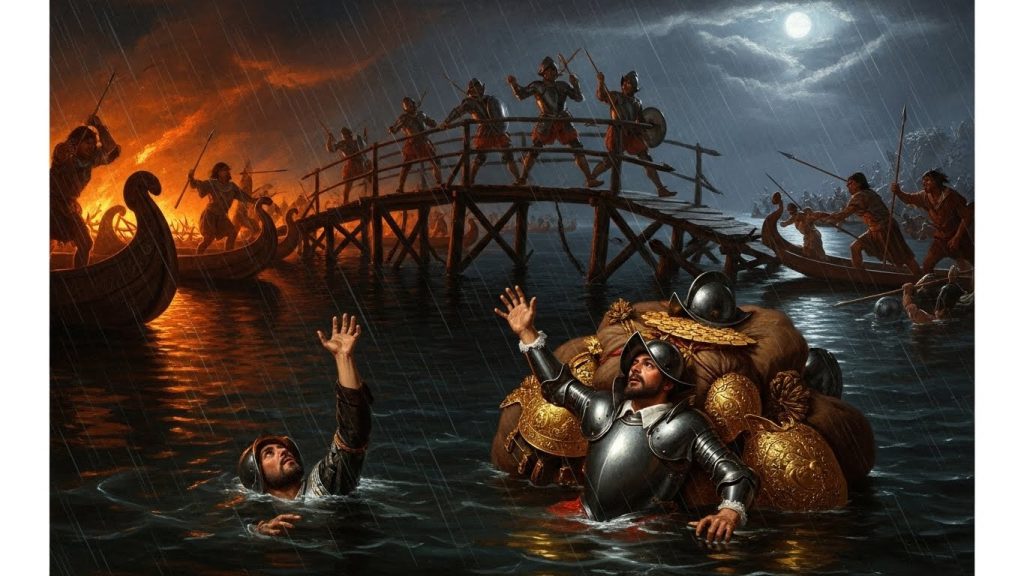
In his autobiography, Diego tells that I, Diego, one of Cortés’s 500 soldiers, we had heard before entering Tenochtitlan that this city was made of gold. But that night, gold became a noose around our necks. The night was about to begin, and we went to a place outside the city, stepped onto the bridge. And we could feel that ahead on the same bridge, in the darkness, the enemy was hiding. Cortés ordered us to be silent, to make no sound. Gold was tied to our backs. And there was a sword in hand, but there was fear in the heart. We were slowly moving forward when suddenly there was a commotion in the water. And then a scream was heard, after which a whistling arrow came, then a second, and then thousands more arrows. The Spaniards were shouting to each other, “The Aztecs are here, the Aztecs are here.”
And the Aztecs were coming fast in their boats, like a devil walking on water. They had painted their skin with blue color. Shining spears and sky-piercing cries. Our horses also started to shy away in fear. The bridge began to break, and the soldiers standing on it began to fall into the lake one by one.
I was with a soldier named Pedro, who was wearing armor made of gold. He had taken this armor from inside the pyramid. And as soon as he fell into the lake, that heavy armor made of gold started pulling him down. I grabbed his hand and he shouted, “Get me out!” And I shouted, “Drop the gold! Take off the armor!” And he tried hard, but he couldn’t take off the armor. And the next moment, Pedro disappeared into the water. He was dead, under the weight of the same gold that he had come to take back home to Spain.
We were running here and there. The bodies were scattered here and there, the boats were on fire. The Aztec army was fighting like crazy. This was their land, this was their city. And this was their revenge. Cortés’s face had become serious. Now there was no arrogance in his eyes, but tears. He was sitting under a tree. And we heard him say, “This gold has become our death.”
You know, the tree under which Cortés was sitting, that tree still exists today. This is the original picture of that tree, which the Spaniards later gave a name to, Árbol de la Noche Triste, meaning “The Tree of the Sad Night.” The tree where Cortés cried. The tree under which the conquistador sat, with tears in his eyes and his sword falling from his hands.
And this night, in the history of Spain and Mexico, this night is known as La Noche Triste, meaning that night when the mountain of sorrow broke.
Almost all of Cortés’s soldiers were killed. And that dollars’ worth of gold was sunk in the depths of the lake. La Noche Triste is not just a military defeat. But it was a decision of nature against human pride, greed, and arrogance. And this tree today, it stands as a witness to that decision. Árbol de la Noche Triste.
Just think what kind of history this old witness has seen. But as a Muslim, what do we learn from this night? That when wealth rules the heart, then man only drowns.
That night, Cortés escaped from there. But only two years later, he brought a very large army, cannons, and the tribes living in the forests of the empire, the tribes that the Aztecs hunted and sacrificed, the tribes that hated the Aztecs intensely, Cortés had also allied himself with those tribes. And I told you that this hatred then played a very important role in this story.
And then this force of thousands of people, to wipe Tenochtitlan off the face of the earth, then besieged the entire lake. 93 days. For 93 days, those people besieged Tenochtitlan. They blocked the water coming from the canals. Food’s, they cut off the supply routes. Plague and diseases started spreading in the city. The once magnificent Tenochtitlan was now hungry, thirsty, and wounded.
And finally, on August 13, that is, in the same month, but in 1521, the Aztec Empire came to an end forever. That empire, which was extremely advanced but was built on the foundation of intense polytheism, that empire was now drowned in the water and mud of the lake. According to the sixth verse of Al-An’am, “Do they not see how many generations We have destroyed before them? To whom We had given such power in the world that We had not given to them.”
What did we learn from the story of the Aztec Empire? You see, Allah gave them intellect, with which they built cities floating on the lake, created wonders. But their cruelty, polytheism, and obsession with human sacrifice became their downfall. A dream built on a lake, which was the pinnacle of intellect of its time but completely devoid of faith, that’s why it was buried in the mud forever.
What happened after the destruction of the empire? Cortés started to tear down the city. He had their largest pyramid, the Temple of the Sun, torn down and a church built there. But of course, since all this was happening in a hurry, they couldn’t completely demolish the pyramid. Therefore, in 1978, when electricity wires were being laid in Mexico, at that time, the pyramid of Tenochtitlan was accidentally discovered, on which millions of people were sacrificed.
Although the Spaniards had looted most of its treasure, but some traditions and secret reports suggest that during those 93 days of siege, some priests took most of the treasure out of the pyramid and hid it somewhere else, buried it. And this, that the whole treasure was never found by Cortés. Even today, the Aztecs are quite famous for their lost treasure. And even today, many research expeditions have been conducted in search of this treasure.
What happened to La Malinche? The girl died at the age of 30. And the Spaniards see her as their great benefactor. La Malinche also had a son with Cortés, and what happened to him after that, no one knows. But the girl who was a victim of her parents’ disloyalty in her childhood, she took her revenge by destroying the entire empire. Some people say she was a traitor. And some people say that she was a woman who gave birth to a new civilization after the Aztecs. But I think, my personal opinion is, that La Malinche was a helpless woman caught between two cultures, who had to make very tough decisions at a young age. If she went against her parents, they would have sacrificed her. And if she went against Cortés, he would have killed her.
Imagine what complex stories were born in those jungles. What kind of incidents happened? What kind of conversations took place in those past nations?
The city of Tenochtitlan was destroyed, but what happened to the lake, that is, Texcoco? The Spaniards didn’t like this lake. For them, this water was just a source of disease, mud, and difficulties. And then, naturally, there were so many diseased bodies lying in it, so obviously this would have been a cause of horror for them. So after the destruction of Tenochtitlan, they started drying up the lake. They broke the canals, bridges, and pyramids. And slowly, the whole lake became a land.
You can see that compared to the Aztec era, this lake has almost disappeared today. The lake on whose shores people once stood whose eyes were dazzled by the shine of Aztec gold, today only small parts of it are left, on whose shores perhaps no one stands anymore.
But the city of which the king had a dream, that wherever you see an eagle eating a snake, your city will be established there. So, today, on the flag of Mexico, you will see exactly this eagle and exactly this snake. In memory of that great city of Tenochtitlan, in whose lake’s place today Mexico City is located.
And then finally, Hernán Cortés. They say that Cortés was brought down by the curse of the Aztec people. Their curse brought him down. Immediately after destroying the empire, his love, La Malinche, also died in her youth. After her death, Cortés, when he returned to Spain, not a single person praised his achievements. And he started to feel like going back to La Malinche’s grave once more. But before he could go, he also died in Spain. Out of pity, his body was sent back to be buried near La Malinche’s grave, but peace, it seemed as if it was not in his fate. Sometimes someone would destroy his grave, and sometimes someone else. Cortés’s bones were moved from one place to another eight times. Until finally, some parts were buried in one place and some in another.
Here, our story for today comes to an end, but for the community, there are many lessons hidden in this story. King Montezuma and his nobility had such pride in their civilization, their power, and their religious structure that at first, he didn’t take the threat from Spain seriously. Whereas An-Nahl tells us that Allah does not like those who are arrogant. Then discord and internal weakness. This is a very big curse. The other tribes in the empire were angry with the Aztecs and were oppressed by them. And Cortés used this weakness. He had allied himself with the other tribes of the empire. Whereas Al-Imran tells us to hold fast to the rope of Allah and not be divided.
Then the lesson of understanding warfare. That the enemy doesn’t always win by strength alone. But he can also use intelligence and psychological attacks, as Cortés did. He used diplomatic cunning. And he allied himself with the empire’s own people. Whereas Al-Imran guides us that the plots of the disbelievers should not prevail over you.
And then the biggest lesson is this, that the end of oppression is only destruction. Aztecs, human sacrifice, oppression, and tyranny were based on a system. And their religion also considered this oppression justified and endorsed it. Whereas Surah Hajj tells us that Allah’s help cannot be with the oppressor.
So, with all these beautiful lessons, we conclude today’s episode. And now, you must do two things. First, please press the like button below this video. So that this interesting and informative video can reach the other members of our YouTube family. And secondly, please read my pinned comment, my top comment, in the comment section below, because in that comment, there is a very important message for all of you from me. Thank you and God bless.
