
In the name of Allah, the Most Gracious, the Most Merciful. Peace be upon you.
There is a very famous and, to a large extent, mysterious saying attributed to Hazrat Ali ibn Abi Talib (may Allah be pleased with him) that, “I know the paths of the heavens more than the paths of the earth.”
This statement is actually written in a very famous 11th-century book, “Nahj al-Balagha.” It was written by a great scholar of his time, Sayyid Sharif Radi, and in this book, Sharif Radi compiled some of the sermons of Hazrat Ali (may Allah be pleased with him)—not all, but some sermons and letters.
And these are the sermons that Hazrat Ali (may Allah be pleased with him) delivered in a mosque in Kufa during his caliphate. Among these sermons, in sermon number 187, this saying of Hazrat Ali (may Allah be pleased with him) is written. The complete saying is something like this: “O people!”
“Before that turmoil comes which will trample even the rein under its feet, that turmoil which will destroy people’s intellects. O people! Before you lose me, ask me whatever you wish, because I know the paths of the heavens more than the paths of the earth.”
Now, many people have interpreted this saying in different ways. Some have said it means that Hazrat Ali (may Allah be pleased with him) knew heavenly commands more than worldly matters. Some have said, no, this is only about the knowledge of jurisprudence (fiqh). And some have outright declared this narration to be false, saying that these are all fabricated stories and Hazrat Ali (may Allah be pleased with him) never said such a thing.
As for the claim that Hazrat Ali (may Allah be pleased with him) never said such a thing, there is disagreement about this narration. So, I request you to try doing public preaching sometime, and you will meet people who, even when you present verses of the Quran and hadiths from Bukhari before them, will still find a point of contention. This, after all, is just a statement written in a human book.
But as for the question of whether Hazrat Ali (may Allah be pleased with him) said this in relation to heavenly commands and worldly affairs, he did have knowledge of worldly matters because, after all, he was a caliph. And in this sermon, he is also saying that a turmoil is coming that will trample the rein under its feet and will destroy intellects.
Therefore, it doesn’t quite fit that the paths of the heavens here only refer to religious knowledge. But I fully understand that my YouTube family includes people of all kinds and all ages. So, putting aside all this technical debate and controversial points, I begin my topic, which is about the knowledge of Hazrat Ali ibn Abi Talib (may Allah be pleased with him) and the paths of the heavens. And believe me, after watching this video, God willing, you will enjoy it.
What was the status of Hazrat Ali ibn Abi Talib’s (may Allah be pleased with him) knowledge? He (may Allah be pleased with him) is among those companions who had memorized the entire Quran during the lifetime of the Prophet Muhammad (peace be upon him). And on one occasion, Hazrat Ali (may Allah be pleased with him) himself said,
(Citation: Tabaqat al-Kubra, Vol. 2, p. 275)
“I can tell about every single verse of the Quran whether it was revealed during the day or at night, whether it was revealed on a mountain or in a plain. I can tell when, where, and in whose favor that verse was revealed.”
Therefore, Hazrat Ali (may Allah be pleased with him) is a companion who is counted among the highest scholars of Quranic exegesis (Tafsir). And among the companions who possessed top-level knowledge, his name (may Allah be pleased with him) and the name of Ibn Abbas (may Allah be pleased with him) are certainly included.
Let me tell you about a testimony to the knowledge of Hazrat Ali (may Allah be pleased with him). Masruq ibn al-Ajda’ (may Allah be pleased with him) was a great scholar among the Tabi’in.
And for my new viewers, let me explain again that Tabi’in are those who learned their knowledge directly from the companions of the Prophet (may Allah be pleased with them). And Masruq, since childhood, was a very eager student of knowledge.
Imam Sha’bi (may Allah have mercy on him) says that he had never seen a child more eager for knowledge than Masruq. The Mother of the Believers, Hazrat Aisha (may Allah be pleased with her), had adopted him as her son; she used to call him her son. And Masruq says that for the sake of acquiring knowledge,
(Citation: Tabaqat al-Kubra, Vol. 2, p. 282)
“I learned knowledge from all the companions of the Messenger of Allah, and I saw that the culmination of knowledge reaches six people.”
Meaning, among all the companions, the highest knowledge is possessed by these six people: Hazrat Ali (may Allah be pleased with him), Hazrat Umar (may Allah be pleased with him), Abdullah ibn Mas’ud (may Allah be pleased with him), Mu’adh ibn Jabal (may Allah be pleased with him), Zayd ibn Thabit (may Allah be pleased with him), and Hazrat Abu Darda (may Allah be pleased with him). And then Masruq says that when he compared the knowledge of these six, he saw that even among them, the knowledge of two reached its peak: one was Hazrat Ali (may Allah be pleased with him), and the other was Ibn Mas’ud (may Allah be pleased with him).
Now, a question arises: where did Hazrat Ali (may Allah be pleased with him) get so much knowledge from? There was a reason for it: a prayer made for him by the Prophet Muhammad (peace be upon him). There are two companions for whose knowledge the Prophet himself prayed: one was Abdullah ibn Abbas, and the other was Hazrat Ali.
You may have often heard me mention the name of Abdullah ibn Abbas, and you may have noticed that his knowledge also speaks of the heavens and the earth. And just like him, the knowledge of Hazrat Ali also speaks of the paths of the heavens.
What was that prayer of the Prophet (peace be upon him)? It is in a great 9th-century book, “Al-Mustadrak al-Hakim,” that when the Prophet Muhammad (peace be upon him) was about to send Hazrat Ali (may Allah be pleased with him) to Yemen,
(Citation: Tabaqat al-Kubra, Vol. 2, p. 274)
he said, “O Messenger of Allah! You are sending me to a place where a very old and senior nation lives,”
“whereas I do not even know how to make judgments. O Messenger of Allah! I fear that I may not be able to do justice to my appointment there.” And then, the Prophet (peace be upon him) placed his hand on his chest and prayed to Allah, “O Allah! Guide Ali’s heart and make his tongue firm.” And after that, Hazrat Ali says, “By the One who caused the seed to sprout from the earth,”
(Citation: Tabaqat al-Kubra, Vol. 2, p. 274)
“after that, I never had any difficulty in making a judgment for the rest of my life.”
And it was after this incident that he said that no verse was revealed about which I did not know whether it was revealed during the day or at night, on a mountain or in a plain.
And after this incident, Hazrat Ali ibn Abi Talib (may Allah be pleased with him) was considered the greatest scholar of `Ilm al-Qada’ (the science of making judgments) in Medina. ‘Qada’ means the knowledge of making judgments, and from ‘Qada’ the word ‘Qadi’ (judge) is derived.
And what was behind this excellence of his? The prayer of the Prophet Muhammad (peace be upon him), which he had asked from Allah for the knowledge of both Ali and Ibn Abbas (may Allah be pleased with them). And then see what titles these two companions received later on. One was called the “ocean of knowledge,” and the other, the “gate of the city of knowledge.”
Because in Al-Mustadrak al-Hakim, there is this hadith: “I am the city of knowledge, and Ali is its gate.”
(Citation: Prophet Muhammad ﷺ, Al-Mustadrak al-Hakim 4637)
Therefore, doubting the knowledge of Hazrat Ali (may Allah be pleased with him) does not befit us. And now I come to his saying that “I know the paths of the heavens more than the paths of the earth.” And to fully understand these paths, you have to look at the original Arabic text of Nahj al-Balagha, where Hazrat Ali says:
(Citation: Nahj al-Balagha, Sermon 187, p. 444)
“I know the paths of the heavens more than the paths of the earth.”
“I have more knowledge of the paths of the heavens than the paths of the earth.” What are these ‘turuq’? This word, in fact, with the same recitation, also appears in the Holy Quran. Surah Al-Mu’minun, verse 17:
(Citation: Allah) “And We have created above you seven ‘tara’iq’.”
Meaning, “We have made seven ‘tara’iq’ above you.”
Now, generally in Urdu, the word ‘tara’iq’ is translated as ‘sky’ or ‘heavens,’ as in “We have made seven skies above you.” But I am truly very sorry, but for the sky, Allah has used a very specific word in the Quran, ‘samaa’.
Again and again, Allah has used the words ‘samaa’ and ‘samawat’ for the sky. For example, in Surah Nuh:
(Citation: Allah, Nuh 71:15) “How Allah has created seven heavens in layers.”
Meaning, “How Allah has created seven heavens one above the other.”
So, if the word for the sky is ‘samawat’, then the meaning of ‘tara’iq’ must surely be something different. Now, in 44 tafsirs (exegeses)—I’ve often told you that the videos you watch, I prepare them with great effort; behind them is knowledge gathered from 44 tafsirs—in these 44 tafsirs, three meanings have been given for the word ‘tara’iq’. The first meaning: seven heavens.
And we have already excluded this, that this cannot be, because Allah has used a very specific word for the sky, ‘samaa’. The second meaning: seven recitations. Some scholars say that ‘tara’iq’ means seven recitations, that “We have placed seven recitations upon you.”
By the way, this matter of seven recitations is mentioned in a Sahih Hadith, that the Quran was indeed revealed in seven recitations, so you should recite it in the way that is easiest for you.
(Citation: Prophet Muhammad , Bukhari 2419)
But in this verse, the talk is about creation, not recitation, so the interpretation of ‘recitation’ is not very convincing here. Therefore, I searched for the definition of this word ‘tara’iq’, which is a plural, in 17 Arabic dictionaries. Side by side, placing 17 dictionaries together. These dictionaries were written from the 8th century to the year 2008, meaning they contain definitions from every era. And I’ll tell you the names of a few of these dictionaries so that if you want to verify for yourself, you can.
Kitab al-‘Ayn, Kitab al-Jim, Tahdhib al-Lughah, Taj al-Lughah, and Lisan al-‘Arab, etc. And in all of them, I found only one meaning for this word ‘tara’iq’: “a path on which one can travel.”
A path that has been specially leveled, prepared for walking; not uneven, but a clean, beautiful path through which things come and go. In other words, in simple terms, there are seven paths above us that exist with 100% reality, through which one can travel, through which things come and go.
And these paths are actually used by angels for their comings and goings, and I’ll explain how. These are the major, the main paths. There could be smaller paths as well, that we don’t know. But these seven major and significant paths are such that Allah has mentioned them in Al-Mu’minun, saying that “We have created them above you.”
And regarding these paths, I made a whole season called “Doors of Wonder.” And I chose this name because my beloved Prophet (peace be upon him) himself gave it this name: “Doors of the Sky.” Because Ibn Abbas (may Allah be pleased with him) narrates that once, while Gabriel was sitting with the Prophet (peace be upon him), a loud sound was heard from the sky.
(Citation: Prophet Muhammad ﷺ, Muslim 1877)
As if a door had been opened with force. Gabriel (peace be upon him) raised his head and said, “This is a door from the sky that has been opened today.” This door had never been opened before today. And from it, an angel is descending to the earth who has never descended before today.
The doors of the sky, the paths through which angels travel. Through these paths, things ascend and descend. The paths of the sky, the doors of wonder that open and close.
In the 13th century in Khorasan, there lived a scholar, Sheikh Sa’d al-Din al-Taftazani. Although he had a slight lisp, the knowledge given to him by Allah was as vast as a great river. At the age of only 16, he had written his first book on Arabic language and logic, “Sharh al-Tasrif al-‘Izzi.”
Now, in this book, he has written a very amazing paragraph, which I am translating here into simple Urdu, because its original Arabic words are a bit difficult. In this paragraph, Sheikh Sa’d al-Din is discussing the event of Mi’raj (the Prophet’s Ascension). That is, where the paths of the sky, those doors, were opened for the Prophet Muhammad (peace be upon him). First, listen to this paragraph, and then imagine from what an amazing angle Taftazani is trying to explain.
He says that the opening of the heavens is not impossible. This is denied only by those who do not believe in Paradise and Hell. Rifts, that is, paths, open in the heavens and then close again. It was through these rifts that Gabriel (peace be upon him) would descend from the sky to Mecca in a single moment. And to consider this thing—the opening of the rifts—as impossible is equivalent to denying Gabriel himself.
If you had difficulty understanding the word-for-word translation, let me explain it again in the simplest terms. Sheikh Sa’d al-Din is saying that paths in the heavens open and close. Only those who have weak faith, who do not know the greatness and power of Allah, deny this. It was by emerging from these paths and doors that angels would enter from the sky and appear in Mecca in a single moment.
And to deny these paths means we are also denying the coming of angels. And in today’s language, what do we call these doors? Many people call them wormholes, many call them portals. But I call them “doors of the sky.” I call them “paths of the sky” because Allah and His Messenger have given them this name themselves.
Okay, now how do these paths open and close? This question can be answered in two ways. The first answer is of a scientific nature, and the second is of a divine nature. And allow me to share a little bit of information with you from both perspectives. The first answer, from a scientific point of view. Look, I am explaining this in very simple language; I am not giving mathematical equations here, otherwise the video would become very dry. No!
Rather, I am giving you a general concept, and by the way, I got this general concept after sifting through a lot of research in physics. You see, if somehow you were able to generate an energy of 10 to the power of 16 electron volts within the sky,
you could create a small tear, a minor crack, a rift in the sky. But do you have any idea how big of a machine you would need to generate an energy of 10 to the power of 16 electron volts? Such a machine, such a particle accelerator, would have to be 9.46 trillion kilometers long. And do you know how big the largest particle accelerator we have right now is? 27 kilometers. That’s it.
This 27-kilometer-long machine, located on the border of France and Switzerland, is nothing in comparison to the energy that could create even a small tear in the sky. So now, imagine what an extreme, extreme, extreme power you would need to open these paths, to exit the confines of the sky. And I am very much sure that many of you viewers have understood what I am pointing at.
“O company of jinn and mankind! If you are able to pass beyond the regions of the heavens and the earth, then pass. You will not pass except by authority.” (Surah Ar-Rahman, verse 33). Except with extreme power.
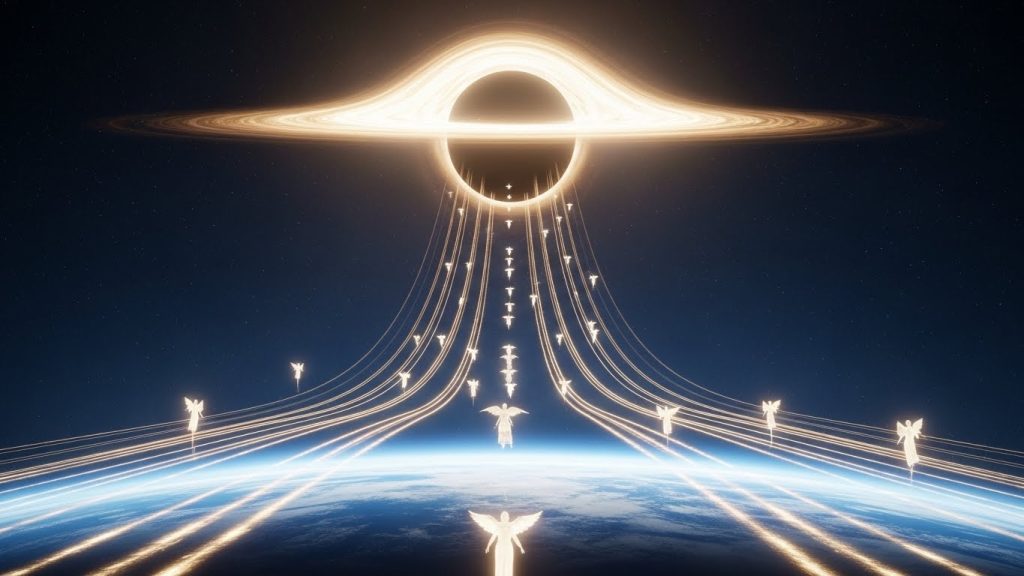
Now do you realize what extreme power is needed to open this path in the sky? By building a machine 9.46 trillion kilometers long and generating an energy of 10 to the power of 16 electron volts from it, you can only make a single tear in the sky, nothing more! You can’t do more than that because to open that path, to use it, you need an unimaginable power, an unprecedented power, a ‘Sultan’.
You will need ‘Sultan’! Dominance and power. And even then, in the verses immediately following, it says that even then, fire and flames and smoke will be sent upon you, and it will be so powerful that you will not be able to withstand it.
(Citation: Allah, Ar-Rahman 55:35)
And that is why it is mentioned in Jami’ at-Tirmidhi that no angel can fly from the earth…
(Citation: Prophet Muhammad ﷺ, Jami’ at-Tirmidhi 3582)
In other words, no angel can open that path until he says, “There is no might nor power except with Allah.” Meaning, there is no strength and no power except the power of Allah. Sultan! Unprecedented power, extreme power. Allah is the Greatest! This is the divine explanation that can open those paths.
Okay, now one more thing. There is something else that is very important to discuss in the context of these paths: black holes. I know that many of you viewers are familiar with the term black holes.
Explaining them from scratch here would be nothing but a waste of time. But we also need to understand that this video of ours is watched by everyone from five-year-old children to 60-year-old elders, and not everyone is familiar with these concepts. So allow me to briefly share the concept of black holes with you.
In the simplest terms, a black hole is like a blind well in our universe. An extremely, extremely powerful and dark place, and what is inside it, no one knows. Entire stars, entire worlds, entire galaxies fall into them.
But where they go, no one knows to this day. No probe of ours, no ship, no satellite has ever been able to go inside a black hole. We have never even seen one, except just once.
In 2019, and you might remember that the news was very famous at that time, how by combining telescopes from all over the world and calibrating them together, NASA took a picture of a black hole in the center of another galaxy named M87. But that’s it. We don’t know anything more about black holes. Where things go after falling into them, nobody really knows. And even if we could see a black hole, it would just look like a black, blind, round rift, inside which nothing is visible. And we don’t even know where things go after entering it.
So my understanding is, and by the way, this is an educated guess, which I have made after reading a lot of literature on astrophysics, that if black holes are some kind of paths, if they take us somewhere, even then, there is a huge difference between black holes and the paths of the sky, i.e., ‘tara’iq’. They are not the same thing. They are not the same thing.
Black holes, if they have a path in them, then going on it would be like going into a roulette wheel. A roulette wheel, surely you have all seen it, how this wheel, placed in a gaming zone, spins, and the person throwing throws a dice on it. And no one knows in which slot of the wheel the dice will land. My theory is that if a black hole is some kind of path, even then, the one who enters it will not know where he will emerge.
Firstly, of course, that person will not be able to withstand the extremely dark and powerful, extreme gravity of the black hole. But let’s say that theoretically, if that person enters the black hole alive and well, even then, no one knows where he will emerge. But ‘tara’iq’, the paths of the sky, these are sophisticated, smooth, and illuminated paths, and the one who travels on them will know where he will emerge. For example, the angels who use these ‘tara’iq’.
And freeing themselves from the confines of our universe, they emerge in a completely different realm. I wish I could describe what I am seeing before my own eyes right now. Okay, now, in the context of this black hole, there is one more thing: this black hole is not accidental either. Look, surely these are some kind of paths that are leading somewhere. Because we can see that stars fall into them, galaxies fall into them.
Worlds fall into them and they never return. Which has only one meaning: they are transported somewhere else. Where they go, we don’t know. But were black holes some kind of accidental pits that formed in our universe? Of course not! Absolutely not! The question doesn’t even arise because nothing in this universe is accidental.
Look, our entire universe is based on only 57 things. 57 numbers that are called physical constants in the language of science. These numbers never change; they always remain the same. For example, the speed of light in this universe, the mass of an electron, the electromagnetic force—these things always, always remain the same. This is called the fine-tuning of the universe.
And from this, we understand that in this universe, there is neither too little nor too much of anything. So were black holes some kind of accidental pits that formed in our universe? Of course not! Absolutely not! The question doesn’t even arise because nothing in this universe is accidental. Surely they have a purpose, and what is that purpose? Scientifically, we don’t know to this day.
But I have some ideas, some theories from divine literature, which I will, God willing, definitely share with you in a video dedicated solely to discussing black holes. So for now, let’s come back to our original topic, the paths of the sky. I told you about 44 tafsirs.
One of them is Tafsir-e-Usmani. In Tafsir-e-Usmani, a hadith is quoted from Hazrat Abu Hurairah (may Allah be pleased with him), who says that once all of us companions were sitting around the Prophet Muhammad (peace be upon him), talking with him, when suddenly clouds appeared in the sky. The Prophet of Allah asked, “Do you people know what this is?”
Now, you can imagine, had the companions never seen rain clouds before? Of course, they had. But look at their eagerness to learn knowledge, how they reply: “O Messenger of Allah (peace be upon him), Allah and His Messenger know best.”
He said, “These are the clouds that irrigate the earth.” Then he asked, “What is above it?” And this time the companions genuinely replied, “We don’t know. Allah and His Messenger know best.” He said, “Above it is a protected roof and a closed wave.” You have to keep these words in mind, especially the phrase “closed wave,” this will be very important in the upcoming videos.
Then above it is the second heaven, then the third, and in this way, the Prophet (peace be upon him) counted all seven heavens. Now, Imam Tirmidhi (may Allah have mercy on him) has called this hadith ‘ghareeb’.
And I realize that seeing this word ‘ghareeb’ (strange/unfamiliar), many people will think that perhaps this hadith is weak, perhaps its narrators are not reliable, perhaps the narration is not authentic, but it’s nothing like that. This word ‘ghareeb’ is not our Urdu word for ‘poor,’ but in 7th-century Arabic, ‘ghareeb’ meant ‘stranger’ or ‘unfamiliar’.
And a ‘ghareeb hadith’ meant that the hadith contained some words that were completely new to the reader, unfamiliar, and required further explanation. In simple words, Imam Tirmidhi (may Allah have mercy on him) is saying that this “protected roof in the sky,” this “closed wave,” this is a new thing, it needs more explanation and research, which is why I, Imam Tirmidhi, am calling it a ‘ghareeb hadith’.
And as we say in Urdu, “ajeeb-o-ghareeb” (strange and peculiar), this is that kind of ‘ghareeb’. Meaning, the hadith is authentic, but research it because there is much to be learned from it. A protected roof. Now I understand that, you see, in today’s age, it is not very difficult to understand the concept of a protected roof above the clouds.
What is above us? Right now, go to the roof of your house and look towards the sky, what will you see? Stars. But do you know how many things there are between you and those stars that you cannot see? And among these unseen things is a very protected roof that keeps you safe from the killer rays coming from those stars and the sun.
From the earth up to 6.5 miles, there is a thick and strong roof, the troposphere. Above that is a 31-mile-thick and even stronger roof, the stratosphere.
And then above that, and even stronger, a 450-mile-thick strong roof, the thermosphere, where the world’s most beautiful light show takes place. As always, my favorite, the dark green aurora lights. And then above that? Above that is the closed wave, the sealed wave. What is that?
