
“In the name of Allah, the Most Merciful, the Most Compassionate. Assalam-u-Alaikum.
After the creation of the heavens and the earth, we find frequent mention of another creation of Allah: the Mala’ika, whom we also call Angels. A creation brought into existence long before us, unseen by our eyes. But how do we know they exist, and why is it necessary to believe in their presence?
In Surah Al-Baqarah, believing in the Mala’ika is twice mentioned as an essential part of faith. One of these instances is in the majestic verses revealed on the seventh heaven during the Mi’raj (Night Journey). An angel specifically descended to earth to offer congratulations on these verses, which I will discuss further. In Surah An-Nisa, not believing in angels is equated with being deeply lost in misguidance. Our journey today is about these very angels: who they are, where they live, what they look like, and what their roles are. But before moving forward, I want to place a question before you: why is it that we cannot see angels? Have you ever thought about this?
There is a verse in Surah Al-Haqqah: ‘So I swear by what you see and what you do not see.’ What is it that we do not see? What are those things that remain hidden from our sight? Many people might respond by saying we cannot see air or fragrance. I believe such answers are quite superficial. While we may not see these things, we certainly detect them. The speed of air is detectable; the intensity of a fragrance can be sensed. Setting aside angels for a moment, consider how many things in the heavens we can neither see nor even detect. Let me explain how.
Everything that can be seen or detected in this universe provides signals across 19 types of light or frequencies, known as bands. These 19 bands together form what science calls the Electromagnetic Spectrum of the universe. In technical terms, this spectrum is a collection of various frequencies, wavelengths, and photon energies. In simpler terms, anything made of the energy or matter that we know must exist somewhere on this spectrum. For example, the waves emitted by mobile phones, though invisible, exist on the Radio Wave band. Similarly, microwave or ultraviolet rays are invisible, but we can feel their heat; they too exist on this spectrum. However, there is a tiny portion on this strip between ultraviolet and infrared. In fact, it is so small that it constitutes only 0.0035% of the entire spectrum. This small portion is called the Visible Spectrum, and it is the only part our eyes are capable of seeing. This is the band made of light consisting of seven colors.
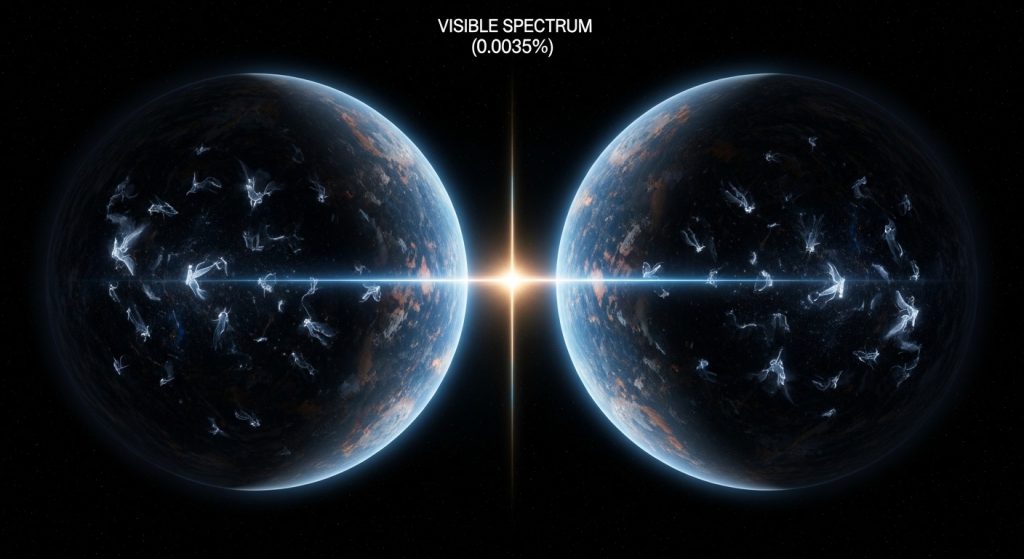
Do you understand the implication of this? It means that if there were 200,000 different things in this universe placed before us, we would only be able to see seven of them. In other words, 99.9965% of the universe is hidden from our sight, covered and veiled. If a creation is made from matter outside this electromagnetic spectrum—from a different kind of substance not present on this strip—then let alone seeing it, we wouldn’t even be able to detect it. Therefore, one thing is established early on: in our journey today, science will not be of much help. Consequently, our main sources for this chapter will remain the Quran and Hadith.
Regarding the creation of angels, there is a Hadith narrated by Hazrat Aisha (RA) stating that Allah created angels from Noor (light), jinn from a smokeless flame of fire, and Adam from that which has been described to you (clay). Now, angels are created from Noor. Noor is often translated as a ‘cool light’ in Urdu, but what kind of light this actually is, no one knows. However, it is certain that it is not the light of the seven colors from the visible spectrum. Furthermore, the latter part of this Hadith clarifies that these two creations (angels and jinn) are made from matter whose details have not been fully explained to us.
In the Quran, the Arabic word Mala’ika is used for angels, which can have two origins. The first is malaka, meaning ‘he governed’ or ‘he ruled.’ The second is the Hebrew word malakh, meaning ‘messenger.’ Both are fitting because angels are part of Allah’s kingdom and serve as messengers by His command. We also learn from the Quran and Hadith that angels have no physical needs. Feeling tired, eating, drinking, or getting angry is not in their nature—unless a specific angel was created with such a purpose. Later, I will also tell you about angels created specifically for wrath and sternness. According to Abu al-Aliyah (RA), among the six days of creation, the angels were created on Wednesday.
I will begin with the angels who belong to the general creation and are closer to humans, and then gradually move toward greater and more powerful angels—those at the highest levels of the angelic hierarchy. Angels who remain close to humans become associated with them right from their birth. The Messenger of Allah (SAW) said that as soon as human life begins in the womb, Allah appoints an angel who says: ‘O Lord, now it is a drop (nutfah). O Lord, now it is a clot (‘alaqah). O Lord, now it is a lump of flesh (mudghah).’ Then, when the human form is complete by Allah’s command, the angel asks: ‘O Lord, will it be male or female? O Lord, will it be wretched or blessed? O Lord, what is its lifespan, and O Lord, how much sustenance is ordained for it?’ Then, by Allah’s command, that angel records the person’s provision, age, deeds, and whether they will be righteous or wicked.
When that angel finishes and departs, another angel arrives to protect the newborn until the child reaches the age of understanding. Then that angel also leaves, replaced by two angels who record the person’s deeds. At the time of death, those two also depart, and Malak-ul-Mawt—the Angel of Death—arrives. He then takes the soul, and in the grave, the questioning angels arrive, whom we know as Munkar and Nakir. In short, from a human’s birth until after their death, certain angels remain close at all times. But what do we know about these angels?
Surah Al-Infitar: ‘And indeed, [appointed] over you are keepers, noble and recording; they know whatever you do.’ This verse is about the Kiraman Katibin. They are two among the angels close to us, recording all our deeds. But why are they called Kiraman, meaning ‘noble’ or ‘honorable’? According to a narration from Ibn Abbas (RA), the Prophet (SAW) said that Allah has endowed these angels with the best character. They pull back from a person during shameful acts. It is narrated by Ibn Abi Hatim that these two angels, the Kiraman Katibin, retreat from a person in two states: when the person is in a state of major ritual impurity (janabah) and when they are bathing. Mention of these recording angels is also found in Surah Yunus.
Another type of angels close to us is mentioned in Surah Ar-Ra’d: the Mu’aqqibat. The verse says: ‘For each one are successive [angels] before and behind him who guard him by the command of Allah.’ The Mu’aqqibat are angels appointed in front of and behind a person for their protection. In Tafsir Ibn Jarir, it is narrated from Hazrat Uthman (RA) that he asked the Prophet (SAW) how many angels are with a person. The Prophet (SAW) mentioned ten angels, including one who protects the throat and two who protect the eyes. It is narrated from Hazrat Ali (RA) that guarding angels are appointed for every human, and unless it is Allah’s will, no one can kill another even if they wished to, because angels protect that person by Allah’s command. These angels only step aside in two situations: when what is written in destiny occurs, or when the time of death arrives. These protective guardian angels are also mentioned in Surah At-Tariq: ‘There is no soul but that it has over it a protector.’
However, for Allah’s special people, the protection also becomes special. For instance, Sa’d bin Abi Waqqas (RA) saw during the Battle of Uhud two men dressed in white protecting the Prophet (SAW), fighting the disbelievers with great intensity. Sa’d bin Abi Waqqas said he had never seen those two before that day, nor did he see them afterward.
In Surah As-Sajdah, there is mention of another angel appointed over us: ‘Say, “The angel of death who has been entrusted with you will take your soul.”‘ In the Quran, this angel is called only Malak-ul-Mawt (the Angel of Death). In a narration by Ibn Abi Hatim, the Prophet (SAW) said that the Angel of Death is fully aware of every part of the land and sea. He checks five times every day to see whose time of death has arrived. However, without Allah’s command, he cannot take anyone’s soul even if he wanted to. In Islamic literature, the Angel of Death is commonly associated with the name Izrail. Interestingly, this name is also among the things adopted from Islam into the Sikh religion, where the Guru Granth Sahib mentions an angel named ‘Izrail’ who takes the souls of the deceased.
Apart from the Angel of Death, Surah An-Nazi’at mentions two other types of angels under his command. Read the first five verses of Surah An-Nazi’at, and you will see five names: Nazi’at, Nashitat, Sabihat, Sabiqat, and Mudabbirat. Among these, the Nazi’at are those who plunge deep and violently snatch away the soul at the time of death, while the Nashitat are those who draw out the soul very gently and easily.
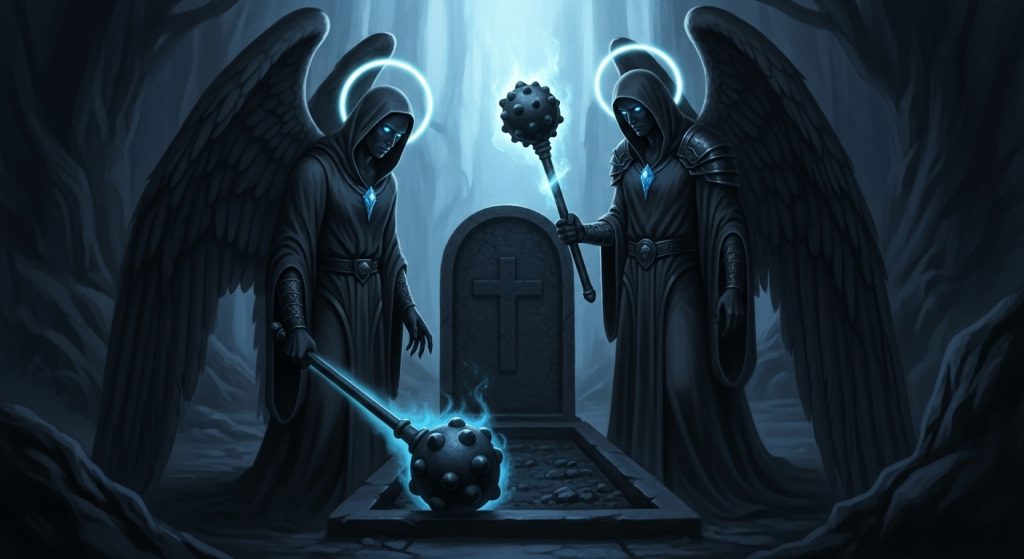
Detailed mention of the angels of the grave is found in books of Hadith. For example, the Messenger of Allah (SAW) said that when one of you is buried, two angels come to him, black in color with blue eyes; one is called Munkar and the other Nakir. Regarding these angels, it is mentioned in Bukhari that the trial in the graves will be similar to the trial of the Dajjal (Antichrist) or very close to it. Regarding the grave, Musnad Ahmad mentions an angel who is set upon a disbeliever in their grave. That angel is blind, mute, and deaf, and in his hand is a mace so heavy that if a large mountain were struck with it, the mountain would turn into dust.
Before I tell you about the great angels and their descriptions, it is important for you to know where the angels are. According to a Hadith in Sunan Ibn Majah, the Prophet (SAW) said: ‘I see what you do not see, and I hear what you do not hear. The heaven creaks, and it has the right to creak. There is no space in it even equal to four fingers except that an angel is there, placing his forehead in prostration before Allah, the Lord of Honor. If you knew what I know, you would laugh little and weep much.’ In fact, it was after hearing this very Hadith that Abu Dharr Al-Ghifari (RA) said out of fear: ‘I wish I were a tree that is cut down.’
But what are the angels doing in these infinite expanses of the universe? Are they given other duties besides praising the Generous Lord and prostrating to Him? The answer is in Surah An-Nahl: ‘They fear their Lord above them, and they do what they are commanded.’ Do you remember the angel who protected us in the mother’s womb, or the one who guarded us until we reached the age of discretion? Allah Almighty has assigned various tasks to this creation, which they perform from morning to evening, even down to the thundering of clouds and the blowing of winds.
When the people of Taif mistreated the Prophet (SAW) following his call to Islam, the angel whom Allah had appointed over the mountains came to him. This angel offered salutations and said: ‘O Prophet, if you wish, I will bring together the rugged mountains on either side and crush these people.’ Similarly, in a narration from Ibn Abi Hatim, an angel appointed over the mountains said: ‘O Messenger of Allah, we receive Allah’s command regarding how much rain is to fall in which place.’ Furthermore, angels were sent to provide news of various matters to the Prophets. When magic was performed on the Prophet (SAW) and he felt he had done something when he actually hadn’t, he told Hazrat Aisha (RA): ‘O Aisha, Allah has given me the answer to what I was asking Him. Two angels came to me; one sat at my head and the other at my feet. One asked the other: “What is this man’s ailment?” The other replied: “He is under a magic spell.” The first asked: “Who cast the spell?” The other replied: “Lubaid bin al-A’sam of the Bani Zurayq.” Then he asked: “In what thing was the magic placed?” The answer was: “In a comb and the hair shed from it, placed in the bark of a male date-palm.” The questioner asked: “Where is this magic now?” And the one giving the answer said: “In the well of Dharwan.”‘ Following this news from the angels, the Messenger of Allah (SAW) went to that well with a few companions and had the magic buried along with its container.
The Quran also mentions angels conversing with other Prophets and non-Prophets, delivering Allah’s message to them. According to Surah Ash-Shura, it is not possible for Allah to speak to any human except through inspiration, from behind a veil, or by sending a messenger (an angel). For example, in Surah Al-Hijr, the angels’ conversation with Hazrat Ibrahim (AS); in Surah Al-Hijr, the angels’ conversation with Hazrat Lut (AS); in Surah Aal-e-Imran, the angel calling out to Hazrat Zakariyya (AS) to give him glad tidings; in Surah Maryam, the angel appearing to Hazrat Maryam (AS) to give her news of Hazrat Isa (AS); and in Surah Hud, the angels giving news to Sarah (AS), the wife of Ibrahim (AS), about a son, Isaac, and after him, Jacob. The Quran mentions the conversation of angels with Maryam (AS) and Sarah (AS), neither of whom were Prophets. However, when conversing with non-Prophetic humans, angels always appear in human form, as mentioned in Surah Maryam: ‘Then he represented himself to her as a well-proportioned man.’ I will explain the reason for this later. According to a Hadith in Bukhari, the Prophet (SAW) said that among the Children of Israel, there were people who were not Prophets but still the angels would speak with them.
While there are many mentions of angels coming and going from human homes, there is one occasion where these angels immediately retreat. The Prophet (SAW) said that angels do not enter homes that contain a dog or an image. However, there are some angels whose arrival is mentioned specifically in the Hadiths. For example, according to a Hadith in Muslim, Hazrat Jibril (AS) was once sitting with the Prophet (SAW) when a sound was heard from the sky like the sound of a door opening. Jibril (AS) looked up toward the sky and said: ‘Today a door has been opened in the heaven that has never been opened before.’ At that moment, an angel descended, about whom Jibril (AS) said: ‘This is an angel who has never come down to earth before.’ This angel offered salutations and gave the Prophet (SAW) glad tidings of receiving two lights (Noors) that had never been given to any Prophet before him. The first light was Surah Al-Fatihah, and the second was the final two verses of Surah Al-Baqarah.
Then there is a narration in Musnad Ahmad that the Prophet (SAW) told Umm Salama (RA): ‘Make the gathering proper and tidy, because today an angel is coming who has never been on earth before.’ In fact, this was the same angel who gave the Prophet (SAW) the news of the martyrdom of Hazrat Hussain (RA) and showed him the red soil of the place where Hussain (RA) was to be martyred.
But how do these angels descend to earth or ascend from earth to the sky? Surah Al-Ma’arij, verse 4, reveals that angels descend and ascend through certain paths or stairways. According to this verse, these are paths through which an angel covers a journey of 50,000 years in a single day. In Tirmidhi, the method of using these paths is even mentioned: no angel can fly or ascend from the earth without saying ‘La hawla wa la quwwata illa billah‘ (There is no might nor power except with Allah).
Before telling you about the great angels and their descriptions, I want to mention three names for which I could not find much information, though the locations where they are appointed are very amazing. The first is an angel named Irtiyail, who is appointed to remove grief and sorrow from the hearts of the descendants of Adam. The second angel is mentioned in a narration from Ka’b al-Ahbar, who says: ‘There is an angel in Paradise whose name I also know. That angel, from his creation until now, has been making jewelry for the people of Paradise, and he will remain occupied in this task until the Day of Resurrection. If even one bracelet made by him were to appear in this world, the sun’s light would grow dim just as the moon pales when the sun rises.’ The third name is Dhul-Qarnayn from Surah Al-Kahf, whom some scholars, based on a saying of Hazrat Umar (RA), consider to be an angel.
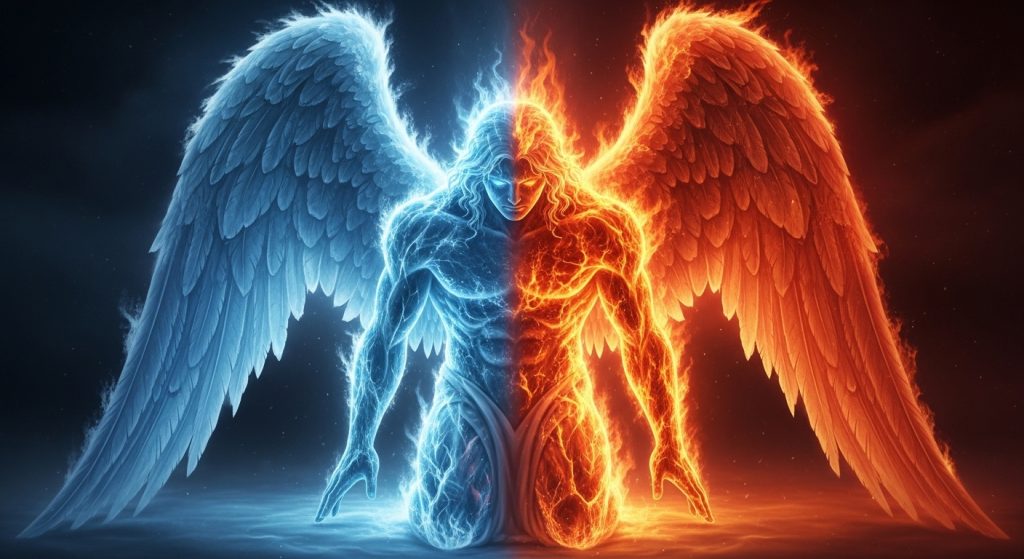
From here on, I will take you toward the heavens where we will encounter some great and very powerful angels. The Hadith of the Mi’raj narrated by Ibn Abbas (RA) mentions the Prophet (SAW) seeing many angels on that night. Based on this Hadith, the 10th-century Shafi’i scholar Abu Ishaq al-Tha’labi also wrote detailed descriptions of angels in his Tafsir. He mentions an angel named Habib on the first heaven, Raqia, whose body is half ice and half fire. Such ice that does not extinguish the fire, and such fire that does not melt the ice. Moving further in this description, on the third heaven, Qaydum, there is mention of an angel with 70,000 heads. In fact, more details about this are found in a narration from Hazrat Ali (RA): there is an angel with 70,000 heads, each head having 70,000 mouths, each mouth having 70,000 tongues, and with all these tongues, he glorifies Allah. From every glorification, Allah creates an angel who can see other angels, but other angels cannot see them. Similarly, in the Tafsir of Al-Tha’labi, there is mention of an angel named Khasfayil on the fourth heaven, Ma’una, who is also known as the Angel of Tears. And on the fifth heaven, Riq’a, the guardian of Hell, the angel Maalik, is mentioned. Regarding this angel Maalik, Surah Az-Zukhruf mentions that the people of Hell will call out to him by name, saying: ‘O Maalik, let your Lord put an end to us!’ And he will reply: ‘Indeed, you will remain.’ Maalik is one of the most mysterious angels of the Lord, and not only Maalik himself but also all the angels working under him. I want to tell you about them.
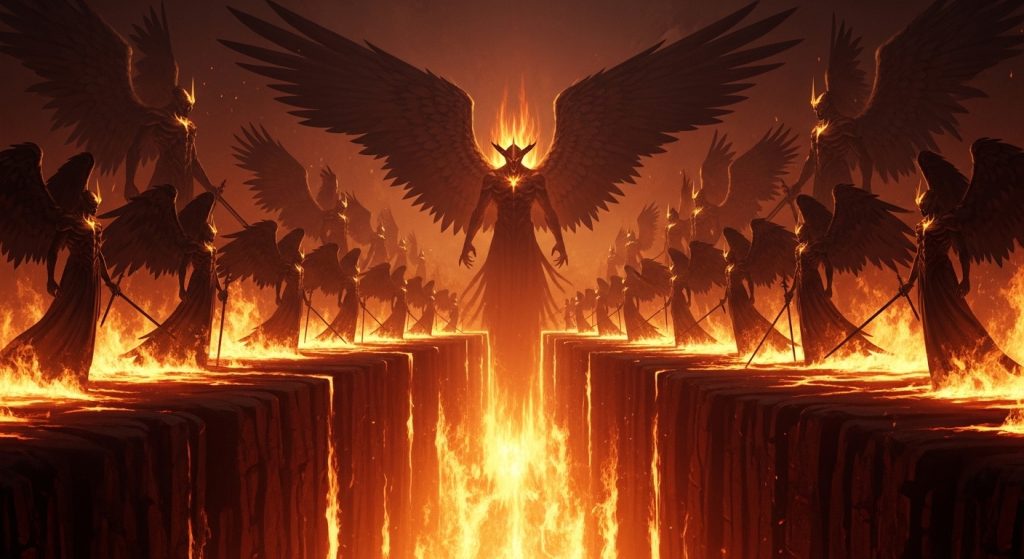
The 10th verse and onward of Surah Al-Alaq are actually about an event. An incident occurred in Mecca, reported in Silsilah al-Sahihah, that Amr bin Hisham (Abu Jahl) used to stop Muhammad (SAW) from praying. Once, when the Prophet (SAW) was praying near the Haram Sharif and Abu Jahl passed by, he shouted: ‘O Muhammad, did I not forbid you from praying?’ He threatened the Prophet (SAW) with harsh words, but the Prophet (SAW) gave him a stern reply. At this, he became even angrier and said: ‘O Muhammad, with what are you threatening me? In this valley, I have the most supporters and the largest council.’ At this point, the 17th and 18th verses of Surah Al-Alaq were revealed: ‘Then let him call his associates. We will call the Zabaniyah.’ And in Sahih Muslim, the following words appear: Abu Jahl stepped forward intending to place his foot on the neck of Muhammad (SAW), but he suddenly retreated, walking backward, trying to protect himself with his hands. When asked what happened, he said: ‘Between me and Muhammad, there appeared a trench of fire, a terrifying sight, and many wings.’ The Prophet (SAW) said: ‘If he had come near me, the angels would have snatched him limb by limb.’ Zabaniyah is itself a very mysterious term. In a trench of fire, countless terrifying wings—these are mentioned in Surah Al-Muddaththir: ‘Over it are nineteen.’ The Saudi Arabian Ministry of Religious Affairs has interpreted Zabaniyah as the name of a group of angels, including 19 great angels. Where are they stationed? Verses 26 and 27 of Surah Al-Muddaththir mention the place: Saqar. And what is Saqar? The answer is at the end of an event mentioned in Surah Al-Muddaththir. This narrative actually begins from the 11th verse: ‘Leave Me with the one I created alone.’ According to some scholars, this refers to Walid bin al-Mughirah. The following verses say: ‘And to whom I granted prolonged wealth… and made [life] easy for him… Then he considered and plotted. May he be destroyed [for] how he plotted… Then he looked… Then he frowned and scowled. Then he turned back and was arrogant. And said, “This is not but magic imitated [from others]… This is not but the word of a human being.” I will drive him into Saqar. And what can make you know what is Saqar? It lets nothing remain and leaves nothing [unburned].’
I do not know what image forms in your mind while reading all this or what you feel when you hear it, but sometimes the state that comes over me while speaking or writing about such verses can only be described by silence. After these powerful and awe-inspiring angels, I want to tell you about a very beautiful place by which Allah has sworn an oath in Surah At-Tur: Bait-ul-Ma’mur. A place of worship on the seventh heaven, Ariba, where angels worship. The name Bait-ul-Ma’mur itself means an ‘inhabited’ or ‘frequented’ house. According to a Hadith in Mishkat al-Masabih, this house of worship is so filled with angels that 70,000 angels enter it every day to worship, and their turn does not come again until the Day of Resurrection. This is the same Bait-ul-Ma’mur against whose wall the Prophet (SAW) saw Hazrat Ibrahim (AS) reclining on the night of Mi’raj. Regarding the angels worshiping in it, there is a very beautiful Hadith in Sahih Muslim: The Messenger of Allah (SAW) said that we (Muslims) have been favored over other people in three things, one of which is that our ranks (in prayer) have been made like the ranks of the angels.
After these, I want to tell you about one of those two angels whose name is not only mentioned in the Quran but Allah has also said that whoever is their enemy is an enemy of Allah Himself: Hazrat Mika’eel (AS). Scholars associate him with the responsibility given by Allah to provide sustenance to His creation. Or, according to some scholars, he commands the angels who are in charge of the laws of nature, such as the growth of vegetation or the falling of rain. He is also among the angels upon whom the Prophet (SAW) sent peace in his prayers. In Musnad Ahmad, Ali bin Hussain (RA) says that the name of Hazrat Mika’eel (AS) is Ubaidullah. According to a Hadith in Silsilah al-Sahihah, the Prophet (SAW) once asked Jibril (AS): ‘O Jibril, I have never seen Mika’eel laughing.’ Jibril (AS) replied: ‘O Messenger of Allah, since the day Hell was created, Mika’eel has not laughed.’ Further, in a Hadith in Musnad Ahmad, the Prophet (SAW) asked: ‘Has Mika’eel ever said anything humorous to you?’ Jibril replied: ‘He can only ask me humorously whether I too was made of fire.’
After Mika’eel (AS), another great angel whom Allah has appointed for a very significant task: blowing the Trumpet on the Day of Judgment. The Sur (Trumpet), which according to Tirmidhi is something like a horn, will bring about the Day of Resurrection once blown. In Musnad Ahmad, the Prophet (SAW) says: ‘How can I be at ease when the one with the Trumpet (Israfil) has placed the Trumpet to his mouth and is ready to blow it?’ He is simply waiting for the Divine command. Hazrat Abu Huraira (RA) narrates that the Prophet (SAW) said: ‘Since Israfil was given the responsibility of blowing the Trumpet, he has been standing in readiness, his eyes fixed on the Throne, fearing that he might be commanded even before he blinks. And his eyes are like bright stars.’
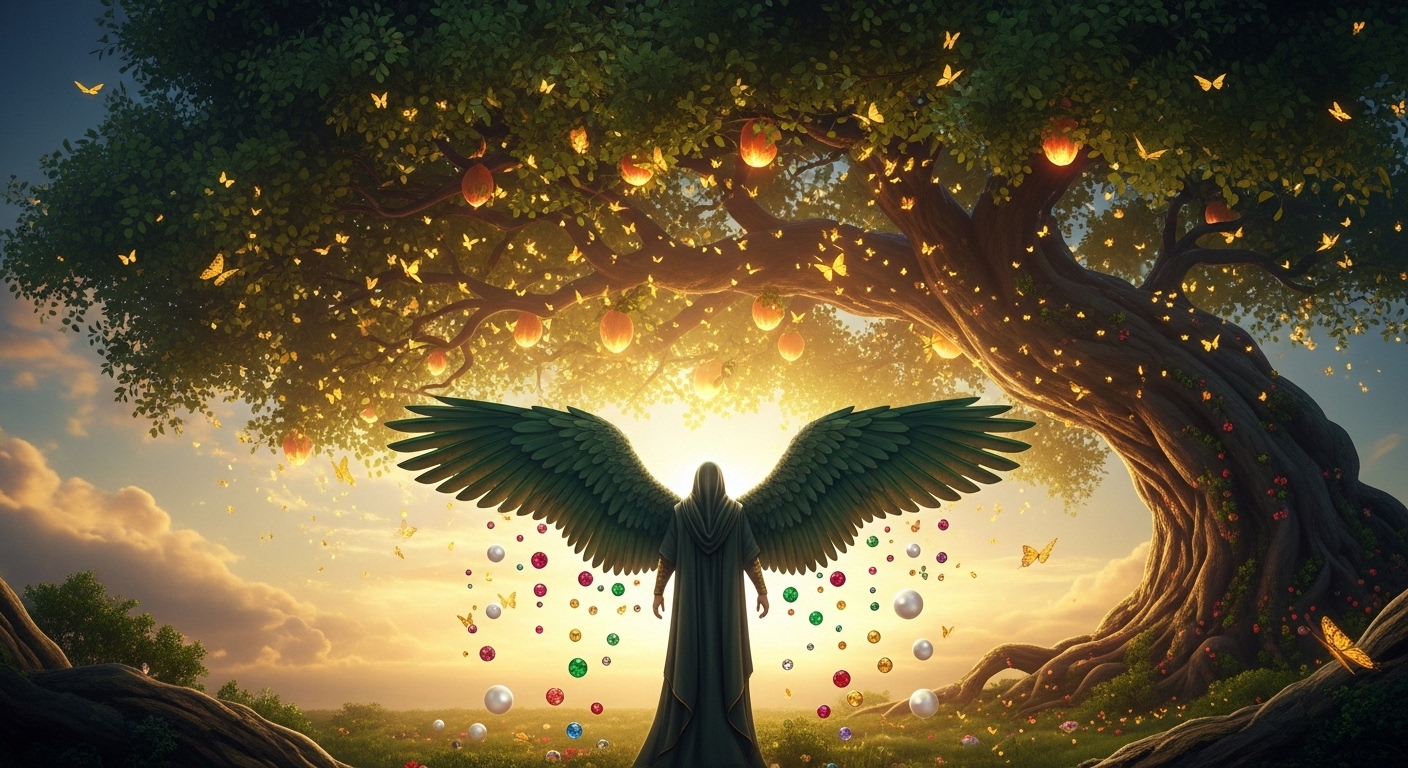
After Israfil (AS), the angel with whose name almost all Muslims are familiar: Hazrat Jibril (AS). His name is mentioned by name four times in the Quran: twice in Surah Al-Baqarah, and in Surah An-Nahl and Surah At-Tahrim. In two places, he is called a ‘mighty in power’ and a ‘trustworthy’ angel, namely in Surah An-Najm and Surah Ash-Shu’ara. Jibril (AS) is the angel who communicated with many Prophets, and he is tasked with very powerful and mighty duties, such as bringing revelation or bringing intense punishment upon nations. Ali bin Hussain (RA) says that his name is Abdullah. This is the angel who brought the first revelation: ‘Iqra bismi Rabbika-lladhi khalaq‘ (Read in the name of your Lord who created). He is also the angel who took the Prophet (SAW) with him on the night of Mi’raj to the seventh heaven and up to the Sidrat-ul-Muntaha. Jibril (AS) sometimes appeared to the Prophet (SAW) in the form of Dihyah bin Khalifah al-Kalbi, and sometimes in the form of a man whose clothes were extremely white and whose hair was extremely black. Jibril (AS) is the angel whom the Prophet (SAW) saw twice in his original form: once in Mecca and once near Sidrat-ul-Muntaha on the night of Mi’raj. Jibril (AS) in his original form is a magnificent and powerful angel who has 600 dark green wings. Each one of these wings covers the entire horizon, and from each wing, pearls, emeralds, rubies, and jewels are shedding—the reality of which is known to none but Allah, the Lord of Honor.
Regarding the event of seeing this angel in Mecca, Prophet Muhammad (SAW) said: ‘After my retreat in the Cave of Hira, I descended into the valley. As I was walking, I heard a voice. I looked forward, backward, right, and left, but saw no one. I heard the voice again and looked again. When I heard the voice for the third time, I looked up toward the sky and saw the same angel who had come to me at the Cave of Hira, sitting on a chair between the earth and the sky. I became frightened of him, to the point that I fell to the ground. Upon returning home, I asked to be covered with a blanket. And on this occasion, the verses of Surah Al-Muddaththir were revealed: “O you who covers himself [with a garment], arise and warn.”‘ I will tell you about the second time he saw Jibril (AS) in his original form at the end of this chapter.
But there is a Hadith in Musnad Ahmad regarding Jibril and another angel. Once, some Jews came to the Prophet (SAW) and said they would ask five questions, and if he answered them, they would recognize him as a Prophet and follow him. The Prophet (SAW) even took an oath from them on this. Their fourth question was: ‘Who is this Ra’d (Thunder)?’ The Prophet (SAW) said that Ra’d is one of Allah’s angels who is in charge of the clouds. In his hand is a whip of fire with which he drives the clouds to where Allah has commanded them to go. The Jews asked: ‘What is this sound that is heard from it?’ The Prophet (SAW) said it is the sound of his whip. They said the Prophet (SAW) spoke the truth. Then they asked their fifth question: ‘An angel is appointed for every Prophet who brings revelation to him; who is your companion angel?’ The Prophet (SAW) replied: ‘My companion angel is Jibril.’ When the Jews heard the name of Jibril (AS), they stood up and said: ‘Jibril? This angel brings war, fighting, and punishment; he is our enemy angel. If you had said Mika’eel, who brings mercy, vegetation, and rain, we would have accepted your word.’ At this, the verse of Surah Al-Baqarah was revealed: ‘Whoever is an enemy to Jibril—it is he who has brought the Quran down upon your heart by permission of Allah—then indeed, Allah is an enemy to the disbelievers.’
From here begins the part of this chapter where I will talk about the appearance and form of the angels. Now, most humans, when they think of angels, imagine a very beautiful and innocent face. Perhaps this is why, when the women in the gathering of the wife of the Governor of Egypt saw Joseph (AS) and cut their fingers, according to Surah Yusuf, they exclaimed: ‘Perfect is Allah! This is not a man; this is none but a noble angel.’ But not all angels are like this. If you remember the faces of Munkar and Nakir—black complexion and blue eyes—or the Zabaniyah—many wings in a pit of fire—or the angel on the first heaven, Raqia, whose half body is of ice and half of fire. Or the 70,000-headed angel on the third heaven, Qaydum, who has 70,000 mouths. Imagine these sights in your mind; I don’t think your heart could remain without trembling at the thought of 70,000 heads.
In the Quran, a description of angels is given stating that they have wings. In the first verse of Surah Fatir, there is mention of angels with two, three, and four wings, and also that Allah adds to His creation as He wills. Ibn Umar (RA) says that during the time of the Prophet (SAW), I was an unmarried youth and used to sleep in the Prophet’s Mosque. I noticed that whoever saw a dream would mention it to the Prophet (SAW). One day I thought: ‘O Allah, if there is any good in me in Your sight, then show me a dream as well so that I too, like other people, may ask the Prophet (SAW) for its interpretation.’ Ibn Umar says that I then slept and saw two angels who came to me and took me away, and then a third angel joined them and said to me: ‘Do not fear, you are a righteous man.’ And then this Hadith continues. But why did the angel reassure him by saying ‘Do not fear’? In many places in the Bible, when an angel’s conversation is mentioned, it always begins with ‘Fear not.’
The 7th-century scholar Muhammad bin Muslim tells of an angel named Barq (Lightning) who has four faces: one like a human, one like a bull, one like a lion, and one like a vulture. When he wags his tail, lightning flashes. Now imagine a four-faced angel appearing before you; I don’t think you could easily endure it. The Gospel (Injeel) gives very detailed descriptions of four types of angels. The first type is the Cherubim. According to the Gospel, they have a hybrid appearance; the Bible describes them with four wings, two of which cover their bodies and two used for flight. The second type is the Malakhim, from the Hebrew word malakh, meaning messengers. According to the Bible, these are the angels that look most like humans, in terms of coming and going. The third type is the Seraphim, mentioned in the Book of Isaiah, according to which they have six wings: two for flying, two to cover their faces, and two to cover their feet. If you have ever been to Turkey or visited the Hagia Sophia, the image on its ceiling is actually of the Seraphim. According to the Bible, the fourth type is the Ophanim, who are perhaps the most strangely shaped angels—described as golden wheels flying in the sky with many eyes on their outer rims. There is a Hadith in Mishkat and Musnad Ahmad whose authenticity is somewhat debated, but it mentions eight angels who are in the form of mountain goats, and the distance between their hooves and knees is as great as the distance between one heaven and another.
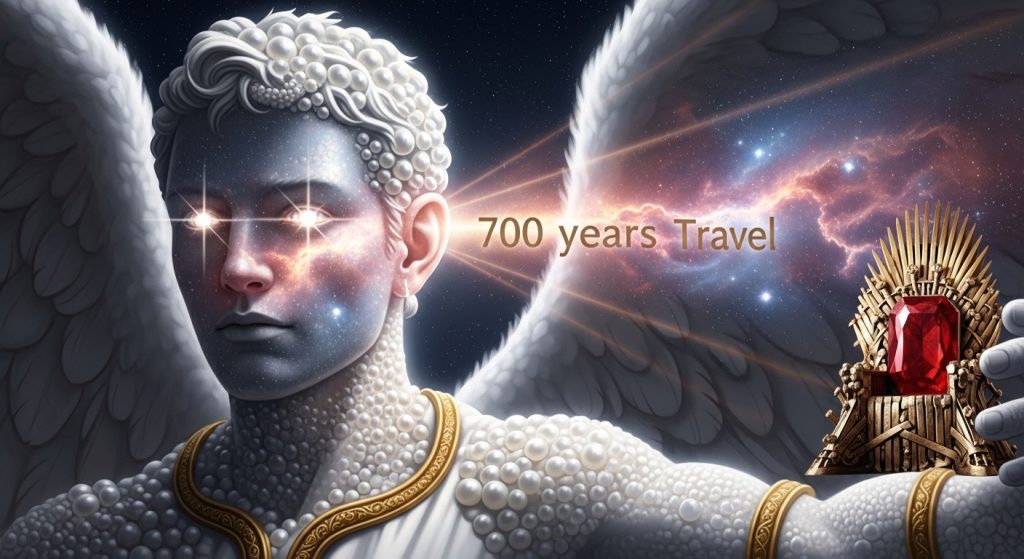
Before this chapter ends, I want to tell you about two types of angels that belong to a very mysterious order or rank, mentioned in Surah Ghafir: ‘Those [angels] who carry the Throne and those around it exalt [Allah] with praise of their Lord and believe in Him.’ There are eight carriers of the Throne, about whom Jabir (RA) says: ‘I was permitted to speak about one of the angels who carries Allah’s Throne: the distance from his earlobe to his shoulder is 700 years.’ A Hadith from Ibn Abbas (RA) means that when our Lord decides on a matter, the angels carrying the Throne glorify Him. Then the angels near them glorify Him, and so on, until the glorification reaches the lowest heavens, even reaching the heaven of this world. Then the angels near the Throne ask those carrying the Throne: ‘What has our Lord said?’ So they inform them. Then the inhabitants of the upper heavens inform those of the lower heavens, and thus the news comes down heaven by heaven until it reaches the heaven of this world. This is the place from which jinn try to steal the news. And this decision of Allah sounds to these angels like the sound of a chain being dragged over a smooth, clean stone. Fear grips the hearts of these angels, and they begin to flutter their wings.
Who are these angels around those carrying the Throne? I found mention of them in four different places in the Quran, where they are called the Muqarrabun—the ‘close ones’ or ‘those brought near.’ Surah Al-Mutaffifin, Surah An-Nisa, Surah Ghafir, and Surah Ha-Mim As-Sajdah. According to Surah Ha-Mim As-Sajdah, the Muqarrabun are angels of different orders or ranks who constantly glorify Allah. According to Surah Al-Mutaffifin, these are the Muqarrabun who look upon the Illiyyin. Illiyyin, which means the ‘highest of the high,’ is a written book where the souls of the righteous and their records of deeds are preserved. The Muqarrabun always remain near it. These are the same Muqarrabun about whom Khwaja Mir Dard wrote that famous verse: ‘For the sake of heartache, man was created; otherwise, for obedience, the Karubiyan (Cherubim) were not few.’ Muqarrabun, Karubiyan, the angels who proclaim praise. Amazingly, during the study of 3,500-year-old Assyrian literature, I found the word Karibu, which refers to a creation that praises constantly. Very detailed information about these Muqarrabun or Karubiyan is also found in a 13th-century book, Kitab al-’Aja’ib wa Ghara’ib al-Mawjudat (The Book of Wonders of Creatures and the Marvels of Creation), but that detail is for another day.
From the seventh heaven, Ariba, up to the Throne—what other angels exist between these two besides those carrying the Throne, Israfil, and the Muqarrabun—is beyond our knowledge. What lies beyond is known to none. As stated in the commentary of the 110th verse of Surah Ta-Ha: Allah revealed this Quran, and in it is the knowledge of things that Allah wished to inform His servants of—namely, signs, guidance, commands of Allah’s pleasure and His displeasure, and news of the past and future. Otherwise, besides all these, there are the sacred attributes of Allah which neither any Prophet knows nor any angel, unless Allah Himself chooses to inform them.
What do angels actually look like? To be honest, perhaps humans are not ready for this. The human mind might not be able to accept it, might not comprehend it; it might become terrified and overwhelmed. Angels are among the most powerful creations of the Lord of Majesty, whom science can never understand. That is why, in this entire chapter based on angels, scientific references seemed helpless.
But before I leave, I must give you one scientific perspective. In 1964, during the Byurakan conference, a Russian scientist, Nikolai Kardashev, presented a very interesting measure—a theory about human capability and the scale of capability for any other civilization that might exist in the universe. According to this scale, if another creation exists in the universe besides humans, it stands to reason that it would either be less advanced than humans—a very basic form of life—or more advanced. If that creation is more advanced than humans, according to Nikolai Kardashev, it could be of three types. Type 1: it would know how to use all the energy of its own planet. If that were the case, it would be a Type 1 creation. By this measure, humans are not yet even a full Type 1 creation, because we are still centuries away from using the total energy of our Earth. Type 2: it would know how to use the energy of its own sun in addition to its planet. Nikolai named this a Type 2 creation. And Type 3: it would know how to use and control the energy of not just its planet and its sun, but its entire galaxy. That would be a Type 3 creation. The entire galaxy’s black holes, white holes, and wormholes would be at the disposal of this creation. Compared to us, their technology would be such that if we wanted to send a signal to a distant planet, it would take us several weeks; but if a Type 3 creation did the same, it would do it in just three seconds. Now, since Nikolai Kardashev believed a more advanced creation than this was not possible, he did not present his theory beyond Type 3. However, today two more additions have been made to this scale. There could be a Type 4 creation: one that knows how to use the wormholes—the doors or shortcuts—of not just its own galaxy, but of this entire universe. And then above that is another type, a Type 5 creation: which would have access not only to this universe but to the universes beyond this one. It would have access to the realities there.
Now, I have a question for you. Today I have told you about many angels and the capabilities given to them by Allah. Those angels who brought congratulations on the verses of the Quran to the Prophet (SAW) by opening the doors of the heavens. Those angels who, by Allah’s command, took Muhammad (SAW) overnight from Masjid-ul-Haram to Masjid-ul-Aqsa, and then from Masjid-ul-Aqsa to the doors of the first heaven, Raqia, and from there to the second heaven, Asfalun, then to the third heaven, Qaydum—even though all these heavens, compared to one another, are like rings lying in vast deserts. They took him up to the doors of the seventh heaven, Ariba. Can you try to find this immensely powerful creation of Allah on any Kardashev scale or on any Electromagnetic Spectrum designed according to our meager understanding? In my personal opinion, it is shameful to even think so. Our minds will never be able to see or calculate the angels. In fact, angels aside, let me give you a real-life example. There is a concept in Anthropology called ‘First Contact’—what happens when two different beings meet without being aware of each other’s existence beforehand. Let me give you just one small example, a real-life example: in 1930, when the people of Papua New Guinea saw a white traveler, Mick Leahy, for the first time, they were so frightened that they first began rubbing his body to remove the whiteness from his skin. They thought this white man was perhaps white from some disease or had white clay on his body. They were terrified seeing a white person. Humans have very weak hearts. They would not be able to endure seeing a powerful and awe-inspiring creation like angels.
In this chapter, I promised you that at the end, I would tell you about the second time Prophet Muhammad (SAW) saw Hazrat Jibril (AS) in his original form. Surah An-Najm, verses 5 to 18. I am presenting a summary of these verses and various Hadiths about the Mi’raj: On the night of Mi’raj, Prophet Muhammad (SAW) witnessed some magnificent sights created by Allah. On the sixth heaven, Daqna, made of gold and red stones, is a magnificent tree, Sidrat-ul-Muntaha. Its roots are in the sixth heaven, Daqna, and its branches reach the seventh heaven, Ariba. A tree upon which golden butterflies hover, and whose beauty of colors no creation in the world can describe. This was the place where the Messenger of Allah (SAW) saw Hazrat Jibril (AS) for the second time in his original form. In the state where he had 600 dark green wings, each covering the entire horizon, and from those magnificent wings, pearls, emeralds, and rubies were falling. And there is a narration that when Jibril (AS) felt the presence of the Lord of Majesty beyond the veil, he immediately fell into prostration right there.
Now, for just a moment, imagine this sight: a magnificent tree whose roots are in the sixth heaven and branches in the seventh heaven, whose colors and beauty no creation in the world can describe, upon which golden butterflies are hovering, and there a magnificent noble angel is prostrating before our only Deity, the Lord of Majesty and Honor. During my 35 years of life, I have never imagined a more powerful and beautiful sight. And that is why the 18th verse of Surah An-Najm says: ‘He certainly saw of the greatest signs of his Lord.’
I want to end this chapter with a very beautiful Hadith from Tirmidhi: Hazrat Muhammad (SAW) said that there are some angels who travel about the earth. When they find a people remembering Allah, they sit with them. Later, when these angels go up to the heaven, Allah asks them: ‘What were My servants doing?’—though He knows best. The angels reply: ‘O Lord, they were exalting Your praise and Your greatness.’ Allah asks: ‘Have they seen Me?’ The angels say: ‘No, O Allah, they have not seen You.’ Then Allah asks: ‘What would happen if they saw Me?’ Then He asks: ‘What do they want and what do they ask for?’ The angels say: ‘O Lord, they ask for Paradise.’ Allah asks: ‘Have they seen Paradise?’ The angels say: ‘No, O Lord, they have not seen Paradise.’ Allah asks: ‘What would happen if they saw it?’ Then Allah asks: ‘From what do they seek refuge?’ The angels say: ‘O Lord, they want to be saved from Hell.’ Allah asks: ‘Have they seen Hell?’ The angels say: ‘No, O Lord.’ Allah asks: ‘What would happen if they saw it?’ And then Allah says to those angels: ‘I call you to witness that I have forgiven all those people.’ The angels say: ‘O Allah, among them was a person who was not there for Your remembrance but had come for some other business of his own.’ Allah says: ‘They are such people that even the one sitting with them shall not be deprived.’
To be honest, I feel like that last person—one who wanders in search of knowledge only to describe the greatness of his Lord. And the only reason for writing this documentary was for me to also speak of my Allah. Perhaps Allah, making those angels witnesses, might forgive me as well. JazakAllah.”
