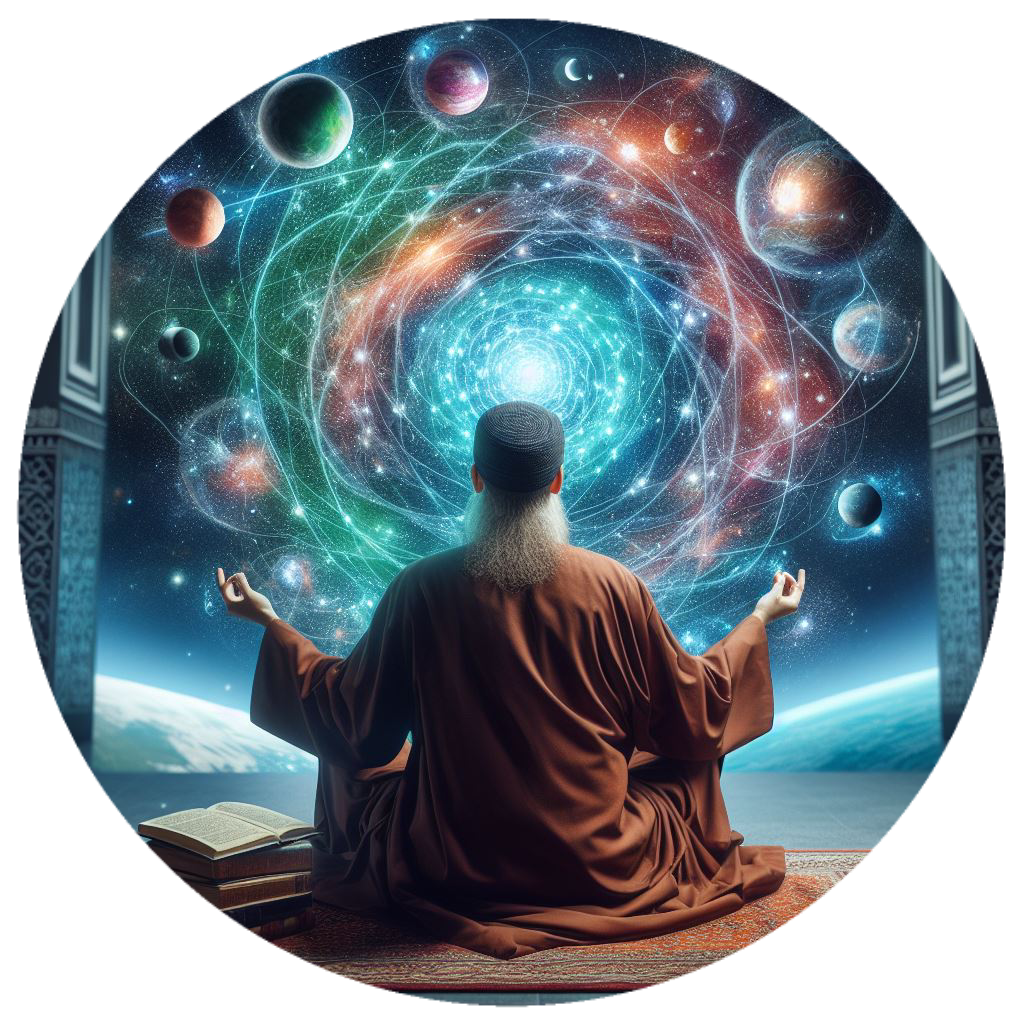


In the name of Allah, the Most Gracious, the Most Merciful. Assalam-o-Alaikum. Today, you’re about to watch a episode that everyone who understands Urdu should see. This is the only episode of mine that I’m wholeheartedly saying you should watch. In sha Allah, after watching this, you’ll truly understand the meaning of “Allahu Akbar.”
In my previous two episodes, I told you about the ten dimensions hidden within our universe. We can see three of these dimensions, but the other seven remain invisible to us. And then, there was the highest and most supreme dimension of all—the tenth dimension.
But the story doesn’t end with just ten dimensions. Because today, I’m going to show you something that will take you even beyond the tenth dimension. This beautiful journey begins with a very powerful machine built by humans.
Look at this. This is a rocket. It carries various kinds of equipment, instruments, satellites, and sometimes even humans, up into space. But this isn’t just any ordinary rocket. It’s the SLS rocket from NASA, the world’s largest space agency. And NASA has used this rocket in some of its biggest missions to date.
But do you know how much it costs to launch this rocket from Earth just once? Just once. A single liftoff of this rocket, in Pakistani currency, costs approximately 550 billion rupees. 550 billion rupees for a single launch. The flight of this rocket is one of the most expensive projects in the world.
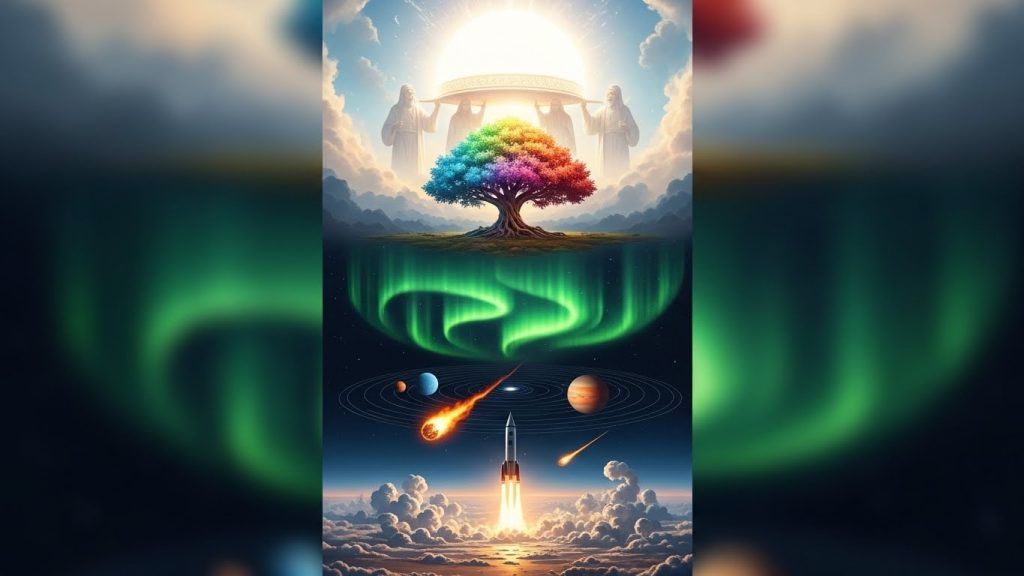
But what is it that inspires humans to build such expensive projects? The answer is the quest for knowledge. Humans have always been curious to know what lies in the worlds above. And today, I’m going to take you on that incredible journey.
This is our Earth, the surface of our planet. This is where we all live. Here, you’ll see humans, animals, oceans, mountains, rivers, and forests. You’ll see many different forms of life here. But as you ascend with this rocket, your surroundings will change.
First, you’ll reach the Earth’s atmosphere, where you’ll see large black or white clouds. Rain, storms, and massive clouds—it’s all here. We call this place the troposphere. But the troposphere is just the first stop on our journey. We still have a long way to go.
Above the troposphere, there’s a new place where you’ll see a layer of ozone wrapped around the entire world. This layer, made of three oxygen atoms (O3), protects us from the harmful rays of the sun and space. If this layer didn’t exist, the sun’s dangerous rays would have been enough to put humans into an eternal sleep of death.
You’ve surely heard about Dhul-Qarnayn from Surah Al-Kahf. According to Surah Al-Kahf, when Dhul-Qarnayn went on his second journey, he saw some people who couldn’t protect themselves from their sun because, according to Surah Al-Kahf, there was no barrier between them and the sun.
So, some scholars believe that the people Dhul-Qarnayn saw had their world’s ozone layer or a similar protective layer, some kind of curtain or barrier, that was destroyed. That’s why they couldn’t protect themselves from the sun. By the way, I’ve discussed this point in great detail in “The Dhul-Qarnayn Series.” If you want to know more, you should definitely watch that series.
But then, as you go above the ozone layer, you’ll see a kind of celestial firework display all around you. Because this is where large meteorites coming from above ignite. And then, after burning, they break apart and scatter everywhere. Surely, you’ve seen blazing trails in the night sky. Those trails are basically the small, broken pieces of these large meteorites that, after burning and breaking apart, fall to the ground.
But then, as you go even higher, you’ll see a dance of lights. Vivid purple here, deep red there, and dark green lights in other places—incredibly beautiful lights. In “The Time Travel Series,” when I took you back to the time of Prophet Solomon (peace be upon him), we saw some horses that were presented before him. The Quran mentions those horses, and some interpretations suggest that those horses emerged from behind a green curtain. And who knows, maybe that mysterious green curtain was these celestial lights. Because remember, Solomon’s throne also used to fly in the heavens.
But from this point on, space is not that far away. So, from here on, there’s a kind of boundary called the Karman line. It’s a frontier between our atmosphere and space. Below it, there’s still air, but it’s very thin and light. And for this reason, our planes can’t go beyond this point because here, the wings of the planes can’t support their weight. Therefore, only a rocket can take you higher from here.
Once you cross the Karman line, space begins. And here, the sky will appear black to you, not blue. We call this place the Low Earth Orbit. Most of our satellites, GPS, and communication satellites—about 12,000 in total—are orbiting in Low Earth Orbit. There are some satellites above Low Earth Orbit as well, but after that, the High Earth Orbit begins. And here, large space telescopes sent by humans are orbiting. For example, the Hubble Telescope, a very famous and old telescope. And you might remember that the James Webb Telescope was also sent into space two and a half years ago. It’s also orbiting in High Earth Orbit. Besides these two, there are other space telescopes here that have sent us some of the most beautiful pictures of the universe. But one picture that I must share with you is this great wall made of billions of galaxies. If you start flying from one end of it in a rocket, and even if your rocket is traveling at the speed of light, it would still take you one and a half billion years to get from one side of that wall to the other.
This wall is the largest single structure found in this universe. And its name is the Kuiper Superstructure. But what I’m going to show you later in this episode will make this wall feel like a mere grain of sand.
From here, or from High Earth Orbit, deep space officially begins. Now you’ve entered a new world where you’ll see some very beautiful stars. You’ll also see incredibly beautiful comets, with tails of gas millions of miles long trailing behind them. From here, you’ll see our entire solar system. That is, all those planets that are revolving around our sun, just like us. You’ll see the gray surface of the moon. You’ll see the erupting volcanoes on our neighboring planet, Venus. You’ll see the red soil of Mars and the ice frozen at its poles. You’ll see this red spot on Jupiter, which is actually a huge storm that has been raging on Jupiter for the past 400 years. If your eyes are very sharp or if you have a big and powerful telescope in your hand, you’ll see the 95 moons revolving around Jupiter.
Yes, there’s only one moon around our world, while there are currently 95 moons revolving around Jupiter, each of which is a world in itself. For example, on two of the 95 moons, Europa and Ganymede, there’s solid ice, but if you look closely, you’ll see that under these thick layers of ice, there could be large lakes of liquid water. And we don’t know what’s swimming in them right now.
After our beloved Earth, the most beautiful planet in the solar system is Saturn. Here, we’ll see that too. A golden-colored planet with large rings revolving around it. You’ll see the dark blue Neptune, where very strong winds blow. You know, in jest, scientists often call Neptune the god of winds. Because the fastest winds in our solar system blow on it, almost 2,500 kilometers per hour, which is twice the speed of sound. You know, if such strong winds blew on Earth, entire countries would be scattered like tiny pieces of paper. Not just scattered, but shattered into pieces.
In the “40,000 Years of Knowledge” series, when the torment of the wind came upon the people of ‘Ad, we talked about all these winds.
Our solar system extends only this far. Because beyond Neptune, we’ll go far beyond the boundaries of our home. From here on, there’s a boundary called the Oort cloud. Trillions of small and large rocks have engulfed the entire solar system, holding it in a kind of enclosure. Up to here, you’ll still feel the sun’s gravity and its light, a little bit. But once you cross the Oort cloud, the sun will no longer be felt. And here, you’ll have entered a world that is called the interstellar world—the regions between the stars.
But the interesting thing to see is that two spaceships built by humans have already entered the interstellar regions. NASA’s Voyager 1 and Voyager 2 spacecraft. On these spacecraft, NASA has sent pictures of many things. For example, a picture of a human, the sound of his voice, the sound of a child laughing and crying, the sound of the animals of our world, and the sound of the water here. Recordings of some verses from the Quran, the Bible, and the Torah. The music of this world, for example, some compositions by Bach. In short, everything that represents us as humans is on these two spacecraft. And the purpose of these missions was that if any extraterrestrial civilization ever saw these spacecraft or came across them, they would know that someone used to live in this small world. These two spacecraft will never turn back towards Earth. For now, we still have a very faint contact with them. But soon, this contact between us will also be lost, and both Voyager missions will be lost forever in interstellar space. As for who will find them in the end, we don’t know anything about that for now.
In interstellar space, you won’t just see stars and planets, but also some extremely beautiful and extremely terrifying things. For example, exploding stars. Just like everything in this universe, stars are also born, and they also die. And when a star dies, its death occurs in the form of a great explosion. We call that explosion a supernova. That explosion produces so much light that it can even be seen from Earth. And in the 12th century, some people in China and Japan saw a supernova with their own eyes. For 185 days, this exploding star was visible, and then it gradually disappeared.
But what happens after a supernova depends on the size of the star. For example, if the star in its lifetime was as big as the sun, then after exploding, its atoms break apart and scatter, and what’s left behind is a fast-spinning sphere much smaller than the original star, which is called a neutron star. Neutron stars are very, very, very heavy. And through mathematics and astrophysics, we know that even a spoonful of a neutron star would weigh trillions and trillions of tons on Earth. Its density is that high. But despite being so heavy, these stars spin very fast. And as they spin, they produce a sound that is like a knock—a continuous knock, which in the language of science is called a pulsar. And some scholars believe that the neutron star is the thing mentioned in Surah At-Tariq.
The 86th chapter of the Quran is Surah At-Tariq. And like most words in the Arabic language, this word “Tariq” also has several meanings. One meaning is “that which comes at night.” But another meaning is “the one who knocks.” And some scholars believe that these verses of Surah At-Tariq—”By the heaven and the knock” and “And what will make you know what the knock is? It is the brightly shining star”—refer to a neutron star, which produces a very distinct knocking sound.
But interestingly, sometimes neutron stars take on an even more mysterious form—the form of a magnetar. A star spinning at an extremely high speed that becomes an extremely powerful magnet. No magnet in this universe is as powerful as a magnetar. In fact, its magnetic field is so powerful that you would have to keep your spaceship trillions of miles away from a magnetar. Otherwise, there’s a high chance that the magnetar would tear apart not just the rocket, but also the cells in your brain.
The extremely powerful masterpiece of Allah, born from the ashes of dead stars. But if the size of the exploding star was larger than the sun, then it would become neither a neutron star nor a magnetar, but would turn directly into a black hole. One of the most mysterious objects in this universe, into which everything falls and is lost forever and never comes out again.
So in interstellar space, you’ll see all these wonders—black holes, forming and breaking stars, other worlds where many creatures may be living. But the final wonder of the interstellar world, as far as our eyes can see, is a distant galaxy, JADES-z14. This is the final limit of our vision, as far as we can see.
But what is above that? Here, things get very interesting. Because now we are about to enter a world that we have never seen with our own eyes. However, there is one source that gives information even beyond this. And that source is the deep study of the Quran and Hadith.
From here, we will find a very large barrier, an obstacle, a surface that we cannot cross. Nothing can go beyond this. And this surface is made of a kind of water that feels alive, animate. And this is the first heaven, whose name is Raqi’a. This place is beyond the reach of science. No rocket in the world can reach here. Because firstly, these distances are so vast that humans do not have the power to cross them. And perhaps that is why Allah says in Surah Ar-Rahman, “If you can pass beyond the regions of the heavens and the earth, then pass. You cannot pass except with an authority.”
So, just to reach this point, we will need a great, unimaginable power, let alone to cross this barrier.
Once, when someone asked Ibn Abbas (may Allah be pleased with him) about this very place, Ibn Abbas replied that there is a gate here called Majarra. And nothing can pass through it without permission, not even temperature.
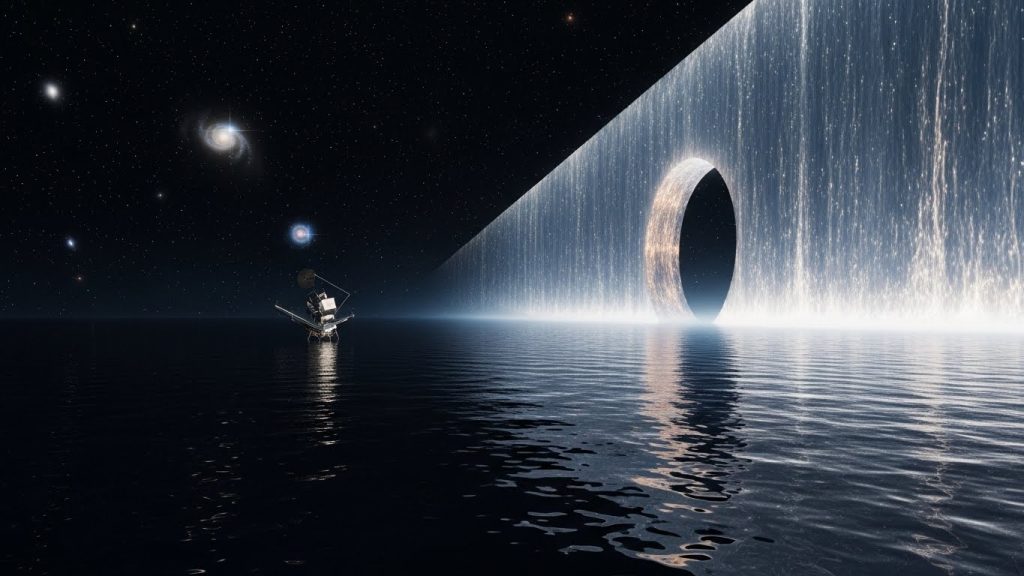
But what is above the first heaven and Majarra? From here on, we get direct information from a Hadith.
Once, the Messenger of Allah (peace and blessings be upon him) was teaching his companions. His eyes fell on a cloud passing through the sky. He asked his companions, “Do you know what this is?” You know, when the Messenger of Allah (peace and blessings be upon him) asked a question, out of respect, the companions never gave a prompt answer, saying, “O Messenger of Allah, the answer to your question is this.” No. With extreme politeness, they would say, “O Messenger of Allah, Allah and His Messenger know best.”
So this time too, the companions gave the same answer. He said, “This is the ‘Anan. It irrigates the land. And it also rains on those who disobey the command of Allah.”
Above that is the first heaven. And between it and the second heaven is a distance of 500 years. Wait here for a minute. Remember one thing: we can’t say how long each of those 500 years is. Is this year the 365-day year? I don’t think so. Because the 365-day year is a year on this earth. Whereas in the universe, the length of a year is different in different places. I’ll give you just one example from the solar system, so you can get an idea of how many different days a year can have in just this small area.
For example, on Earth, a year is 365 days long. Whereas on Mercury, a year is only 88 days. On Venus, a year is 225 days, and on Mars, a year is 687 days. On Jupiter, the world where we saw a huge storm, a year is 4,500 days long. And on the ringed planet, Saturn, a year is 10,500 days. And this blue world, where extremely strong winds blow, its year is, you know how many days? 60,190 days. 60,190 days.
Therefore, to consider the 500-year distance between the two heavens as this (our world’s) year would perhaps be an injustice. Who knows if each of those 500 years is equal to a million light-years for us.
And a very important point: this entire structure is spherical. They are enclosed within each other. Because we also get this information from a narration that if the second heaven is like a huge desert, then the first heaven is like a small ring lying in it. Pay attention to the shape of the ring. It’s spherical. “Jawami al-kalim” was a miracle of the Prophet (peace be upon him). There are great, hidden secrets in his words. And the example of the ring is a very strong indication of a spherical heaven. And as for science, I don’t think we can ever understand this magnificent size with words. Where is the size of a huge desert, and where is the size of a small ring lying in it? And then the third heaven. If the third heaven is like a huge desert, then the second heaven is like a ring lying in it. Amazing, amazing, amazing scales. Neither can we understand these scales in kilometers nor in light-years. But what is between every two heavens? We also get that from different narrations.
You see, when the companions of the Prophet (peace and blessings be upon him) were learning from him, every companion had some specialty. Some companions became very expert in matters of jurisprudence, and some companions in laws and their enforcement. Similarly, some companions had a lot of knowledge about war, and some about the administrative affairs of the Muslims. But if you study the lives of all the companions carefully, you will see that there were two companions who had a lot of knowledge about the creations of Allah. One was Ali ibn Abi Talib (may Allah be pleased with him), and the other was Ibn Abbas (may Allah be pleased with him).
And once, when Ibn Abbas (may Allah be pleased with him) was interpreting the 54th verse of Surah Al-A’raf, “Indeed, your Lord is Allah, who created the heavens and the earth in six days,” Ibn Abbas explained the six days and the creations in them in very beautiful detail. And he says that when Allah created the creatures, on the fifth day, He created the angels living in the heavens and those creatures—both inanimate and animate—about which no one knows except Allah. That is, there are angels between every two heavens, just as there are in our world. It is known from the Hadith that there are at least ten angels around every person. So, similarly, there are angels between every two heavens, but in addition to them, there are also such creatures about which no one knows except Allah. Imagine what kind of creatures are living between every two heavens.
Anyway, in the same way, one by one, the Prophet (peace be upon him) counted the seven heavens. And every heaven is like a ring lying in the desert compared to the heaven above it. And then the seventh heaven, about which we learn from the book of Imam Jalaluddin Suyuti (may Allah have mercy on him), “As-Samaya fi al-Hayat as-Saniyya,” that its name is ‘Ariba. And it is made of a light that humans cannot even comprehend. Remember that electromagnetic spectrum that I showed you? We can see only 0.003% of the total light. We can’t even comprehend light beyond that. So ‘Ariba is probably made of some such light. By the way, the mention of ‘Ariba is also found in the ancient commentaries of the Torah, which they call ‘Araboth.
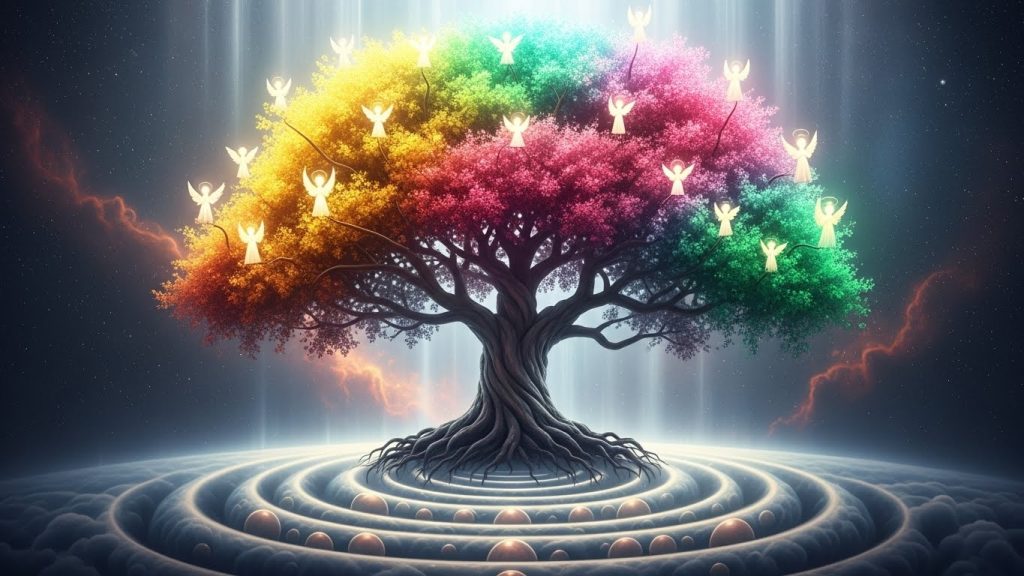
Between the seventh and sixth heavens, there is also a great tree whose name is also mentioned in the Quran, “Sidrat al-Muntaha.” This tree is one of the most beautiful creations of Allah. And on the night of Mi’raj, the Prophet (peace be upon him) saw it with his own eyes. And he says that when he saw it, the colors of the tree were changing. And they were such beautiful colors that he didn’t even know those colors. No creature in the world can describe the beauty of those colors. On every branch of that tree, a new world is inhabited. Multiple realities. Angels live on every branch of it. And the number of those angels is so great that no one can count them except Allah. And in the very center of Sidrat al-Muntaha, at its very core, is the station of Gabriel (peace be upon him). This is the place where Gabriel (peace be upon him) resides. And the name of that tree is Sidrat al-Muntaha because it is the limit of all creation’s knowledge. Whatever comes up from below is taken from there, and whatever comes down from above is received from there. But what is above that?
Imam Abu Muhammad ibn Abi Hatim (may Allah have mercy on him) in his commentary quotes a narration from Ka’b (may Allah be pleased with him) that from the height of Sidrat al-Muntaha, Jannat al-Firdaws begins. And near it is a chair. This is the chair that is mentioned in Ayat al-Kursi of Surah Al-Baqarah: “His Kursi extends over the heavens and the earth.” That is, the vastness of His Kursi has encompassed the heavens and the earth.
Here, one thing is very important to understand. The thing we call a chair is different from this. When I say the word “chair,” what comes to your mind? Something to sit on, with four legs, a backrest. But Ayat al-Kursi tells us that His Kursi has encompassed the heavens and the earth. From this, it becomes very clear that the nature of that Kursi is very different. We can probably never understand the shape of that Kursi. And since Sidrat al-Muntaha is the limit of our knowledge, our knowledge also stops working beyond that. Therefore, due to the end of knowledge here, we don’t know much about the Kursi, what exactly it is.
Some Sahaba scholars say that it is a sign of Allah’s knowledge. And some say that no, it is not a sign, but the Kursi is literally a creature. And if you read carefully, you will also realize that the Kursi is indeed a physical creature. For example, the same Hadith that gives the example of the desert and the rings, in it, the Prophet (peace be upon him) said that all the seven heavens are like a ring lying in the desert compared to the Kursi. Allahu Akbar.
Just imagine that every heaven is nothing compared to the heaven above it, except for a small ring lying in the desert. And the seventh heaven, which is bigger than all the heavens, is only as much as a ring lying in the desert compared to the Kursi. Allahu Akbar. By Allah, my heart trembles when I think of such large scales. I told you that the Kuiper Supercluster will feel like a grain of sand to you. This Hadith also makes it clear that the Kursi is indeed a physical creature. And some scholars say that it could be the eighth heaven, which they call Falak-e-Thawabit. But that is a very complicated discussion. I’m not taking you in that direction because those are very complex matters. Then they talk about another creature being there, that is, Falak-e-Asir. But since Allah Himself has mentioned the number of heavens as seven in the Quran, we take the understanding that the Kursi is a different creature of Allah that encompasses all seven heavens and all the earths. It is bigger than the seven heavens and all the earths, but it is still not the biggest creature of Allah. And now I’m going to tell you about the biggest creature of Allah. And why I’m calling it a creature, you’ll see that later as well.
But before that, understand one thing. According to our understanding, this whole structure has a spherical shape. That is, the seven heavens, the earths in them, and then the Kursi. One reason for this is Ayat al-Kursi, that Allah’s Kursi encompasses the heavens and the earth. Which gives the impression that the seven heavens and the earth are in a kind of enclosure that is enclosed within the creature called the Kursi. And then the Hadith of the desert and the ring also gives the impression that all the heavens are spherical in nature.
But there is also a third reason. The Hadith where the Messenger of Allah (peace and blessings be upon him) pointed to the cloud and asked the companions, in the same Hadith, the Prophet of Allah also counted the earths. The Prophet (peace be upon him) asked the companions, “What is below?” The companions gave the same answer, that Allah and His Messenger know best. Then the Prophet (peace be upon him), in the same way that he counted the seven heavens, he also counted seven earths. I don’t have time to go into the details of what is on those earths because the episode will get very long. But when he talked about the seventh earth, he said, “If you could hang a rope to that last earth, that rope would also reach back to Allah.” This gives another clarification that the entire structure of the heavens and the earth is spherical.
And then, after reciting this Hadith, the Prophet (peace be upon him) recited those verses of Surah Al-Hadid, “Whatever is in the heavens and the earth is exalting Allah.”
But what is above the Kursi? Above this is the biggest creature of Allah, the ‘Arsh (Throne) of Allah. The Quran mentions Allah’s ‘Arsh in many places, and in most places, it is called “the great ‘Arsh,” declaring it a great creature. In common parlance, ‘Arsh has many meanings, such as the throne of a kingdom, a roof, or the command center of a kingdom—the place from where the kingdom is ruled. Ibn Abbas (may Allah be pleased with him) says that the ‘Arsh is called ‘Arsh because of its height, because there is no creature higher or bigger than it. ‘Abdullah ibn ‘Umar ibn al-Khattab (may Allah be pleased with him) says that once the Messenger of Allah (peace be upon him) told us about those qualities of his that no other prophet had. And one of those qualities was the knowledge of who is holding the ‘Arsh. And the answer to that was the angels. Great angels who have lifted the ‘Arsh on their backs.
How many are these angels? Some narrations say there are four, and some say seven. But in the narration of Mustadrak al-Hakim, the Prophet (peace be upon him) did say this much: that the angels are like mountain goats. He even mentioned their hooves, that there is such a distance between their hooves and their ankles as there is between the heavens and the earth. And he also said that Allah has given me permission to tell you about one of the angels who carry the ‘Arsh, that there is such a distance between his neck and his earlobes that if a flying bird were to fly between them, it would fly for 700 years. By the way, all the narrators of this narration are reliable. This means that this Hadith is of a very authentic level.
The ‘Arsh is a physical creature of Allah. We have a lot of evidence for this. For example, it is mentioned in a Hadith that there are some lanterns hanging under the ‘Arsh, in which the souls of the martyrs reside. That is, they are physical lanterns that are hanging with a physical ‘Arsh. Then there is a great sea under the ‘Arsh, which is called Bahr al-Masjur. In Surah At-Tur, Allah has sworn by five things. “By the Tur, and by a Book inscribed in an open scroll, and by the Frequented House, and by the high roof, and by the overflowing sea.” Okay. Notice that the book written in open scrolls, that is, the Preserved Tablet, is also above the seventh heaven. The Frequented House, that is, the place of worship of the angels, is also above the seventh heaven. The high roof, that is, the ‘Arsh itself, is also above the seventh heaven. Tur, which we call a mountain, where is that? This is a completely different discussion and not the topic of this episode. But then, the overflowing sea, that is, Bahr al-Masjur, is also above the seventh heaven. Under the ‘Arsh, there is a great sea filled with amazing water, overflowing with waves. And this was the sea whose water, during the flood of Noah (peace be upon him), gushed out of his oven. And it is mentioned in a Hadith that when the trumpet is blown and all the creatures faint and then go into death, then of course the heavens and clouds will be destroyed by then. But then a rain will fall, which will be from the water of Bahr al-Masjur. And it will rain on the creatures for 40 days, until they are submerged in it by 12 “hands.” This “hand” is a cubit, that is, about one and a half feet. So everything will be submerged in it by 12 hands. And then, with the effect of that water, people will start coming back to life from death. That is why the water of Bahr al-Masjur is also called Bahr al-Hayawan and then Bahr al-Hayat.
Therefore, under the ‘Arsh, there is a great sea called Bahr al-Masjur, whose water is like a thick liquid. The ‘Arsh is a physical creature. We also know this from another narration. Silsilah al-Sahihah 3123: Israfil (peace be upon him) is holding the trumpet in his hand and is continuously looking towards the ‘Arsh. And his eyes are like shining stars. Imagine, just imagine this scene. Allahu Akbar.
The person who we know saw the ‘Arsh directly with his own eyes was Prophet Abraham (peace be upon him). You have to keep this point in mind. In sha Allah, there will be such a great and beautiful discussion on this that you will enjoy listening to it. Perhaps that discussion cannot happen in today’s episode, but in the next episode, I will definitely discuss that incident.
Then, the Messenger of Allah (peace be upon him) once advised to ask for Jannat al-Firdaws from Allah, because the roof of that Jannah is the ‘Arsh of the Most Merciful. And ‘Ikrimah (may Allah be pleased with him) says that the light we see in the stars is 70 times less than the light we will see in the Kursi. And the light we see in the Kursi is 70 times less than the light we will see in the ‘Arsh. And as for the size, no creature of Allah is bigger than the ‘Arsh.
According to the Hadith of the desert and the rings, Silsilah al-Sahihah 3189, all the heavens are like a ring lying in the desert compared to the Kursi. And the Kursi is like a ring lying in the desert compared to the ‘Arsh. Allahu Akbar.
Believe me, sometimes a sense of awe overcomes me when I think about such large scales. I told you that the Kuiper Supercluster will feel like a grain of sand to you. This Hadith also makes it clear that the Kursi is indeed a physical creature. And some scholars say that it could also be the eighth heaven, which they call Falak-e-Thawabit. But that is a very complicated discussion, and I am not taking you in that direction because those are very complex matters. Then they talk about another creature being there, that is, Falak-e-Asir. But since Allah Himself has mentioned the number of heavens as seven in the Quran, we take the understanding that the Kursi is a different creature of Allah that encompasses all seven heavens and all the earths. It is bigger than the seven heavens and all the earths, but it is still not the biggest creature of Allah. And now I will tell you about the biggest creature of Allah. And why I am calling it a creature, you will see that later as well.
This Hadith makes it clear that the entire structure is spherical. For example, when the Prophet (peace be upon him) asked his companions about the cloud, he said, “Do you know what is above you? Above you is the sky, whose name is Raqi’a, and it is a protected roof, a wave that is held back. And between it and the heaven above it is a distance of 500 years.” You see, a wave that is held back is a very beautiful metaphor. And it is also known from this Hadith that the sky has a physical existence.
And another thing to note here is the spherical shape of the structure. I’ll ask you a simple question: why do you think a wave is held back? Thank you, and Allah Hafiz.
