

Sajah, even though she was a woman, she claimed to be a prophet. She lived in the Taghud tribe on the border of Iraq and was the chief of that tribe. But it wasn’t that everyone accepted him as a prophet. Rather, many of his close associates were political collaborators. She could read fortunes, which was a form of kufr, and he would present truths and lies to people. Another man joined him, his name was Malik bin Urayya. He was previously a Muslim, but during the reign of Hazrat Abu Bakr (may Allah be pleased with him), he abandoned Islam and became an apostate. He refused to pay zakat and another of his crimes was that he allied himself with Sajah.
But when Khalid bin Walid fought against these apostates and defeated them, the people of other tribes re-converted to Islam. But Malik bin Urayya was still in a dilemma. But then his allies abandoned him and on the other hand Khalid bin Walid was suppressing these apostates. When Khalid bin Walid saw Malik bin Urayya without an ally, he quickly tried to suppress him. On the other hand, the Ansar were saying that they wanted to attack after getting permission, but Khalid bin Walid said that if they had to wait for permission, it would be too late. On the other hand, we see that Hazrat Abu Bakr (may Allah be pleased with him) gave those who were the commanders of the army the power to make independent decisions. So Khalid bin Walid attacked and the Ansar reluctantly joined the battle. Malik bin Urayya was arrested and finally killed. However, there are two accounts of how Malik bin Urayya was killed. The first is that when Khalid bin Walid asked him about zakat, he refused to pay it and as a result he was sentenced to death.
Another narration states that Khalid bin Walid told the Muslim army to “dafiyum” which means to heat. But different places have different meanings in Arab society, so the Ansar thought that maybe they were talking about killing Malik bin Urayya, so they killed him.
Since the murder was obvious, various rumors spread. Abu Bakr Al Ansari was very unhappy and without permission he came to Hazrat Abu Bakr (may Allah be pleased with him) and complained.
He went and complained against Khalid bin Walid that he had killed Malik bin Urayya without permission and had married his wife. Then he made the same complaint to Hazrat Umar (may Allah be pleased with him). He became very angry upon hearing this and immediately summoned Khalid bin Walid to Medina. As soon as Khalid bin Walid heard this news, he rushed to Medina wearing battle armor. As soon as Hazrat Umar (may Allah be pleased with him) saw him in this state, he became angry and grabbed him and tore the bird’s feathers from his head. He told him that you are a traitor. You killed a Muslim without permission and married his wife. But Khalid bin Walid knew that Hazrat Umar (may Allah be pleased with him) was a close friend of Hazrat Abu Bakr (may Allah be pleased with him). So he remained silent and Hazrat Abu Bakr (may Allah be pleased with him) declared that Khalid bin Walid was innocent. Hazrat Umar bin Khattab (may Allah be pleased with him) told Hazrat Abu Bakr (may Allah be pleased with him) to dismiss Khalid bin Walid. But in response, Abu Bakr (may Allah be pleased with him) said that he had investigated and found no fault in Khalid bin Walid.
Hazrat Abu Bakr (may Allah be pleased with him) sent 11 different armies under the leadership of 11 emirs to different regions to destroy the apostates, one of which was sent to Bahrain. The army, led by Awal Adran Adrani, set out for Bahrain. At night, Awal Adran Adrani suddenly heard screams in the middle of the desert. Then a companion came and informed him that an enemy camp had been set up nearby and that they were drinking and shouting. Then, seizing the golden opportunity, Awal Adran Adrani ordered an attack on the enemies and killed them. Under Awal Adran Adrani leadership, the Muslims scattered the apostates and they began to flee to various places. But they fled and took refuge on an island with an ocean in the middle that was impossible for the Muslim army to cross. Then Awal Adran Adrani told them to seek help from Allah, and accordingly the Muslim army sought help from Allah. Then the Muslim army crossed the sea on horseback without any hesitation, and those who were not on horseback crossed the sea on foot, killed the enemies, and returned.
Now we are going to discuss the most important Yamaha war. This war was waged against Musaylama the false prophet claimant. Musaylama conspiracy was the most dangerous because while it was very easy to suppress other false prophets, it was very difficult to suppress him. His conspiracy was a huge conspiracy against the Caliphate. He met the Prophet (peace and blessings of Allaah be upon him) during his lifetime and the Prophet (peace and blessings of Allaah be upon him) had predicted that he would later claim to be a false prophet.
Musaylama could perform magic and his greatest magic was that he could cut off the wings of a pigeon and put them back together. He also had contact with the jinn and the devil, which he used to mislead people. He could imitate the Quran, but when he imitated the Quran and presented it to people, he became a laughing stock in front of everyone. Musaylama appeared in that war with an army of 30 to 40 thousand, and the reason why such a large army fought on his behalf was ignorance. Because not all of those who fought on his side had the true teachings and knowledge of the Quran. In this context, there is a proverb in Arabia that says that there will always be some people who will pick up things that fall on the ground, meaning that there will always be some people who will pick up even useless things from their way.
Hazrat Abu Bakr Siddiq (RA) sent 11 armies, out of which only three were sent to fight in Yamaha. One of these three armies was led by Hazrat Khalid bin Walid (RA). The importance of this battle was so great that Hazrat Abu Bakr (RA) sent the companions who had participated in the Battle of Badr to this battle. Hazrat Abu Bakr Siddiq (may Allah be pleased with him) highly respected the companions who participated in the Battle of Badr and would not send them on any other battle. But this battle was so important that Hazrat Abu Bakr Siddiq (may Allah be pleased with him) and his personal likes and dislikes, sent his companions who had participated in the Battle of Badr to this battle.
Not only that, the Muhajirin and Ansar participated in this war. The Muhajirin and Ansar were the elite forces of this war, but they did not have any powerful weapons. Rather, they were the early warriors of Islam, so their status was very high and they were very close to Allah. Hazrat Abu Bakr Siddiq (may Allah be pleased with him) did not send the Mu’aziz and the Ansar to other wars, rather he sent them to fight against Musaylama.
In this war, we see that all the people who lived in the Persian territories also abandoned Islam and they were also eagerly waiting to see the outcome of this war because it would be determined through this war whether Islam, meaning the Caliphate, would remain or Islam would be destroyed. As a result, this war was a serious threat to the Caliphate. Khalid bin Walid set up camp on a high mountain with a flat land below, the sea on one side, and a garden in front. These gardens were under the control of enemy forces.
At the beginning of this war, Musaylama lost one of his important military leaders, named Maja. Before this battle, Maja had gone with his army to fight another tribe, but on the way he came close to the Muslim camp, when the Muslim army seized the opportunity and attacked them and captured every one of them.
Then Khalid bin Walid asked their army who is your Prophet. They said that Musaylama is our Prophet. Then Khalid bin Bali decided to kill them but then they said that you kill us all but please don’t kill our leader Maja. Hearing this, Khalid bin Walid chained Maja and killed his party members. Then Khalid bin Walid ordered his wife to keep an eye on Maja and thus Khalid bin Walid created psychological pressure on the enemy.
At the beginning of the war, Musaylama divided his army into three parts, one on his right, one on his left, and he led the middle army. Similarly, the Muslim army was divided into three parts: one on the right, one on the left, and the middle force was naturally led by Khalid bin Walid.
At the beginning of the war, Musaylama son encouraged the people by saying, “O people, fight with all your might, otherwise they will kill your Prophet Musaylama.”
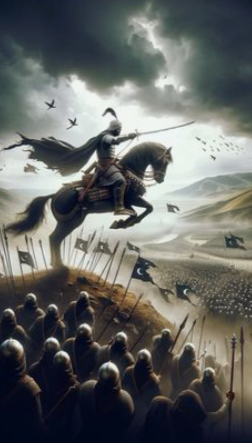
Then the war began. The Muslim army numbered only 13,000, while Musaylama army numbered 40 to 60,000. When the battle began, only the clang of weapons could be heard across the field. Khaled bin Walid was bravely killing anyone he found in front of him. On the other hand, Musaylama army was not idle in any way, but they were also fighting bravely.
At first, Musaylama army attacked the Muslim army, and the Muslim army was initially quite weak. The Muslim army slowly began to retreat and eventually reached the tent they had been following behind. There they saw their leader Maja, but Maja said, “Don’t look at me, just continue the fight.” At this stage, Khalid bin Walid took the opportunity to regroup the Muslim army. Then the other companions advised Khalid bin Walid to separate the fighting troops according to tribes, meaning that the Ansar would be one tribe and there will be another tribe of Muhajirs. This means that it can be understood that the people of a tribe have become relatively relaxed while fighting. It was then seen that the Bedouins of Arabia were showing some relative laxity, but later they were the ones who emerged victorious in the battle. On the other hand, the Ansar and the Muhajirin also wanted to be victorious over each other because they each wanted to be victorious in terms of good deeds.
Musaylama was completely safe in battle, surrounded by his bodyguards. Khalid bin Walid decided to attack him directly. He was trying to reach Musaylama through the middle with his cavalry, but it was difficult because the enemy was surrounding him on all sides. Then Khalid bin Walid challenged Musaylama to a direct fight. We see from Arab history that in various battles, high-ranking commanders would engage in direct wrestling. So Khalid bin Walid cleverly challenged him to a wrestling match.
So, out of respect, Musaylama could not refuse this invitation. He started approaching Khalid bin Walid, but his army was guarding him behind him. Then Khalid bin Walid asked Musaylama, “Well, if I offer you peace instead of fighting, what conditions will you give?”
Then Musaylama made a strange gesture, he tilted his neck in a distorted way and it seemed like he was talking to someone. In fact, the devil would speak to him and then foam would come out of his mouth and his face would become distorted. Then Satan advised him that he would never be a Muslim.
Khalid bin Walid immediately understood this and rushed forward Musaylama to attack the swift, but then Musaylama quickly ran back and took refuge among his troops. Faced with fierce resistance, his forces began to retreat and they entered a walled garden and closed the gate. Barak ibn Malik (may Allah be pleased with him) asked his fellow soldiers to throw him into the garden, but they refused. Finally, after much pleading, he was thrown into the garden and he fell into it alone. History tells us that he had about 70 wounds on his body, but he opened the gate for the Muslim forces while fighting.
The Muslim army broke through the gate and entered, and since the space was narrow, skirmishes broke out between them, and a large number of warriors were wounded and killed on both sides.
We have already mentioned that Musaylama was in a safe place established by his bodyguards where it was not possible to go directly to kill him, when a companion named Wasi threw it at him and it went through his chest and came out. Then another companion quickly went and struck Musaylama on the head, killing him.
His killing sealed the victory for the Muslims. On the other hand, his army, which was trapped in the garden, was unable to fight and was dying one by one at the hands of the Muslims. About 10,000 of the 21,000 enemy troops died in the garden, making it known in history as the Garden of Death. When the battle ended, it was evening. Later in the evening, Khalid bin Walid went out with Maja to identify Musaylama and later it was possible to identify Musaylama.
Hazrat Abu Bakr Siddique (RA) was very anxious to know the outcome of this battle. But Abu Bakr Siddiq (RA) was very angry when he heard that Khalid bin Walid had won the battle and had made a treaty with Majah and married his daughter. He wrote a letter to Khalid bin Walid, rebuking him, but in response, Khalid bin Walid said that I did not marry her for my own satisfaction, but rather for strategic reasons. However, if you are dissatisfied, I will satisfy you.
After receiving Khalid bin Walid’s letter, Hazrat Abu Bakr Siddique (may Allah be pleased with him) relented somewhat and several companions persuaded him on behalf of Khalid bin Walid.
