
Close Menu
  • Home
  • Islamic History
    • Life of Prophet Muhammad
    • Abu Bakr al-Siddiq
    • Umar ibn al-Khattab
  • Companions
  • Series
    • 40,000 Years of Knowledge
    • The Secrets of the Universe
    • Amazon Series
  • About
  • Contact
  • Series Reading Guide
What's Hot

Ibrahim and Nimrod in Islam: What the Quran Says—and What History Cannot Confirm

2 October 2026

Prophet Ibrahim and Ancient Mesopotamia: Quran, Sumer and the Limits of History

30 September 2026

Thamud and Prophet Salih: The Quranic Account and the Archaeology of al-Hijr

28 September 2026
YouTube
YouTube Facebook
Religion Essence Hub
  • Home
  • Islamic History
    • Life of Prophet Muhammad
    • Abu Bakr al-Siddiq
    • Umar ibn al-Khattab
  • Companions
  • Series
    • 40,000 Years of Knowledge
    • The Secrets of the Universe
    • Amazon Series
  • About
  • Contact
  • Series Reading Guide
Religion Essence Hub
Home » Episode 16 – Umar on Enjoining Good and Forbidding Wrong
Umar ibn al-Khattab

Episode 16 – Umar on Enjoining Good and Forbidding Wrong

Religion Essence Hub Editorial TeamBy Religion Essence Hub Editorial Team15 November 2025Updated:9 September 2026No Comments5 Mins Read9 Views
Facebook Twitter Pinterest Telegram LinkedIn Tumblr Copy Link Email
Follow Us
Google News Flipboard
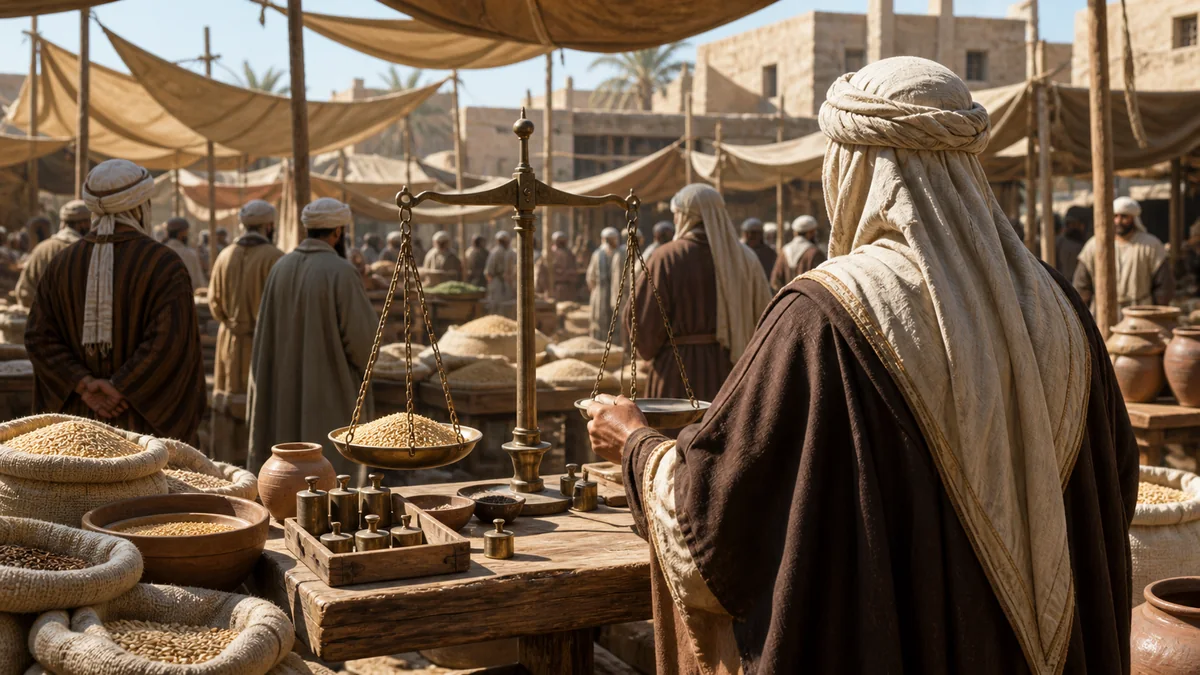
Seventh-century market inspection using balance scales and measured grain
Share
Facebook Twitter LinkedIn Pinterest Email Copy Link

Enjoining good and forbidding wrong is an important theme in Muslim accounts of Umar ibn al-Khattab’s leadership. It concerns public responsibility, sound worship and honest conduct. Yet an account of that responsibility must also distinguish reliable reports from later stories and avoid treating forcefulness as a virtue in itself.

This episode examines the Black Stone, the memory of Hudaybiyyah and a well-known story about the Nile. It also considers why advice and oversight require knowledge, restraint and attention to other people’s rights.

The Quranic starting point

Quran 22:41 describes people who, when established in the land, maintain prayer, give alms and encourage good while opposing wrongdoing. The verse connects authority with duties rather than treating power as an end in itself.

It belongs to a passage concerning people who had suffered expulsion and wrong. Its moral language should not be reduced to a slogan about harsh punishment. Nor should an explanation of the verse be attributed to a named companion without identifying the report that carries that attribution.

Umar and the Black Stone

A particularly clear report describes Umar kissing the Black Stone at the Kaaba. He explains that the stone has no independent power to benefit or harm, and that he is following the Prophet’s example. The narration is recorded in Sahih al-Bukhari 1597.

The distinction is between performing an act of worship taught by the Prophet and assigning divine power to a physical object. Umar makes the intention behind his action explicit, rather than leaving observers to infer it from the action alone.

The report is short and specific. It does not require invented scientific explanations for pilgrimage rituals, nor does it establish that asking a sincere question about religious practice is wrong. Explanation can help readers understand what a practice means without attributing unsupported claims to Umar.

The tree associated with the pledge at Hudaybiyyah

The pledge under a tree at Hudaybiyyah holds an important place in Muslim memory. Quran 48:18 refers to the believers who pledged allegiance beneath the tree and to God’s knowledge of what was in their hearts.

However, certainty about the event is not the same as certainty about a later tree identified with it. In Sahih al-Bukhari 4163, Sa‘id ibn al-Musayyab relates that his father had participated in the pledge but could not recognize the tree the following year. The report challenges people who later claimed to know its location.

This must be considered when discussing the separate story that Umar ordered a tree to be cut down. The Bukhari narration does not report that order. It would therefore be misleading to cite it as direct proof that Umar felled the original tree. The historical identity of a place and the religious significance of the event associated with it are different questions.

The letter to the Nile: a story with a weak chain

A widely repeated account says that the governor Amr ibn al-As stopped an alleged human sacrifice to the Nile. The story then describes Umar sending a letter affirming that the river flowed by God’s will, followed by a rise in the water.

This account should not be narrated with the same confidence as the Black Stone report. Islam Question & Answer’s examination of its transmission identifies a weak chain, including an unnamed intermediary, and concludes that the event is not established through it.

That assessment concerns the evidence for this particular story. It is not a claim that Muslims must reject the possibility of miracles. Conversely, believing miracles possible does not authenticate every narrative that describes one.

The story does not establish an annual Egyptian sacrifice, a precise water-level figure or Umar’s authority over rivers. Such assertions require evidence beyond an account whose transmission is uncertain.

Correction also needs restraint

Religious advice does not exist apart from other ethical obligations. Quran 49:12 warns against unfounded suspicion, spying and backbiting. Sahih Muslim 2594a emphasizes the value of gentleness.

These texts are important when considering later anecdotes about inspecting public behaviour or reprimanding individuals. A vivid story about physical punishment does not, on its own, authorize a reader to repeat that conduct. Claims that an unusual way of walking was caused by a spirit, or cured through beating, should not be offered as medical explanations.

Likewise, encouraging prayer and remembrance can be discussed without inventing a fixed gathering or an exact conversation. A report needs its own source before it can establish the details of a particular practice.

Honesty and knowledge in public dealings

Market oversight is another recurring subject in Umar’s biographies. Its useful ethical focus is informed, honest dealing: people should understand the responsibilities connected with the transactions they undertake. A general portrayal of oversight does not establish the wording of every attributed command or prove that a modern licensing system existed in the same form.

The episode’s central lesson is therefore broader than severity. Good conduct includes explaining worship accurately, respecting the limits of historical evidence, and combining public responsibility with restraint. A careful account of Umar’s leadership should practise the same honesty it commends.

Sources and further reading

  • Quran 22:41: responsibilities associated with authority
  • Bukhari 1597: Umar’s explanation at the Black Stone
  • Quran 48:18: the pledge beneath the tree
  • Bukhari 4163: uncertainty about the tree’s location
  • Transmission assessment of the letter-to-the-Nile story
  • Quran 49:12: suspicion, spying and backbiting
  • Muslim 2594a: gentleness

Continue the series

← PreviousAll partsNext →

Follow on Google News Follow on Flipboard
Share. Facebook Twitter Pinterest LinkedIn Telegram Email Copy Link
Religion Essence Hub logo
Religion Essence Hub Editorial Team
  • Website

The Religion Essence Hub Editorial Team researches, reviews and updates articles about religion, history, beliefs and culture.

Related Posts

Episode 14 – Umar’s Night Patrols and Public Accountability – Part 1

27 August 2026

Episode 26 – Umar’s Final Days and the Succession Council

15 November 2025

Episode 25 – Al-Farooq Miscellaneous Matters of the Caliphate

15 November 2025

Comments are closed.

Top Posts

Part 2 – Shepherding as a Metaphor for Prophethood

19 August 202446 Views

Part 4 – Hanifs: Monotheism in Pre-Islamic Arabia

19 August 202436 Views

Part 6 – The First Revelation in the Cave of Hira

4 September 202429 Views

Part 3 – Prophet Muhammad’s Marriage to Khadijah: Partnership, Sources and Context

19 August 202424 Views
Don't Miss
40,000 Years of Knowledge

Ibrahim and Nimrod in Islam: What the Quran Says—and What History Cannot Confirm

2 October 20268 Mins Read1 Views

The Quranic debate between Ibrahim and an unnamed ruler, the later identification with Nimrod, and why claims connecting him to Sargon of Akkad remain unproven.

Prophet Ibrahim and Ancient Mesopotamia: Quran, Sumer and the Limits of History

30 September 2026

Thamud and Prophet Salih: The Quranic Account and the Archaeology of al-Hijr

28 September 2026

Aad, Iram and Prophet Hud: What the Quran and Archaeology Show

25 September 2026
About Religion Essence Hub

Religion Essence Hub publishes accessible articles about religion, history, beliefs, scripture and culture. We explain complex topics clearly and responsibly. Email: contact@religionessencehub.com

Facebook YouTube
Our Picks

Ibrahim and Nimrod in Islam: What the Quran Says—and What History Cannot Confirm

2 October 2026

Prophet Ibrahim and Ancient Mesopotamia: Quran, Sumer and the Limits of History

30 September 2026

Thamud and Prophet Salih: The Quranic Account and the Archaeology of al-Hijr

28 September 2026
Most Popular

Prophet Ibrahim and Ancient Mesopotamia: Quran, Sumer and the Limits of History

30 September 20261 Views

Ibrahim and Nimrod in Islam: What the Quran Says—and What History Cannot Confirm

2 October 20261 Views

Part 38 – Madinah’s Jewish Communities and Early Political Tensions

19 February 20252 Views
  • Home
  • Privacy Policy
  • About Us
  • Corrections Policy
  • Disclaimer
  • Editorial Policy
  • Editorial Team
  • Get In Touch
  • Terms of Use
  • Cookie Policy (UK)
© 2026 Religion Essence Hub. All rights reserved.

Type above and press Enter to search. Press Esc to cancel.

Manage Consent
To provide the best experiences, we use technologies like cookies to store and/or access device information. Consenting to these technologies will allow us to process data such as browsing behavior or unique IDs on this site. Not consenting or withdrawing consent, may adversely affect certain features and functions.
Functional Always active
The technical storage or access is strictly necessary for the legitimate purpose of enabling the use of a specific service explicitly requested by the subscriber or user, or for the sole purpose of carrying out the transmission of a communication over an electronic communications network.
Preferences
The technical storage or access is necessary for the legitimate purpose of storing preferences that are not requested by the subscriber or user.
Statistics
The technical storage or access that is used exclusively for statistical purposes. The technical storage or access that is used exclusively for anonymous statistical purposes. Without a subpoena, voluntary compliance on the part of your Internet Service Provider, or additional records from a third party, information stored or retrieved for this purpose alone cannot usually be used to identify you.
Marketing
The technical storage or access is required to create user profiles to send advertising, or to track the user on a website or across several websites for similar marketing purposes.
  • Manage options
  • Manage services
  • Manage {vendor_count} vendors
  • Read more about these purposes
View preferences
  • {title}
  • {title}
  • {title}