

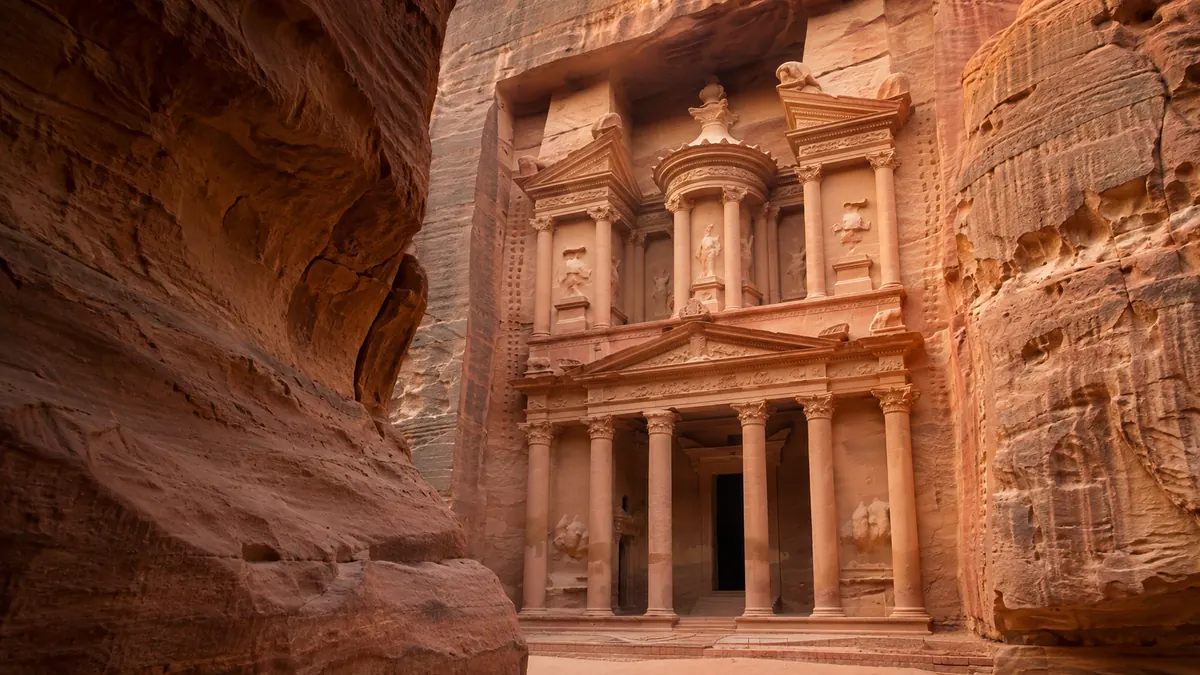
Petra looks improbable at first sight: a monumental city cut into sandstone, surrounded by an arid landscape. Its most impressive achievement, however, was not a supernatural secret. The Nabataeans combined access to trading routes with the engineering needed to collect, channel and store water.
This instalment follows the documentary’s journey through Petra, its ancient inhabitants, their religious landscape and the stories attached to the city’s decline. Archaeology can answer some of those questions. Others belong to interpretation, and should remain clearly labelled as such.
Who were the Nabataeans?
The Nabataeans developed a kingdom whose best-known centre was Petra, in present-day Jordan. Their city stood within networks connecting Arabia and the Mediterranean world. Its buildings reflect those connections: local traditions appear alongside architectural forms familiar from the wider Hellenistic and Roman worlds.
Petra was not simply a collection of impressive tombs. It also had streets, places of worship, domestic spaces and infrastructure. Seeing the city as a functioning settlement helps explain why its inhabitants needed more than a spectacular entrance. Trade, administration, skilled labour and reliable water supplies all mattered. The Metropolitan Museum of Art’s introduction to the Nabataean kingdom places Petra within this regional setting.
The documentary draws attention to rulers, coins and ancient military encounters. Such evidence is valuable when handled separately: an inscription can identify a name or dedication; a coin can associate a ruler with a particular issue; a later narrative can preserve an account of a campaign. They do not all provide the same kind of information, and none should be made to answer every question about Nabataean society.
The Siq and the building called the Treasury
Many visitors approach Petra through the Siq, a narrow natural gorge. Its winding passage creates a striking transition from enclosed rock walls to the façade known as al-Khazneh, or the Treasury. That modern name is not proof that the building once stored a hidden royal fortune.
The contrast between the narrow approach and the elaborate façade is part of Petra’s visual power. Yet photographs of this single view can also give a misleading impression: the city extends far beyond it. The theatre, tombs, temples and other monumental remains belong to a much larger archaeological landscape. UNESCO’s description of Petra emphasises both its rock-cut architecture and its wider cultural connections.
It is equally important not to describe the whole Siq as a passage laboriously carved from solid rock. People modified and managed the route, but its geological formation and the human works within it are different parts of the story.
Water was the city’s essential technology
In an arid environment, water presents two very different problems. Too little threatens everyday life; a sudden flood can damage buildings and endanger people. A successful settlement must address both.
Petra’s inhabitants used channels, cisterns and other installations to move and store water. The approach to the Siq also included measures to divert dangerous flows. The official Petra visitor information describes a dam and a tunnel associated with flood management, rather than a scheme designed to fill the Treasury with water. See the Petra Development and Tourism Region Authority’s main-trail guide.
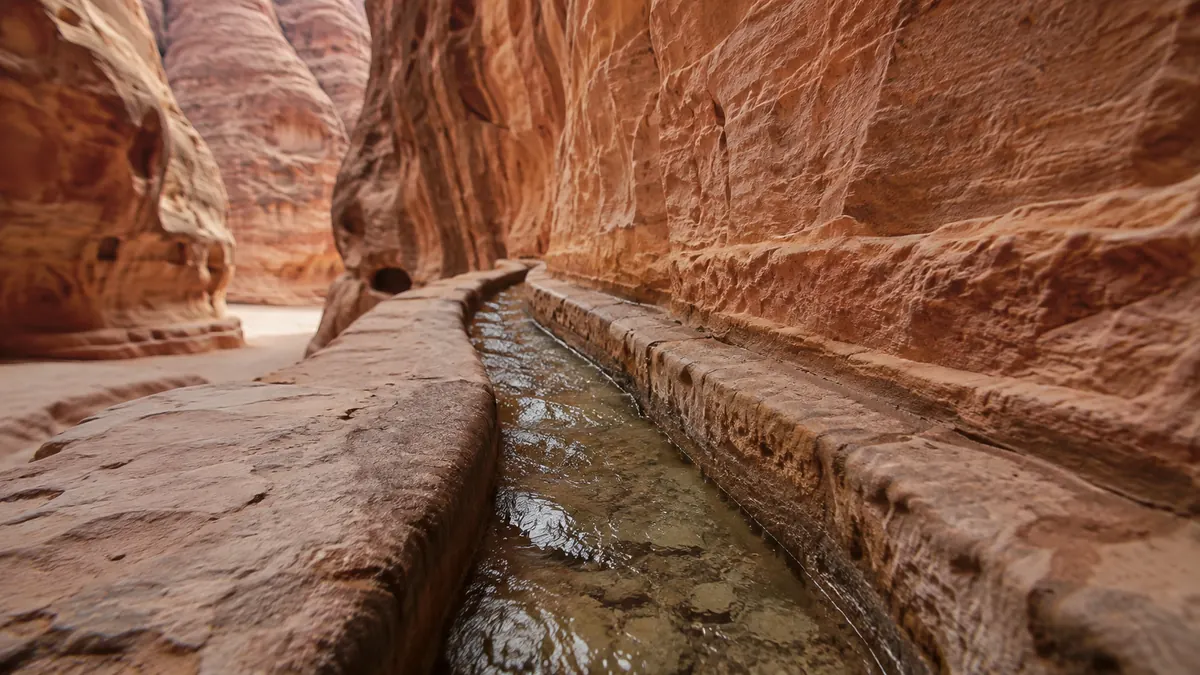
AI-generated editorial illustration of a rock-cut water channel. It is not a survey photograph or a reconstruction of one identified installation.
The engineering becomes easier to appreciate when we imagine routine work rather than a single dramatic invention. Channels needed maintenance. Storage had to bridge dry periods. Water had to reach useful destinations while uncontrolled runoff was directed away from vulnerable areas. A spectacular façade could impress a visitor, but a dependable water system helped make a city possible.
The nearby site known as Little Petra provides another example of infrastructure serving movement and settlement. Its cisterns and associated spaces are described in the authority’s guide to Siq al-Barid. Such remains connect the monumental landscape to the practical needs of travellers and communities.
Religion at Petra: what names and symbols can tell us
The episode also considers Nabataean religion, including Dushara and connections with the broader religious world of ancient Arabia. Inscriptions, sanctuaries and representations help scholars investigate worship, but religious identity cannot be reconstructed from a name’s modern sound alone.
The French Ministry of Culture’s archaeological resource on Nabataean gods and temples offers a useful starting point. It treats these traditions through their archaeological setting rather than assuming that all Arabian communities shared one unchanged system.
For Muslim readers, Quran 53:19–23 is relevant to the discussion of al-Lat, al-Uzza and Manat. The passage criticises the religious claims made about these figures. That scriptural criticism should not be confused with an archaeological demonstration that every cult originated in Petra, or that a particular surviving monument belonged to one of them.
This distinction allows both subjects to be discussed clearly. A religious text addresses belief and worship; an excavation investigates material remains. A connection between them needs evidence specific to the proposed connection.
Why did Petra change and decline?
The documentary presents the city’s later history as a dramatic reversal. It is tempting to turn that reversal into one event: an earthquake, the loss of trade, or a complete disappearance of its inhabitants. The archaeological picture is more gradual and varied.
Roman rule did not instantly erase the city, and damage did not always mean permanent abandonment. Brown University’s excavation reporting discusses the major earthquake of 363 CE while also recognising Petra’s continuing importance in later antiquity. Buildings could be damaged, repaired, reused or replaced. See the 1993 excavation report.
The responsible question is therefore not simply, “What made an entire people vanish?” It is, “How did settlement, resources, political connections and building use change over time?” Different parts of a city may have different histories. A ruined structure cannot, by itself, reveal the fate of every person who once lived nearby.
Nor does destruction provide an archaeological test of a community’s moral character. Religious reflection on the impermanence of wealth is distinct from proving a particular divine judgement through broken masonry.
Rediscovery does not mean nobody knew it existed
Accounts of Petra often celebrate the European traveller Johann Ludwig Burckhardt’s visit in 1812. The word “rediscovery” needs care: increased European knowledge is not the same as a place becoming known to human beings for the first time. Local knowledge should not disappear from the story merely because a traveller brought the site to a new audience.
Petra’s enduring interest needs no invented mystery. It brings together landscape, architecture, trade, water management and religious life. Its ruins invite questions, but the strongest answers come from identifying evidence and acknowledging what remains uncertain.
Continue through the 40,000 Years of Knowledge reading guide. For a separate scriptural discussion, see Surah al-Kahf: Major Themes and Interpretations.
Editorial approach
This article follows the episode’s principal subjects while distinguishing documented remains from proposed explanations. It does not identify Petra’s inhabitants with a Quranic community solely because both are associated with rock-cut buildings, or treat religious polemic as a substitute for historical evidence. The illustrations are modern interpretive artwork, not archaeological documentation.
