

A bird returns with news of a prosperous kingdom ruled by a woman. A letter crosses the distance between two courts. A queen consults her advisers, sends a gift and eventually encounters something that unsettles her expectations. The story of the Queen of Sheba and Suleman is about knowledge and belief as much as royal splendour.
The Quran calls her a woman ruling the people of Saba, without giving her personal name. Bilqis, or Bilqees, is the familiar name in later Islamic tradition. Keeping that distinction in view helps us follow the scriptural story without blending it with every later legend about her.
The hoopoe’s report
The account begins when Suleman notices the hoopoe’s absence. When the bird returns, it reports a kingdom with a powerful queen and a magnificent throne. It also describes the people worshipping the sun. Suleman does not immediately treat the report as settled: he sends a letter and observes what follows. See Quran 27:20–28.
That movement from a report to verification is easily lost when the episode is reduced to its spectacular ending. The messenger brings information, but the ruler must decide how to respond to it. The story advances through communication, not simply through a display of superior force.
The queen is introduced as a ruler with resources, authority and a court. She is not an anonymous spectator waiting for Suleman to act. Her decisions shape the encounter from its earliest stages.
A letter, consultation and a diplomatic gift
The letter identifies Suleman and calls the recipients to respond without arrogance. The queen consults her advisers. They stress their strength but leave the decision to her; she considers what an invasion would mean for a kingdom and its people. She then sends a gift to learn how Suleman will react. See Quran 27:29–37.
His rejection of the gift makes clear that the encounter cannot be settled as a routine exchange of wealth. The narrative moves beyond the familiar tools of royal diplomacy.
The queen’s consultation remains an important part of the story. Asking for counsel is not presented as an absence of authority. She hears the options, considers consequences and takes responsibility for a decision. Her attention to the damage caused by conquest also prevents the episode from being read merely as admiration for military power.
Saba beyond the story: trade, temples and irrigation
Ancient Saba was a real South Arabian kingdom centred in what is now Yemen. The archaeological landscape around Ma’rib includes settlements, temples and major irrigation works. UNESCO’s account of the Landmarks of the Ancient Kingdom of Saba, Marib connects its prosperity with incense trading and an extensively irrigated oasis.
This gives the setting substance. Wealth depended on water management, organised communities and exchange networks, not just a throne covered in gold. The remains at Ma’rib show the infrastructure behind a prosperous regional power.
They do not, by themselves, identify a particular excavated palace as the queen’s residence or prove the date of her meeting with Suleman. The broad archaeological history of Saba and the identification of one person are different questions. Labels used by visitors or later storytellers should not be mistaken for inscriptions establishing ownership.

Bilqis, Makeda and different literary traditions
The queen appears in more than one religious and literary tradition. Her names and later biography vary, so a detail familiar from one account should not silently be inserted into another.
The Ethiopian Kebra Nagast, for example, connects the queen with an account of royal descent through Menyelek. The British Library’s catalogue of manuscript Or 818 documents that tradition in a Ge’ez manuscript. It is evidence for a transmitted Ethiopian narrative, not a contemporary court record of the meeting.
Comparing traditions can reveal what different communities valued about the queen. It does not require pretending that all versions tell an identical story. In this article, the Quranic sequence remains the main thread; later names and traditions are identified as such.
The throne: what the Quran says, and what it leaves open
Before the queen arrives, Suleman asks who can bring her throne. An ifrit offers to do so, but a figure possessing knowledge of the Book promises a shorter interval. When Suleman sees the throne before him, he responds by recognising a test of gratitude. The queen is subsequently asked about it, and the account culminates in her declaration of belief. See Quran 27:38–44.
The passage does not name the knowledgeable figure, describe machinery or identify a physical transport mechanism. Names such as Asif belong to later interpretation. The distinction matters because a familiar explanation can otherwise begin to sound like part of the verse itself.
Within the story, Suleman’s immediate response is especially revealing. He does not claim that the event makes him self-sufficient. The remarkable arrival becomes an occasion to consider whether he will be thankful. The throne is therefore a test for the powerful ruler as well as a striking experience for his visitor.
Does quantum teleportation explain the event?
The word teleportation makes an attractive modern comparison, but it has a specific meaning in physics. Quantum teleportation transfers a quantum state using entanglement together with classical communication. It does not transport a throne, dismantle a human body or send a usable message faster than light. IBM explains the distinction in its quantum teleportation teaching module.
A ground-to-satellite experiment reported teleporting quantum states over distances reaching 1,400 kilometres. The result concerned quantum information, not the movement of a large object between palaces. See the 2017 research paper in Nature.
Consequently, the experiment cannot be cited as a demonstration of how the queen’s throne arrived. A Muslim may understand the event as a miracle without claiming that a modern laboratory has reproduced it. For a fuller discussion of later portal claims, see Solomon’s portals in religious traditions.
Splendour, craftsmanship and later embellishment
The surrounding traditions describe Suleman’s court in richly material terms. In the biblical account, the craftsman Hiram works in bronze, and the large basin called the Sea rests on twelve oxen. Those details belong to 1 Kings 7; they are not descriptions supplied by the Quran’s queen-of-Sheba passage.
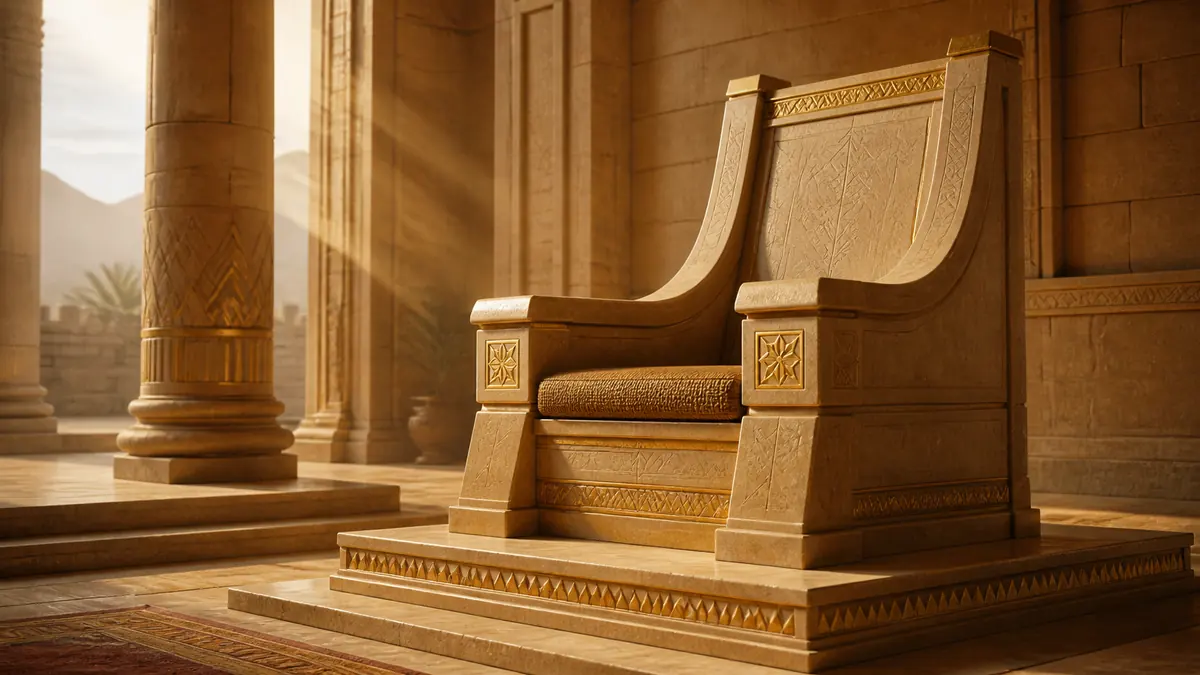
Later stories add mechanical animals, magical devices and increasingly elaborate throne rooms. Such details may be memorable literature, but they do not become archaeological facts through repetition. A conceptual illustration of a throne should likewise be read as an aid to imagination, not an exact reconstruction of the queen’s seat.
The sound approach is to ask what each source actually contributes. A scriptural account, a later retelling and an excavated object can all be interesting without being interchangeable evidence.
What the encounter asks of its readers
The queen’s story moves through several kinds of knowledge: a report brought from afar, political advice, an exchange between rulers and the reassessment of something apparently familiar. Its conclusion is not simply that Suleman’s court was more impressive than hers.
For the reader, the central questions are practical as well as religious. How should a ruler respond to unexpected information? Can consultation coexist with decisive leadership? Does privilege encourage gratitude or self-importance? These questions keep the episode meaningful even when its spectacular elements attract most of the attention.
Read as a whole, the encounter joins royal responsibility to humility. The queen is willing to reconsider, and Suleman interprets an extraordinary gift as a test. Their story deserves that broader reading—not only a search for a lost throne or a modern machine that the text never describes.
