

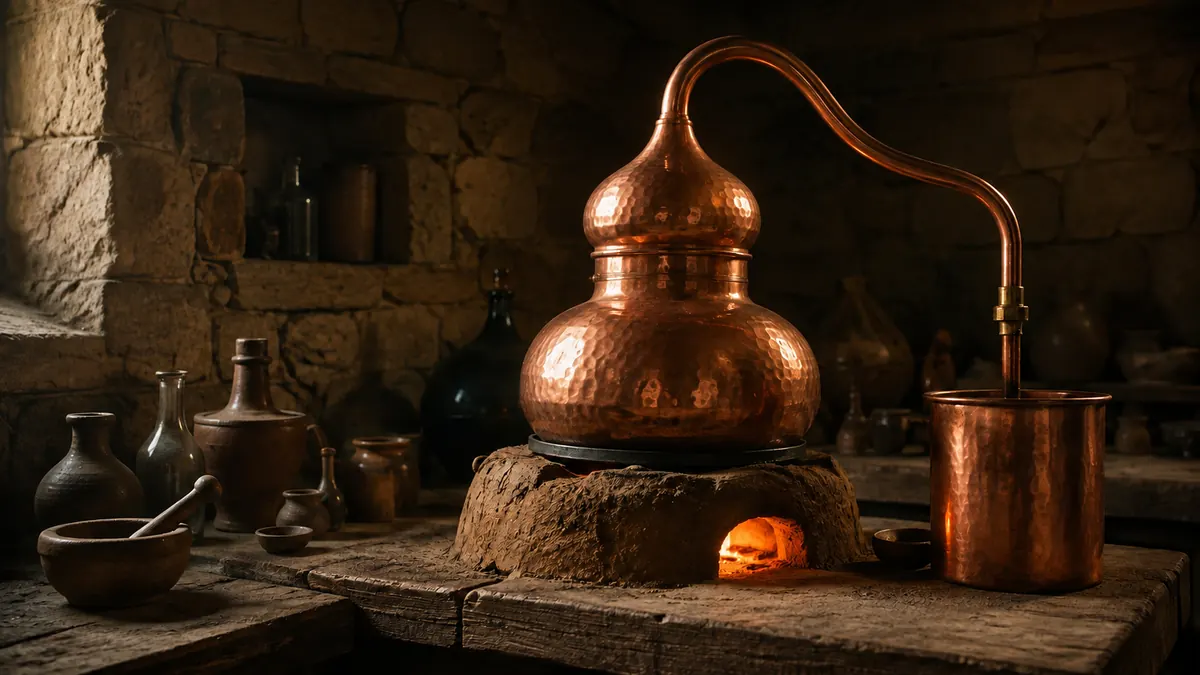
Could a substance turn an ordinary metal into gold? Could an elixir restore health indefinitely? Such questions helped give alchemy its enduring fascination. They also encouraged a mixture of practical experiments, philosophical theories, elaborate symbolism and claims that could not be demonstrated.
This instalment follows the documentary’s discussion of alchemy, the philosopher’s stone, the Emerald Tablet and the wish to understand life itself. The subject is most useful when we separate what historical practitioners believed from what their experiments actually established.
Alchemy was more than a search for gold
Alchemy was not one organisation with a single founder, doctrine or purpose. Across different periods and places, writers investigated metals, medicines, colours and the transformation of substances. Their work could combine observations at a furnace with ideas about the order of nature and the perfection of matter.
The philosopher’s stone became one especially powerful goal: an imagined substance or preparation credited with extraordinary transforming abilities. Accounts of it differ, and a reference to a “stone” does not necessarily describe an ordinary mineral that someone could pick up from the ground.
The Science History Institute’s account of alchemy places the tradition within a long history of experiments and texts. That perspective avoids two extremes: accepting every alchemical claim as a lost scientific achievement, or assuming that nobody involved ever learned anything useful.
From manuscripts to working vessels
The documentary moves between ancient writers, Arabic-language works and later European readers. That movement matters. Ideas travelled through translation, copying, commentary and adaptation; they were not passed down as one perfectly unchanged secret.
An alchemical manuscript might describe real operations while also using coded language. A vessel could be recognisable even when the substance inside it was named metaphorically. Such writing poses a problem for modern readers: we must not assume that every symbol is a literal ingredient, or that a dramatic description records a successful experiment.
The Institute’s exhibition Fire and Gold: The Art of Alchemy brings together images and books from this experimental and symbolic world. The objects help explain why alchemy belongs to the history of knowledge, even though its grandest promises remained unfulfilled.
Names on a manuscript are not always modern authorship claims
The episode mentions authorities such as Hermes and Jabir. A famous name on a historical work requires investigation: when was this particular text written, what manuscripts preserve it, and why was it associated with that name?
A traditional attribution, a pseudonymous text and a securely documented author’s notebook are not interchangeable. Treating every work associated with Hermes as a document written by one identifiable ancient person would collapse a literary tradition into an unsupported biography. Likewise, uncertainty about an attributed corpus should not become a confident declaration that every text within it is fraudulent.
This is not a reason to abandon the manuscripts. It is a reason to ask better questions of them. A text can reveal what a later community studied or valued even when the identity of its author remains uncertain.
What is the Emerald Tablet?
The Emerald Tablet is a short text associated with the Hermetic tradition and repeatedly interpreted by alchemical writers. Its language about relationships between higher and lower things became especially influential.
The legend of a physical emerald object and the history of the surviving text are different matters. Repeating a discovery story does not establish that an excavated emerald tablet has been authenticated. Nor should similarly titled works be merged into one book merely because they both concern secrets or wisdom.
Isaac Newton’s interest in alchemical literature is documented in surviving manuscripts, not just modern rumour. The Newton Project’s catalogue of alchemical papers points readers towards identified texts and their repositories. These records are a firmer foundation than unattributed quotations circulating online.
Why the philosopher’s stone was so persuasive
The promise of the stone joined several desires: wealth, mastery of nature, relief from illness and the hope of overcoming ordinary human limits. Those desires explain its appeal without establishing that the promised substance existed.
Stories of successful adepts could attract serious investigators. The Science History Institute’s account of Dr Butler and the quest for the philosopher’s stone describes how claims of remarkable cures and transmutation prompted attempts to discover and test a process. A reputation was a starting point for investigation, not a substitute for a reproducible result.
There is a useful distinction here between a question and its answer. Asking whether matter can be transformed can lead to productive research. Concluding that a secret preparation grants unlimited wealth or immortality requires evidence far stronger than a compelling story.
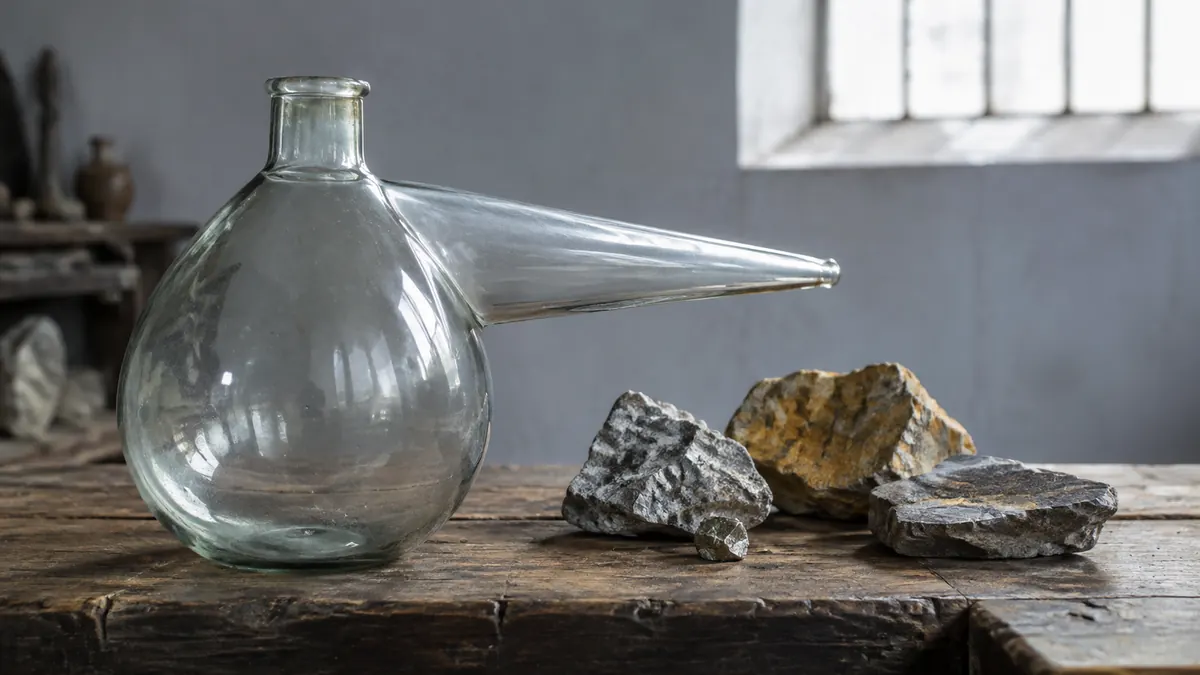
AI-generated editorial still life of historical laboratory equipment and minerals. No substance shown is a verified philosopher’s stone.
Did alchemy begin as an attempt to copy Isa’s miracles?
The documentary connects the pursuit of artificial life with the miracles of Isa, or Jesus. This is a religious interpretation of the subject, not a demonstrated single origin for the diverse history of alchemy.
In Quran 5:110, the signs associated with Isa are repeatedly described as occurring by God’s permission. Within that passage, healing and bringing life are not presented as techniques that a reader can reproduce by collecting the correct ingredients. Quran 3:49 likewise places these signs within Isa’s prophetic mission.
The distinction is important in both directions. An Islamic account of a miracle is not a laboratory recipe. A historical alchemist’s attempt to imitate living processes does not, by itself, prove that the practitioner was responding to one particular religious passage.
The episode also invokes Quran 2:102, which rejects the attribution of disbelief to Solomon and discusses the misuse of magic. That warning should not be converted into a claim that every investigation of chemistry or medicine is equivalent to sorcery.
Modern transmutation is real—but it is not the alchemical promise
Modern physics can change one element into another by changing atomic nuclei. In 2025, the ALICE collaboration reported measurements of lead nuclei becoming gold nuclei through electromagnetic interactions at the Large Hadron Collider. This is documented by CERN’s explanation of the experiment.
The crucial difference is the mechanism. Ordinary chemical operations rearrange electrons and chemical bonds; nuclear transmutation changes the nucleus. Fleeting, extremely small quantities created in a particle accelerator do not validate a medieval recipe for making economical gold. They also offer no evidence for an elixir of immortality.
Reading the strange material responsibly
Alchemical literature can include hazardous substances, imagined methods of generating life and remarkable claims about plants. Those passages belong to historical study, not home experimentation. A symbolic drawing or an old recipe is not evidence of safety or effectiveness, and nothing in this article should be used as a treatment or laboratory instruction.
The most interesting conclusion is not that all alchemical knowledge was secretly correct. It is that curiosity, ambition and error can coexist in the same intellectual tradition. Studying that tradition carefully reveals both the appeal of extraordinary promises and the importance of checking what a source can actually prove.
Use the series reading guide to follow the connected discussions of prophecy, ancient knowledge and historical interpretation. The next instalment examines John Dee, Newton and the manuscripts that are often recruited into stories about secret societies.
