

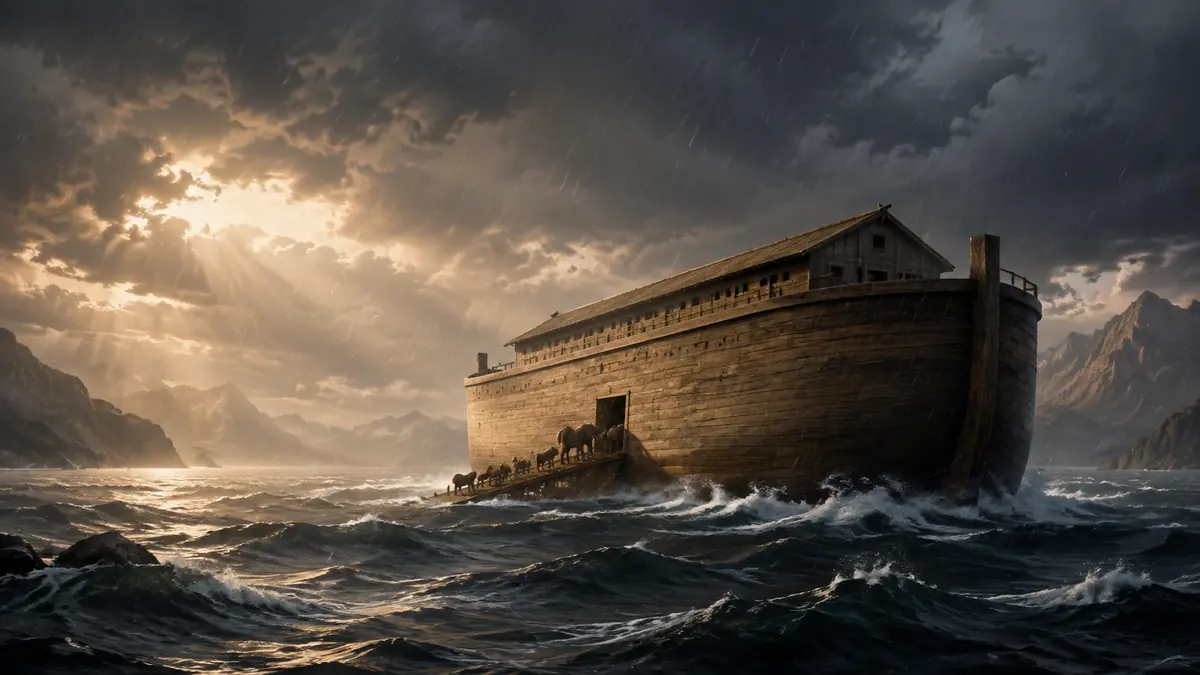
The story of Noah raises questions that many people first ask as children. How could animals travel in one vessel? Who went aboard? Did the flood cover the whole planet? The source lecture begins with those honest questions and then brings together Quranic verses, later commentaries and a modern theory involving stored DNA.
Those materials do not all carry the same authority. The strongest way to understand Noah’s Ark in the Quran is to begin with what the Quran actually states, identify later reports as later reports, and leave unsupported scientific explanations where they belong: in the category of speculation.
Noah’s long call to his people
Noah, or Nuh, is one of the Quran’s major prophetic figures. Surah Nuh records his persistent call to worship Allah and his complaint that repeated public and private preaching was met with rejection. Quran 71:5–20 presents a preacher who tries more than one approach over a long period rather than abandoning his community at the first refusal.
Quran 29:14 says that Noah remained among his people for a thousand years minus fifty. The verse establishes the extraordinary length of his mission among them; it does not provide a complete biography or a modern chronological date.
The conflict was fundamentally moral and theological. Noah called his people away from false worship, while influential opponents dismissed him and those who believed with him. In Quran 11:36–39, Noah is informed that no more of his people will believe and is instructed to build the Ark under divine guidance.
What the Quran says about the Ark
Several passages contribute parts of the account:
- Quran 11:37 commands Noah to construct the vessel under Allah’s watch and revelation.
- Quran 23:27 connects the beginning of the event with the sign of the oven overflowing and instructs him to take aboard pairs, his family except those already judged, and the believers.
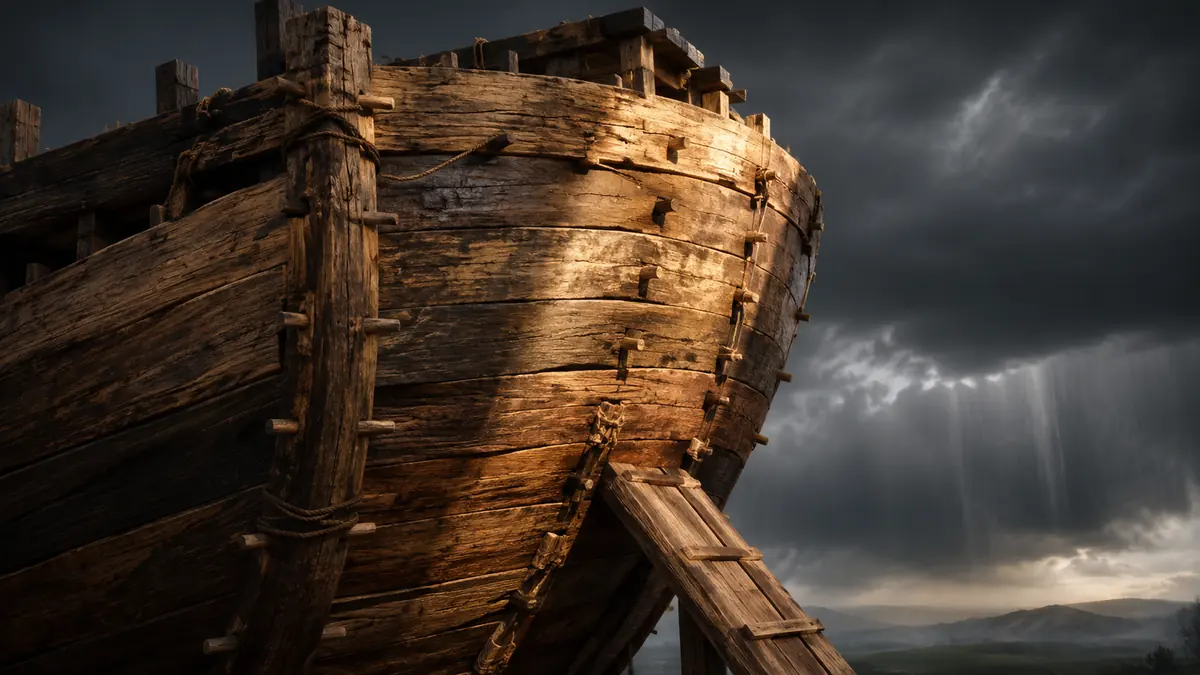
- Quran 54:11–15 describes water pouring from the sky, springs bursting from the earth and Noah being carried on a vessel made of planks and fastenings.
- Quran 11:41 records Noah telling the passengers to embark in Allah’s name.
- Quran 11:44 says that the water subsided and the Ark came to rest on al-Judi.
Together, these verses give a vivid but selective narrative. They do not provide measurements, a floor plan, a complete passenger list or a species inventory.
Who was saved?
The Quran mentions Noah, the believers, members of his family who were not excluded by the divine judgment, and pairs from the categories he was ordered to carry. It also makes clear that biological relationship did not guarantee salvation.
When Noah called to a son who had remained apart, the son said that he would take refuge on a mountain. A wave came between them and he drowned. The exchange in Quran 11:42–46 turns the story away from ancestry and toward moral responsibility.
Quran 66:10 also uses the wives of Noah and Lot as examples of people who were close to righteous servants but were not saved by that connection. The Quran does not name eighty passengers or give another exact total. Numbers found in commentaries and historical works should therefore be introduced as transmitted reports, not Quranic facts.
How large was the Ark?
The Quran calls it a fulk, a vessel, and describes it as made of planks and fastenings. It gives no dimensions. Reports about a particular length, width, height or number of decks come from later exegetical and historical literature.
Such reports are part of the reception history of the story and may be discussed respectfully. They cannot be used as if they were measurements supplied by the Quran. Different reports also disagree, which is another reason not to build a calculation on one selected figure.
What does “pairs of each” mean?
Translations often render the instruction as taking a pair “of every kind.” The Arabic expression is concise, and interpreters have long discussed its scope. The text does not use the modern biological concepts of species, genus or DNA sample.
That distinction matters because modern taxonomy contains millions of described species and continues to change as scientists study relationships. Reading a contemporary classification system back into a seventh-century Arabic phrase creates an answer the verse itself does not give.
The Quran’s purpose in this passage is not to publish an inventory. It presents preservation by divine command amid judgment. Questions about the practical mechanism may remain, especially for readers who understand the event as a miracle.
Did Noah preserve animal DNA?
The source lecture considers a theory that the Ark might have carried genetic material rather than living animals, comparing it with modern seed banks. The comparison is imaginative, but neither the Quran nor a reliably transmitted report says that Noah used DNA technology.
Modern seed vaults preserve seeds that already contain viable plant embryos. Reconstructing whole animal populations from stored DNA is a very different process. DNA alone is not a living embryo, and successful cloning requires intact cells, suitable ova, gestation and advanced laboratory systems. No historical or archaeological evidence connects such technology to Noah.
This theory should therefore not be offered as a reconciliation of scripture and science. A believer may accept divine intervention without inventing an undocumented technology, while a historian should acknowledge that the physical details cannot be reconstructed from the available text.
Al-Judi, not a modern certainty about the wreck
The Quran names al-Judi as the Ark’s resting place. Later geographical traditions have proposed locations in the wider region of Upper Mesopotamia and eastern Anatolia. Modern claims about a boat-shaped formation or a discovered wooden hull periodically attract attention, but none has achieved a secure archaeological identification as Noah’s Ark.
The careful conclusion is modest: al-Judi is part of the Quranic account, while the precise modern coordinates and physical remains are not established by the Quran or by a scholarly archaeological consensus.
Why later details must be labeled
Later tafsir, storytelling and Biblical material influenced how communities pictured the Ark. Details such as its exact construction, the sequence in which animals boarded, the food stored aboard, the number of passengers and the duration of every stage may come from different bodies of tradition.
Labeling these sources does not disrespect them. It prevents a later report from being mistaken for revelation and makes the article more useful to readers who want to verify each claim.
A simple evidence guide helps:
- Quranic statement: the text explicitly says it.
- Authenticated prophetic report: a hadith with an identifiable source and grading supports it.
- Later commentary or history: a scholar transmits or interprets the detail.
- Modern hypothesis: a recent writer proposes a mechanism without direct historical evidence.
The central lessons of the account
The Ark is not presented merely as an engineering puzzle. The Quran repeatedly places the story within themes of patient preaching, arrogant refusal, divine judgment, mercy and gratitude.
Noah’s son shows that family status cannot replace faith and conduct. Noah’s persistence shows that truth is not measured by immediate popularity. The survival of the believers is described as a sign to later generations, not an invitation to turn uncertainty into false precision.
Frequently asked questions
Does the Quran give the Ark’s dimensions?
No. Specific dimensions and deck arrangements come from later reports, not the Quranic text.
Does the Quran state how many people boarded?
No exact passenger number appears in the Quran.
Does “every kind” mean every modern species on Earth?
The Quran does not define the phrase through modern taxonomy. Claims about a precise species count go beyond the text.
Does Islam teach that Noah used DNA technology?
No Quranic verse or authenticated hadith establishes that claim. It is a modern speculative theory.
Where did the Ark rest?
Quran 11:44 names al-Judi. Claims identifying a particular modern formation or excavated object as the Ark remain unproven.
What to remember
The Quran gives a powerful account of Noah’s long mission, the building of the Ark, the flood, the saving of the believers and the vessel’s resting on al-Judi. It does not supply many of the numerical and technological details found in later retellings. Keeping revelation, commentary and speculation separate produces an account that is both more faithful and more credible.
For the preceding article in this series, read Cave Art, Idris and the Book of Enoch: What the Evidence Actually Says.
