

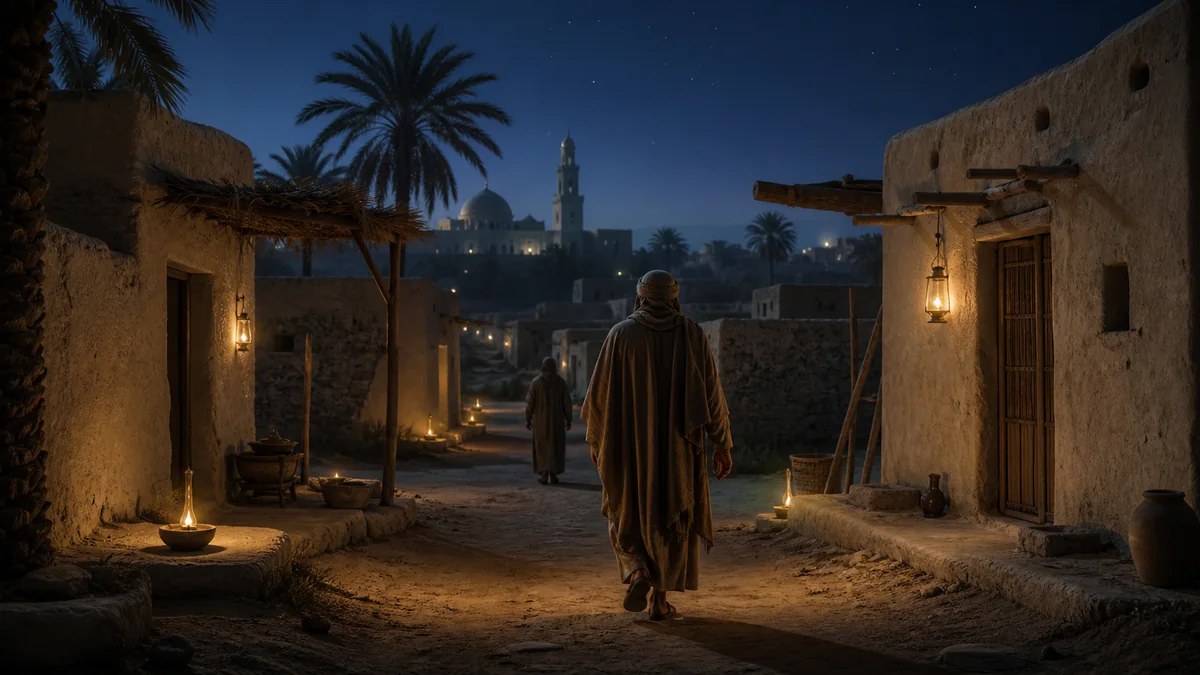
Editorial note: Accounts of Umar ibn al-Khattab’s night patrols are found mainly in later historical and biographical literature. Their details vary and should not be treated as authenticated hadith unless a specific chain and grading are supplied.
Leadership beyond the public audience
Umar ibn al-Khattab is remembered not only for major decisions but also for a demanding idea of public responsibility. Later Muslim historians describe him walking through Medina at night to learn how people lived beyond the formal reports that reached the ruler.
The image of a leader leaving official surroundings has remained powerful because government can look orderly from an office while hardship remains hidden in homes and streets. Whether every popular story can be verified in all its details, the recurring theme is consistent with Umar’s well-attested concern for justice and accountability.
The Quranic framework of public trust
The Quran commands believers to return trusts to their owners and to judge with justice. It also commands justice, excellence, and care for relatives, while condemning oppression. Public authority is therefore an entrusted duty rather than personal ownership.
Another Quranic principle is that wealth should not circulate only among the rich. For a ruler, these teachings require more than fair courtroom decisions. They include attention to hunger, access, distribution, and the people least able to present their complaints to officials.
Why patrol at night?
Later reports portray night patrols as a form of direct observation. At night, public performance is reduced: markets close, official visitors disappear, and domestic hardship may become easier to notice. A leader travelling without ceremony can encounter concerns that subordinates might overlook or filter.
- Verification: compare official reports with conditions on the ground.
- Accessibility: notice people who do not know how, or are afraid, to approach authority.
- Urgency: respond to hunger or danger without waiting for routine administration.
- Self-accountability: test whether policies are working for ordinary families.
Popular stories and historical caution
Two types of stories are often connected to Umar’s patrols: an encounter with a hungry family and a conversation involving a mother who urged her daughter to dilute milk. Versions appear in later historical works and sermons, sometimes with additional dialogue and moral detail.
These accounts can illustrate concerns associated with Umar’s rule, but responsible writing should identify them as historical reports and avoid presenting every sentence as certain. A memorable story gains credibility not from repetition alone but from the quality of its transmission and its agreement with stronger evidence.
Accountability in practice
The deepest lesson of the patrol tradition is that responsibility moves downward before privilege moves upward. A ruler who considers himself answerable before God must ask who is missing from the reports, who bears the cost of delay, and whether a regulation that looks sound in theory creates hardship in practice.
Modern institutions cannot be governed by informal visits alone. They need records, audits, trained staff, transparent rules, and lawful review. Yet direct observation still matters. Leaders in charities, schools, businesses, and governments can become insulated by summaries that hide human experience.
Lessons for public service
- Authority should make a person more answerable, not less.
- Welfare problems should be investigated before blame is assigned.
- Leaders need channels that reveal uncomfortable information.
- Historical reports should be cited with honesty about their strength.
- Compassion and competent administration must support each other.
Key sources and source limits
- Quran 4:58 — trusts and just judgment.
- Quran 16:90 — justice, excellence, and care.
- Quran 59:7 — preventing wealth from circulating only among the rich.
- Later biographical and historical compilations preserve patrol narratives in varying forms; their details require source-by-source evaluation.
Series note: This is Episode 14 of the Umar ibn al-Khattab series. Episode 15 continues the discussion of the night-patrol tradition.
