

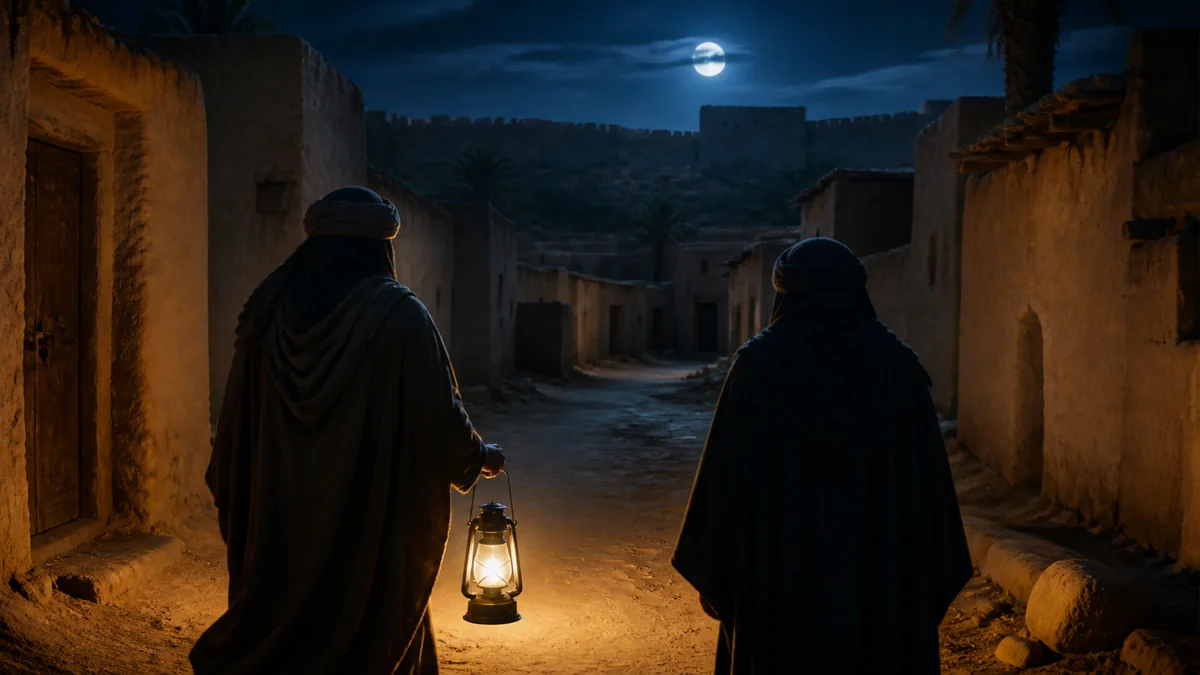
Stories of Umar ibn al-Khattab’s night patrols explore a question at the heart of public responsibility: what happens when those in authority cannot see everyone’s circumstances? This second part considers honesty in trade, care for animals and the need to check a report before relying on it.
The evidence is not identical for every story. The milk seller and several household anecdotes belong to popular historical retellings. The account of Abu Musa seeking permission, by contrast, can be read directly in a numbered hadith reference.
The milk seller and honesty in private
In the story recounted in this series, Umar rests beside a house while walking at night. He hears a mother ask her daughter to add water to milk. The daughter refuses, although the ruler is not visibly present to enforce the rule.
The point of the account is the daughter’s own honesty. Mixing water into milk while selling it as undiluted milk deceives the buyer. The story contrasts a public rule with the private decision that makes the rule effective.
This does not mean that a ruler’s every wish automatically takes precedence over a parent’s wishes. The issue is refusal to take part in wrongdoing. The article’s earlier wording turned a specific moral example into a sweeping claim about obedience; that was too broad.
The continuation says that Umar enquires about the household and that the young woman later marries his son Asim. The exact dialogue and the family’s personal circumstances have not been verified here. They are therefore presented as elements of the traditional story, not as a documented conversation.
The later connection with Umar ibn Abd al-Aziz
The account connects this family story with Umar ibn Abd al-Aziz, often called Umar II. He was a later Umayyad caliph, not one of the four rulers conventionally grouped as the Rashidun. His reign belongs to 717–720 CE, as recorded in the King’s College London Prosopography of the Byzantine Empire.
Calling him a “fifth rightly guided caliph” is an expression of admiration in some Muslim writing. It should not erase the chronological gap or confuse the two men named Umar.
The series also tells of Umar II serving a simple meal to privileged guests as a lesson against extravagance. That anecdote illustrates the theme of restraint, but its precise menu, waiting time and speeches have not been established for this article. There is no basis here for turning the meal into a modern recipe or a numerical claim about present-day government spending.
Public resources are not personal rewards
These accounts contrast holding office with enjoying privileges. A public official may have access to resources that other people do not. The ethical question is whether those resources serve their intended purpose or are treated as a private benefit.
The same distinction applies when reading a historical story. Praise for a ruler’s restraint does not prove that every allowance was identical, every complaint was resolved or every member of a ruling family behaved in the same way. Specific claims need specific evidence.
Care for working animals
Several stories in the episode describe Umar objecting to overloading animals, inadequate feeding and exhausting a mount to obtain a preferred food. Their shared lesson is that an animal’s suffering should not become invisible because a human being finds the journey useful.
The earlier text accidentally reversed this lesson with wording that appeared to tell people to starve their animals. The intended meaning is the opposite: feed them properly, avoid excessive loads and do not mistreat them.
Those particular encounters still require individual historical verification. A separate, identifiable religious source for humane treatment is Sahih Muslim 1955a, which teaches care even in the context of slaughter. That report supports the ethical principle; it does not authenticate every camel story attributed to Umar.
Abu Musa and permission to enter
A more directly traceable incident concerns Abu Musa al-Ash‘ari. Sahih al-Bukhari 6245 says that he asked permission to enter Umar’s home three times. When permission was not given, he left.
Asked why he had gone away, Abu Musa explained the Prophet’s instruction to leave after three unanswered requests. Umar asked for corroboration. Abu Musa then approached a gathering of the Ansar, and Abu Sa‘id al-Khudri accompanied him to confirm the report.
The names matter. In this narration, Ubayy ibn Ka‘b speaks at the gathering, while Abu Sa‘id is the youngest person who goes as a witness. The previous version blurred those roles.
Checking knowledge without claiming to know everything
The permission account illustrates two limits. A visitor’s wish to enter does not remove the householder’s privacy. A respected leader’s knowledge is also not complete: another person may know a report that the leader has not heard.
It would go too far to infer from this one incident that every hadith always requires two witnesses, or that a sincere narrator can never remember something correctly without corroboration. The report describes a particular exchange. Wider rules of hadith evaluation require a wider body of evidence.
Together, the stories ask readers to consider conduct when no supervisor is watching, the treatment of vulnerable creatures and the willingness to verify what they repeat. The lesson is strongest when the article itself follows that last principle.
Sources and reading notes
- Sahih al-Bukhari 6245 — Abu Musa, Umar, Ubayy and Abu Sa‘id in the permission account.
- Sahih Muslim 1955a — the principle of humane treatment.
- King’s College London: Omar 2 — the later caliph’s dates and historical identification.
Source note: The milk seller, family meal and individual animal encounters remain traditional anecdotes in this series. The linked hadith references should not be understood as authentication of those separate stories.
