
A difficult manuscript invites curiosity. Its unfamiliar symbols can make it tempting to imagine that it contains a single forbidden secret, especially when its owners include famous scholars. Yet an unreadable page is first a problem of language, provenance and interpretation—not proof of a hidden organisation controlling history.
This instalment follows the documentary’s discussion of John Dee, Isaac Newton, the Voynich manuscript and the meeting points between alchemy and religious thought. The surviving documents are fascinating enough without attributing to them conclusions that their evidence cannot support.
Separate traditions before connecting them
The episode begins with alchemy, esoteric learning and Kabbalah. These subjects sometimes interacted, but they are not different names for one movement. “Esoteric” describes restricted or specialised teachings; it does not, by itself, identify an organisation, a crime or a plan to acquire political power.
Kabbalah belongs to the history of Jewish mystical interpretation. The Zohar is one of its central works, with interpretations of scripture and religious practice. The National Library of Israel’s introduction to the Zohar provides a starting point grounded in manuscripts and the history of the text.
A Christian alchemist’s use of a Jewish concept would not make every Jewish reader an alchemist. Nor would a shared symbol establish that all the people using it belonged to the same society. Connections need to be demonstrated through particular texts, dates and relationships, rather than assumed from resemblance.
John Dee: scholarship and extraordinary claims
John Dee lived in the sixteenth and early seventeenth centuries. His interests ranged across mathematics, navigation and other learned pursuits, alongside activities we would now classify as occult. He is a useful example of why modern subject boundaries do not always map neatly onto an early modern scholar’s work.
The Royal Museums Greenwich catalogue connects Dee with learned networks involving Mercator and Elizabethan scholarship. This is more precise than describing his public role only as that of a magician who secretly directed a monarch.
Dee also recorded experiences he understood as communication with angels. A record of someone’s belief is evidence that the belief was held or reported; it is not independent verification that the beings described were present. The distinction remains necessary even when a manuscript is genuine and its author is famous.
Later editions and commentaries introduce another layer. An editor’s judgement about Dee’s experiences is not automatically Dee’s own conclusion, and neither can stand in for an external test of the events. Reading the document and its publication history separately helps prevent a dramatic retelling from turning several voices into one eyewitness account.
What the Voynich manuscript does—and does not—establish
The Voynich manuscript, held at Yale as Beinecke MS 408, contains an unusual script and illustrations that have attracted generations of proposed explanations. Its fame partly rests on the gap between how much material survives and how difficult that material is to interpret securely.
Yale’s collection description of the manuscript is particularly important for one claim in the documentary: suggested ownership by John Dee has been seriously questioned. It should not be presented as a book unquestionably recovered from a collection he buried.
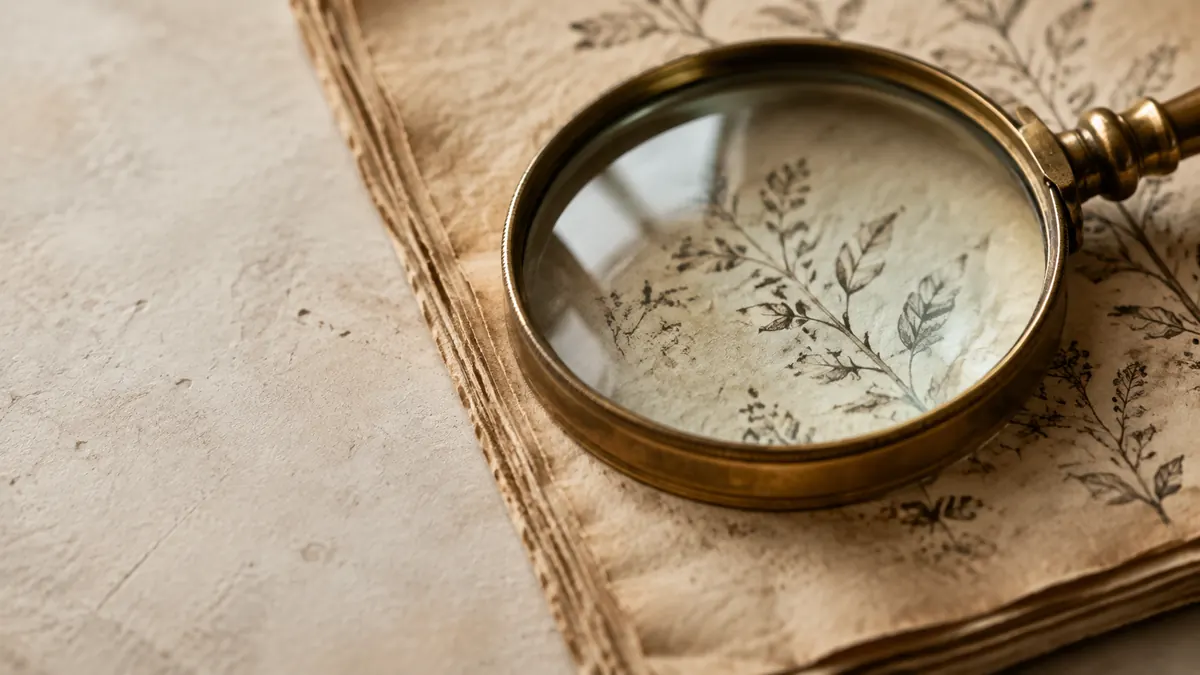
AI-generated illustration of manuscript examination. This is not a reproduction, translation or newly deciphered page of the Voynich manuscript.
Pictures of plants, containers or bathing figures may suggest possible subjects, but they do not settle the meaning of the writing. A tube in an illustration is not enough to prove that the whole book is an alchemical manual. Similarly, an unidentified plant drawing does not establish that the artist saw vegetation from another world.
The most defensible approach is to distinguish three statements: the manuscript exists; a researcher proposes an interpretation; that interpretation has been independently demonstrated. The first does not make the third true automatically.
Newton’s alchemy is documented
Isaac Newton’s involvement with alchemical texts is not merely a conspiracy theory. Manuscripts survive in which he copied, compared and investigated alchemical material. The Newton Project’s catalogue identifies works, dates and repositories, with links to the Chymistry of Isaac Newton project where transcriptions are available.
These papers complicate the familiar image of Newton as a scientist concerned only with motion and gravity. They do not invalidate his mathematics, and they do not establish that every alchemical claim he studied was correct. A person’s demonstrated success in one field cannot serve as proof of an unrelated belief.
His papers also contain different kinds of writing. A copied passage may preserve another author’s claim; a set of notes may record an experiment, comparison or unresolved question. Before saying “Newton discovered” something, a reader needs to establish which kind of document is being quoted.
Private papers are not the same as a secret society
Some of Newton’s work remained little known for a long period, and the history of its dispersal matters. The Newton Project’s introduction to its manuscript catalogue explains the treatment and transmission of material now spread across collections.
An unpublished manuscript can have many explanations: an unfinished project, limited circulation, personal interest, the conventions of a field, or later decisions by owners and editors. Secrecy is one possible historical question, not a universal answer.
Likewise, an institution later named after Newton does not establish that he belonged to it. Membership needs contemporary evidence. Knowing someone who participated in a society is also different from being a member oneself. A chain of associations becomes weaker, not stronger, when those distinctions are ignored.
The episode’s references to dangerous experiments and personal distress require similar care. We should not assign a medical cause to a historical person’s illness or reconstruct an accidental fire’s motive without adequate evidence. Uncertainty should remain visible rather than being filled with the most dramatic available explanation.
Disturbing objects need provenance, not sensational conclusions
The documentary also invokes unusual book bindings and imagery about death. Even when an object is authentic, its production date, binding date, ownership and original purpose need separate investigation. A later binding of an older text cannot prove that the text’s original authors commissioned that binding.
Nor does a disturbing artefact establish that everyone who studied the same subject practised the same behaviour. This is a basic safeguard against guilt by association. It applies equally to alchemists, religious communities and collectors.
The question to ask is concrete: which object, in which catalogue, examined by whom, and supporting which specific conclusion? Without those answers, the example may be memorable but historically uninformative.
Knowledge and humility
The episode returns to the Islamic distinction between human investigation and divine power. Quran 5:110 describes Isa’s extraordinary signs as occurring by God’s permission. Within that religious framework, a miracle is not reduced to a hidden formula simply because an alchemist wished to reproduce it.
The broader lesson also applies to historical research. Curiosity is valuable, but curiosity does not remove the need for evidence. A genuine manuscript, a brilliant author and a mysterious symbol can all be real while the theory connecting them remains unproved.
Follow the series reading guide for the preceding discussion of alchemy and the concluding chapter on Solomon traditions, the Cairo Genizah and the Knights Templar. This article is an evidence-led adaptation of the episode’s topics, not an endorsement of its speculative links between communities or institutions.
