

Editorial note: This installment distinguishes between the Quran, rigorously authenticated hadith, and later biographical details. It avoids imaginative dialogue where the early sources do not preserve exact wording.
From private teaching to a public warning
During the earliest stage of the Meccan mission, the Prophet Muhammad (peace and blessings be upon him) taught a small circle of believers. The next phase, however, demanded a public declaration. In the Quran, God instructed him to warn his closest relatives and to show mercy toward those who followed him. This order placed responsibility close to home: a messenger could not call distant people while ignoring his own family and clan.
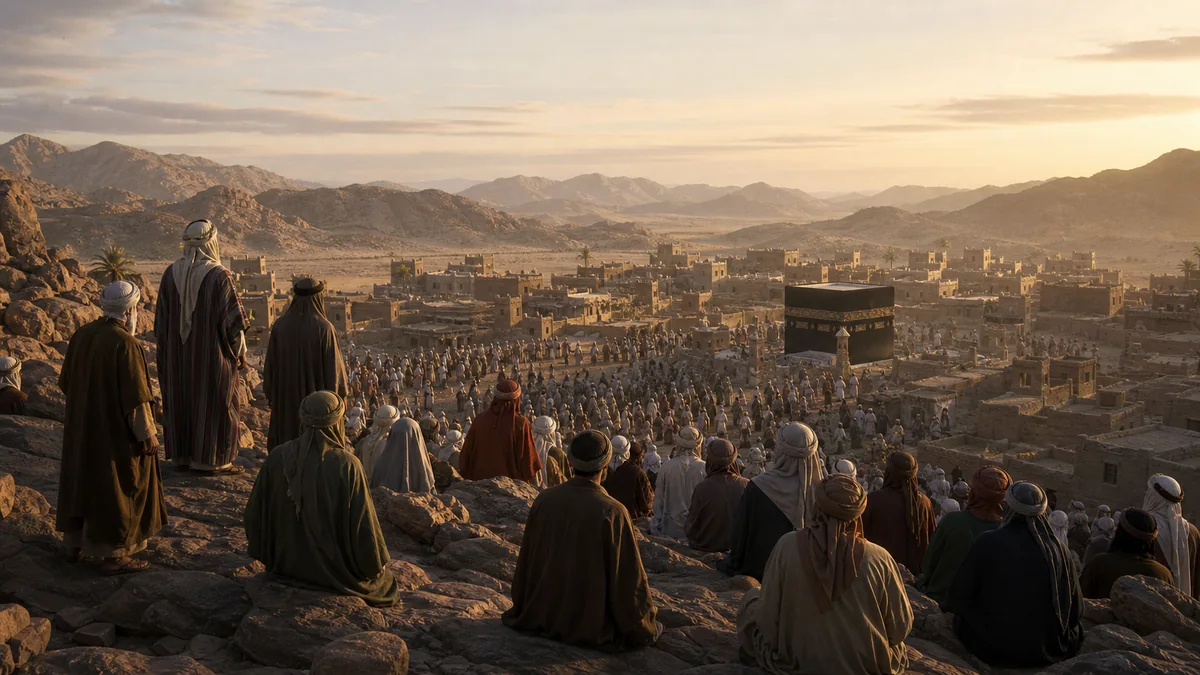
The public warning associated with Mount Safa became one of the clearest moments in that transition. Safa was a familiar rise beside the Kaaba from which an urgent caller could attract the attention of Mecca. As a result, the setting made the message impossible to dismiss as a private conversation.
The gathering at Mount Safa
An authenticated report in Sahih al-Bukhari relates that the Prophet climbed Safa and called the clans of Quraysh. When they assembled, he asked whether they would believe him if he warned that enemy horsemen were approaching from behind the valley. They answered that they had never known him to lie. He then warned them of a severe accountability before God.
The question suited its audience. Meccan society depended on reliable warnings, trusted witnesses, and protection of the clan. By recalling his established reputation for truthfulness, the Prophet asked his listeners to apply the same standard of evidence to a message that challenged their religious habits.
Abu Lahab’s response
Abu Lahab, an uncle of the Prophet, reacted with open hostility. His words turned the gathering from a serious warning into a public confrontation. Family ties did not guarantee acceptance, and social rank did not place anyone beyond moral responsibility.
Surah al-Masad, chapter 111 of the Quran, condemns Abu Lahab’s opposition and the pride he placed in wealth and status. The chapter is not merely a family dispute preserved in scripture. It presents a larger principle: wealth, lineage, and influence cannot rescue a person who knowingly resists truth and harms others.
Why this event mattered
- Public responsibility: the call to worship one God moved into the open life of Mecca.
- Evidence and trust: the Prophet’s opponents acknowledged his honesty even while resisting the implications of his message.
- Equality before God: the same moral warning addressed relatives, leaders and everyone else.
- Personal choice: closeness to a righteous person cannot replace faith, integrity, and action.
Reading the account responsibly
An authenticated hadith supports the core of the Safa account. Later works of sirah add context and narrative detail. However, readers should not automatically give those additions the same evidentiary weight. This distinction protects both historical accuracy and the spiritual meaning of the episode.
The Mount Safa warning therefore marks a decisive change. The early Muslim community was still small and vulnerable. Yet the Prophet stated the message publicly, without privilege for family or elite status. The event prepares the ground for the organized objections and attempts at compromise examined in Part 10.
Key sources
- The command to warn close relatives and care for the believers (Quran 26:214–215).
- The authenticated Mount Safa report (Sahih al-Bukhari 4770).
- The Quranic judgment concerning Abu Lahab (Surah al-Masad (Quran 111)).
Series note: This is Part 9 of the Life of Prophet Muhammad (PBUH) series. Continue with Part 10 for Quraysh’s objections and attempts at compromise.
