

The story of Prophet Lut in the Quran is not only an account of a community’s destruction. It is also the story of a prophet trying to protect his guests, of Ibrahim pleading for others, and of a household ordered to leave before morning. These personal moments give the narrative its urgency.
Lut is known as Lot in English biblical tradition. His people are commonly associated with Sodom and the surrounding settlements near the Dead Sea. That traditional identification is familiar, but the Quran does not name Sodom or Gomorrah or provide coordinates for either city.
This article follows the account from Ibrahim’s visitors to Lut’s departure, then examines the historical and geological questions raised by the story. The Quranic narrative, later commentary and archaeological hypotheses each require a different kind of reading.
From Ibrahim’s journey to Lut’s mission
Quran 21:71 describes Allah rescuing Ibrahim and Lut and bringing them to a land blessed for all peoples. Quran 37:133 identifies Lut as one of the messengers. These verses establish their religious connection without setting out a complete family tree or travel itinerary.
The lecture introduces Lut as Ibrahim’s nephew and follows a route through Mesopotamia, Egypt and the Levant. Those details belong to the wider biblical and historical tradition; they are not all stated in the Quran. In particular, the verse about the blessed land does not name Hebron or specify a journey from Egypt.
This distinction matters because a familiar retelling can gradually become more detailed than its source. The central Quranic account does not depend on knowing every stop along the journey.
The visitors who first came to Ibrahim
In Quran 11:69–76, messengers visit Ibrahim with good news. He offers them food, but their refusal to eat makes him uneasy. They reassure him and explain that they have been sent to the people of Lut.
After receiving reassurance and the promise of a son, Ibrahim pleads concerning Lut’s people. The passage describes his tenderness and patient disposition, yet the messengers tell him that the decision has been made.
Quran 29:31–32 adds another exchange. Ibrahim points out that Lut is in the town. The messengers answer that they know who is there and will save him and his household, except his wife.
Later retellings expand Ibrahim’s pleading into a series of negotiations. Those additional conversations should not be confused with the Quran’s wording. The revealed account is brief, but its emphasis on Ibrahim’s concern for others is unmistakable.
What the Quran says about Lut’s people
Quran 7:80–84 presents Lut condemning men approaching men with desire rather than women. Quran 29:28–30 also mentions obstructing the road and wrongdoing in public gatherings. The people respond with defiance and demand that he bring the threatened punishment.
The narrative therefore contains several connected elements: sexual wrongdoing as described in the text, public misconduct, hostility to a messenger and threats against vulnerable guests. A careful account should not erase any of these elements or reduce the episode to a slogan.
Traditional Muslim interpretation treats the sexual conduct described in these passages as prohibited. Explaining that religious teaching does not justify harassment or violence against people today. The story concerns a particular community in scripture; it is not evidence for blaming present-day disasters on a group of people.
A difficult night: Lut protects his guests
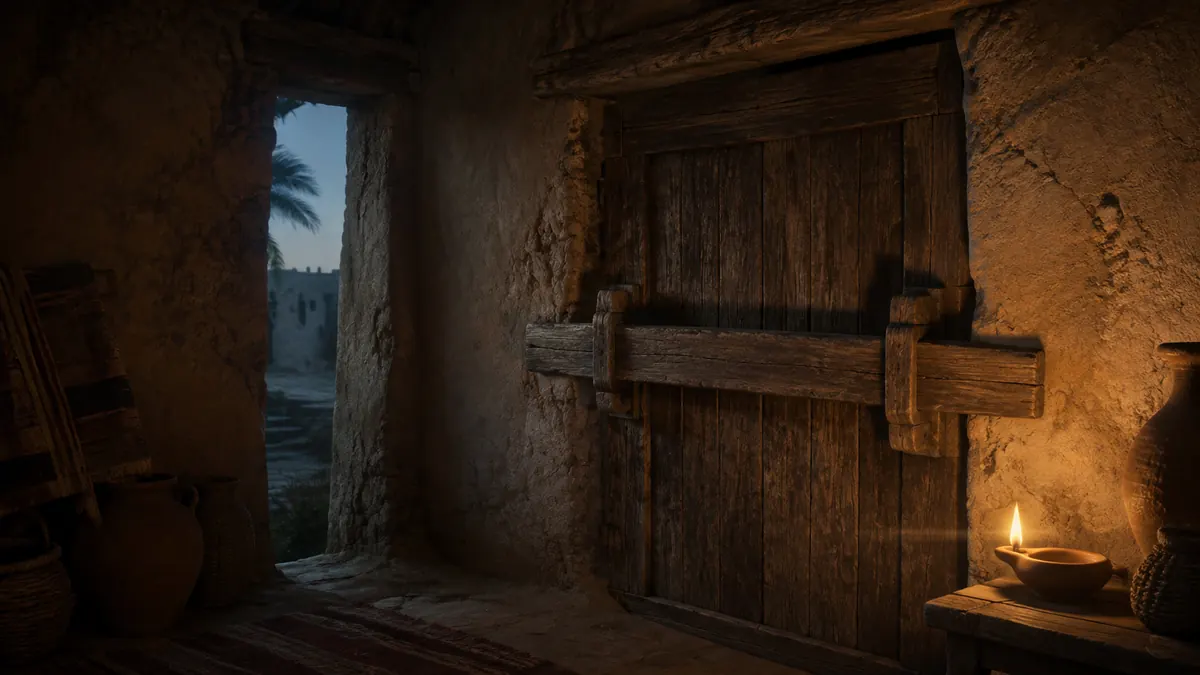
When the messengers reach Lut, he is distressed about their safety. Quran 11:77–83 describes the people hurrying to his home and Lut urging them not to disgrace him through his guests.
He appeals to their sense of right and wrong and refers to his daughters as a lawful alternative. Commentators differ over whether this means his own daughters in marriage or the women of his community, understood as a prophet’s daughters. The verse should not be turned into a claim that he permitted an assault on anyone.
The people reject his appeal. Lut wishes that he had the strength or protection needed to resist them. His distress is an important part of the passage: he takes responsibility for people under his roof even when he appears to lack the power to defend them.
The messengers then reveal that they have come from his Lord and assure him that his opponents cannot reach him. Quran 54:37 also describes the loss of the attackers’ sight when they sought his guests.
The lecture includes further details about a barred doorway, the crowd and an angel’s intervention. Such details occur in expanded narrative traditions. They should be distinguished from what the Quran itself explicitly relates.
The command to leave before morning
The messengers instruct Lut to leave with his household during the night and not look back. Quran 15:65 tells him to follow behind his family and continue where commanded. The emphasis is on departure and obedience, not on watching the disaster unfold.
Lut’s wife is excluded from the promised rescue. The Quran does not give her name, the names of his daughters or a detailed description of her final movements. Those particulars vary in later accounts and should not be presented as settled Quranic facts.
The passage in Surah Hud describes the settlement being overturned and stones of baked clay raining upon it. Quran 15:73–74 also mentions a mighty cry at sunrise. These are the descriptions within the religious narrative; they are not, by themselves, a modern diagnosis of an earthquake or asteroid event.
Where were Sodom and Gomorrah?

The traditional search focuses on the Dead Sea region, but locating a ruined settlement and proving its ancient name are separate tasks. Quran 15:76 places the remains by a well-used route, while Quran 37:137–138 addresses people who pass them by morning and night. Neither passage supplies a modern map reference.
The lecture draws attention to the Greek geographer Strabo. In Geography 16.2.44, Strabo records local traditions about ruined towns near the lake, with Sodom described as their principal city. He also discusses earthquakes, fire, asphalt and sulphur.
This is valuable evidence that such traditions circulated in antiquity. It is not an eyewitness report of Lut’s lifetime. Strabo is reporting explanations and local memories long after the events those traditions describe.
The lecture also proposes links with Akkadian material and place names in the Ebla tablets. A resemblance between names is not enough to confirm a location. A strong identification would require an identifiable text, a secure reading, compatible geography and chronology, and supporting archaeological evidence. Without that chain, these remain proposals rather than proof that Sodom has been found.
Earthquakes, falling stones and the limits of comparison
Could natural processes help explain an ancient destruction account? They can supply hypotheses, but each hypothesis needs evidence from the particular site and period. Similar descriptions of loud sounds, wind, fire or falling debris do not establish a shared cause.
The lecture compares the story with reports of disasters in historical China and then introduces the possibility of an atmospheric explosion. Such comparisons may prompt research, but old chronicles can contain uncertain dates, casualty counts and interpretations. They should not be treated as instrument measurements.
Modern airbursts are real. NASA’s account of the 2013 Chelyabinsk event documents a small asteroid breaking up in Earth’s atmosphere. That demonstrates a physical phenomenon, not that the same phenomenon destroyed a particular ancient town.
A relevant caution concerns Tall el-Hammam. A widely circulated paper proposing an airburst at the site was retracted in April 2025. The journal’s editors concluded that its airburst claim was not sufficiently supported by the data. It should therefore not be cited as established scientific confirmation of the Quranic narrative or of Sodom’s location.
Another geological claim in the lecture also needs correction: California will not fall into the ocean if the San Andreas Fault moves. The US Geological Survey explains that the plates mainly move horizontally past one another. Dramatic comparisons can make a story memorable while still misrepresenting the science.
Reading the account with care
The story of Prophet Lut in the Quran combines warning with a close view of moral responsibility. Ibrahim shows concern for others. Lut protects his guests under pressure. Rescue depends on responding to the divine command, not merely on family connection.
For readers interested in history, the surrounding questions remain worth studying. Ancient texts can preserve traditions, excavations can reveal destruction, and geology can investigate possible mechanisms. None of those disciplines benefits when uncertainty is replaced with certainty for dramatic effect.
The most useful approach is to keep three questions separate: What does the Quran say? What do later commentators add? What can the surviving historical evidence support? This preserves both the force of the religious account and the integrity of the investigation.
Read the preceding article: Ibrahim and Nimrod: Quran, Tafsir and History.
