

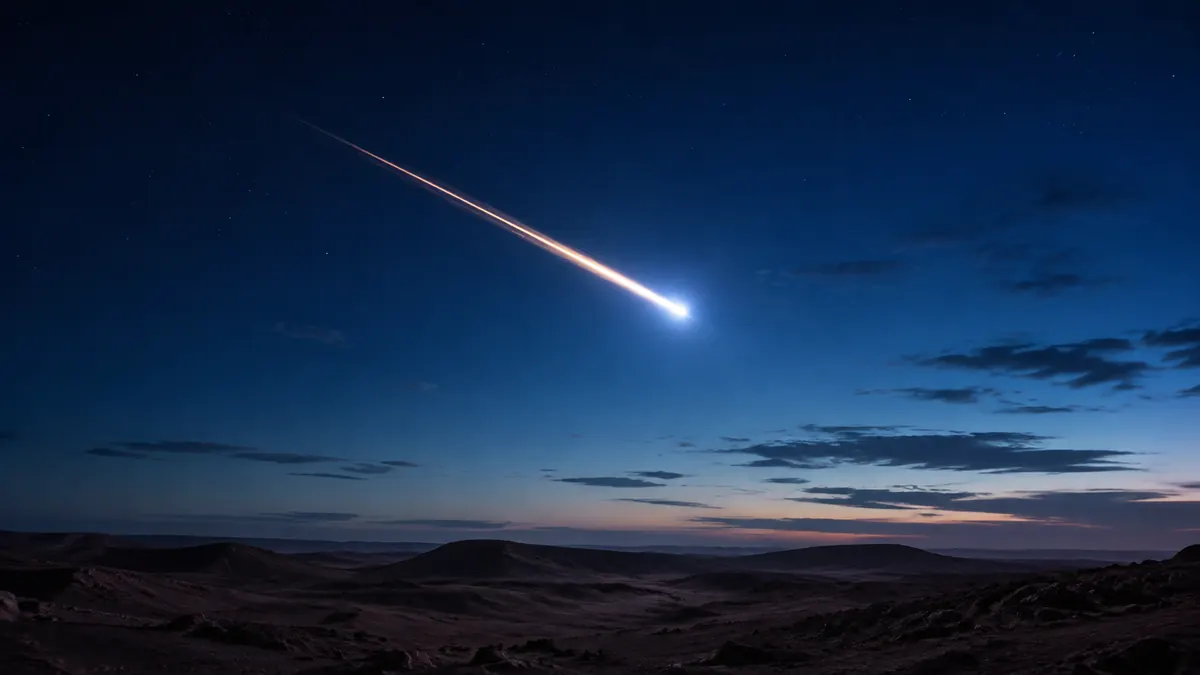
A sudden light crosses the night sky. To an observer it may look like a falling star, yet the stars themselves have not moved. The flash comes from material entering Earth’s atmosphere. Larger objects can produce a fireball or a damaging airburst, making the same broad family of phenomena both beautiful and, occasionally, dangerous.
Questions about meteors in the Quran bring astronomy into conversation with religious interpretation. Can an airburst explain the destruction of Lut’s people? How can meteor showers be predicted if scripture speaks of heavenly protection? And does an iron meteorite carry evidence of a journey beyond our solar system?
The source episode raises these questions together. Answering them carefully requires a distinction between an observed physical process, a proposed historical explanation and a belief concerning the unseen.
Meteoroid, meteor and meteorite: three different things
The terms describe different stages, not three interchangeable names for a shooting star. A small natural object travelling through space is a meteoroid. The light produced as it enters an atmosphere is a meteor. A surviving piece that reaches the ground is a meteorite.
NASA’s guide to meteors and meteorites explains that the material can help scientists study the formation and history of the solar system. A meteorite may develop a dark fusion crust as its outer surface melts during atmospheric entry.
The visible streak is therefore not a star dropping from the sky. Nor does every meteor produce a recoverable rock. Atmospheric entry destroys or disperses much of the incoming material before it reaches the ground.
What happens in a meteor airburst?
An incoming object meets increasingly dense air at high speed. The interaction transfers energy, heats the surrounding gas and removes material from the object. If the stresses exceed its strength, it can fragment rapidly and release substantial energy in the atmosphere. This is the process commonly called an airburst.
The damage depends on more than diameter. Speed, composition, strength, entry angle, fragmentation and the altitude at which energy is deposited all matter. A table assigning every object of one size an exact explosion height and destruction radius gives a false impression of certainty.
The lecture uses several numerical examples to convey the danger. Readers should treat them as rough illustrations, not fixed laws or reliable forecasts for a particular town. Estimates of how often an event occurs are also statistical averages, not a timetable: a rare event need not wait a certain number of years before happening again.
NASA’s work on asteroid-impact modelling examines how different incoming objects behave. Such modelling matters precisely because atmospheric breakup and its effects are not uniform.
Chelyabinsk: a modern event with direct evidence
On 15 February 2013, an asteroid approximately 17–20 metres across entered the atmosphere near Chelyabinsk, Russia. NASA’s analysis of the fireball used observations to reconstruct its trajectory, speed and energy release.
The blast damaged buildings and shattered windows. It showed that an object need not excavate a huge crater to cause harm: an atmospheric shock wave can affect the ground beneath it. The light and the arrival of the pressure wave are different parts of the event, not simply a frightening noise with no physical force.
However, a fragment recovered after an airburst does not retain the destructive energy of the entire original asteroid. Claims that one recovered piece would necessarily kill everyone for kilometres around confuse the original entry event with a much smaller fragment’s later fall.
Chelyabinsk is useful because cameras, instruments and recovered material documented the event. That combination provides a stronger basis for scientific conclusions than a resemblance between an ancient story and a modern explosion.
Does an airburst explain the fate of Lut’s people?
The preceding article examined Lut’s guests, his departure and the search for Sodom. The Quran describes an overturned settlement and a rain of stones; Quran 11:82–83 uses the expression commonly translated as stones of baked clay.
The lecture proposes an airburst as a possible physical explanation. That is a hypothesis, not something the Quran explicitly states. The word sijjil should not be presented as a modern scientific classification meaning a stony-iron meteorite. A resemblance between falling stones in a narrative and fragments from an airburst does not establish their identity.
There is also an important research update. In April 2025, Scientific Reports retracted the paper that claimed an airburst destroyed the ancient city of Tall el-Hammam. Its editors concluded that the evidence did not sufficiently support the airburst claim.
That retraction does not disprove the Quranic account. However, readers cannot responsibly use the paper as established scientific confirmation of that account. Identifying a site, dating its destruction and determining the cause are separate historical questions.
Lut’s wife and the story of the salt pillar
The episode returns to Lut’s wife before moving to the night sky. Quran 66:10 places the wives of Noah and Lut together as examples of people whose connection to righteous servants did not save them. Other passages exclude Lut’s wife from the promised rescue.
The Quran does not say that she became a pillar of salt. That detail belongs to the biblical narrative in Genesis 19:26. Later traditions also differ about whether she remained in the town or left and then turned back.
Natural formations near the Dead Sea have acquired names associated with the story. A rock’s resemblance to a standing person is not archaeological evidence that it was once a human being. The religious lesson and the modern identity of a particular formation should not be treated as the same claim.
Why meteor showers can be predicted
Many meteor showers recur because Earth passes through streams of debris along its orbit. Astronomers can model those streams and estimate when more meteors will be visible. This does not mean they can predict the exact appearance of every individual streak.
The Leonids offer an important correction to the lecture’s simplified explanation. They are an annual November shower. Their parent comet, Tempel-Tuttle, has an orbit of roughly 33 years, and some encounters with dense debris produce much stronger displays. A spectacular storm is not guaranteed every 33 years, and the shower does not disappear during the intervening years.
Sporadic meteors, which are not associated with an obvious active shower, also occur. “Predictable” and “unpredictable” are descriptions of our ability to forecast an observation; they are not the basic mineral categories used to classify meteorites.
What iron meteorites actually tell us
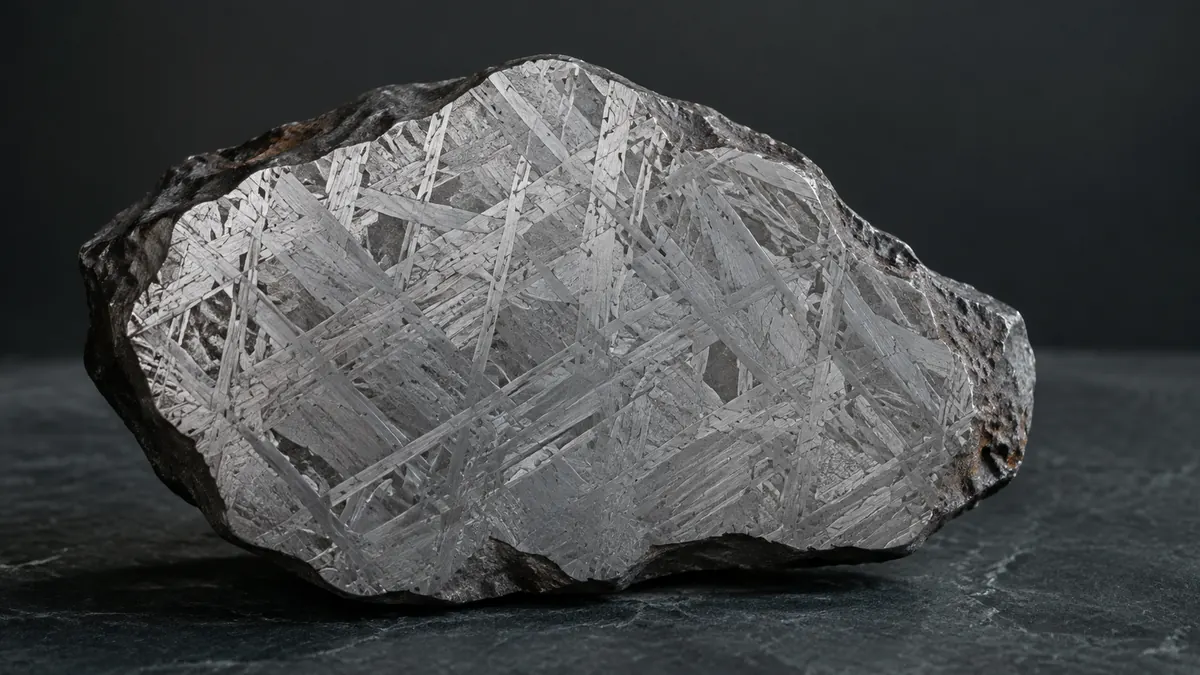
Meteorites are broadly divided into stony, iron and stony-iron groups. NASA’s meteorite research guide explains that iron meteorites commonly sample the metallic cores of ancient parent bodies. Their iron-nickel structures can record very slow cooling inside an asteroid.
This directly corrects the episode’s suggestion that iron meteorites, as a class, come from outside the solar system. Their metallic composition does not establish an interstellar origin. Nor does a stone-and-metal mixture mean that a meteorite must survive entry intact.
The lecture’s discussion of ancient people valuing iron from the sky is a separate historical question. An object can be culturally important without revealing an otherwise unknown journey through distant galaxies. Researchers must study its composition and structure before making claims about its origin.
A melted outer surface also does not mean the whole meteorite necessarily became a ball of liquid metal. Atmospheric entry, surface heating and the history of its interior are different processes. A vivid description of a glowing object should not replace that distinction.
Meteors in the Quran and the unseen
Quran 37:6–10 describes the adornment of the lowest heaven and protection against rebellious devils, including a pursuing shihab thaqib, a piercing flare. Quran 15:16–18 contains a related description of a clear flame pursuing an eavesdropper.
These passages form part of Islamic teaching about the unseen. They do not give a chemical composition, a meteorite catalogue number or a rule identifying iron specimens as the objects involved. The lecture’s proposed connection between a particular meteorite class and heavenly pursuit is therefore an interpretation, not an established result of astronomy.
The predictability of a meteor shower concerns the physical motion of debris. Whether an event also has an unseen significance is a different kind of claim. An orbit calculation cannot establish that significance, and a scriptural passage should not be turned into an unsupported laboratory classification.
The episode closes with Quran 86:1–3, which describes al-Tariq and a star of piercing brightness. It is important not to collapse every Quranic expression about celestial light into one modern object. Those verses do not explicitly identify an iron meteorite or specify its origin.
Wonder without overstating the evidence
The strongest part of the episode is its invitation to notice the sky and ask questions. That curiosity can lead readers toward both a closer study of scripture and a better understanding of astronomy.
Meteors are real, airbursts can be damaging, and meteorites preserve information about ancient solar-system material. The Quranic story of Lut and the passages about heavenly protection address religious questions. Connecting the two requires care: a possible analogy is not proof, and a striking image is not a measurement.
Keeping those boundaries clear does not remove wonder. It allows wonder to lead to learning rather than to claims the evidence cannot carry.
