

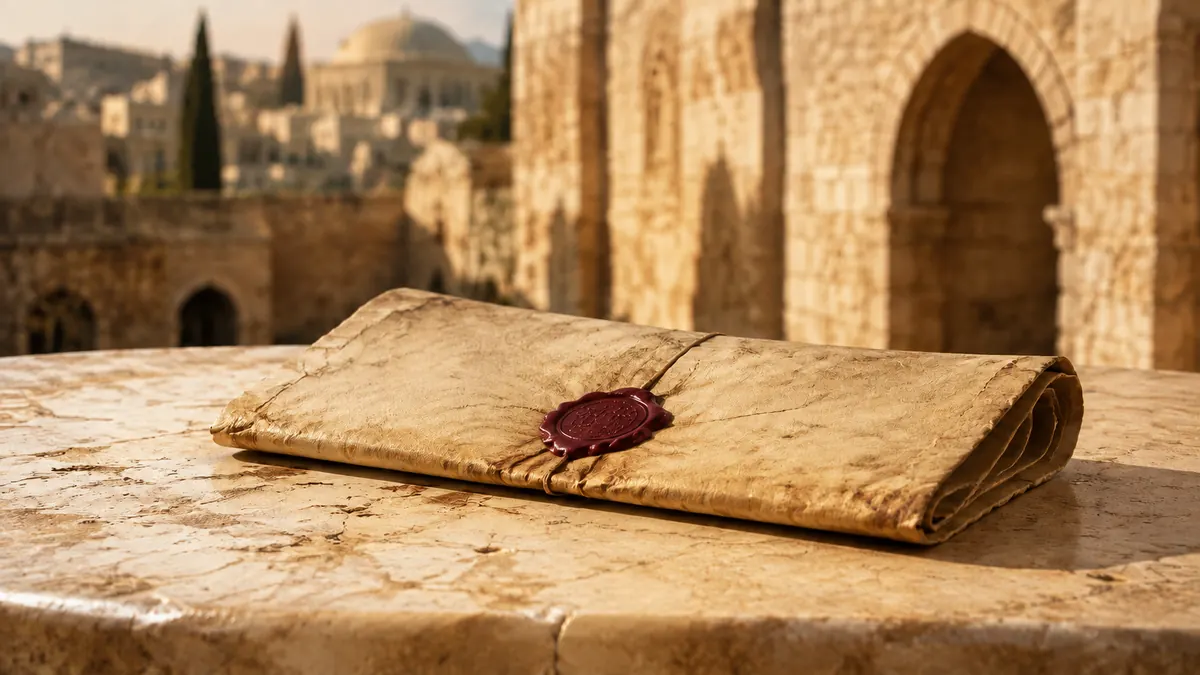
Hidden chambers, old manuscripts and the ruins of Jerusalem make a compelling setting for a story about lost knowledge. The final episode of this series brings those subjects together through traditions about Solomon, the Cairo Genizah and the Knights Templar. Its closing concern is moral: how should a person seek truth without being led astray by the desire for power?
Answering that question well also requires care with the history. Archaeological remains, religious commentaries and medieval trial records are different kinds of evidence. They cannot be joined into a single secret history simply because each contains something mysterious.
What Quran 2:102 says about Solomon
The episode begins from Quran 2:102, which rejects an accusation of disbelief against Solomon and discusses the teaching and misuse of magic. This is the scriptural foundation of its argument, and should be distinguished from the additional narratives found in later explanation.
Stories about books being concealed beneath Solomon’s throne belong to the history of interpretation. The Quranic verse itself does not identify an excavated tunnel, a modern manuscript collection or a medieval military order. Connecting any of those things to Solomon’s court requires a separate evidential argument.
This distinction protects the religious text from claims it does not make. A believer can accept the verse’s teaching without being required to accept every later theory about the whereabouts of hidden books.
Jerusalem: layers of history, not one underground mystery
The area known to Muslims as al-Haram al-Sharif and to Jews as the Temple Mount has a long and deeply significant religious history. That importance makes precise description especially necessary. Different buildings, periods and traditions should not be collapsed into one site with an unchanged function.
Charles Warren’s nineteenth-century investigations are documented by the Palestine Exploration Fund. His team examined structures on, around and beneath the area, producing plans and observations that remain part of the history of Jerusalem’s archaeology.
A passage or cavity, however, does not identify the motive of everyone who used it. Before saying that a tunnel was dug to find a particular magical book, we would need evidence for its date, builders and intended use. Its irregular shape alone cannot supply those answers.
There is also a difference between material recovered from a recorded archaeological layer and objects found in displaced soil. An object can be genuinely old while the removal of its context limits what it reveals about its original location. That limitation should be explained, not treated as proof that everything imagined beneath the site must be present.
The Cairo Genizah: a remarkable archive of ordinary life
The Cairo Genizah preserves an extraordinary range of manuscript fragments associated with the Ben Ezra Synagogue in Old Cairo. Its importance extends far beyond mysterious or magical texts. Documents illuminate worship, trade, family life, legal affairs and relationships across communities.
In 1896, Agnes Lewis and Margaret Gibson brought material to Cambridge that helped alert Solomon Schechter to the collection’s significance. Cambridge’s account of the discovery records that the Chief Rabbi of Egypt gave Schechter permission to take material. It therefore does not support describing the whole acquisition simply as a clandestine theft of a buried occult library.
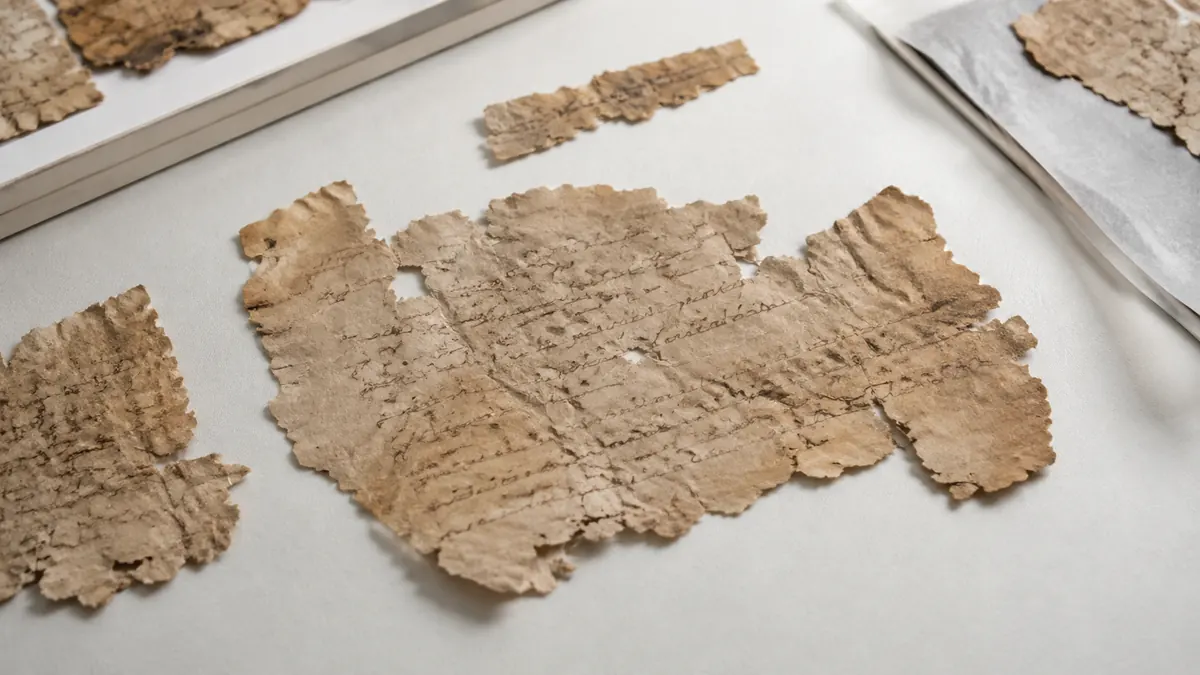
AI-generated editorial illustration of manuscript preservation. The fragments are imagined and do not reproduce a specific Genizah document.
The collection’s variety is central to its value. Cambridge’s overview of the Taylor-Schechter collection describes sources that reveal real people and their social worlds. A magical text in a collection would establish that such a text circulated; it would not make every document magical or every member of the community a practitioner.
Nor can a medieval manuscript be identified as a book from Solomon’s throne merely because both are discussed in the same narrative. That identification would require a demonstrable chain of transmission, not a shared atmosphere of secrecy.
The Knights Templar and the problem of accusations
The episode next turns to the Knights Templar, their wealth, their political position and the proceedings against them. Here, the distinction between an allegation and an established fact is essential.
Trial material can tell us what someone was accused of, what an interrogator asked and what a witness reportedly said. To interpret it, historians must also consider custody, coercion, institutional interests and the survival of records. Quoting a confession without that setting risks treating a prosecution’s case as a transparent account of everyday practice.
The documentary gives particular weight to the Chinon parchment. Historian Barbara Frale’s study, The Chinon Chart: Papal Absolution to the Last Templar, Master Jacques de Molay, places the document within the struggle between Philip IV and Clement V and the papal commission’s examination of the leaders in 1308.
Crucially, the document concerns absolution; it is not a straightforward declaration that the leaders’ sins could never be forgiven. Nor is a record made in 1308 an eyewitness report of an execution in 1314. Documents from different stages of the proceedings must not be merged into one continuous testimony.
Baphomet: keep the image in its own century
The familiar goat-headed image frequently used in modern discussions of Baphomet belongs to a much later setting than the medieval Templars. Scholar Julian Strube examines Éliphas Lévi’s image in its nineteenth-century intellectual context in The “Baphomet” of Eliphas Lévi: Its Meaning and Historical Context.
Using that later drawing to illustrate a medieval accusation can quietly create the impression that both refer to an identical object. That is precisely what needs to be demonstrated, not assumed. An ingenious proposed expansion of a name into several words is likewise not proof of the name’s historical origin.
The same caution applies to numerical patterns. Selecting dates involving seven, or counting an interval in a particular way, does not establish that an organisation planned events around that number. The pattern may be noticed after the events; evidence of intention would need to come from elsewhere.
Lost portraits and the limits of a report
Near its conclusion, the episode revisits a traditional account of images said to represent earlier prophets. Such a report requires its own transmission analysis. It cannot tell us that the described objects are now preserved in an unidentified church or hidden collection.
The fact that one important manuscript cache survived does not prove that another proposed cache exists. A possibility is worth distinguishing from a discovery. For this reason, the illustrations here depict places and archival work, not purportedly authentic portraits of prophets.
The strongest conclusion is ethical, not conspiratorial
The episode ends with an extended report attributed to Abu Dharr and themes of restraint, gratitude and care for others. Rather than presenting every detail in that long composite account as equally authenticated, we can point readers to separately identified teachings that support its central ethical concerns.
Sahih al-Bukhari 10 connects Muslim conduct with protecting others from harm through one’s tongue and hands. Sahih al-Bukhari 6018 links faith with good speech or silence and consideration for neighbours and guests. These teachings direct attention towards conduct that can be practised, not secrets that supposedly confer mastery over others.
Quran 49:6 also warns about acting on reports without verification and causing harm. That principle is especially relevant after a series involving disputed histories and extraordinary claims. Seeking truth includes resisting an accusation when its evidence is incomplete.
Return to the 40,000 Years of Knowledge reading guide to revisit the sequence. The series ends most usefully with curiosity joined to humility: respect the sources, identify uncertainty and judge ideas without assigning collective guilt to a religious community.
