
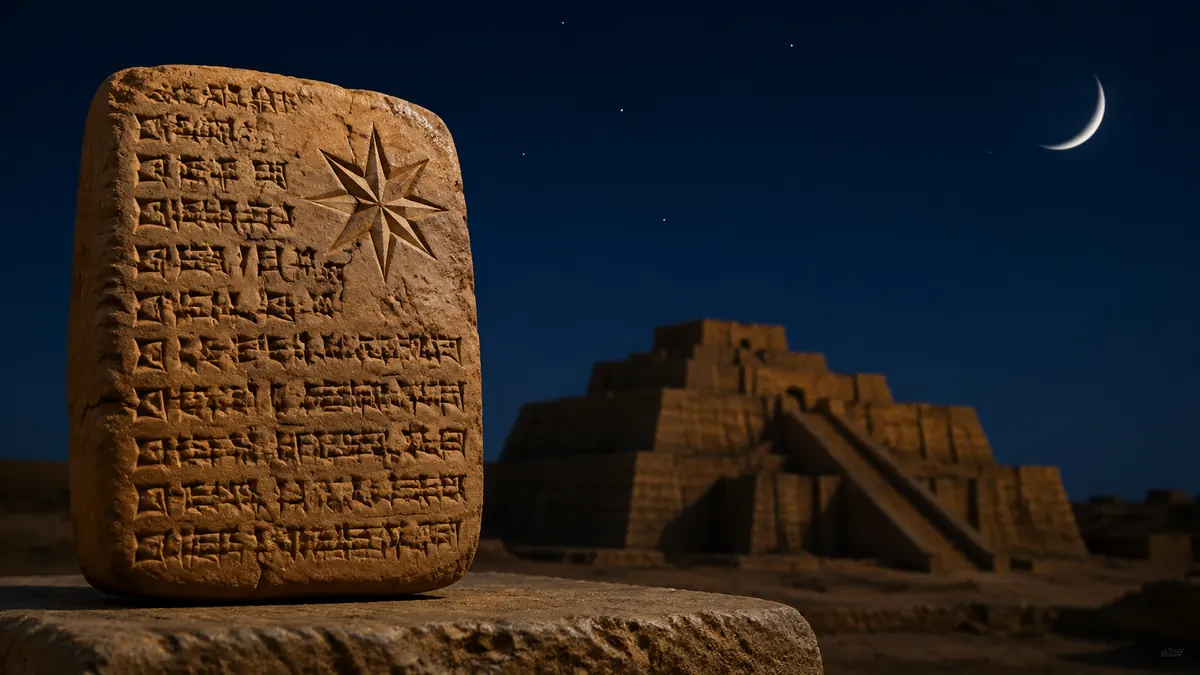
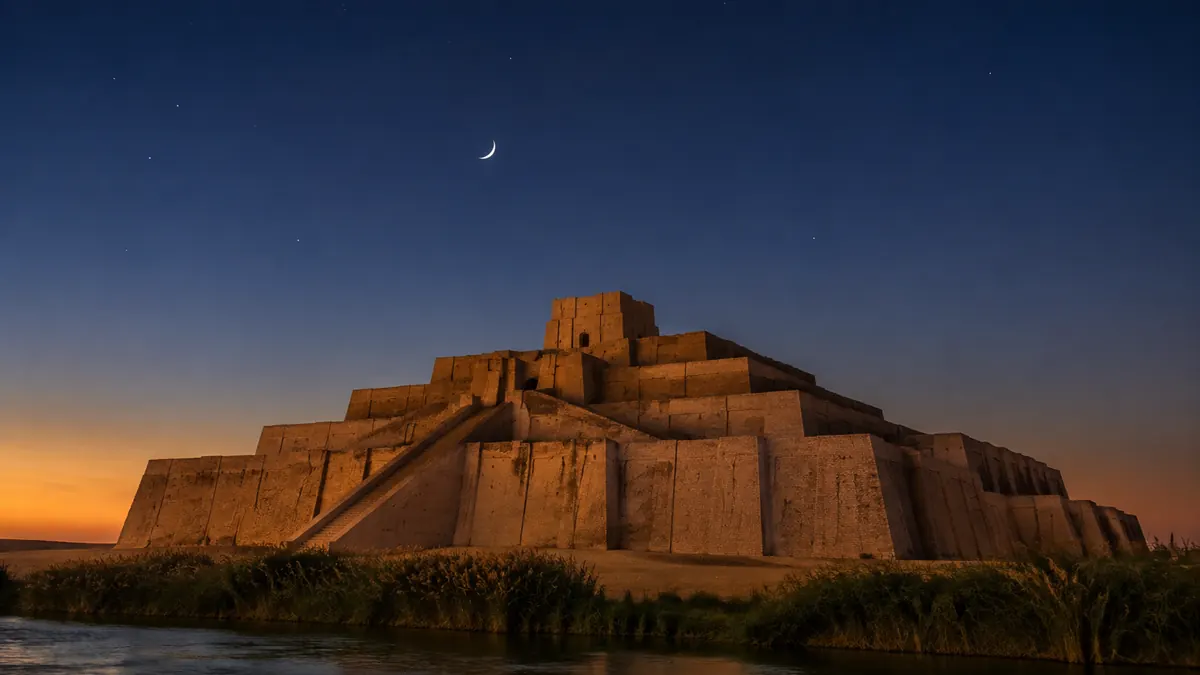
The story of Prophet Ibrahim is often placed against the temples, stars and royal power of ancient Mesopotamia. That setting is meaningful: the cities between the Tigris and Euphrates produced monumental temples, sophisticated mathematics and detailed observations of the sky. Their scholars also interpreted celestial events as messages about kings, harvests and war.
The source lecture uses that world to explain Ibrahim’s arguments against celestial worship. The connection is illuminating when handled carefully. The Quran gives the religious account with clarity, while archaeology describes Mesopotamian societies. It does not presently identify Ibrahim in an inscription, establish his exact city or date his life to one named dynasty.
What the Quran establishes about Ibrahim
The Quran describes Ibrahim as a devoted monotheist, a model of faith and one whom Allah took as a close friend. Quran 4:125 calls him khalil, while Quran 2:124 recalls tests that he fulfilled before being made a leader for people.
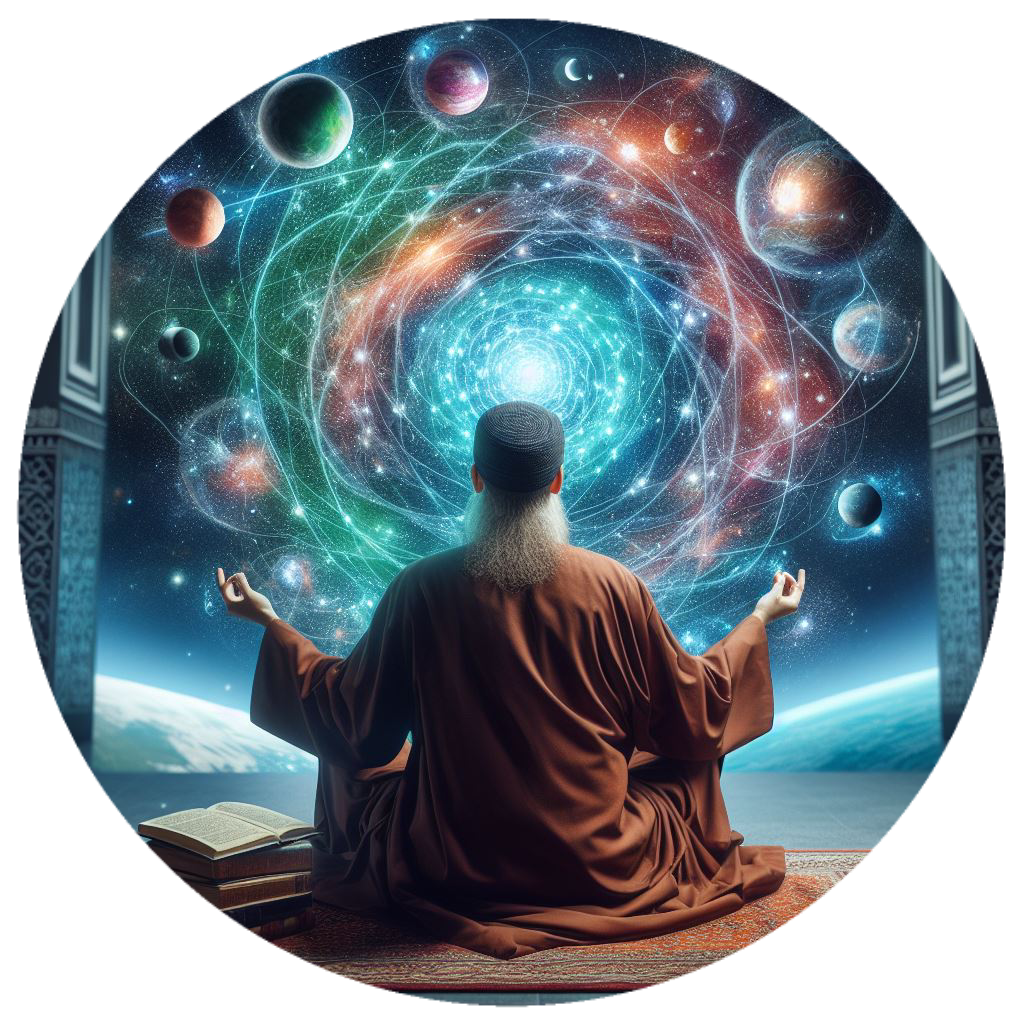
His conflict with his community concerned worship and authority. In Quran 6:74–79, Ibrahim challenges his father’s or guardian’s idols and reflects on a star, the moon and the sun. Each celestial body disappears. He concludes by turning wholly toward the Creator of the heavens and the earth.
The passage is not a lesson in astrology. Its logic moves in the opposite direction: a created object that rises and sets cannot be the eternal Lord. Whether the words are read as a staged argument to expose his people’s beliefs or as part of his journey to certainty, the conclusion is unambiguous worship of the Creator rather than the heavens.
The idols and the unanswered question
Quran 21:51–67 presents Ibrahim questioning the statues to which his people were devoted. After they leave, he breaks the idols apart except for the largest and directs the people to ask it what happened.
The surviving idol cannot answer. Ibrahim’s argument makes the contradiction visible: the worshippers know that their images cannot speak, protect themselves or benefit anyone, yet they return to defending them.
Quran 37:88–98 tells the episode with another detail. Ibrahim looks toward the stars and says that he is unwell. The people turn away, and he approaches their gods. The Quran does not name their festival, describe its calendar or identify the temple building. Later commentaries offer explanations, but those additions should not be presented as words of the Quran.
Was Ibrahim speaking falsely?
A well-known hadith in Sahih al-Bukhari refers to three statements associated with Ibrahim, including “I am sick” and his attribution of the idols’ destruction to the largest statue. Muslim scholars have commonly explained these as indirect or strategically framed expressions made for a righteous purpose, not ordinary dishonest speech.
The Quran itself shows the intention: Ibrahim wanted his audience to confront the inability of the objects they worshipped. Readers should therefore avoid reducing the episode to the claim that a prophet casually lied. The moral argument and its context are essential.
Mesopotamia: the land between the rivers
Mesopotamia is a Greek name for the region “between the rivers,” principally the Tigris and Euphrates. Southern Mesopotamia saw the growth of cities such as Uruk, Ur and Eridu during the fourth and third millennia BCE.
UNESCO’s account of the Ahwar and the ancient cities of southern Iraq highlights their mud-brick temples, palaces, city walls, irrigation works and administrative archives. These societies helped develop early urban government and writing on an extraordinary scale.
Sumer was not the only culture in the region. Sumerian-speaking cities were followed and overlapped with Akkadian, Babylonian and Assyrian states. The political map changed repeatedly over thousands of years, so “Mesopotamia” is a regional description rather than the name of one people or empire.
Astronomy, astrology and celestial omens
The lecture is right to emphasize the importance of the sky in Mesopotamian scholarship. Scribes recorded eclipses, planetary visibility, weather and unusual celestial appearances. Those records demonstrate sustained observation and mathematical skill.
Observation was also joined to divination. The scholarly series known as Enuma Anu Enlil organized celestial signs and their predicted consequences. The University of Pennsylvania’s Open Richly Annotated Cuneiform Corpus describes tablets dealing with the moon, solar phenomena, weather and planets. Their portents frequently concerned the king, enemies, floods, crop failure and disease.
This is an important distinction. Mesopotamian scholars could make real observations without every interpretation being scientifically valid. Predicting a lunar eclipse through accumulated data is astronomy; claiming that the eclipse guarantees a king’s death is an omen interpretation.
Did Sumerians invent the zodiac?
Mesopotamian sky catalogues strongly influenced later Babylonian and Greek astronomy. Constellations and the zodiac developed through a long process, however, and should not be attributed to one person or one sudden discovery.
The lecture repeats later stories about a child born during Noah’s flood who supposedly discovered astrology. These narratives come from medieval works written long after the periods they describe. They are part of the history of storytelling, not contemporary evidence for the origin of Mesopotamian astronomy.
Can Ibrahim be dated to Sumer or Akkad?
Popular histories often place Ibrahim at Ur and assign him a date around the early second millennium BCE. Other reconstructions move him earlier and connect him with Akkadian rulers. The Quran does not supply either date.
Archaeology has recovered tens of thousands of tablets, buildings and objects from Mesopotamia, yet none securely names the Quranic Ibrahim or documents the idol-breaking episode. That absence does not decide a theological question, but it limits what a historian can claim.
It is therefore reasonable to explain the religious environment of ancient Mesopotamia as context. It is not responsible to say that a particular ziggurat, furnace or dynasty has been proved to be Ibrahim’s.
Similar beliefs do not prove a shared revelation
The lecture notes parallels between Mesopotamian literature and themes known from Abrahamic scripture, including creation, a great flood and an afterlife. Parallels are real and worth studying, but they can arise through cultural exchange, shared human questions or later literary development.
A Muslim may believe that divine guidance reached many nations. Archaeology, however, cannot confirm that a specific Mesopotamian text is a damaged version of an unidentified prophet’s revelation unless evidence connects them. Faith and historical method answer different questions and should not be made to provide evidence they do not possess.
What Ibrahim’s argument contributes
Ibrahim’s Quranic argument does not reject observation of nature. It rejects turning created things into ultimate authorities. The sun, moon and stars can be studied precisely because they follow an order; their regularity does not make them gods or reliable sources of personal fortune.
His confrontation with the idols similarly asks people to test inherited claims. An object unable to hear, speak or defend itself cannot deserve worship simply because ancestors revered it.
Frequently asked questions
Does the Quran say Ibrahim lived in Sumer?
No. The Quran narrates his mission but does not name Sumer, Ur, Babylon or Akkad as his home.
Does archaeology prove Ibrahim lived during Sargon’s reign?
No inscription or securely dated object establishes that identification. It remains a modern proposal rather than an archaeological conclusion.
Did Ibrahim worship a star, the moon and the sun?
The passage culminates in his rejection of celestial worship. Many interpreters understand his statements as an argument directed at his community’s beliefs.
Were Mesopotamians skilled astronomers?
Yes. Their records show sustained observation and calculation. Their celestial scholarship also included omen-based divination, which is different from modern astronomy.
Does the Quran name the festival attended by Ibrahim’s people?
No. The Quran says they turned away after he said he was unwell; details about a particular festival come from later interpretation.
A careful conclusion
Ancient Mesopotamia provides a credible cultural setting in which celestial bodies, temples and royal authority mattered deeply. The Quran’s account of Ibrahim directly challenges those forms of misplaced worship. The historical setting enriches the reading, but it does not authorize precise claims about his date, city or dynasty. Separating scripture, archaeology and later narrative makes the story clearer and more trustworthy.
Continue from the previous article: Thamud and Prophet Salih: The Quranic Account and the Archaeology of al-Hijr.
