

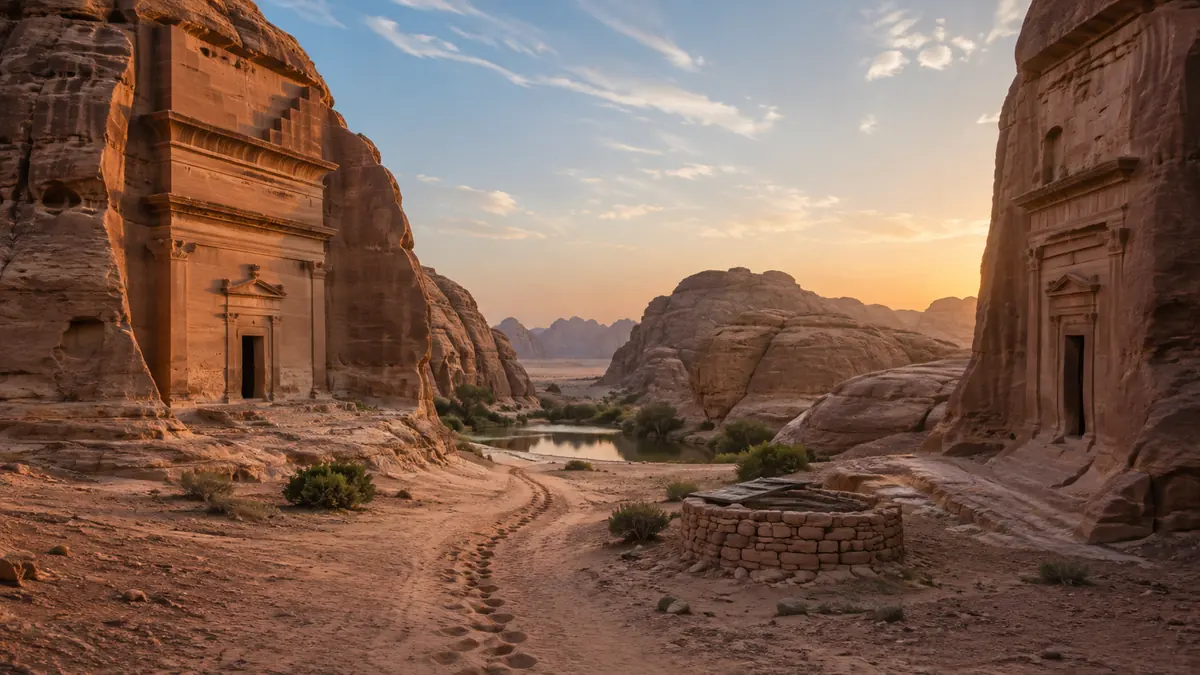
Thamud were known for carving dwellings into rock. Their messenger Salih called them to worship Allah, remember their blessings and stop spreading corruption. When they demanded a sign, the she-camel became a test of whether a powerful community would honour a boundary it had been given.
The source lecture also takes readers to al-Hijr, or Mada’in Salih, with its spectacular rock-cut façades. The connection requires precision: the Quran associates Thamud with al-Hijr and rock carving, but most monumental façades visible at the modern archaeological site belong to the much later Nabataean city of Hegra.
Thamud in the Quran
The Quran mentions Thamud in several passages. In Quran 7:73–79, Salih addresses them as his people and calls them to worship Allah. He reminds them that they became successors after Aad, settled in the land, built palaces on its plains and carved homes from the mountains.
Quran 11:61–68 adds Salih’s appeal that the One who brought them forth from the earth and enabled them to live upon it deserved their worship. The response shows a familiar conflict: Salih had been respected before his message challenged inherited worship.
Quran 26:141–159 describes gardens, springs, crops and skilfully carved mountain homes. The criticism is not of engineering itself. It is directed at a society that enjoyed security and abundance while rejecting moral limits.
The she-camel as a sign and a trust
The she-camel is called a sign from Allah. Salih tells his people not to harm her. Quran 26:155–156 describes a division of access to water: she had a drinking day and the people had theirs.
The sign therefore carried an ethical demand. A shared resource could not be controlled only by the strongest group. Respecting the camel meant respecting a command and the rights attached to it.
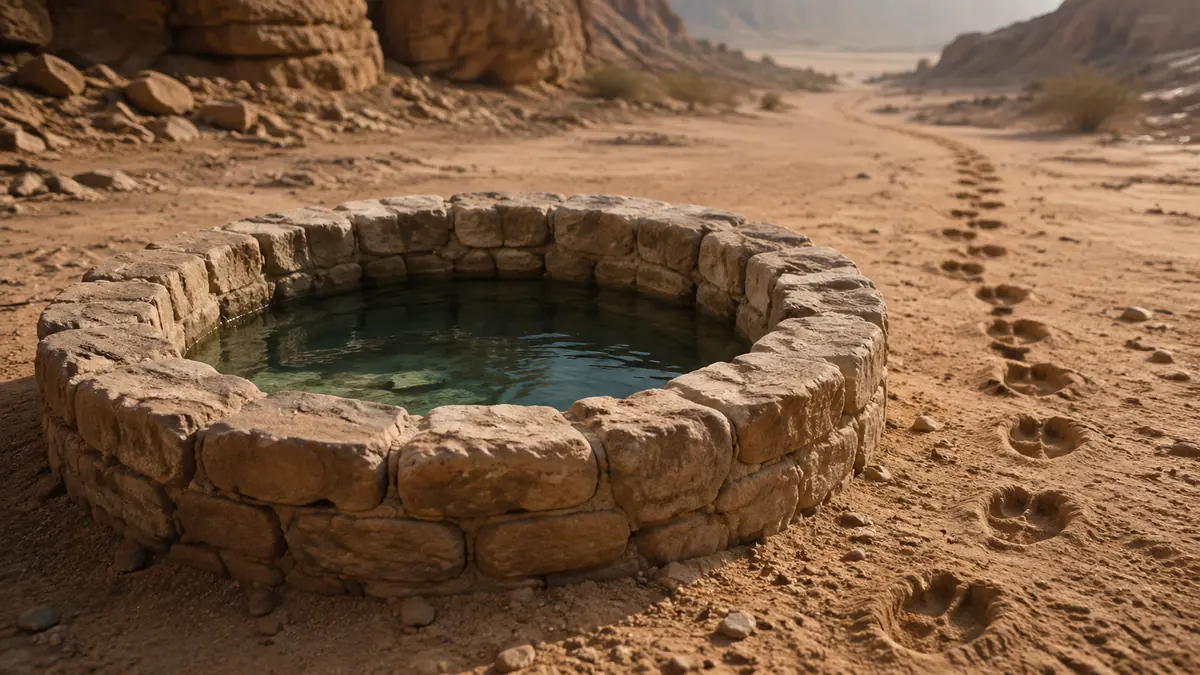
The Quran does not explain a biological mechanism for the sign or narrate every detail found in later retellings. Claims that the camel visibly emerged from a particular rock, had a precisely measured size or produced a fixed quantity of milk come from later narrative traditions and should be labeled as such.
The killing of the camel
Thamud defied the warning and hamstrung the camel. Quran 54:23–31 describes their rejection, their complaint that following one human messenger would be error, and the action of the person who undertook the crime after being called by his companions.
The Quran can speak of the deed as the act of the community because the wider group approved or enabled it. Quran 91:11–15 calls the killer the most wretched among them and connects the collective denial with the consequences that followed.
In Quran 11:65, Salih tells them to enjoy their homes for three more days. The Quran gives the warning; reports that their faces changed to particular colours on each day are later additions rather than Quranic details.
Nine plotters and the attempted attack on Salih
Quran 27:45–53 describes the community dividing into factions and mentions nine men who spread corruption instead of reform. They plotted to attack Salih and his family by night and then deny responsibility.
The passage reinforces a central theme: the camel’s killing was not an isolated impulsive act. It belonged to a pattern of organised wrongdoing, denial and attempted violence against the messenger.
The blast and earthquake
Different Quranic passages use complementary terms for the punishment: a blast or mighty cry, an earthquake and an overwhelming event. Quran 7:78 says that an earthquake seized them, while Quran 11:67 describes the blast leaving them fallen in their homes.
The lecture compares destructive sound levels, rocket launches, animal calls, volcanic eruptions, the Tunguska event and unexplained “skyquake” reports. Such comparisons can help a listener imagine that pressure waves and loud events can cause harm, but they do not identify the Quranic punishment with a known modern acoustic event.
Some popular decibel claims are also misleading because sound intensity depends on distance, medium, duration and measurement conditions. The Quran presents the event as divine judgment; it does not provide a frequency, decibel level or technological mechanism.
Al-Hijr in scripture
Thamud are also called the people of al-Hijr in Quran 15:80–84. The passage states that they denied the messengers, turned away from signs and carved secure homes in the mountains, but their constructions did not protect them when the blast came.
Quran 89:9 similarly recalls Thamud, who cut into the rocks in the valley. These descriptions explain why the dramatic sandstone landscape of north-western Arabia became central to Muslim memory of the story.
What archaeologists date at Hegra
The modern site called Hegra, al-Hijr or Mada’in Salih contains a major ancient settlement and monumental rock-cut tombs. UNESCO describes it as the largest well-preserved site of Nabataean civilisation south of Petra. Its World Heritage listing records 111 monumental tombs, including 94 decorated façades, along with wells and inscriptions.
Most of the famous façades date from the first century BCE to the first century CE. They belong primarily to the Nabataeans, a literate trading society active many centuries after the period traditionally assigned to Salih and Thamud.
The site also preserves pre-Nabataean inscriptions and rock art, showing that people used the landscape before the monumental Nabataean city. That earlier activity is important, but it does not turn every visible tomb into a house carved by the Quranic Thamud.
Why the distinction matters
Visitors often photograph a Nabataean tomb and caption it “the houses of Thamud.” The image may convey the general reality of rock-cut architecture in al-Hijr, but the caption makes a chronological claim the monument itself contradicts.
An accurate description is more interesting:
- The Quran associates Thamud with al-Hijr and rock-cut dwellings.
- The region has a long history of settlement and inscription.
- The best-preserved monumental façades are mainly Nabataean tombs from around the turn of the Common Era.
- Archaeology has not securely identified a particular surviving façade as the home of a named person from Salih’s community.
This does not weaken the Quranic account. It prevents later buildings from being assigned to the wrong people.
“Thamudic” inscriptions are not a simple identity label
Older scholarship used “Thamudic” for several kinds of ancient North Arabian inscriptions that did not fit better-known scripts. The label covers material from broad areas and periods. It does not mean that every writer of such an inscription belonged to the Quranic Thamud.
Modern epigraphers increasingly classify inscriptions more precisely by script and region. A script label, a tribal name and the theological narrative must not be treated as interchangeable evidence.
The Prophet Muhammad’s warning at al-Hijr
Hadith reports describe the Prophet Muhammad passing through the dwellings of people who had been punished and warning his companions not to enter carelessly or use their water as though the place carried no lesson. The reports emphasise humility, reflection and fear of repeating wrongdoing—not tourism built on dramatic speculation.
This ethic remains relevant. Archaeological places should be treated with respect, their structures dated honestly and their religious significance discussed without false claims.
Frequently asked questions
Who was Salih?
Salih was the messenger sent to Thamud. He called them to worship Allah and stop corruption, and the she-camel was given as a sign and test.
Did the camel emerge from a rock?
The Quran calls the camel a sign but does not describe her emerging from a rock. That detail belongs to later narrative tradition.
Are the famous Hegra façades Thamud’s homes?
Most are Nabataean tombs dated to the first century BCE and first century CE. The site has earlier remains, but the famous façades should not be assigned to Thamud.
Why do the Quranic passages mention both a blast and an earthquake?
The passages use different but compatible descriptions of the overwhelming punishment. The Quran does not give a modern physical model for it.
Were there nine men involved?
Quran 27:48 mentions nine men in the city who spread corruption and did not reform. The passage connects them with a plot against Salih and his family.
What to remember
The Quran portrays Thamud as a skilled and prosperous people who abused security, rejected Salih and violated a clear trust represented by the she-camel. Al-Hijr preserves a real ancient landscape of rock carving, trade and settlement, but its best-known façades are later Nabataean tombs. Faithful writing respects both truths: it follows the Quranic account and lets archaeology speak at its own date and level of certainty.
For the related account of the preceding people, read Aad, Iram and Prophet Hud: What the Quran and Archaeology Show.
