

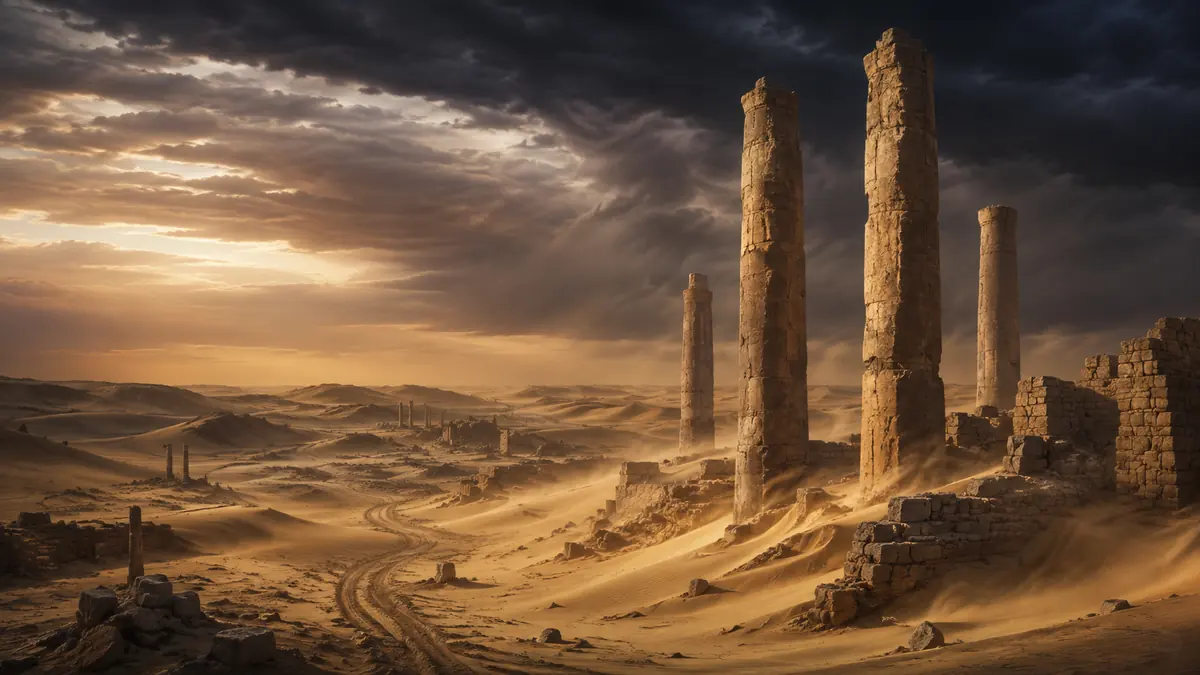
The people of Aad occupy a striking place in the Quran. They possessed strength and built impressive structures, yet their confidence hardened into arrogance. Their messenger Hud called them back to the worship of Allah, but they rejected him. A relentless wind then destroyed them.
The source lecture connects Aad and Iram with the Empty Quarter, the archaeological site at Shisr in Oman, monumental pillars and later stories of unusually tall people. Some of those connections are possible interpretations; others go beyond what the Quran or archaeology can currently prove.
The Quranic account of Aad
The Quran presents Aad as successors after the people of Noah and as a community blessed with power. In Quran 7:65–72, Hud calls his people to worship Allah alone and reminds them of the strength and stature they had received. They accuse him of foolishness and reject his warning. Judgment then overtakes them, while Hud and the believers survive.
Quran 11:50–60 adds an important part of Hud’s message: he asks for no payment and urges his people to seek forgiveness. He promises that sincere repentance would bring renewed strength, but they insist that he has not brought sufficient proof and refuse to abandon their gods.
Other passages emphasise their pride. Quran 41:15–16 records their boast, “Who is stronger than us?” The Quran responds by directing attention to the Creator who gave them that strength.
Iram of the pillars
Quran 89:6–8 asks the reader to consider what happened to Aad, “Iram of the pillars,” whose like had not been created in the lands. The short expression Iram dhat al-imad has generated several interpretations.
Interpreters have understood Iram as a people or ancestral group, a region, or a city associated with Aad. The “pillars” may refer to monumental architecture, tent poles, political power or people of imposing stature. Translation cannot resolve every historical question in these few words.
The Quranic point is clear even where the archaeology is not: Aad were remarkable in their world, and their achievements did not protect them when power became oppression and denial.
Where were the Ahqaf?
Quran 46:21–26 describes Hud warning his people at al-Ahqaf. The word refers to curved or wind-shaped sand formations. Classical geography often placed the region in southern Arabia, broadly between Yemen, Hadramawt, Oman and the great desert.
This description supports a southern Arabian setting, but it does not provide coordinates for a buried capital. The Rub al-Khali, or Empty Quarter, is vast. Identifying a particular ruin within it requires inscriptions, datable occupation layers and evidence connecting the site to the name or people in question.
The search for Ubar and Shisr
Explorers and researchers used old travel accounts, maps and satellite imagery to trace caravan routes linked to the frankincense trade. Excavations at Shisr in Oman revealed a fortified oasis where routes converged.
A NASA Earth Observatory history of the expedition explains both the excitement and the uncertainty. Popular reporting associated the site with Ubar, a legendary desert trading centre sometimes linked to Aad or Iram. Yet researchers found no inscription identifying Shisr as Iram, and researchers later expressed greater caution about the claim.
NASA’s technical archive describes the location as the likely site of a legendary Ubar caravansary, not a demonstrated palace-city of the Quranic Aad. The archaeological remains mainly illuminate a historic oasis and trade network. However, they do not establish that Aad built the fort or that its destruction occurred in Hud’s time.
The discovery is valuable without being turned into more than it is.
Did satellite images reveal a buried metropolis?
Remote sensing can reveal old tracks, vegetation changes, buried walls and differences in soil or moisture. It helps archaeologists decide where to survey and excavate. It does not read the name of a city from space.
At Shisr, converging caravan routes and buried structures supported further fieldwork. Archaeologists still needed to study dating, pottery, architecture and inscriptions on the ground. Calling every line under the sand a street of Iram reverses the proper order of evidence.
An accurate article should say that satellite data contributed to the discovery and investigation of Shisr, while the identification with Quranic Iram remains unproven.
Were the people of Aad giants?
The Quran describes Aad as powerful and reminds them that Allah increased them in physical form or stature. Later literature expands this into stories of extraordinary height. Some retellings connect Aad with Biblical Nephilim or other giant traditions.
The Quran does not give a measurement for an individual from Aad. No verified skeleton or securely excavated human population demonstrates the enormous heights sometimes claimed online. Images of “giant skeletons” are frequently artworks, altered photographs or miscaptioned discoveries.
It is sound to say that the Quran portrays Aad as physically formidable. It is not sound to provide precise giant dimensions or present unrelated folklore as archaeological confirmation.
Pillars, architecture and ideology
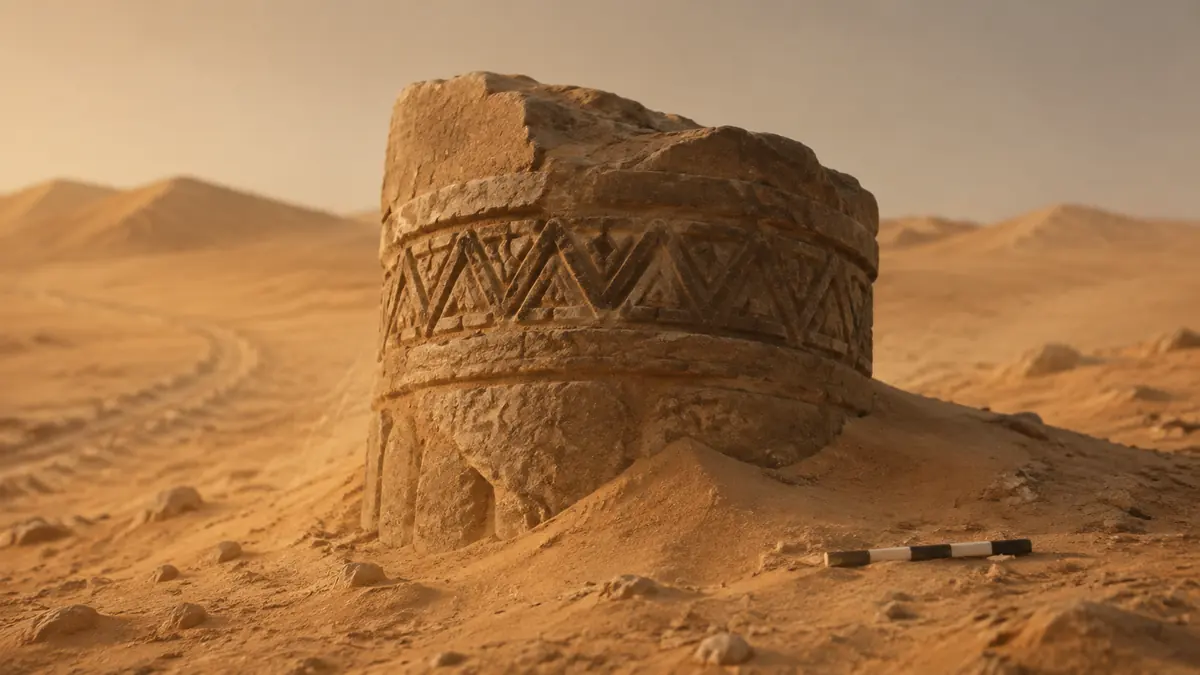
The lecture usefully observes that pillars are not merely structural. Across ancient societies, monumental columns could express royal authority, sacred order and wealth. Their capitals and reliefs might carry symbols meaningful to the people who built them.
That general observation helps readers imagine why “pillars” could characterise an impressive society. It does not identify a specific surviving column as an object made by Aad. Researchers therefore need to date buildings and identify their builders through archaeological context.
The Quran itself also cautions against building for display. In Quran 26:123–140, Hud criticises Aad for constructing monuments on high places and building as though they would live forever, while exercising power harshly. The problem is not craftsmanship; it is pride, permanence imagined without accountability, and oppression.
The wind that destroyed Aad
The Quran describes a furious, bitter or screaming wind sent against Aad. Quran 69:6–8 says it was imposed upon them for seven nights and eight days, leaving the people fallen like hollow palm trunks. Quran 46:24–25 depicts them seeing a cloud approaching and expecting rain, only to learn that it carried the punishment they had demanded.
These verses give the event theological meaning and memorable imagery. They do not identify a modern storm category, wind speed or exact weather mechanism. Comparing the account with severe desert winds can illustrate destructive force, but a modern meteorological label should not be presented as the Quran’s explanation.
Claims the evidence does not establish
Treat the following statements cautiously:
- Shisr has been definitively proven to be Quranic Iram.
- Satellite radar revealed a complete buried city hundreds of metres below the sand.
- A particular ancient tablet unambiguously names the same Aad as the Quran.
- Archaeologists discovered a race of human giants belonging to Aad.
- Every monumental pillar in southern Arabia preserves Aad’s ideology.
Readers do not need these claims to understand the Quranic story. Overclaiming makes the real archaeological discoveries harder to appreciate.
Frequently asked questions
Who was Hud?
Hud was the messenger sent to Aad. He called them to worship Allah, reject false gods, seek forgiveness and use their strength responsibly.
Was Iram a city?
Some interpreters understand it as a city, while others understand it as a people, lineage or region. The Quranic phrase permits discussion but does not supply a modern site map.
Is Ubar the same as Iram?
Modern explorers and popular writers have linked the names. However, no archaeological inscription securely identifies Shisr or another excavated site as Quranic Iram.
Does the Quran say Aad were giants?
It describes their great strength and increased stature, but it gives no body measurements. Extreme giant claims come from later storytelling rather than verified archaeology.
How were Aad destroyed?
The Quran describes a devastating wind lasting seven nights and eight days. Its moral context is central: a powerful society rejected Hud and used strength arrogantly.
What to remember
The Quran recounts the story of Aad and names Iram in connection with them. Southern Arabian deserts and sites such as Shisr provide important archaeological context for ancient trade and settlement, but no excavated inscription has closed the identification debate. The enduring lesson is not that a satellite “proved the Quran”; it is that strength, engineering and wealth do not excuse injustice or remove accountability.
For the flood discussion that precedes this chapter, read Was Noah’s Flood Global? Quranic Language, Geology and Flood Traditions.
