

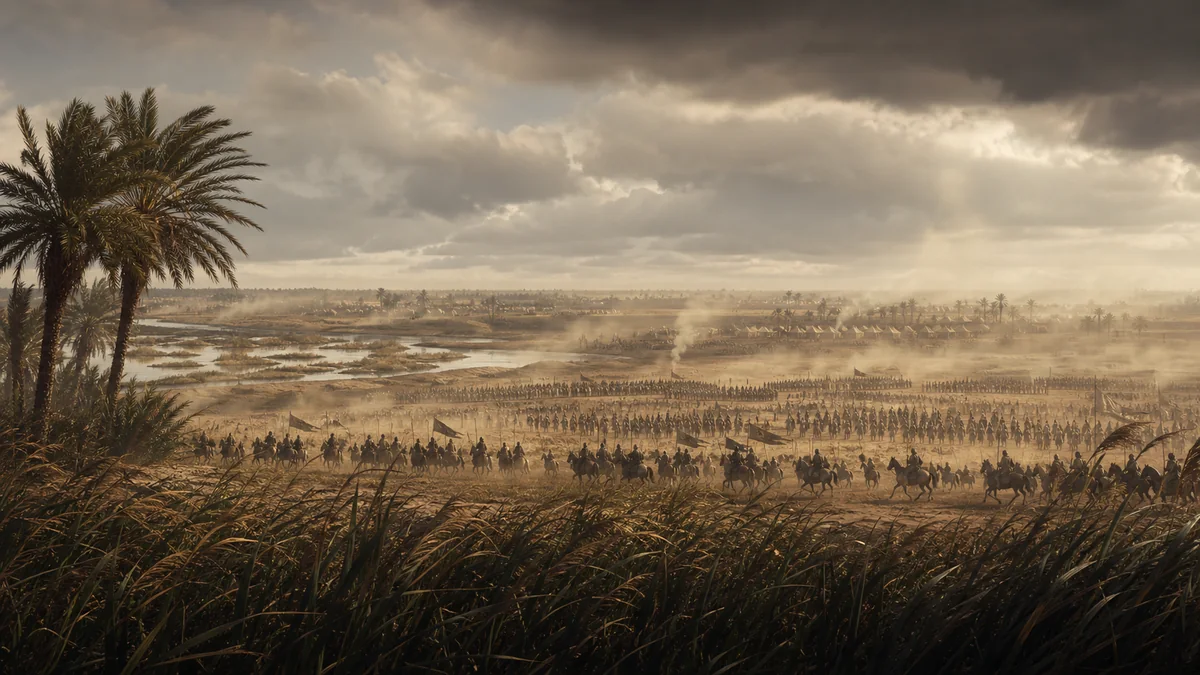
Source note: Al-Qadisiyyah is surrounded by extensive later storytelling. Modern scholarship regards the battle as historical while questioning exact dates, troop figures and many dramatic episodes.
Where and when did it happen?
Al-Qadisiyyah was a settlement on the frontier of Sasanian Iraq. The battle took place in the mid-630s, but surviving sources do not establish one undisputed date. The years 636 and 637 are often proposed, while some modern arguments favour an earlier chronology.
The Muslim force was commanded by Sa’d ibn Abi Waqqas, and the Sasanian army by Rostam Farrokhzad. Traditional sources usually present the Sasanian force as larger. Exact totals range so widely that they should not be repeated as settled fact.
The course of the fighting
Arabic chronicles describe several days of difficult fighting. Elephants, Sa’d’s illness, the death of Rostam and local geography may preserve elements of genuine memory, but the narratives also contain heroic tales and repeated literary themes. The earlier article’s story of Rostam mistaking the call to prayer for a war signal is not sufficiently established to carry the narrative.
Rostam’s death is one of the more firmly remembered turning points. The Sasanian army then collapsed and withdrew, allowing Muslim forces to advance toward al-Mada’in, the imperial capital in Iraq. The victory opened central Iraq but did not instantly end Sasanian resistance. Further major campaigns followed at Jalula and Nihavand.
More than a story of two ethnic groups
Later politics sometimes recast Qadisiyyah as an eternal Arab-Persian conflict. That interpretation is misleading. The battle belonged to a seventh-century struggle involving a new caliphate, a weakened but still powerful empire, local communities and shifting alliances. Modern Arabs and Iranians should not be treated as permanent representatives of medieval armies.
The human and historical consequences
The battle caused heavy losses and accelerated the end of Sasanian government in Iraq. It also created new responsibilities for taxation, land, security and relations with conquered populations. A serious account should study those consequences alongside battlefield courage.
Sources
- Encyclopaedia Iranica: Battle of Qadisiyyah — chronology, sources and modern scholarship
- Encyclopaedia Iranica: Rostam Farrokhzad
- Encyclopaedia Britannica: Umar I — caliphal context
- Quran 4:135 — impartial justice as a governing principle
