

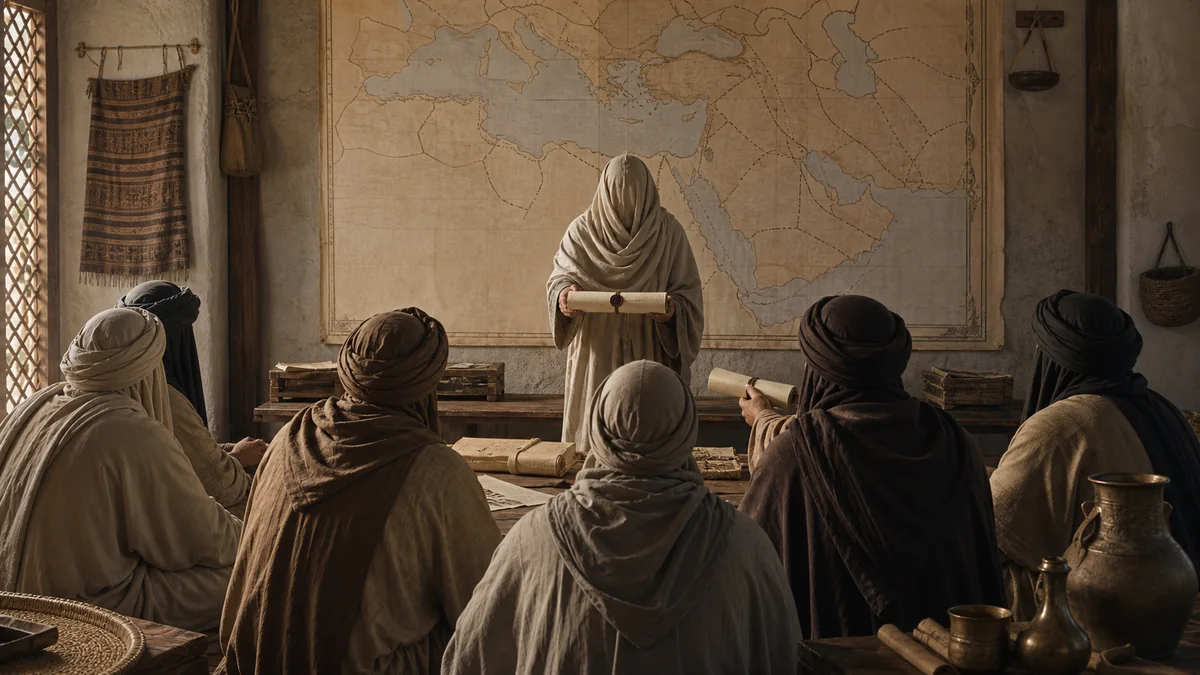
Umar’s governors had to carry out responsibilities far from Madinah. This episode considers the qualities expected of them, the need for supervision and the difference between a principle of good government and proof of a particular administrative practice.
Why the caliphate needed provincial officials
As the territories under the caliphate expanded, the ruler could not personally conduct every local dispute, revenue assessment or military arrangement. The series describes governors, commanders, judges and revenue officials sharing those responsibilities.
A governor is often called a wali in this context. Responsibilities could overlap, and arrangements were not necessarily identical in every place or throughout the whole reign. A simple list of modern-looking provinces can hide those differences.
The central problem was distance. An appointment gave someone authority, but it did not automatically tell the caliph how that authority was being used. Selection therefore had to be considered alongside supervision.
Competence and trustworthiness
The discussion in this series centres on two qualities: ability to perform the work and honesty in carrying it out. Physical strength alone would not qualify a person to settle disputes, manage resources or understand local circumstances.
The ethical comparison is with Quran 28:26, where the story of Moses brings together strength and trustworthiness in the choice of a worker. The verse supplies a principle used in the discussion. It is not itself a record of Umar interviewing a governor.
Religious standing and administrative ability are related questions, but they are not interchangeable. Someone admired for personal devotion might still lack the experience needed for a particular responsibility. Equally, practical ability does not excuse dishonesty.
Consultation and suitability for the task
The episode describes Umar seeking advice and considering experience before appointing officials. The relevant term is shura, meaning consultation. The earlier text mistakenly described him “composing a surah,” which means something different.
Knowledge of a community could help an official communicate and understand a dispute. That does not justify a blanket assertion that every nomadic person or every city-dweller shared the same temperament. The previous text’s absolute rule about never appointing one group over another was not supported by a specific source.
Changes of appointment also require care in interpretation. Removal from a position does not, by itself, prove corruption or disloyalty. Conversely, a reassuring anecdote cannot establish the reason for every dismissal. Individual cases need to be checked on their own evidence.
Authority and access to ordinary people
A recurring theme is that an official should not become inaccessible. The series recalls questions about whether governors attended to the sick, listened to complaints and understood the circumstances of people under their authority.
These questions make the meaning of responsibility concrete. A reputation for being “a good man” is not the same as evidence that people can reach an office, report mistreatment or obtain a fair hearing.
At the same time, the article cannot establish that every complaint was investigated successfully or that most complaints were baseless. Either conclusion would require records beyond the general stories recounted here.
Revenue and the limits of extraction
A specific report is available in Sahih al-Bukhari 3700. Its opening describes Umar questioning Hudhayfah ibn al-Yaman and Uthman ibn Hunayf about whether the taxation imposed on land in Iraq exceeded what it could bear.
This supports a narrower, useful point: the amount that could be collected was not the only question. Umar asked about the burden on those resources. The report is evidence for that exchange, not a complete description of every tax rate or treasury rule.
The earlier text claimed a universal requirement for ten witnesses and guaranteed secrecy for every complaint letter. Without a traceable source, those administrative details should not be presented as established features of the whole government.
Public money and personal privilege
Other anecdotes in the episode criticise officials enjoying benefits that were unavailable to the people around them. Their moral concern is misuse of position, rather than a claim that all food, pay or living arrangements were identical.
A discussion of fairness also needs to distinguish different categories of historical payments. Equal human dignity does not prove that all allowances in a seventh-century revenue system were equal amounts.
Likewise, this article does not establish a universal claim that non-Muslims performed no administrative work, or that kinship could never be a factor in any appointment. Such broad statements go beyond the evidence cited here. They have been removed instead of being repeated as complete rules.
Reading later books on government
The book mentioned in the earlier version was misnamed. It is Al-Ahkam al-Sultaniyyah, associated here with Abu al-Hasan al-Mawardi. The NYU Arabic Collections Online record identifies the author and work.
Al-Mawardi lived centuries after Umar. His work is valuable for studying later legal thought about government, but it is not a contemporary handbook issued by Umar’s administration. A later legal formulation cannot automatically be projected back onto every early appointment.
The lasting question of accountability
The episode’s central question is straightforward: how can someone entrusted with authority remain answerable for its use? Ability, honesty, access and scrutiny each address part of that problem.
Historical admiration is more useful when it remains specific. A documented question about an excessive tax burden teaches more than an unsupported claim that a whole administration never made mistakes. The next episode continues with oversight and complaints involving governors.
Sources and reading notes
- Quran 28:26 — strength and trustworthiness in the narrative of Moses.
- Sahih al-Bukhari 3700 — Umar’s questions about the burden of land taxation.
- NYU Arabic Collections Online: Kitab al-Ahkam al-Sultaniyyah — bibliographic identification of al-Mawardi’s later work.
Editorial note: The broad themes of the original episode are retained. Unverified quotations, absolute claims about appointments and unsupported administrative guarantees have been removed or qualified.
