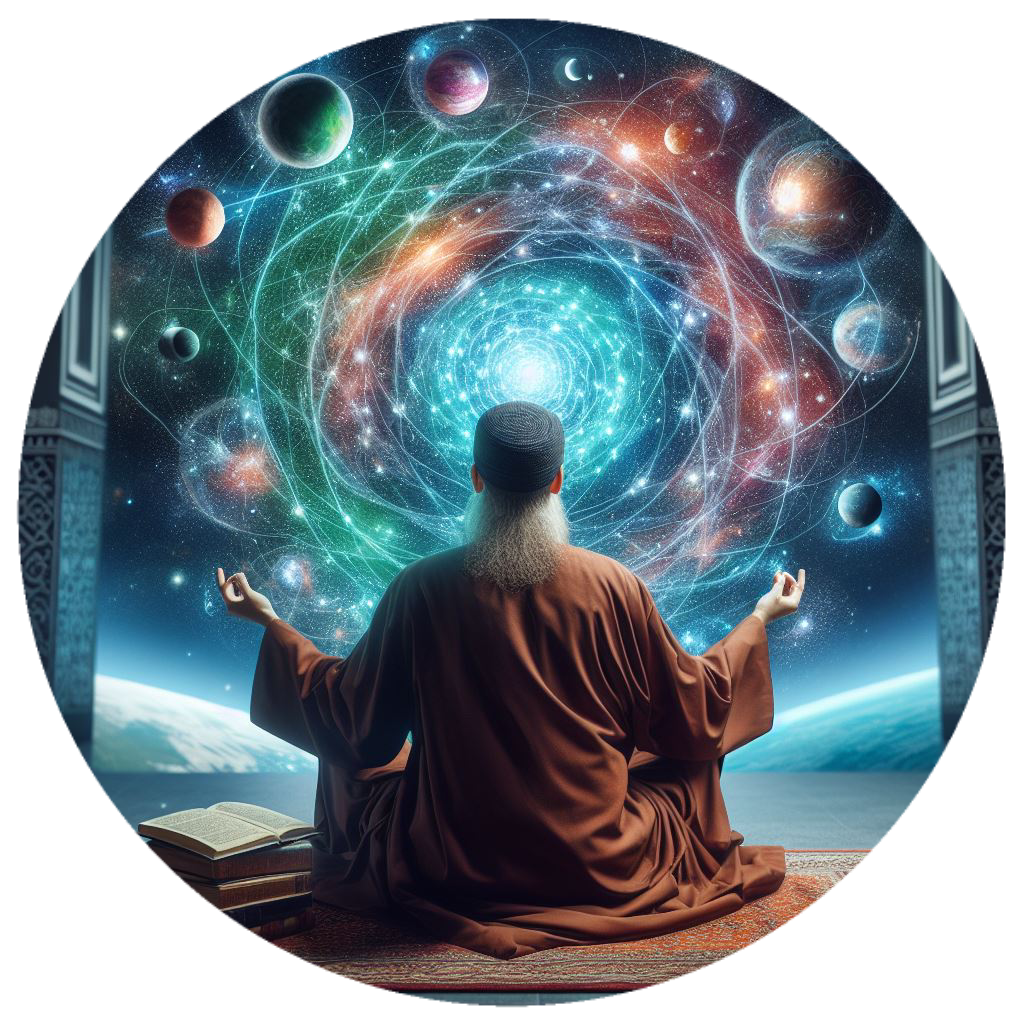

The Quran describes the human being through two connected realities. Our bodies belong to the material world. Allah created the first human from earthly matter, while later generations develop through physical stages in the womb. Human life also includes the ruh, a reality that the Quran associates with Allah’s command and about which people possess only limited knowledge.
This distinction is important. It allows Muslims to study the body through observation and science while remaining careful about claims concerning the unseen. Biology can describe cells, organs, inheritance and brain activity. It does not follow that a laboratory measurement can define the Quranic ruh or settle every question about consciousness, life and death.
Adam’s creation from earthly material
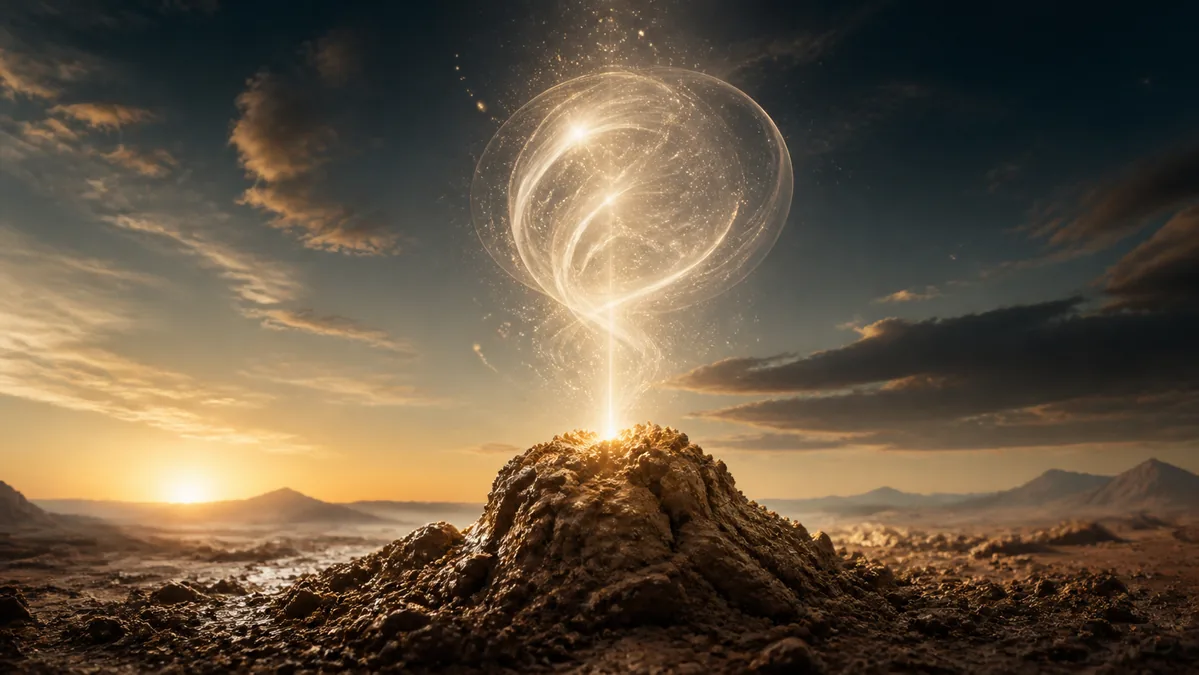
Quran 15:28–29 describes the creation of a human being from sounding clay formed from dark mud. The passage then says that Allah fashioned this being and breathed into him of the spirit He created. He also commanded the angels to prostrate.
A related sequence appears in Quran 32:7–9. It distinguishes the beginning of human creation from clay from the later creation of Adam’s descendants through reproductive fluid. The verses then mention proportioning the human being, the breathing of the spirit, and the gifts of hearing, sight and understanding.
The point is not that the human body is literally a loose pile of soil. Rather, the Quran connects Adam’s origin to earthly material. The elements that sustain every later human body also come from the earth through food, water and the wider environment. The Quranic account joins physical humility with moral dignity: the body has an earthly origin, but human beings receive knowledge, responsibility and the capacity to recognise their Creator.
An authentic narration adds another reflection. Jami‘ at-Tirmidhi 2955 reports that Adam was created from a handful taken from across the earth, and connects the diversity of his descendants with the diversity of the earth. Read the report primarily as a theological explanation of shared origin and human variety, not as a modern genetic formula.
What does ruh mean?
Translators often render the Arabic word ruh as “spirit” and sometimes as “soul.” No single English term reproduces every Quranic use perfectly. The Quran also uses nafs, commonly translated as “self” or “soul,” in contexts involving personal identity, moral responsibility, desire, death and resurrection.
Because the words appear in different contexts, it is unwise to force them into one rigid diagram. Scholars have discussed where their meanings overlap and where they differ. For a general reader, the safest starting point is the Quran’s own boundary:
They ask you about the spirit. Say, “Its nature is known only to my Lord, and you have been given only a little knowledge.” — Quran 17:85
This verse does not forbid reflection. It does prevent confidence from exceeding evidence. A person may study the signs of life, awareness and personality without claiming to have discovered the substance or mechanism of the ruh.
“Breathed into him of My spirit”
When the Quran describes Allah breathing into Adam “of My spirit,” the phrase does not mean that Adam contains a part of Allah. In mainstream Islamic interpretation, the attribution expresses the honour and special creation of the spirit, just as other created things may be attributed to Allah as a mark of honour or ownership.
The verse therefore establishes a created human life by Allah’s command. Readers should not turn this into a claim that God became embodied in Adam. Nor is it a biological description of air entering a body. The wording concerns an act of divine creation whose full nature remains outside ordinary human observation.
A five-stage framework for human existence
The source lecture organises the human journey into five broad stages. This is a useful teaching framework, although the Quran does not present the English list below as a single numbered formula.
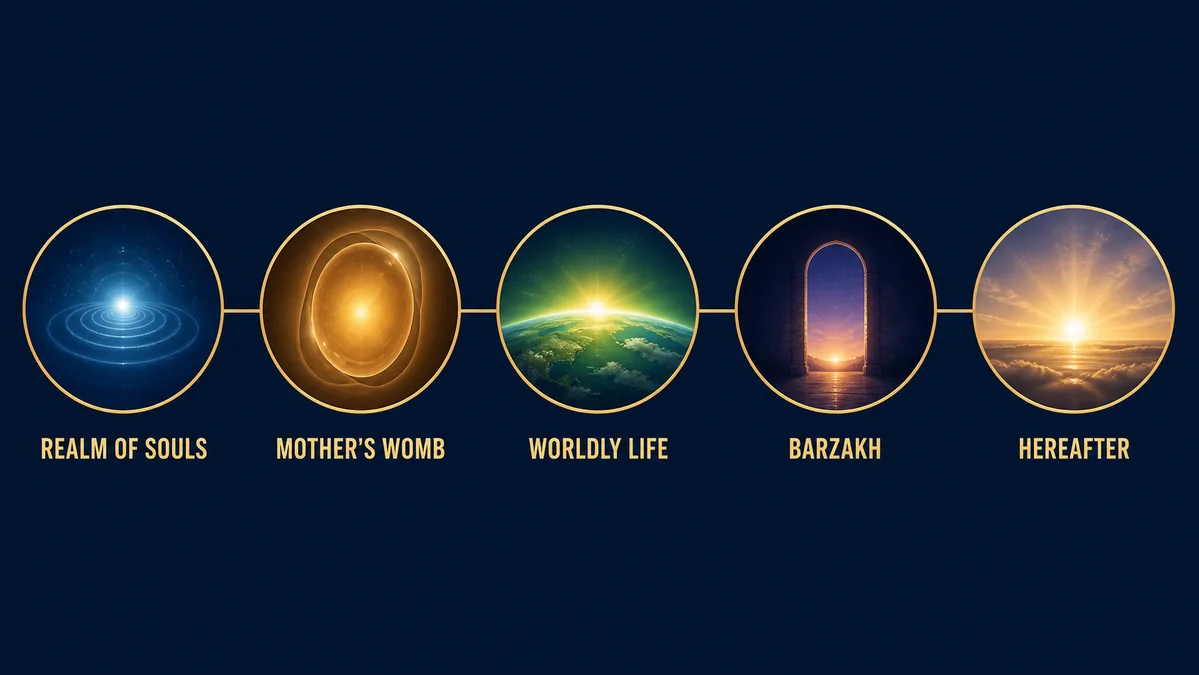
1. The realm connected with the primordial covenant
Quran 7:172 recalls the testimony taken from the children of Adam: “Am I not your Lord?” The verse establishes human accountability and recognition of Allah. Detailed descriptions of exactly how this pre-earthly testimony occurred require sound interpretation rather than imagination.
2. Life in the womb
The Quran repeatedly directs attention to development before birth. Quran 22:5 mentions dust, a reproductive drop, a clinging form, a lump of flesh and the appointed period in the womb. These verses call people to recognise divine power and the reality of resurrection. They are not a substitute for medical care or a modern embryology textbook.
3. Worldly life
Birth begins the visible stage in which a person grows, chooses and acts. The body changes throughout life, but moral responsibility belongs to the continuing person. In this account, worldly life means more than biological survival. It is a test whose choices have lasting consequences.
4. Barzakh
Death ends earthly action and begins an intermediate condition. Quran 23:99–100 describes a barrier, or barzakh, lasting until resurrection. Islam affirms this stage while discouraging unsupported stories that claim precise knowledge of everything experienced within it.
5. Resurrection and the Hereafter
The final stage is bodily resurrection, judgement and continuing life in the Hereafter. Quran 22:5 connects the stages of human development with Allah’s power to bring the dead back to life. In this framework, death is a transition, not the extinction of personal accountability.
Sleep, death and the mystery of personal continuity
One of the lecture’s most striking themes is the comparison between sleep and death. Quran 39:42 says that Allah takes the souls at death and also during sleep, keeping those whose death has been decreed and returning the others until their appointed term.
The verse makes sleep a daily sign for reflection. A sleeper’s awareness of the surrounding world changes, yet the person awakens with an ongoing identity. That does not make sleep medically identical to death, and it does not establish that dreams are always messages. It illustrates how ordinary experience can remind people that their knowledge of consciousness and life is incomplete.
Can science explain the ruh?
Science can investigate the physical conditions associated with life and awareness. Researchers can measure electrical activity in the brain, study injuries that change memory or behaviour, and describe the biological signs used to determine death. These are legitimate and valuable fields of study.
However, the Quran does not present the theological ruh as another organ or physical force that researchers can isolate. A scientific instrument measures observable properties. The unseen reality described by revelation belongs to a different category of claim.
Therefore, avoid two opposite errors:
- Claiming that a new experiment has “proved the soul” when the evidence only concerns bodily or neurological activity.
- Claiming that physical explanations of the brain have disproved the ruh, even though the experiment did not test the Quranic claim.
Faith and science need not be enemies. However, discussions must describe their questions and methods accurately.
What can be said about Adam’s appearance?
The Quran emphasises Adam’s creation, knowledge, responsibility and trial more than ordinary physical description. Sahih al-Bukhari 3326 contains a report that Adam was created sixty cubits tall. Muslims accept authentic revelation while recognising that such a report concerns the beginning of humanity and the unseen past; it should not be advertised as a measurement confirmed by archaeology.
Artwork is even less reliable as evidence. No modern portrait can show what Adam or Hawwa looked like. For that reason, respectful educational material is better served by symbolic imagery than invented faces presented as historical reconstruction.
Adam and Hawwa: a shared human beginning
Stories of a first man and woman appear in many cultures, but similarities should be handled carefully. They can show that questions about human origins are widespread; they do not by themselves prove that every myth preserves the same historical event or that later details belong to the Islamic account.
For Muslims, the Quran and authentic Sunnah remain the foundation. Writers should identify details imported from folklore rather than blend them into revelation. This protects the dignity of the subject and keeps the article useful for readers who want to know what Islam actually teaches.
Key conclusions
- The Quran connects Adam’s body with clay or earth and distinguishes his creation from the reproductive development of later human beings.
- The ruh is a created reality associated with Allah’s command; human knowledge of its nature is limited.
- “Of My spirit” is an attribution of honour and creation, not a statement that a human contains part of the Divine.
- A five-stage framework—primordial covenant, womb, worldly life, Barzakh and resurrection—can organise the discussion, but it should not be treated as a single verbatim Quranic list.
- Sleep offers a Quranic sign for reflection on life and death without making dreams or altered consciousness proof of speculative theories.
- Biology and neuroscience can study the body and the conditions of awareness, while the theological ruh should not be reduced to an unverified scientific claim.
- Authentic texts about Adam should be presented clearly and separately from artistic reconstruction, folklore and modern speculation.
For the preceding discussion in this series, read Seven Earths in the Quran: Classical Interpretations and Modern Questions. Related background is available in Creation and the Seven Heavens in Islamic Thought.
References
- Quran 7:172; 15:28–29; 17:85; 22:5; 23:99–100; 32:7–9; 39:42.
- Sahih al-Bukhari 3326, on the creation and stature of Adam.
- Jami‘ at-Tirmidhi 2955, on Adam’s creation from a handful taken from across the earth.
