
Discussions of human evolution and Adam in Islam often suggest only two choices: reject every scientific finding or reinterpret every religious text. That framing is too simple. Fossils and genetics can investigate biological populations in the past, while the Quran speaks about Adam’s creation, knowledge, moral responsibility and special place in the human story.
The source lecture raises important questions about fossils, Neanderthals and the boundary between humans and other creatures. This article develops those questions while correcting several claims that current evidence no longer supports. Its aim is not to force a final answer where Muslim scholars and scientists continue to disagree. It is to separate established evidence, theological commitments and open questions.
What does evolutionary science actually study?
Biological evolution describes changes in inherited characteristics across generations. In the study of human origins, researchers compare fossils, artefacts, ancient DNA and the genomes of living people. For example, these sources can reveal that populations changed, migrated and interbred. They do not answer every philosophical question about personhood, revelation or moral responsibility.
The word “theory” can also cause confusion. In everyday conversation, a theory may mean a guess. In science, a theory is an explanatory framework tested against evidence. Individual reconstructions within that framework can still change when a new fossil, date or genetic result appears.
That is why responsible discussion should avoid two extremes. A reconstruction in a museum is not a photograph of the past, but neither is it arbitrary. It is an evidence-based model with stated uncertainties.
How fossils are dated
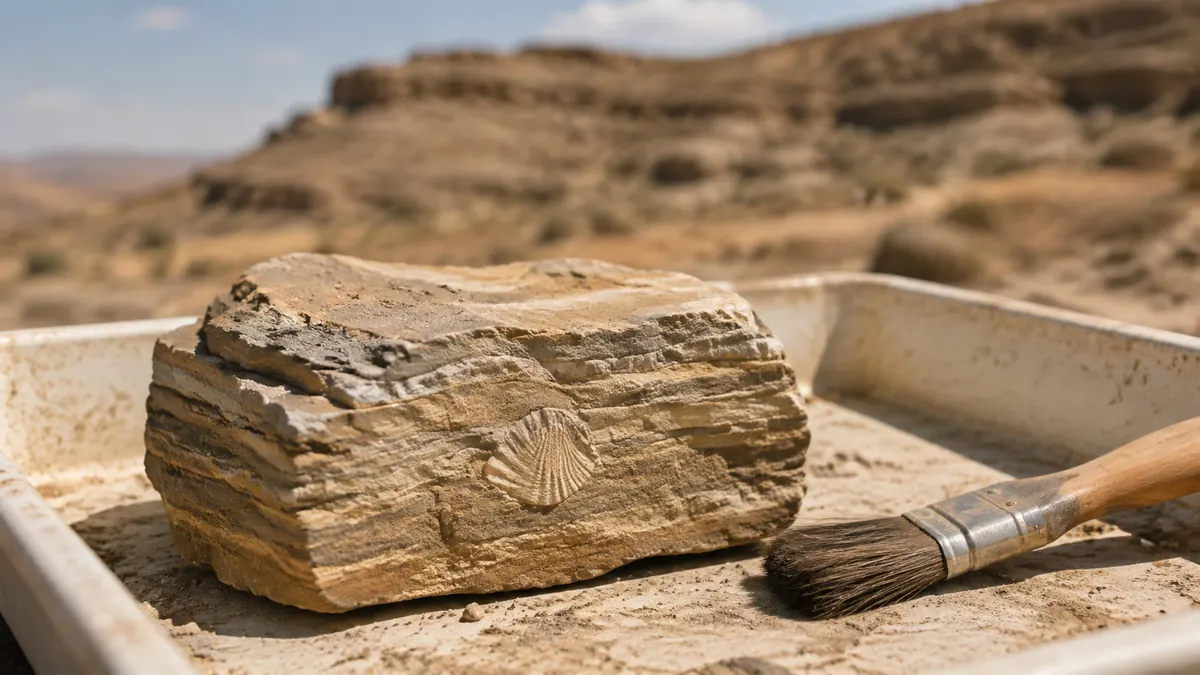
The lecture questions whether scientists simply assume the age of a fossil. In practice, researchers use several methods, depending on the material and its geological setting.
- Stratigraphy examines the relationship between layers of rock or sediment.
- Radiocarbon dating can estimate the age of once-living material within a limited time range.
- Argon-based dating is useful for much older volcanic layers.
- Luminescence dating can estimate when sediments were last exposed to light or heat.
- Cross-checking compares different samples, methods and archaeological contexts.
Every technique has limits and error ranges. A strong date normally depends on context and independent checks, not a single unexplained number. Researchers can revise dates, but revision is a normal part of evidence-based research. It does not show that the entire field rests on invention.
Neanderthals were not simply “ape-men”
Neanderthals lived across parts of Europe and western Asia. They made tools, controlled fire, hunted, cared for injured group members and sometimes buried their dead. Their bodies and skulls differed from those of most living humans, but popular images of unintelligent, shambling creatures are outdated.
Ancient DNA has also changed the discussion. The first draft Neanderthal genome showed that many people whose ancestry lies outside sub-Saharan Africa inherited a small proportion of Neanderthal DNA. The US National Human Genome Research Institute explains that this result is evidence of interbreeding between Neanderthal and early modern human populations.
This finding matters because the categories in the distant past were not always sealed boxes. It does not, by itself, define who possessed revelation, legal responsibility or the spiritual status associated with Adam.
Could Neanderthals speak?
The source transcript presents lack of language as a firm dividing line and suggests that Neanderthals did not possess the human form of the FOXP2 gene. Current research does not support that statement. Sequenced Neanderthal DNA contained the two derived FOXP2 substitutions also found in modern humans, as discussed in this Nature Reviews Genetics research highlight.
FOXP2 is involved in neural and motor systems important for speech and language, but it is not a simple “language gene.” Language depends on many genes, brain networks, anatomy, learning and social life. A shared FOXP2 variant therefore does not prove that Neanderthals spoke exactly as we do. Equally, the available evidence does not justify saying that they could only grunt.
The most accurate conclusion is modest: Neanderthals probably had more sophisticated communication than old stereotypes suggest, while the precise range and structure of their language remain uncertain.
What the Quran affirms about Adam
Begin with what the Quran’s account explicitly teaches.
Quran 15:28–29 connects Adam’s creation with clay and says that Allah fashioned him and breathed into him of the spirit He created. Quran 2:31 states that Allah taught Adam “the names—all of them,” highlighting knowledge and the capacity to learn. Quran 2:30 presents humanity’s role on earth together with the serious possibility of corruption and bloodshed.
These passages establish several theological convictions:
- Allah created Adam intentionally, not as an accident without purpose.
- Human beings possess a distinctive moral responsibility.
- Knowledge and language are central to Adam’s Quranic story.
- Human dignity is tied to divine bestowal, not merely physical strength.
The Quran does not give a fossil age for Adam, identify a geological layer, or provide a technical description of population genetics. Calculations that assign a precise date to Adam normally depend on later chronologies or assumptions, not an explicit Quranic date.
Does the Quran describe a biological mechanism?
Quranic references to clay, dust and earthly material carry physical and theological meaning. Every human body is sustained by matter from the earth, and Adam’s creation is presented as a sign of divine power. Yet the verses do not set out the laboratory steps of a biological mechanism.
Muslim thinkers therefore take different approaches. Some understand Adam’s body as a direct special creation with no biological ancestry. Others consider whether a broader evolutionary history could have existed before Adam while maintaining that his divine selection, knowledge and moral status were special. Still others argue for additional models.
Writers should represent those positions honestly. An article cannot turn a disputed interpretation into a unanimous Islamic doctrine. The safest shared ground is that Allah created Adam, honoured him, taught him and made human life morally accountable.
Biological similarity is not the whole definition of a human person
Genetics can describe relatedness. Anatomy can describe bodies. Archaeology can identify tools, pigments and possible burials. None of these methods can directly measure prophethood or the reception of revelation.
This distinction helps when discussing populations that resembled us. A fossil may show a large brain and skilled hands. A genome may show interbreeding. Those facts are important, but a theological judgment requires theological evidence. Conversely, readers should not use religious conviction to deny a genetic sequence or a carefully dated layer. Evidence can complicate a familiar illustration without losing its value.
Common mistakes in the debate
“Evolution says humans came from the monkeys alive today”
Modern evolutionary biology proposes shared ancestry, not descent from the present-day monkeys in a zoo. In this account, humans and other primates diverged from earlier populations.
“One missing fossil disproves all evolutionary history”
The fossil record is incomplete because fossilisation is rare. Gaps affect the confidence and detail of particular reconstructions, but they do not erase genetic, anatomical and geological evidence.
“Science has proved that Adam never existed”
Science can test claims that generate observable evidence. The prophetic and moral identity of Adam is not a measurement that a fossil can independently confirm or exclude.
“A Quranic verse supplies a modern scientific formula”
The Quran repeatedly invites reflection on creation, but forcing a technical claim into a verse can make faith appear dependent on a scientific interpretation that may later change.
A responsible way forward
Muslims do not need to fear careful investigation. The Quran encourages observation, reasoning and humility. The same humility should operate in both directions: scientific models must state their uncertainty, and religious commentary must distinguish revelation from later speculation.
A productive discussion asks three separate questions:
- What does the physical evidence show? This includes fossils, dating, tools and genomes.
- What does revelation explicitly affirm? This includes Adam’s creation, knowledge, dignity and responsibility.
- What remains interpretation? This includes proposed timelines and attempts to map a theological event onto a particular fossil population.
Therefore, keeping those questions distinct does not remove every disagreement. It prevents the disagreement from being built on claims that neither the evidence nor the Quran actually makes.
Frequently asked questions
Does Islam require a precise date for Adam?
The Quran states no precise date. Writers should not present a date as certain Islamic teaching without reliable evidence.
Does Neanderthal DNA disprove Adam?
No. It demonstrates ancient interbreeding and shared biological history. It does not test prophethood, revelation or Adam’s theological role.
Was FOXP2 unique to modern humans?
No. Neanderthals shared important derived FOXP2 substitutions with modern humans. Scientists still debate what their full communication abilities were.
Must every Muslim accept one model of human evolution?
Muslim scholars and researchers hold different views about biological ancestry and Adam. Discussions should state those differences without treating a debated model as established creed.
What to remember
The evidence for changing and interacting human populations is substantial, but science does not decide every theological question. The Quran presents Adam as a deliberately created, taught and responsible human being. A careful account of human evolution and Adam in Islam respects both kinds of inquiry: it follows physical evidence where that evidence leads and refuses to turn open questions into false certainty.
Continue with What Is the Ruh? Adam’s Creation and the Soul in the Quran for the preceding discussion of Adam’s creation and the Quranic concept of the spirit.
