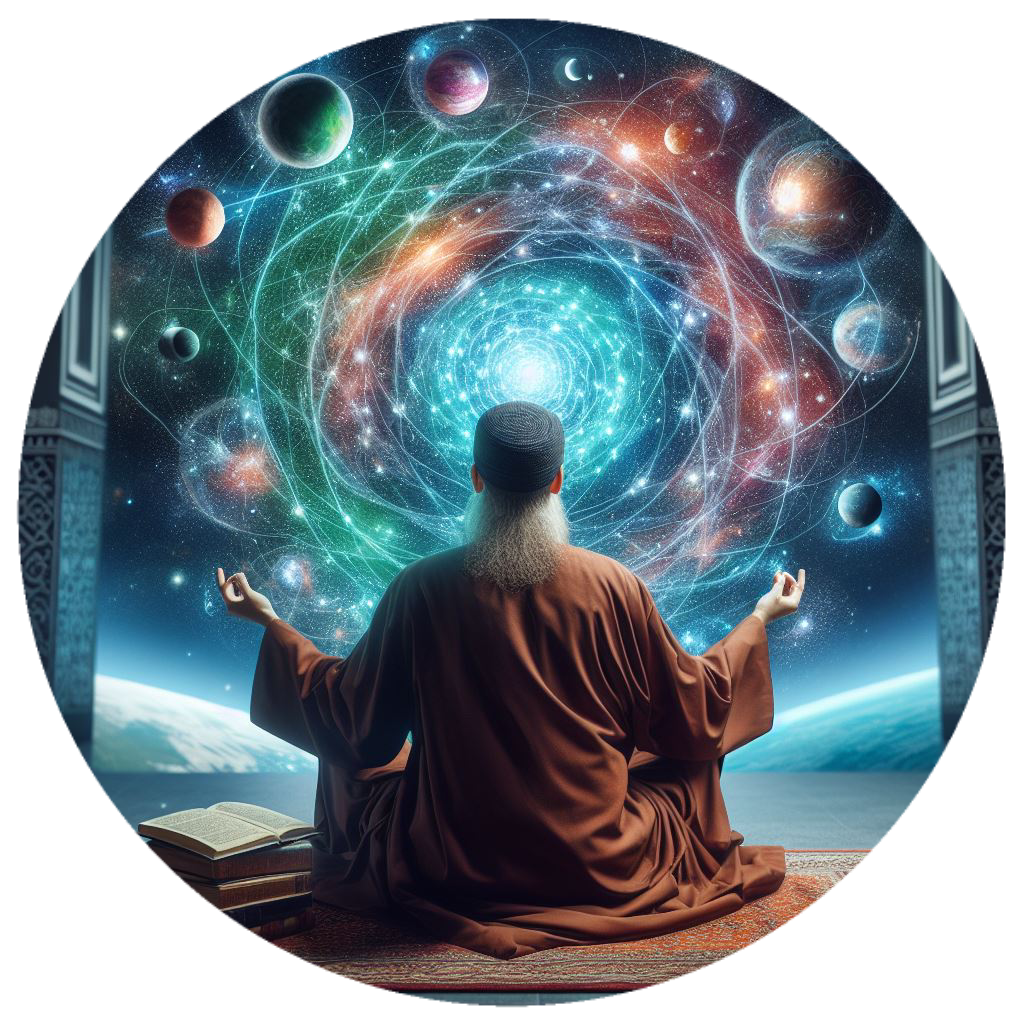

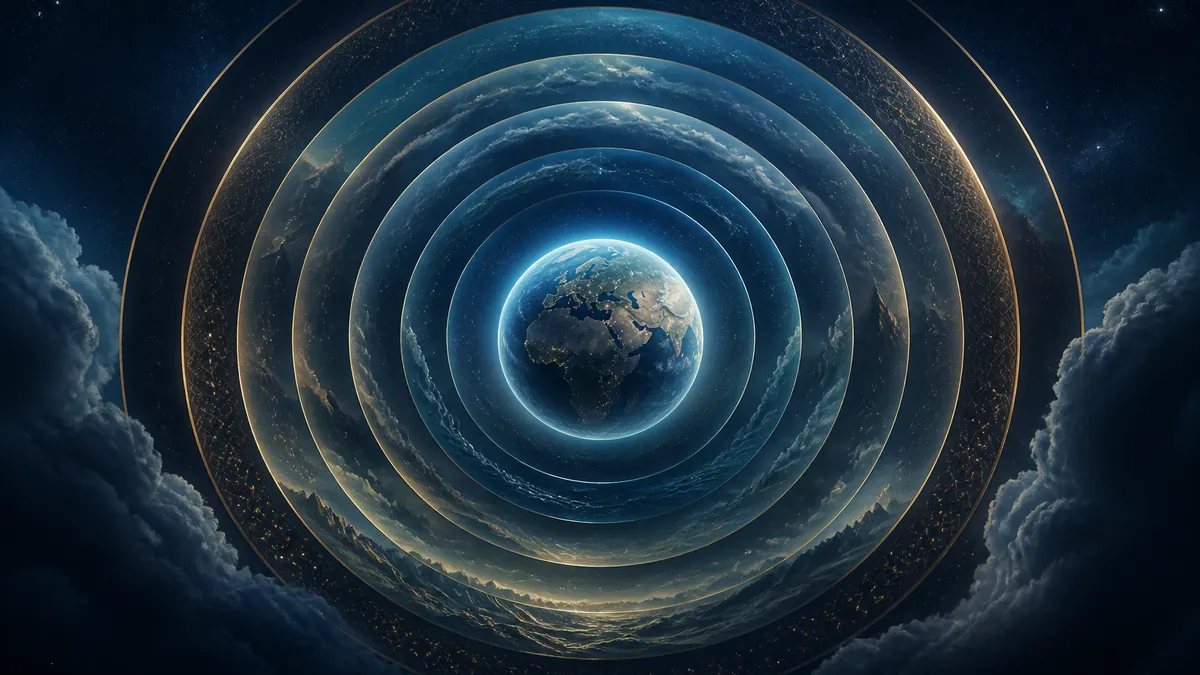
The Quran repeatedly draws attention to the heavens and the earth as signs of Allah’s power and knowledge. One particularly thought-provoking passage appears at the end of Surah At-Talaq, where the creation of seven heavens is mentioned together with an equivalent expression concerning the earth.
This description has generated several questions. Does it refer to seven layers within this planet, seven separate earths, different regions, or realities beyond what human beings can presently observe? Modern discussions sometimes connect the verse with planets, dimensions or parallel worlds. Those comparisons can be interesting, but they must not be confused with established Quranic interpretation or scientific proof.
The central Quranic passage
Surah At-Talaq 65:12 states that Allah created seven heavens and, of the earth, their like. The verse continues by describing the divine command descending among them, so that people may recognise Allah’s complete power and all-encompassing knowledge.
The Arabic expression wa min al-ardi mithlahunna is central to the discussion. It indicates a likeness or correspondence between the heavens and the earths. Many commentators understood this correspondence to concern number: just as there are seven heavens, there are seven earths.
The verse does not, however, provide a physical diagram. It does not describe the size, appearance, inhabitants or precise arrangement of these earths. Any detailed model therefore requires interpretation, and interpretations should be identified as such.

Seven continents or seven earths?
One modern explanation equates the seven earths with the seven continents. This reading is difficult to establish from the text. The modern convention of counting seven continents developed through human geography, and other geographical systems count four, five or six. Continents are also divisions of the surface of the same earth rather than separate earths.
Classical Muslim commentators discussed the passage centuries before the present continental model became standard. Their explanations generally treated the wording as referring to seven earths or levels of earth, not simply seven named landmasses.
For this reason, the continental explanation may function as a loose analogy, but it should not be presented as the clear or exclusive meaning of the verse.
Evidence from authentic hadith
The idea of seven earths also appears in authentic prophetic reports. In Sahih al-Bukhari 2454, the Prophet Muhammad warned that a person who takes another person’s land unjustly will be made to sink through the seven earths on the Day of Resurrection. Related narrations describe the unlawfully taken land being placed around the offender from seven earths.
The immediate lesson of the hadith is ethical rather than cosmological. It condemns oppression, theft and the unlawful seizure of land. Nevertheless, its wording supports the conclusion that “seven earths” was not merely a later attempt to explain the Quranic verse through modern geography.
The report also illustrates an important method of interpretation: Quranic expressions should first be considered alongside well-authenticated prophetic teachings before being linked to newer scientific theories.
How classical scholars understood the passage
Classical works contain more than one way of describing the seven earths. Some scholars understood them as layered earths, one beneath another. Others left their precise nature to Allah, affirming the wording without constructing a detailed physical model.
Reports attributed to Abdullah ibn Abbas have also played a major role in later discussion. One famous report speaks of beings or events in other earths resembling those known in our world. This has sometimes been used to support the idea of inhabited parallel earths.
Such material requires caution. Reports attributed to early authorities vary in wording and strength, and even an accepted chain of transmission does not automatically settle how a difficult statement should be understood. The report should not be converted into a confident claim that identical human histories are occurring in parallel universes.
The safest conclusion is narrower: early Muslims did not necessarily limit the verse to continents or geological layers, but the unseen details were not explained with enough certainty to support a complete cosmological theory.
Could the verse describe layers of our planet?
Another interpretation connects the seven earths with layers inside the planet. Earth science distinguishes structures such as the crust, mantle and core, with further subdivisions depending on whether composition or physical behaviour is being discussed.
The difficulty is that science does not recognise one uniquely required list of exactly seven terrestrial layers. Scientists divide the planet differently depending on the purpose of the model. Matching a selected list of seven layers to the verse after the fact does not demonstrate that this was the verse’s intended meaning.
Geological knowledge may encourage reflection on the complexity of creation, but it should not be presented as a conclusive scientific verification of a particular interpretation.
Parallel worlds and the modern multiverse
Modern physics and philosophy discuss several ideas commonly grouped under the word “multiverse.” These include hypothetical universes produced by cosmic inflation, different outcomes in interpretations of quantum mechanics, and mathematical models involving additional dimensions.
These proposals are not the same theory, and none has established that there are exactly seven Earth-like worlds corresponding to Quran 65:12. The similarity in language can inspire questions, but similarity is not evidence of identity.
It is therefore reasonable to say that the verse leaves human beings with a larger view of creation than the world immediately visible to them. It is not reasonable to claim that contemporary physics has proven the Quranic seven earths or that the verse clearly predicts a particular multiverse model.
For a related discussion, see Dimensions in Quranic Interpretation and Modern Speculation.
Seven earths and the limits of human knowledge
The conclusion of Quran 65:12 is essential to its meaning. The verse directs attention to Allah’s power and knowledge rather than inviting readers to claim certainty about matters for which they have limited evidence.
This provides a balanced approach:
- Affirm what the Quran explicitly states.
- Use authentic hadith to clarify the language and its moral implications.
- Study classical interpretations without treating every transmitted report as equally certain.
- Consider scientific ideas as possible comparisons, not as forced proofs.
- Clearly distinguish revelation, interpretation and speculation.
This approach avoids two opposite mistakes. The first is dismissing the verse because its unseen reality cannot currently be measured. The second is attaching the verse to every new scientific theory and announcing that the theory has already been revealed.
What can responsibly be concluded?
The Quran describes seven heavens and “of the earth, their like.” Authentic hadith also use the expression “seven earths.” These sources provide a sound basis for belief in a reality described by that number.
What remains uncertain is the physical form of those earths. They may be levels, distinct worlds or a reality that does not fit present human categories. The Quran and authentic hadith do not give enough detail to identify them confidently with continents, geological divisions, planets or parallel universes.
The most responsible position is therefore one of informed humility. Muslims may reflect on possible meanings while recognising the difference between a revealed statement and a human attempt to visualise it.
Key points
- Quran 65:12 mentions seven heavens and a corresponding expression concerning the earth.
- Authentic hadith independently refer to seven earths.
- The popular seven-continent explanation is not established by the wording or classical context.
- Geological layers and multiverse theories are modern comparisons, not confirmed interpretations.
- Reports about inhabitants of other earths must be handled carefully.
- The verse ultimately emphasises Allah’s power and complete knowledge.
Further reading: Creation and the Seven Heavens in Islamic Thought and Ibn Abbas and Quranic Interpretations of the Earth.
References
- Quran 65:12, Surah At-Talaq.
- Sahih al-Bukhari 2454 and related narrations concerning the unlawful seizure of land.
- Classical commentary on Quran 65:12, including Tafsir Ibn Kathir.
