

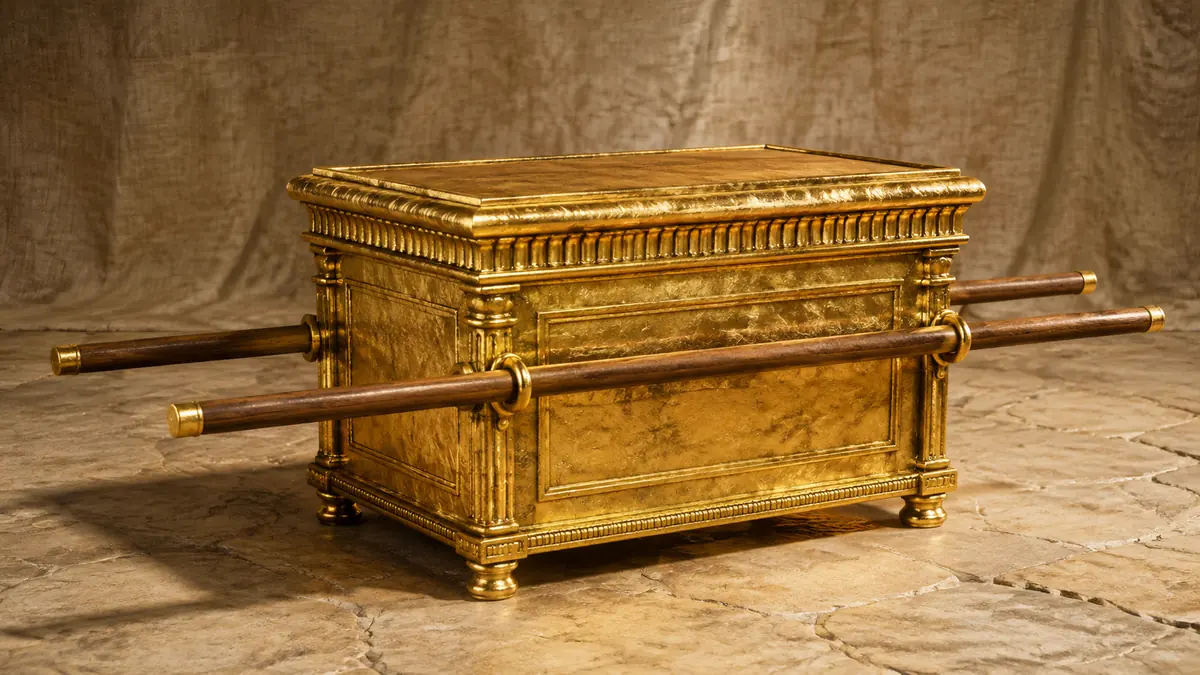
Can time pass differently for different observers? And what does the Quran say about the chest often called Taboot-e-Sakina, or the Ark of the Covenant? These questions share a place in the source episode, which moves from the limits of human knowledge to the history of the Children of Israel.
The connection is a theme of wonder, not proof that the Ark was a time machine. A careful reading separates measured physics, religious narratives and claims about missing objects. That distinction makes the real evidence easier to appreciate.
Three different meanings of “time travel”
The phrase can describe ordinary movement into the future, a difference in elapsed time between observers, or an imagined journey into the past. Those meanings should not be treated as interchangeable.
Time dilation belongs to the second category. Relative motion and differences in gravitational conditions can lead clocks to record different amounts of elapsed time. This is a measured physical effect, not just a plot device in science fiction.
For example, NIST describes experiments comparing precise optical clocks at different speeds and heights. These observations test relativity without requiring a person to pass through a mysterious doorway. See Relativity and Optical Clocks.
In a later experiment, researchers measured a gravitational difference in clock rates across a separation of about a millimetre. The scale of that result is remarkable precisely because the equipment could detect an extremely small effect. It is not a report of a human journey to another century. See NIST’s account of the JILA experiment.
Wormholes are not demonstrated transport systems
The episode uses connected doorways to explain the idea of a wormhole. As a thought experiment, this can help a reader imagine a shortcut through spacetime. It should not be presented as a machine that researchers have built or as an established way to travel into the past.
Likewise, a fixed conversion such as “one hour there equals hundreds of years here” needs a specified physical model. It cannot be attached to an arbitrary doorway, planet or black hole without explaining the assumptions and calculations.
The useful lesson is that time is more subtle than everyday experience suggests. That is a strong conclusion already; it does not need an unsupported claim that usable time portals exist.

Do prophetic narratives describe modern physics?
The documentary places time dilation beside accounts of the Night Journey, al-Khidr and other extraordinary events. A comparison can be thought-provoking, but it is not the same as a scientific explanation supplied by scripture.
The description of Buraq’s stride, for example, does not provide a measured speed from which the full journey can be calculated. Nor does al-Khidr’s knowledge of consequences establish that he physically visited the future. The Quran attributes knowledge to God; it does not describe a mechanism of time travel in that narrative.
Religious belief in an extraordinary event and an experimental claim about its mechanism are different statements. Preserving that distinction avoids reducing the meaning of a sacred account to a physics analogy that may not fit it.
Our article on Moses and al-Khidr explores the narrative’s themes of knowledge and responsibility without treating its exceptional events as instructions for ordinary people.
The Oak Ridge experiment was not a portal project
One of the transcript’s scientific references concerns neutrons and a proposed mirror sector. The actual experiment addressed a puzzle about neutron lifetimes and a specific hypothesis about transitions into mirror neutrons.
Oak Ridge National Laboratory reported in 2022 that the experiment did not find evidence for the proposed mirror-neutron explanation under the conditions tested. The research was a test of a particle-physics hypothesis, not an attempt that successfully opened a doorway to another historical period. See the laboratory’s published explanation.
This is a useful example of why the outcome of an experiment matters as much as its intriguing starting idea. A proposal can be scientifically interesting even when the measurement constrains it rather than confirms it.
The same standard applies to unusual ancient objects. An object requires secure provenance, a defensible date and an explanation of its materials and manufacture. Surprise is not evidence that it arrived from the future.
Talut, leadership and the chest in the Quran
The second half of the episode turns to the Israelites after Musa. In Surah al-Baqarah, they ask a prophet for a king. Talut is appointed, objections are raised, and the account distinguishes qualification for leadership from assumptions about wealth or status. The narrative later describes the test at the river and Dawud’s defeat of Jalut. See Quran 2:246–251.
The chest appears as a sign connected with Talut’s kingship. Verse 248 associates it with tranquillity from God and relics left by the families of Musa and Harun; angels bear it. This is the basis of the familiar expression Taboot-e-Sakina.
The verse does not give the chest’s dimensions, a wood species, a full inventory or its present location. Those details should not be labelled “what the Quran says” merely because they occur in later discussions of the Ark.
What other scriptures add about the Ark
The Hebrew Bible supplies a detailed description in Exodus. It calls for an acacia-wood chest covered with gold, with rings and carrying poles. The dimensions are expressed in cubits. Modern conversions depend on the cubit assumed, so a conversion into feet should not be presented as a precise measurement of an excavated object. See Exodus 25:10–16.
This is a valuable textual description, but its provenance matters: it comes from Exodus, not Quran 2:248. A comparative article should let readers see which tradition supplies which detail.
The same care is necessary with lists of the Ark’s contents. Different scriptural passages and later accounts mention different associated objects. Combining all those references into one inventory, then presenting it as an inspected collection, turns textual tradition into an unsupported archaeological claim.
Another helpful distinction concerns the Holy of Holies. This expression refers to the innermost sacred space in descriptions of the sanctuary or temple, rather than simply being another name for the chest. Confusing the container, the room and the wider sanctuary makes the historical discussion needlessly difficult to follow.
Did a similar chest appear in Tutankhamun’s tomb?
The episode draws attention to an Egyptian object with carrying poles. Here there is a direct archaeological record to consult: Howard Carter’s excavation documentation.
The Griffith Institute identifies Carter object 261 as an image of the jackal Anubis on a shrine, with a sledge and carrying poles. 261 is an object number, not the number of the tomb. The record belongs to Tutankhamun’s excavation and identifies the object in an Egyptian funerary setting. See the original Carter archive entry.
A visual resemblance between portable sacred objects does not establish that they are the same object. Carrying poles solve a practical problem shared by many cultures: moving something important without simply lifting it by its sides.
To identify an Egyptian shrine as the Ark, one would need much more than a similar shape. Its inscriptions, contents, date and archaeological context would all have to support that identification. The cited excavation record does not identify it as Taboot-e-Sakina.
Stories about a curse associated with a tomb cannot bridge that evidential gap. An account of later deaths does not establish the identity of an object found inside, and it should not replace a documented examination of the object itself.
Where is Taboot-e-Sakina now?
The transcript surveys several proposed locations and traditions, including Ethiopia and Jerusalem. These are not interchangeable kinds of evidence. A religious community’s custodial tradition, a medieval literary account, a modern excavation claim and a securely documented find each need to be described on their own terms.
This article has no verified archaeological evidence that establishes the Ark’s present location. It therefore does not label any church, cave, hill or museum object as the confirmed answer. Nor does it repeat a dramatic claim about an impending discovery as though the object had already been examined.
That uncertainty need not erase the Ark’s importance. In the Quranic passage, the emphasis is on divine reassurance and a sign of legitimate leadership. The religious significance of that account is not dependent on announcing a modern discovery.
How the two halves of the episode fit together
Time dilation illustrates how observation can overturn an everyday assumption. The Ark illustrates how an object can carry profound meaning through sacred narrative and historical memory. Both subjects reward curiosity, but they do not require the same method of investigation.
Measured differences between clocks belong to physics. What a scripture says belongs first to careful reading of that scripture. The identity and whereabouts of an ancient object require archaeological evidence. Keeping those methods distinct lets wonder lead to better questions instead of premature certainty.
The result is a more useful conclusion than a claim of a hidden time machine: time dilation is experimentally supported, the Quran describes a significant chest in Talut’s story, and neither fact proves the other is a technological secret.
