

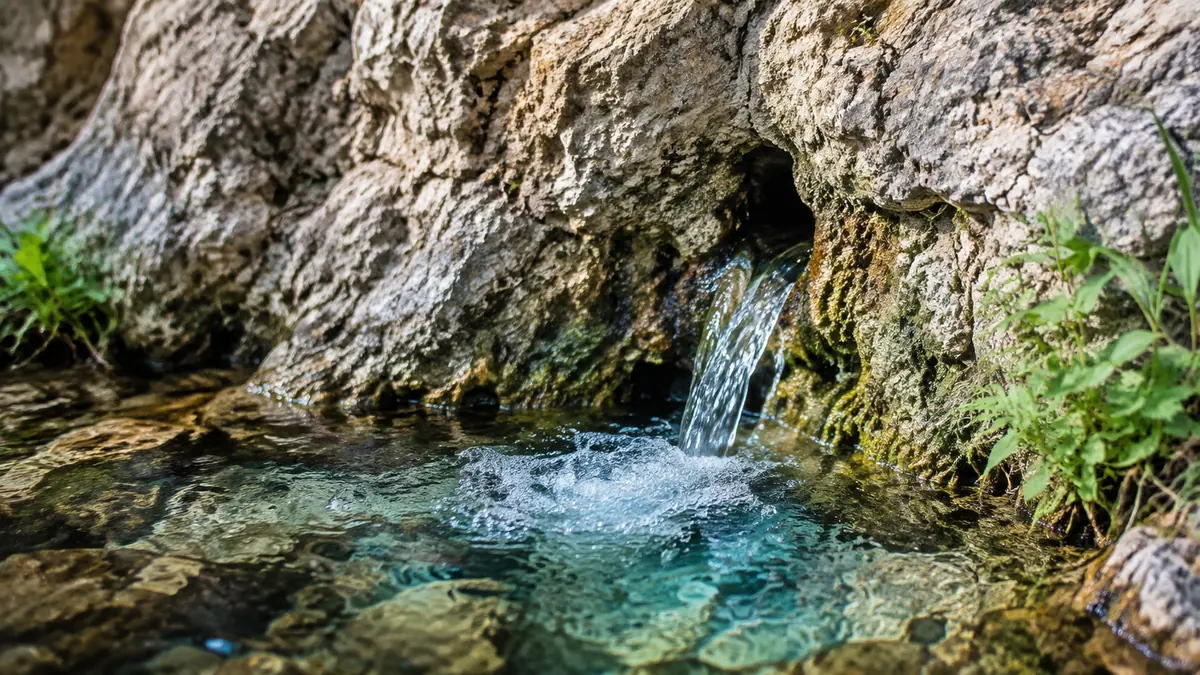
The idea of a water that restores youth has travelled across languages and centuries. In Persian and Urdu, Aab-e-Hayat means the water of life. It evokes more than an unusually refreshing spring: it expresses the hope that ageing, frailty and even death might somehow be overcome.
The source episode approaches this hope through Musa’s journey in Surah al-Kahf, ancient travel stories and modern biology. Each offers something worth exploring, but they answer different questions. A sacred narrative is not a clinical trial, and an animal’s unusual life cycle does not locate a legendary fountain.
This article focuses on the water-of-life tradition and the science of longevity. For a fuller treatment of Musa’s meeting with al-Khidr and its ethical lessons, see our existing Moses and al-Khidr guide.
The fish, the rock and the meeting of the two seas
The discussion begins with a sign in Musa’s journey. He and his young companion reach the meeting of the two seas; the fish they carry makes its way into the water. After discovering what happened, they retrace their steps and find the servant of God from whom Musa will learn. See Quran 18:60–65.
The Quranic passage does not use the Persian name Aab-e-Hayat or supply the coordinates of a fountain. Reports in Sahih al-Bukhari elaborate on the fish and identify the companion as Yusha ibn Nun and the other figure as al-Khidr. They are important sources for the narrative’s context, but should still be distinguished from the wording of the Quran. See Bukhari 4725 and 4726.
The water-of-life motif belongs to the wider interpretive and storytelling history associated with this journey. When a retelling joins the fish, a spring and extraordinary longevity into one account, readers should ask which source supports each element. The presence of one element does not automatically establish all the others.
Why a map cannot settle the question
The episode considers Lake Bardawil and other geographical possibilities near Egypt and Sinai. Such proposals are hypotheses, not an identified destination given in the Quran.
A modern lagoon with several channels may resemble a reader’s understanding of “two seas meeting.” That resemblance alone cannot establish the location of an ancient event. One would also need a defensible chronology, evidence of historical coastlines, a reason for preferring this site over alternatives and supporting textual evidence.
Nor does the fact that a passage leaves a location unnamed prove that it was deliberately hidden to prevent people finding immortality. That is an interpretation of the silence, not information supplied by the text. The honest conclusion is that this article cannot give readers a verified location for Aab-e-Hayat.
Long life in ancient storytelling
One of the episode’s most memorable comparisons comes from Herodotus. In Book III of his Histories, a report about long-lived Ethiopians includes a remarkable spring, an oily feel to its water and a fragrance compared with violets. Herodotus presents the description through the story of visitors and their inquiries, not through a modern investigation of water chemistry. See Histories 3.23.
The account shows that extraordinary waters and longevity fascinated ancient audiences. It does not establish that the spring was the one associated with al-Khidr, that the reported ages were independently verified or that drinking such water could lengthen a human life.
The documentary also discusses stories associated with Chinese rulers, Alexander and European exploration. These traditions developed in different literary and historical settings. Their shared desire for renewed life is a useful comparison; treating every version as testimony to the same physical spring would go beyond the evidence.
A recurring image, not a single documented expedition
Ponce de León and the Fountain of Youth became an especially familiar pairing in European and American storytelling. The motif also appeared in art: old people entering a rejuvenating fountain or a fantastical “mill of youth” became recognisable ways of picturing the wish to become young again. The Metropolitan Museum discusses this visual tradition in its account of an eighteenth-century Mill of Youth fan.
The important distinction is between the history of a story and proof of its promise. Finding the theme in a travel account or a painting tells us that people imagined rejuvenation; it does not demonstrate a successful treatment or a discovered fountain.
What ageing research actually studies
The episode turns from legends to cells, telomeres and repair. This is a productive shift because ageing is a real biological subject that can be investigated experimentally.
Telomeres help protect chromosome ends. Their shortening can matter for cellular function, but ageing is not simply one timer running down. Researchers also study DNA damage, changes in gene regulation, cellular senescence, altered communication between cells and other interacting processes. The 2023 review of the hallmarks of ageing illustrates how much broader the subject is than telomere length alone.
Keeping a cell dividing is also not the same as keeping a whole person healthy. An organ must function within a body, and that body depends on coordinated repair, immunity, metabolism and many other systems. Results in a laboratory organism therefore cannot be translated directly into a promise of indefinite human life.
The real MAGESTIC experiment
The transcript mentions a technology whose name sounds almost mythical. MAGESTIC is real, but it is not evidence of a secret immortality project. A publicly available 2018 research paper describes a method for precise genome editing and tracking genetic changes in yeast.
The work helps researchers connect particular genetic changes with observable effects. Its value lies in what the experiment actually demonstrates, not in an imagined extension to rejuvenating every cell in a human body. See the original MAGESTIC paper in Nature Biotechnology.
The same distinction applies to tissue culture and regeneration. Growing cells in controlled conditions or studying an animal that repairs an injured structure can reveal important biology. It does not mean a person can regrow an entire body or that the Fountain of Youth has been scientifically explained.
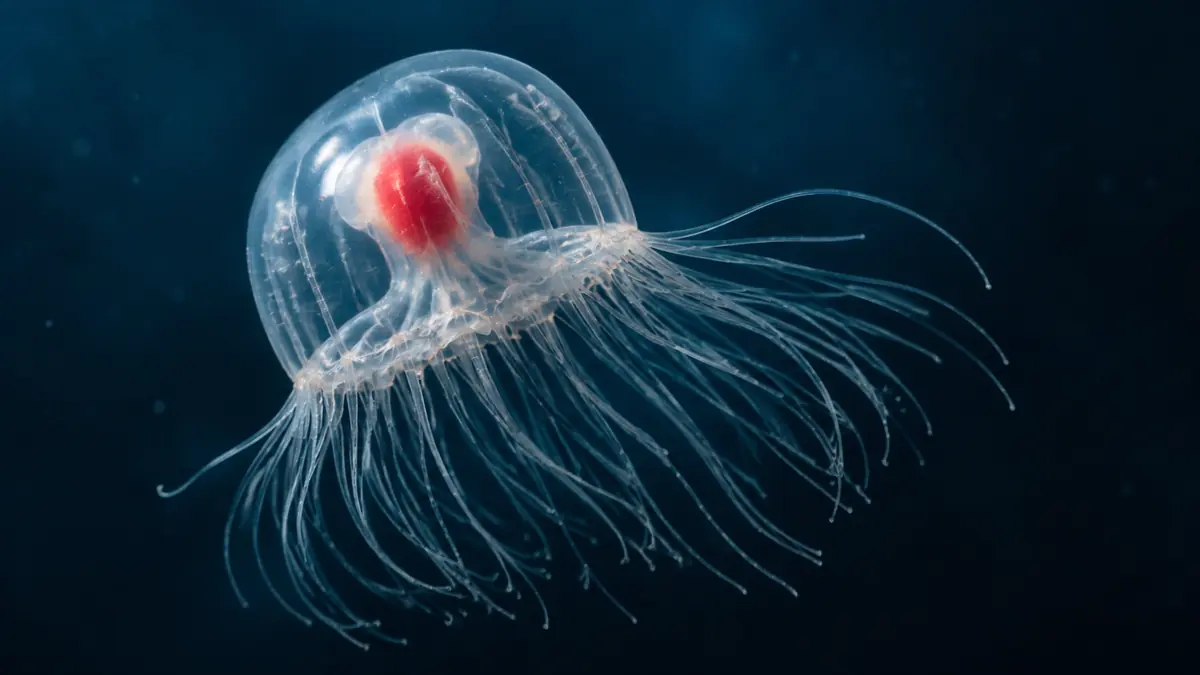
The “immortal” jellyfish and the long-lived shark
The jellyfish Turritopsis dohrnii can, under certain conditions, return from its medusa stage to an earlier stage of development. That unusual capacity explains its popular nickname, the immortal jellyfish. The Natural History Museum describes how the animal’s life cycle can reverse after stresses such as starvation or damage. See its guide to Turritopsis.
The nickname should not be mistaken for invulnerability or a guarantee that every individual survives forever. More importantly, a mechanism in a small marine animal is not a ready-made treatment for human ageing.
Greenland sharks provide a different example. A 2016 study used eye-lens radiocarbon dating to investigate their ages and found evidence for lifespans extending over centuries. The oldest estimate had substantial uncertainty; it was not an exact birth certificate. See the original study.
Long lifespan and life-cycle reversal are different phenomena. Neither study identifies a special water that produces the effect, and longevity by itself is not evidence of immunity to every disease. These animals are compelling enough without adding unsupported claims to what scientists observed.
Special waters, spiritual meaning and health claims
Waters differ in their mineral content and environmental history. That ordinary chemical fact does not establish a fountain that reverses ageing. Price, branding, clarity or an exotic origin cannot substitute for evidence of a health benefit.
Zamzam has a special place in Muslim belief and practice. Respect for that significance should not be turned into a blanket medical claim—for example, that a particular pH reliably dissolves all kidney stones. Treatment depends on the stone and the person’s condition; the US National Institute of Diabetes and Digestive and Kidney Diseases describes several different approaches in its kidney-stone treatment guidance.
This discussion is educational, not a recommendation to replace medical care with a spring water, supplement or untested anti-ageing treatment.
Wonder without an unsupported promise
Aab-e-Hayat remains a powerful way to think about the desire for life, renewal and knowledge. The story associated with Musa begins with searching and leads to humility about what a person does not know. Longevity research also requires humility: observations must survive testing, and promising findings have limits.
The strongest conclusion is not that religion and biology have revealed one hidden fountain. It is that each subject deserves careful attention on its own terms. We can appreciate the stories, study the texts and be fascinated by a jellyfish or a centuries-old shark without telling readers that immortality has been found.
