

Editorial note: This revised history article distinguishes archaeological evidence, scholarly interpretation and traditional narrative. Dates and explanations are attributed where evidence is incomplete or debated.
The Maya political transitions: evidence and explanations
The phrase “collapse of the Maya” can mislead. Many Classic-period southern cities lost royal institutions and population between roughly the eighth and tenth centuries, but Maya peoples continued and remain present today.
What changed
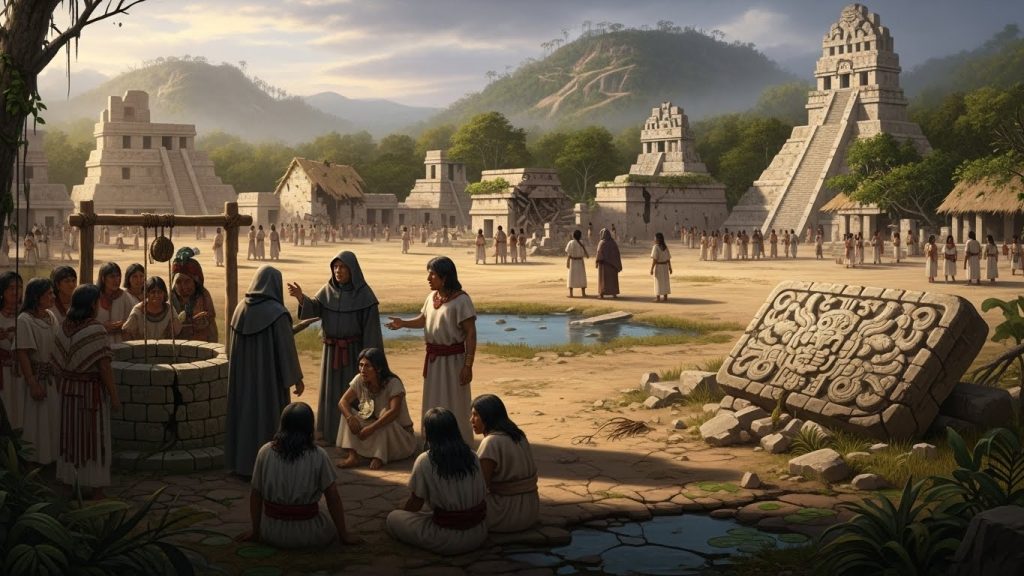
At several southern lowland centers, dated royal monuments ceased, construction slowed and populations moved. The pattern was not simultaneous everywhere, and northern cities followed different trajectories.
Maya societies were competing city-states rather than a single empire. Alliances, warfare, dynastic rivalry and tribute shaped both resilience and vulnerability.
Climate, conflict and political stress
Paleoclimate records indicate severe drought episodes in parts of the region. Drought could reduce harvests and water security, especially where growing populations depended on managed reservoirs and soils.
Climate was not a single automatic cause. Warfare, elite competition, trade changes, environmental pressure and loss of confidence in rulers could reinforce one another.
Continuity after the Classic period
Spanish invasions occurred centuries after many southern Classic centers declined. Postclassic Maya states continued in Yucatán and the highlands, and some resisted colonial rule for generations.
Modern Maya communities preserve languages, traditions and identities across Mexico and Central America. Referring to the Maya only in the past tense is inaccurate.
What remains debated
Scholars continue to debate the relative weight of drought, conflict, land use and political fragmentation. Responsible wording says that factors “contributed to” change rather than claiming one cause for every region.
Conclusion
The evidence supports a multi-causal regional transformation, not a mysterious disappearance. Archaeology, inscriptions and environmental records are most informative when considered together.
How historians assess the Maya transition
Researchers do not rely on one dramatic explanation. They compare inscriptions, settlement surveys, lake and cave sediments, skeletal evidence, agricultural landscapes and patterns of construction. Each type of evidence answers a different question. A final dated monument may show when a royal court stopped commissioning public texts, but it does not prove that every resident immediately abandoned the area. Pollen and sediment can indicate periods of drought or land pressure, yet they must be interpreted alongside political and local evidence.
The strongest conclusion is therefore regional rather than universal: several southern lowland kingdoms experienced severe political and demographic change through interacting pressures. Warfare could disrupt trade and farming; drought could make an already divided political system less resilient; changing alliances could redirect people toward other centres. Northern Maya cities followed different timelines, which is one reason a single-cause “mystery collapse” is misleading.
Continuity matters
Maya history did not end with the Classic period. Maya languages, communities and cultural traditions continued through later states, Spanish invasion and the present. Responsible history distinguishes the decline of particular royal systems from the survival of a people. That distinction also protects the subject from sensational claims that erase Indigenous continuity.
